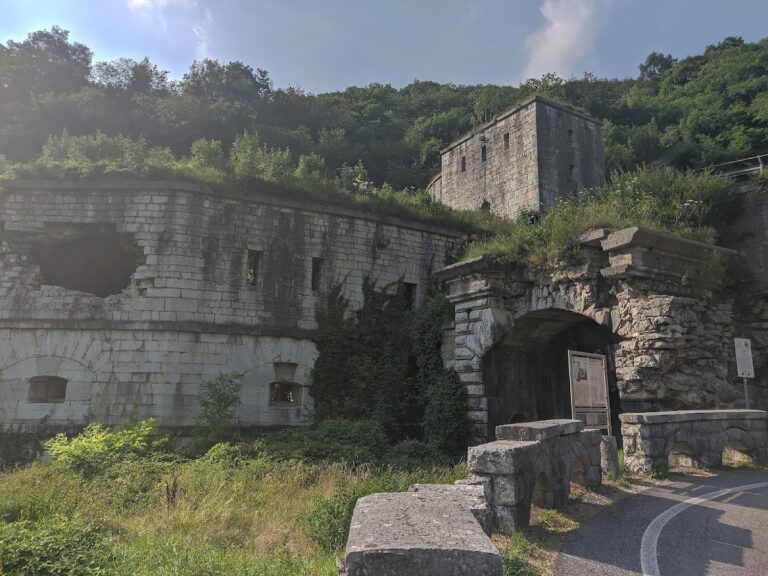
Castello di Asolo: A Medieval Fortress and Renaissance Court in Italy


Site at a Glance
- Rating
- 4.5
- Popularity
- Low
- Country
- Italy
- Primary era
- Medieval
- External website
- Open
- Eras represented
- Medieval, Early Modern
- Civilizations
- Venetian
- Site type
- Military
- Remains
- Castle
On this page14 sections
History
Castello di Asolo is a medieval fortress in Asolo, Italy, occupying the highest part of the town’s historic settlement. Its elevated position commanded the surrounding area and gave the stronghold strategic importance. Asolo lies on an unusually elongated hill dominated by Monte Ricco, a landform that may have inspired the settlement’s ancient Latin-derived name, meaning “pointed place.”
Early Fortification and Medieval Rule
The first recorded reference to Asolo’s castrum, a fortified settlement or military stronghold, appears in 969 in an act issued by Otto I, the German king crowned Holy Roman Emperor in 962. The fortress may have had Roman-period origins. This possibility is associated with the ancient form of Asolo’s name and with the nearby Via Aurelia, a road that connected Patavium with the Via Claudia Augusta Altinate.
Human occupation in the area reaches back to the Middle Paleolithic, and mammoth remains have been found there. During the period of barbarian rule, the castle and settlement passed through successive destructions and reconstructions. The Lombards, a Germanic people who established a kingdom in Italy during the sixth century, surrounded the settlement with ditches, palisades, and dry-stone walls.
The Rocca, the fortified stronghold on the summit of Monte Ricco, initially stood apart from the castle. A later defensive circuit linked it with the castle and the settlement, creating a single fortified complex. Before Asolo came under Venetian rule, the castle belonged to the bishop of Treviso. In the thirteenth century it became the residence of Ezzelino III da Romano, a powerful lord whose authority extended across parts of northeastern Italy. After his fall, the stronghold passed to the Carraresi, the ruling family of Padua, and then, in 1261, to the municipal city of Treviso.
Venetian Control and the Court of Caterina Cornaro
After the defeat of the Carraresi, Venice recognized Asolo’s value as a position for controlling the mainland. The defensive circuit connecting the Rocca, castle, and settlement was completed or strengthened under Venetian authority. Venetian rule lasted from 1393 until the fall of the Republic of Venice in 1797, and this period brought the greatest prosperity to the castle and borough. Venice reinforced the Rocca and the enclosing walls, renovated the castle, and joined its central section to the Rocca. Before this medieval connection, the castle, also called the Palazzo Pretorio or “Praetorian Palace,” had operated independently and partly in opposition to the fortress.
From 1489, the stronghold was entrusted to Caterina Cornaro, a Venetian noblewoman who had become queen of Cyprus before transferring the kingdom to Venice. After she was widowed, Doge Agostino Barbarigo granted her the lordship of Asolo and several residences as compensation. The castle then became the official seat of her court. Caterina’s repeated renovations gave the building its Renaissance character.
The court attracted prominent artists and intellectuals. Pietro Bembo, an important Italian humanist, writer, and literary theorist, set his work Gli Asolani there. Andrea Navagero, Luigi Da Porto, Giorgione da Castelfranco, Lorenzo Lotto, Girolamo da Treviso, and Andrea da Murano also frequented the castle during approximately twenty years of court life.
Decline and Changing Uses
During the War of the League of Cambrai, an early sixteenth-century alliance formed against the Republic of Venice, Caterina Cornaro took refuge in Venice. She died there one year later. After her death, the castle lost its courtly prestige and became the seat of the Venetian praetorian administration.
The fortress was last besieged in 1510, after which its military importance gradually declined. It was later used as a lazaretto, a facility for isolating people during epidemics, and was disarmed in 1650. As its defensive role diminished, battlements and several arches of the enclosing walls were removed, while two towers were reduced in height. The castle later served as a storage facility, and one tower was adapted as the body of a windmill.
During the Napoleonic period, the castle provided accommodation for troops, while the ground floor of the bell tower became a military prison. Soldiers detained there left carbon drawings on its walls. In 1798, the large interior hall was converted into a theatre. An entire wing was demolished in 1820, and the building was later used as a prison after falling into poor condition and abandonment.
Restoration and Present Institution
Restoration interventions were recorded in 1695, 1796, 1820, and 1830. Redevelopment eventually enabled the building to become the town theatre in 1932. The theatre’s elegant architectural structure was dismantled in 1930 to make way for a new cinema hall. Adolph Loewi, a Venetian collector, purchased the structure, which was later reassembled in Sarasota, Florida.
Castello di Asolo is an Italian national heritage property. The complex now accommodates a theatre named for Eleonora Duse and a restaurant-bar, while its external green area is used for organized events.
Remains
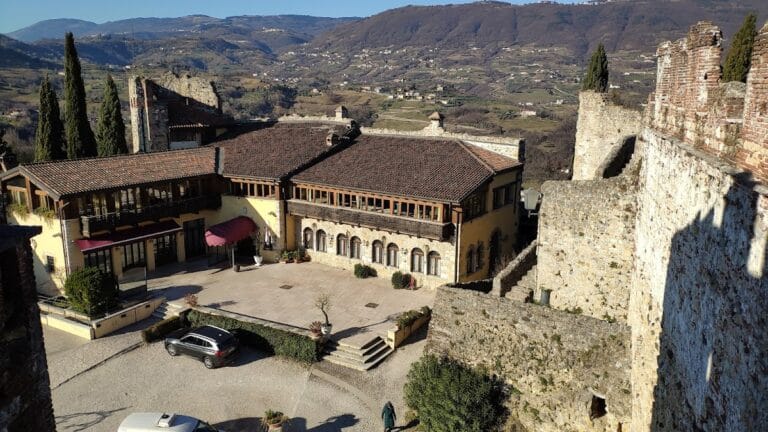
Castello di Asolo occupies the upper part of Asolo’s elongated hill, while the Rocca stands above the borough on the summit of Monte Ricco. The elevated complex overlooks the Treviso plain and the Alpine arc. Its surviving fabric brings together the earlier fortress, the castle buildings, sections of the medieval walls, and towers connected by a walkway along the walls.
Fortifications and Towers
The Rocca
The Rocca is the oldest structure in the complex. It has a polygonal plan with nine unequal sides. Its origins are described as pre-Roman, while its construction is also dated approximately to the late twelfth or early thirteenth century. The fortress occupies the summit of Monte Ricco and formed the principal elevated defensive position above the castle and settlement.
Enclosing Walls and Towers
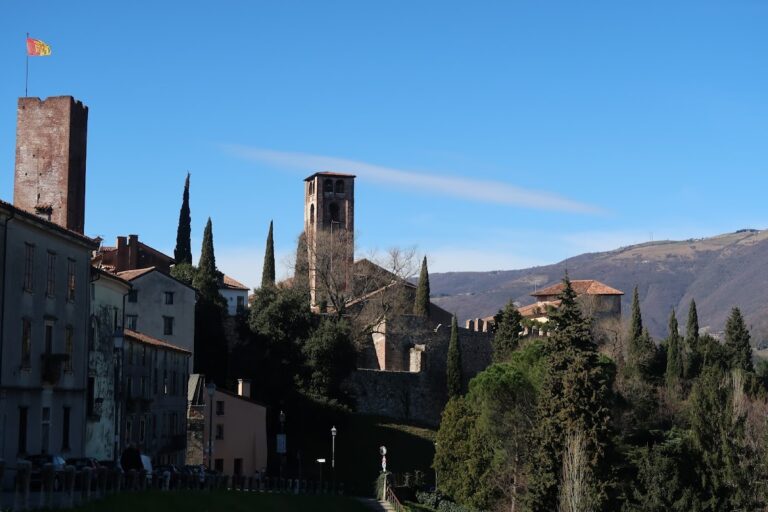
The medieval city walls eventually connected the Rocca with the castle, producing a unified fortified complex. Part of the enclosing walls survives, together with a walkway along the present connection. Of the four original towers, three remain. The surviving structures include the Clock Tower, also called the civic tower, and the truncated tower known as Torre Reata.
The Clock Tower
The Clock Tower contains a bell cast by the De Poli Foundry of Revine Lago in the Province of Treviso. The bell is mounted for swinging and rings daily at noon. Its ground floor retains carbon drawings made by soldiers held in the military prison during the castle’s later military use.
Castle Buildings and Interior Spaces
The Theatre and Duse Museum
The exterior walls of the present theatre form part of the surviving original complex. The former audience hall houses the Duse Museum, while the theatre continues the building’s long association with performance after the large interior hall was converted for theatrical use in 1798.
San Biagio and the Civic Museum
The church of San Biagio once stood inside the castle court. A fresco titled Madonna and Child by Dario, which came from the church, is preserved in the Civic Museum. The work provides a surviving artistic connection to the religious building that formerly occupied the castle court.
External Green Area
A large green area extends outside the castle buildings and is used for organized events. Together with the surviving walls, towers, theatre exterior, and museum spaces, it forms part of the present complex.