Castle (Ezzelini Castle): Medieval Fortification in Bassano del Grappa


Site at a Glance
- Rating
- 4.4
- Popularity
- Low
- Country
- Italy
- Primary era
- Medieval
- Eras represented
- Medieval
- Civilizations
- Holy Roman Empire
- Site type
- Military
- Remains
- Castle
On this page11 sections
History
Castle, also known as Ezzelini Castle or Upper Castle, is a medieval fortification in Bassano del Grappa, Italy, developed around the Church of Santa Maria from the pre-Roman period and rebuilt mainly during the first decades of the twelfth century. Built as a place of refuge on the highest hill, the castle protected local people, goods, and provisions.
Early Fortification and the Ezzelini
The church at the heart of the site was documented at Margnano in 998. Defensive works grew around it, and the oldest surviving wall structures belong chiefly to the twelfth and thirteenth centuries. In the second half of the twelfth century, the bishop of Vicenza, then the castle’s owner, donated it to Ezzelino I, the progenitor of the powerful Ezzelini family. The area before the fortification served as a market and meeting place.
The castle also entered literary history through Giuseppe Verdi’s first opera, Oberto, Conte di San Bonifacio, which places its action in and around Ezzelino’s castle at Bassano in 1228. The opera’s protagonist is a nobleman of the Sambonifacio family, a prominent family from Verona.
From the Scaligeri to Venice
Bassano and its castle remained operational under the Scaligeri, the ruling dynasty of Verona, from 1311 to 1387. The Visconti, the ruling dynasty of Milan, controlled the site from 1387 to 1404. After Bassano submitted to the Republic of Venice on 10 June 1404, the castle continued within Venetian territory.
In 1411, during the war between Venice and the Kingdom of Hungary, the fortification resisted the first bombards used by the troops of Sigismund of Luxembourg, Holy Roman Emperor and king of Hungary. Its defenses were eventually overcome in 1508 by the armies of Maximilian I of Habsburg during the War of the League of Cambrai, a conflict in which a coalition opposed Venice’s territorial power.
Decommissioning and Later Use
After its conquest in 1508, the castle was decommissioned and no longer served its military purpose. This change encouraged commercial and craft activities in Bassano within the walls. During the 1990s, improvement works made the Ortazzo Tower, Ser Ivano Tower, and Guard Corps usable for temporary exhibitions and performances, including ballets and theatre productions associated with the OperaEstate programme. The Municipality of Bassano del Grappa now owns the castle.
Remains
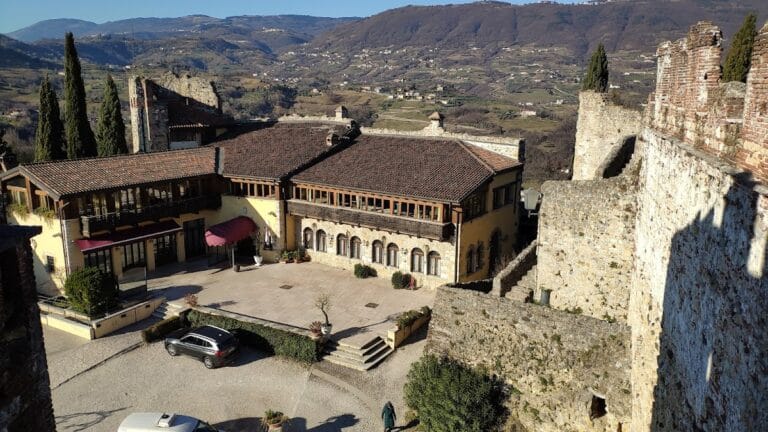
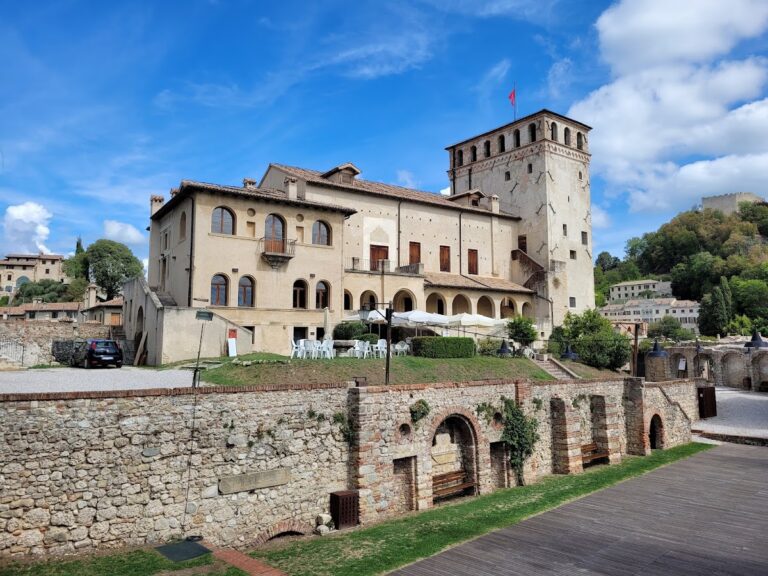
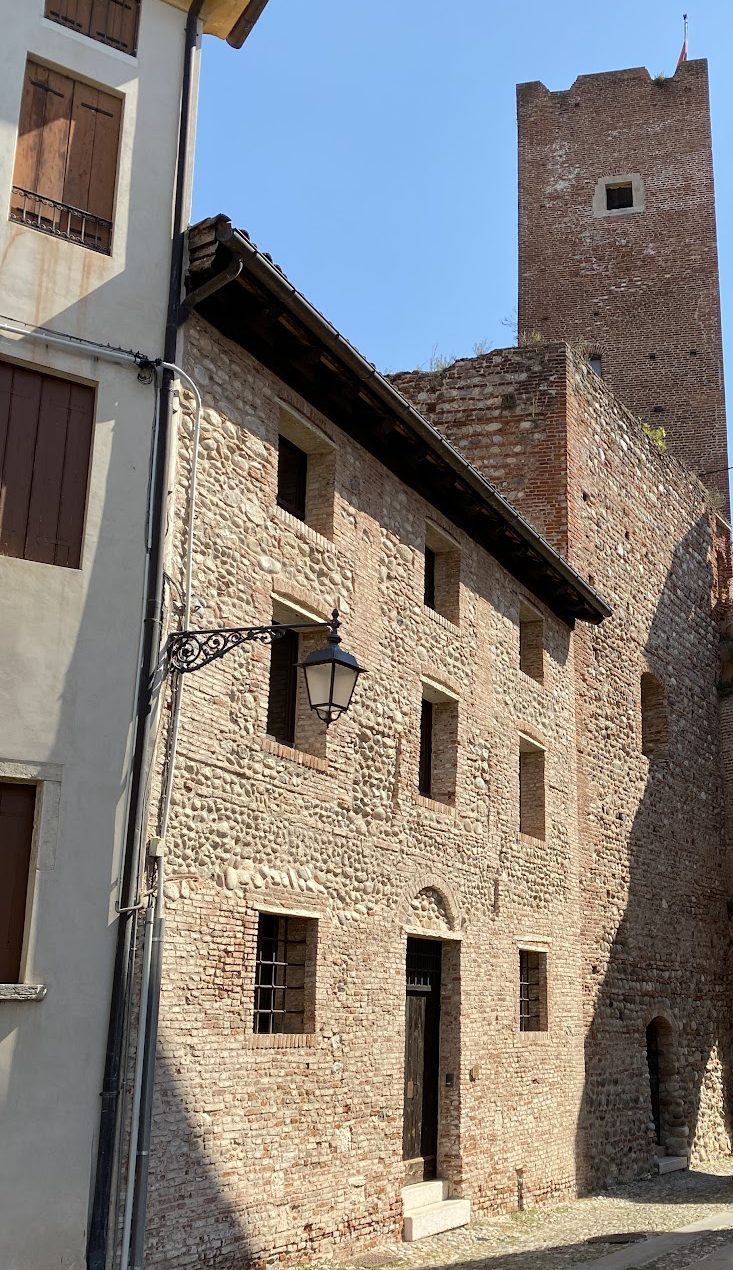
The castle occupies the summit of a hill and has a quadrangular plan formed by two parallel, concentric enclosures. The outer circuit is the older of the two, while the inner circuit includes many elements from the fourteenth century. A patrol walkway runs between the walls. The walls rise approximately 7.50 to 13.50 metres and are built in alternating courses of brick and cobbles gathered from the nearby Brenta River. The east and west sides stand free, while building ranges are attached along the south side. The north side is closed by the flank of the Duomo. An internal square or courtyard lies within the fortification, and the open ground before it retains the historical association with the castle’s market and meeting place.
Defensive Towers
Ser Ivano Tower
The entrance stands beside the imposing Ser Ivano Tower, formerly called the Bolzonella Tower. About 30 metres high, it operated as an autonomous and isolated defensive installation separate from the main castle. The name Ser Ivano refers to a retainer of Ezzelino III, a later prominent member of the Ezzelini family. The earlier Bolzonella Tower was described as an exceptionally difficult defensive machine to capture. The 1990s interventions made the tower usable for exhibitions and performances.
Ortazzo Tower
At the southwest corner of the enclosure stands the Ortazzo Tower, a squat structure with a square plan measuring 8.40 metres on each side. Its southern face reaches a maximum height of 22.64 metres. The tower takes its name from the courtyard that closes the southwest side. The Ortazzo was used as a burial place for people drowned in the nearby Brenta River and for those suspected of suicide. It was also made usable for cultural events during the 1990s interventions.
Central Tower Base
Only the base of the former central tower survives. It now supports the bell tower of the Pieve, a historic parish church that could serve as the principal church of a rural or territorial district.
Duomo and Earlier Church
The north side of the castle adjoins the Duomo, formerly the Pieve of Santa Maria in Colle. An earlier church occupied the site from at least the tenth century. The present building resulted from repeated interventions, beginning with a complete rebuilding in 1471 and continuing until the end of the twentieth century.
Guard Corps
The Guard Corps stands at the entrance to the wall walkway. The 1990s works made this part of the fortification usable for temporary exhibitions and performances, alongside the Ser Ivano and Ortazzo towers.
Nearby sites