Château de Valon: A Medieval Fortified Castle in France


Site at a Glance
- Rating
- 4.6
- Popularity
- Low
- Country
- France
- Primary era
- Medieval
- External website
- Open
- Eras represented
- Medieval, Modern
- Civilizations
- Unclassified
- Site type
- Military
- Remains
- Castle
On this page11 sections
History
Château de Valon is a medieval fortified castle in France, above the town of Lacroix-Barrez, whose origins date to the eleventh century. Hugues de Pierre is identified as its initial owner, and the castle first served as a watchtower. It stood within the former Viscounty of Carlat, a medieval territorial lordship whose viscounts governed lands in Carladez and received homage and military obligations from local lords.
The lordship of Valon
Valon was associated with both a lordship and a mandement, a territory administered from a fortified centre. In 1265, Philippus de Vallo, Stéphane de Valon, Bérenger de La Gleiziole, and Pistors de Muro acknowledged the castle and its territory to the Viscount of Carlat. Further acts of homage by the Valon family followed in 1267, 1280, and 1300.
Tradition connects the early history of Valon with Bertrande d’Amalon, regarded as the natural mother of Henri of Rodez. Henri, born around 1175, was the illegitimate son of Hugues II of Rodez, Viscount of Carlat. Bertrande’s identity and parentage remain matters of tradition rather than certainty, but the story associates Valon’s early lordly history with the Rodez and Carlat lineages.
The lordship later passed to the Peyre family of Pierrefort. Étienne de Peyre de Pierrefort rendered homage for Valon in 1300 to Henri II of Rodez, Viscount of Carlat. In 1341, Étienne’s heiress, Haladie de Peyre, brought Valon by marriage to Aymeric Rolland, lord of Cromières.
The Rolland and Chaumeil families
The Rolland family held Valon through much of the later medieval period. Pierre Rolland, lord of Valon and seneschal of Castres, made his testament at the castle in 1456. A seneschal was a senior administrator with responsibilities that could include justice and military or financial affairs. Pierre requested burial in the castle’s Saint-Blaise chapel beside his ancestors.
Pierre’s descendant Jacques Rolland died in 1524. After his death, Jacques’s three daughters sold Valon to Louis de Chaumeil, a captain of one hundred men-at-arms who maintained a garrison at the castle. Louis was captain of Château de Valon in 1532. His son Michel de Chaumeil married Françoise de Dienne in 1573, acquired the lands of Vilherols in 1580, and sold Valon around 1589 to Louis de Fontanges.
From the Fontanges family to the Revolution
Louis de Fontanges, lord of Auberoque, La Salle, and La Besserette, owned Valon from 1589. His grandson Jean de Fontanges made his testament in favour of his only son, Jean-François de Fontanges, Marquis of Auberoque. Jean-François was killed at the Battle of La Marsaille in Piedmont on 4 October 1693. Valon then passed to his sister Marie-Charlotte de Fontanges, who married Henri-Joseph de La Garde de Chambonas in 1695.
Joseph de La Garde de Chambonas, a brigadier of armies, sold the castle and domain in 1745 to Jérôme de Verdier, lord of Mandilhac and treasurer of France in the Generality of Montauban. Born in 1680, Jérôme de Verdier died in 1767. The property remained within the Verdier family for a time, passing among members who included a captain of dragoons and Jérôme-Marcellin de Verdier, an officer of dragoons and lord of Valon.
Valon later belonged to Philippe de Bancarel d’Hyars, who became a property owner and served as a general councillor of Aveyron in 1826. The castle subsequently passed to the Delrieu family of Pleaux, who gave it to Antoine Delmas.
War, abandonment, and preservation
During the Hundred Years’ War, a prolonged conflict between the English and French crowns that affected central and southwestern French territories, English forces invaded Rouergue, Carladez, and Haute-Auvergne. In 1378, Aymerigot Marchès, a Limousin bandit lord allied with the English, seized Carlat, Alleuze, and Valon. He used these fortified places to raid and ransom the surrounding region.
Marchès was arrested by his relative, the lord of Tournemire, transferred to Paris, and beheaded at the Place des Halles on 12 July 1391. A treaty concluded on 6 July 1391 provided for the redemption and evacuation of captured strongholds. Ramonet de Sort, the Gascon captain holding Valon for the English, surrendered the castle to his suzerain Jean III of Armagnac, Viscount of Carlat.
The castle ceased to be maintained after the French Revolution. Its roofs collapsed around 1845, and local inhabitants removed many building materials and architectural elements. The Delrieu family later gave the property free of charge to Antoine Delmas, who sold it on favourable terms to Jean-Louis Fougerousse, an architect, archaeologist, and painter.
In 1932, Fougerousse took advantage of a construction company working on a church in Lacroix-Barrez to restore the corner of the keep that had been destroyed by lightning. He also installed a concrete platform at the top of the keep, consolidating the structure and preventing its definitive ruin. Château de Valon was later acquired by the Community of Communes of Carladez and made available as a museum. The openings and esplanade were redeveloped in 2003, the left side of the inner courtyard was restored in 2008, and a second pedestrian access was created in 2009. The ruins have been protected as a French historic monument since the order of 21 October 1925.
Remains
Layout and defensive approach
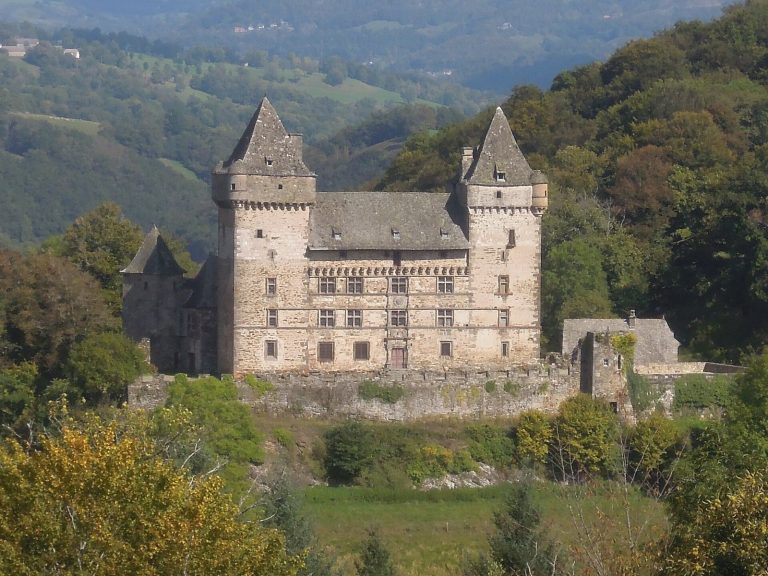
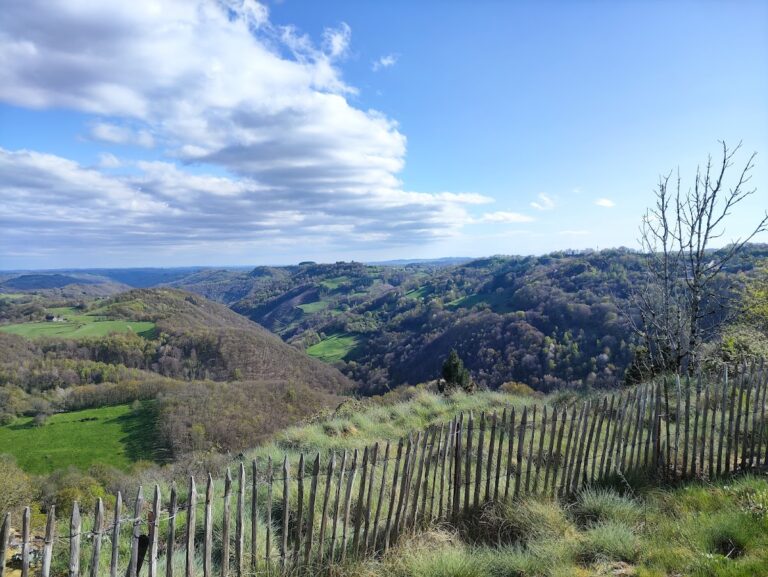
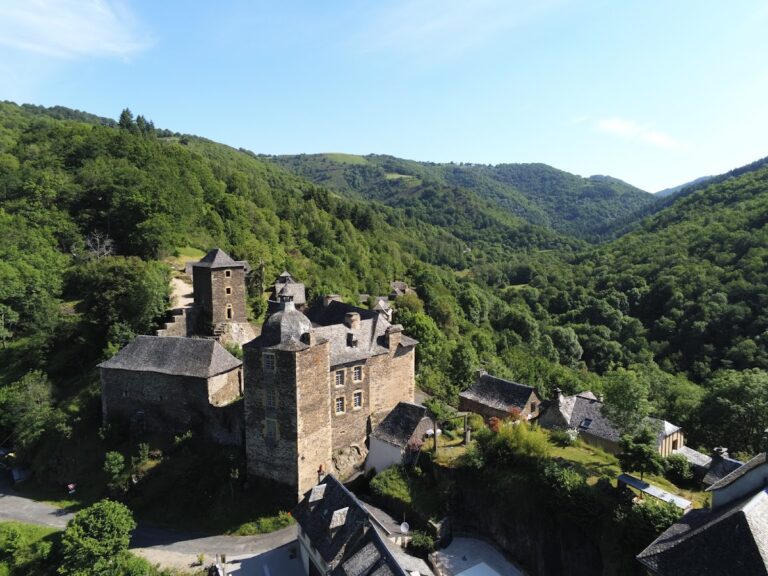
Château de Valon occupies a promontory rising 300 metres above the Truyère valley and Lacroix-Barrez. Most of the complex is built of rough schist rubble masonry. Its arrangement included a completely enclosed forecourt and residential buildings bordering an inner courtyard. At the far end of that courtyard, a solid wall formed a protective enclosure around the keep.
Gates and passageways
A second gate connected the corridor with a passage, while the entrance could be reached only by going around the keep. The documented remains include the outer walls, inner courtyard, esplanade, porch, stone-surfaced ascent, residential buildings, and passageways. The ascent to the porch is formed with stone surfacing, and planned works include its repair and extension as well as the creation of a complete wall-walk, a passage along the top of a defensive wall used for movement and observation.
The keep and chapel
The keep
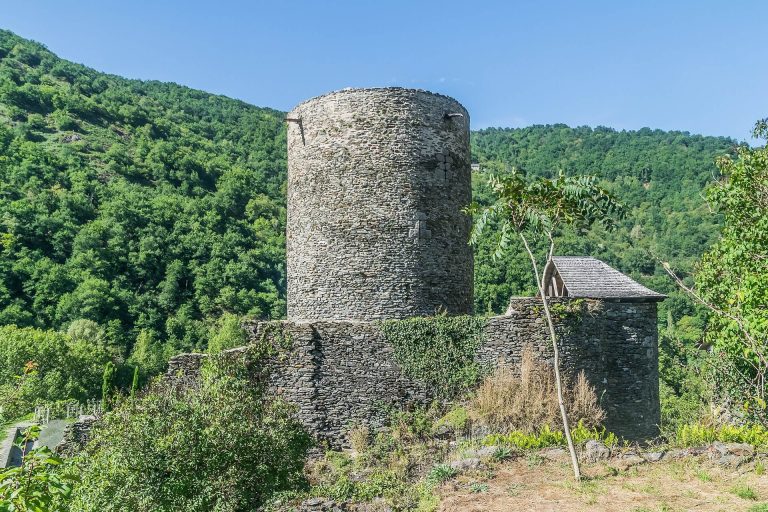
The keep had a small watch turret at each corner and an upper hall surrounded by machicolations, projecting openings or galleries through which defenders could drop or discharge materials onto attackers below. The keep and chapel date to the late fourteenth century. After the nineteenth-century roof collapse and the removal of building materials, the keep retained four superimposed rooms linked by a narrow spiral staircase.
Lightning destroyed one corner of the keep before its repair in 1932. The restoration rebuilt that damaged section and added a concrete platform at the summit, which crowns and consolidates the structure. The platform forms part of the keep’s surviving twentieth-century fabric.
Saint-Blaise chapel
The Saint-Blaise chapel is associated with Pierre Rolland’s 1456 request to be buried there with his ancestors. It forms part of the late medieval complex alongside the keep. Restoration of the church interior is included among the planned works.