Castle of Döbrönte: A Medieval Fortress in Hungary


Site at a Glance
- Rating
- 4.8
- Popularity
- Low
- Country
- Hungary
- Primary era
- Medieval
- External website
- Open
- Eras represented
- Medieval, Early Modern
- Civilizations
- Hungarian
- Site type
- Military
- Remains
- Castle
On this page7 sections
History
Castle of Döbrönte is a fourteenth-century stone fortress in Hungary, built on the western side of the Bakony for Benedek Himfi, a favored courtier of King Louis I and an ispán, a medieval county official with administrative and judicial authority. In 1367, Louis I authorized Himfi to construct the castle on his Döbrönte estate.
Himfi Power and Decline
By the beginning of the fifteenth century, the Himfi family’s political influence had weakened. Neighboring landowners began taking portions of its territory, and in 1401 armed retainers of the Gyulaffy family of Rátót attacked and plundered the fortress. The conflict reflected the competition among Hungarian noble lineages for estates and regional power.
As the revenues of the Himfi estate fell, members of the family turned to raiding. In 1464, Himfi relatives and their armed servants attacked the abbey on Saint Martin’s Hill at Pannonhalma and carried away valuable religious objects. King Matthias Corvinus, the fifteenth-century Hungarian ruler known for strengthening royal authority, confiscated the Himfi estates and granted them to Baron László Kanizsai.
The castle soon returned to Himfi ownership, but disputes continued within the family. A record from 1469 states that Lord Lőrinc, after being forced out of the fortress, attacked and plundered Döbrönte with his men. In 1499, Imre Himfi married his daughter Orsolya to Ferenc Essegvári, who received the Döbrönte castle estate as a pledge.
Sixteenth-Century Defense and Destruction
During the civil wars that followed the 1526 Battle of Mohács, the castle’s lords strengthened its defenses. Its small garrison was reinforced in 1547, when the Diet of Pozsony hired five mounted soldiers for the fortress. Döbrönte was not regarded as one of the major frontier fortresses, however. Palatine Tamás Nádasdy, the highest-ranking secular officeholder in the medieval Kingdom of Hungary and the king’s principal deputy, still described the castle as intact in a report of 1555.
The castle was probably destroyed by a Turkish raiding force after Nádasdy’s report. It was then abandoned, and local inhabitants removed stone from the ownerless ruins for reuse.
Modern Preservation
The ruins were partly restored at the beginning of the twenty-first century. Many architectural details remain buried, and the site forms part of the third phase of Hungary’s National Castle Programme, a public heritage initiative for restoring and presenting historic castles.
Remains
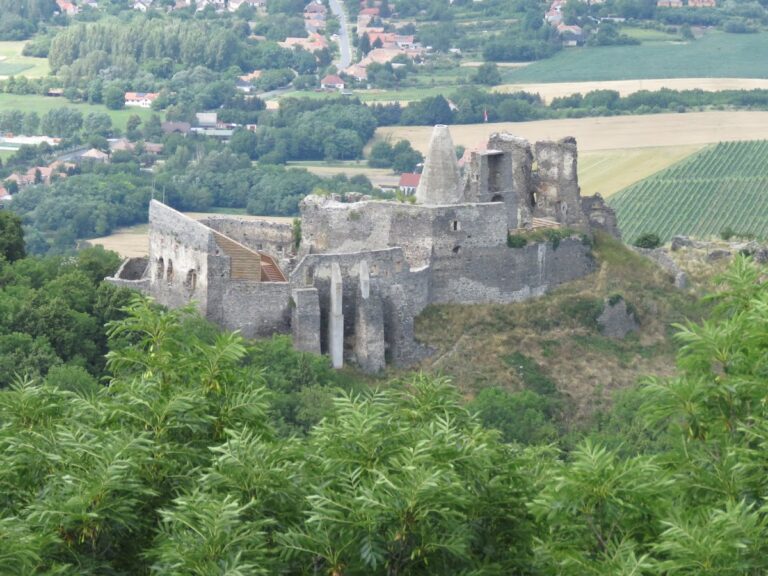
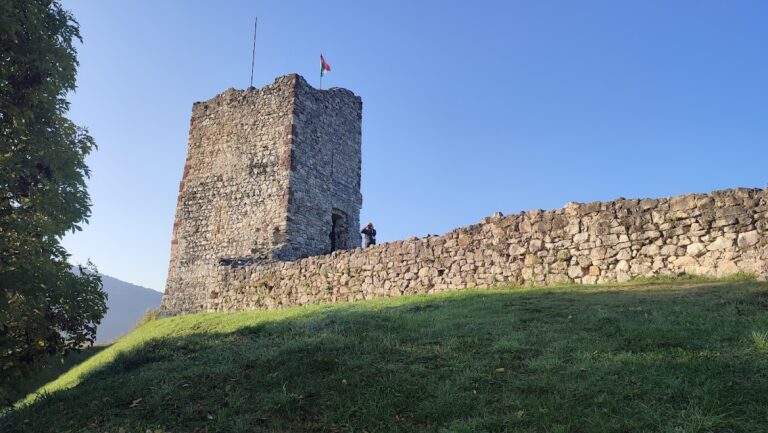
The surviving remains form a ruined stone castle at Döbrönte, with an outer courtyard and a circular artillery fortification. Partial restoration has left sections of the castle fabric visible, while further architectural details remain concealed beneath the ground.
Outer Courtyard
The outer courtyard survives as part of the ruined complex. Its remains belong to the castle’s defensive arrangement and are preserved together with the circular bastion, allowing the surviving features to be understood as parts of a single fortified site.
Circular Bastion
A large, thick-walled circular bastion was added when the castle’s defenses were strengthened after 1526. This rounded artillery fortification contained loopholes through which defenders could direct heavy cannon fire against attackers. The bastion now survives in ruined form, with some of its fabric visible after partial restoration.