Castle of Tiedra: A Medieval Fortress and Dovecote in Spain


Site at a Glance
- Rating
- 4.6
- Popularity
- Low
- Country
- Spain
- Primary era
- Medieval
- External website
- Open
- Eras represented
- Medieval, Early Modern
- Civilizations
- Crown of Castile, Kingdom of León, Spanish
- Site type
- Military
- Remains
- Castle
On this page9 sections
History
Castle of Tiedra is a medieval fortress in Spain, overlooking the town of Tiedra in Valladolid. Its earliest recorded history belongs to the eleventh century, when it was connected with the political negotiations of Sancho II of León, Castile, and Galicia. The castle occupied a strategic position above an extensive landscape and later became a royal and aristocratic possession, a place of imprisonment, and eventually a protected historic monument.
Eleventh-century origins
By 1060, Tiedra was already an important settlement, and a nearby tract of land was known as mercato. The castle was mentioned during the reign of Sancho II, who sent the Castilian military leader Rodrigo Díaz de Vivar, known as El Cid, to meet his sister, Infanta Urraca of Zamora, at Tiedra.
Sancho sought to persuade Urraca to surrender Zamora peacefully. In exchange, she was to receive Medina de Rioseco, the territory known as the Infantado between Villalpando and Valladolid, and the castle of Tiedra. The proposed agreement was never put into effect, but the meeting links the castle’s earliest recorded mention to the dynastic conflicts of eleventh-century León and Castile.
Royal and aristocratic lordships
The castle later formed part of a donation made by Alfonso IX of León to his wife, Berenguela of Castile, as compensation after their marriage was annulled. In 1285, Pedro Álvarez de las Asturias, chief steward of Sancho IV of Castile, received Tiedra and its tower from the king. The property passed to his daughter Teresa Pérez de Asturias, whose marriage to Alfonso Téllez de Molina brought Tiedra into the lineage of the Téllez de Meneses. Their son, Tello Alfonso de Meneses, became lord of Tiedra.
After Tello Alfonso de Meneses died in 1315, his lordships became the property of King Enrique II of Castile. The king donated them to his brother Sancho of Castile, Count of Alburquerque. The inheritance later passed to Sancho’s daughter, Leonor of Alburquerque, who was the wife of Infante Fernando of Antequera.
Confiscation and later ownership
In 1430, Juan II of Castile confiscated Tiedra and imprisoned Gutierre Álvarez de Toledo, bishop of Palencia, in the castle. The imprisonment followed rumours of a conspiracy against the king and his powerful favourite, Álvaro de Luna. Gutierre was eventually acquitted.
During the middle of the fifteenth century, Juan II granted the town and castle to Pedro Girón, a Castilian nobleman. The lordship was formally confirmed in 1476, during the joint rule of Isabella I of Castile and Ferdinand II of Aragon, known as the Catholic Monarchs.
Military decline and conservation
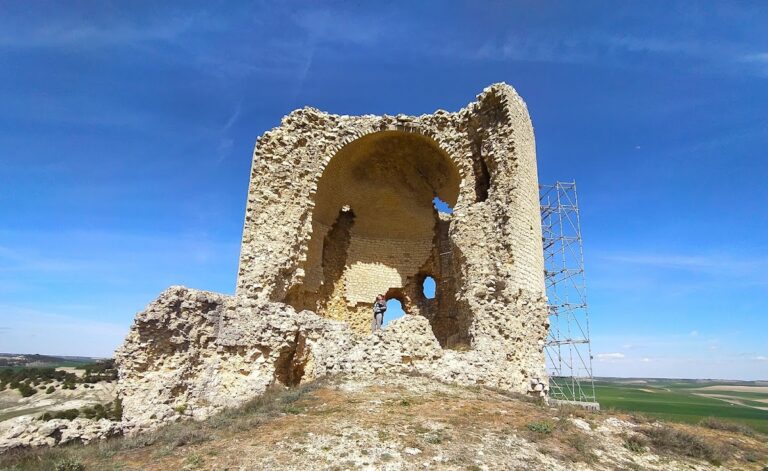
During the sixteenth century, the castle lost its military purpose and was converted into a dovecote. It became municipal property in 2005. Its ruinous condition led the government of Castile and León to carry out emergency works in July 2010 to prevent a partial or total collapse.
Restoration began in 2011, but it was not comprehensive. A storm of rain and wind caused part of the southeastern section to collapse on 24 and 25 December 2013, and the damaged area was repaired several months later. The castle has been under preventive protection since 1949 and has held the designation Bien de Interés Cultural, a Spanish category for protected cultural property, since 1985. It is listed in the Spanish heritage register as an archaeological zone under reference RI-55-0000384.
Remains
Hilltop enclosure
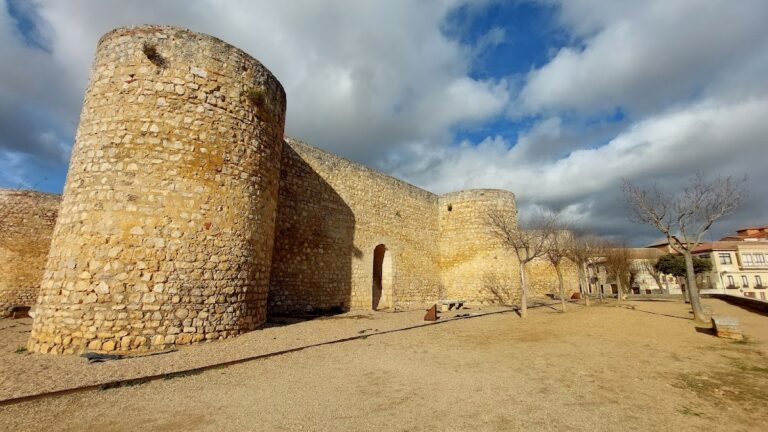
The castle occupies the platform of a hill above Tiedra, with views across the surrounding land and toward the Torozos Mountains. The surviving complex is a roughly cubical section left after the original curtain wall, the main enclosing defensive wall, was demolished. A ditch protects two sides, while two later stretches of wall reinforce the surviving enclosure.
The northern and western wall sections belonged to the enclosure of the first repopulation settlement and are the oldest surviving parts. A later building phase raised the tower. The defensive enclosure contains two circular towers, and a wall beginning at one end may have enclosed an albacar, a protected area associated with a fortified settlement and used for sheltering people or livestock. The site also retains a small ditch, later curtain-wall sections, a present access door, and an access footbridge.
The keep
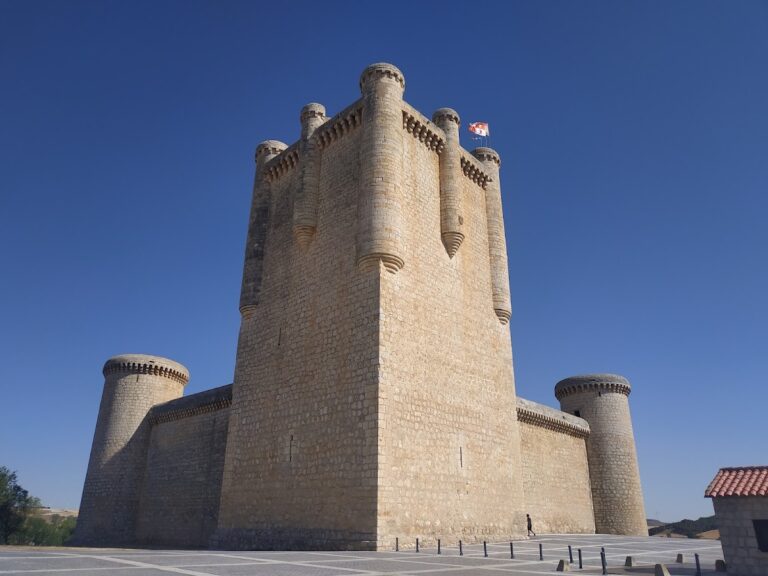
The rectangular keep rises approximately 20 metres and has walls about 2.5 metres thick. Its entrance stands several metres above ground level, an arrangement that made access more difficult for attackers. Stone crenellations survive along the fortification, while the tower’s upper machicolations and its vaulted structure with transverse arches reflect construction attributed to the late thirteenth century and the beginning of the sixteenth century.
Corbels remain along the keep, where they supported beams carrying wooden cadalsos, or projecting defensive galleries. These elements were reconstructed during the latest restoration. The interior of the keep now houses a museum, and the tower functions as a viewpoint over the surrounding landscape.
Southern section and later repairs
The southeastern part of the castle includes the section that partially collapsed during the storm of December 2013 and was repaired several months later. Its present form belongs to the surviving and restored fabric of the enclosure, alongside the circular towers, later wall sections, entrance arrangements, and the small ditch.