Castle of Terre Neuve: A Renaissance Château in Fontenay-le-Comte


Site at a Glance
- Rating
- 4.5
- Popularity
- Low
- Country
- France
- Primary era
- Early Modern
- External website
- Open
- Eras represented
- Early Modern, Modern
- Civilizations
- French
- Site type
- Domestic
- Remains
- Castle
On this page17 sections
History
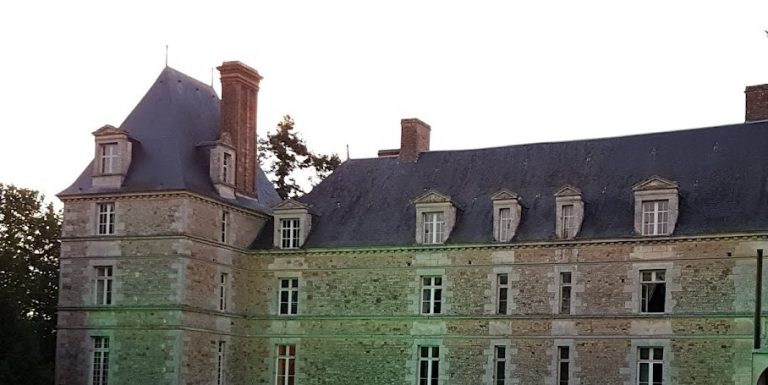
The Castle of Terre Neuve is a Renaissance château in Fontenay-le-Comte, France, built between 1584 and 1594 for Nicolas Rapin during the town’s economic and intellectual apogee in Bas-Poitou. Rapin was a military companion of Henri IV, King of France from 1589 to 1610, as well as a writer. The château became the town’s second major residence after its earlier fortified castle, which was dismantled a few years later.
Foundation and the Rapin family
In 1584, Rapin bought a farm on a plateau opposite Fontenay-le-Comte’s historic center and developed it into the new château. The architect is unknown. An attribution made by the scholar Benjamin Fillon has not been supported by known evidence. The property also became associated with the intellectual circles surrounding Rapin. Among the scholars and public figures received there were the Duke of Sully, Henri IV’s chief minister, the Protestant military leader and writer Agrippa d’Aubigné, the mathematician François Viète, Jacques du Fouilloux, and André Tiraqueau.
After Rapin died in 1608, Terre Neuve remained with his family. By 1691, however, the family had been ruined, and the château passed through several changes of ownership. Marguerite Boursoreille was unable to pay the required installments, so the property was seized by decree and granted to Lazarist missionaries. Also known as Vincentians, the Lazarists were a Catholic missionary congregation founded by Saint Vincent de Paul in the seventeenth century. They had arrived in Fontenay-le-Comte in 1669 and took possession of the château on 23 February 1701.
Lazarist occupation and the Revolution
The Lazarists occupied Terre Neuve through the revolutionary period. On 1 August 1792, the château sheltered 74 priests who had refused the constitutional oath. The Lazarists were deported on 5 September of that year, bringing their occupation of the property to an end.
The Tendron de Vassé and Rochebrune families
Claude Tendron de Vassé acquired the château in 1805. He later served as mayor of Fontenay-le-Comte and as a deputy for the Vendée. Through his daughter Nélia’s marriage to Amédée de Guillaume de Rochebrune, the property passed to their son Octave de Rochebrune.
Born at Terre Neuve in 1824, Octave de Rochebrune became an engraver, painter, and art collector. He returned to Fontenay-le-Comte in 1848 and worked in an etching workshop at the château. He served three times as mayor between 1868 and 1878 and died in Fontenay in 1900. His collection included 492 engraved copper plates.
From the nineteenth century, Rochebrune altered Terre Neuve by incorporating architectural and decorative elements removed from older regional buildings threatened by ruin or destruction. This practice reflected historicism, a nineteenth-century approach that deliberately reused and recombined forms and materials from earlier periods. Rochebrune rebuilt many elements stone by stone, restored some before installation, and recorded their origins through etchings and attached plaques.
Rochebrune was close to Henri d’Artois, Count of Chambord, and to legitimist circles. In 1867, the count gave him removed woodwork through the château’s steward, Arnoult. Chambord was transformed into a field hospital in 1870, followed by further destructive alterations. The transfer of the Chambord material therefore formed part of Rochebrune’s wider effort to preserve architectural elements from historic buildings.
Later generations and public interpretation
Élisabeth de Guillaume de Rochebrune, Octave’s daughter and heir, married Raoul Poignand du Fontenioux. Their descendants have retained the property. In 2018, following an inheritance transfer, a museum devoted to the Fontenioux-Rochebrune collections was established in a dependency. It presents approximately 300 objects, including decorative arts and weapons, and receives a loan from the Dobrée Museum in Nantes that includes material from Octave and Raoul de Rochebrune’s military-archaeology collections. Two rooms devoted to Rochebrune’s office and bedroom furniture also opened in 2018.
The château continued to attract literary and intellectual associations. Georges Simenon lived at Terre Neuve during the early 1940s and began his autobiographical work Pedigree there. The façades and roofs received protection under the supplementary inventory of Historic Monuments by decree of 13 December 1978. On the same date, the entrance porch, the building containing the staircase lantern from Coulonges, the great salon and its Chambord woodwork, the small salon, the hall, and Rochebrune’s former workshop were classified as Historic Monuments.
Remains
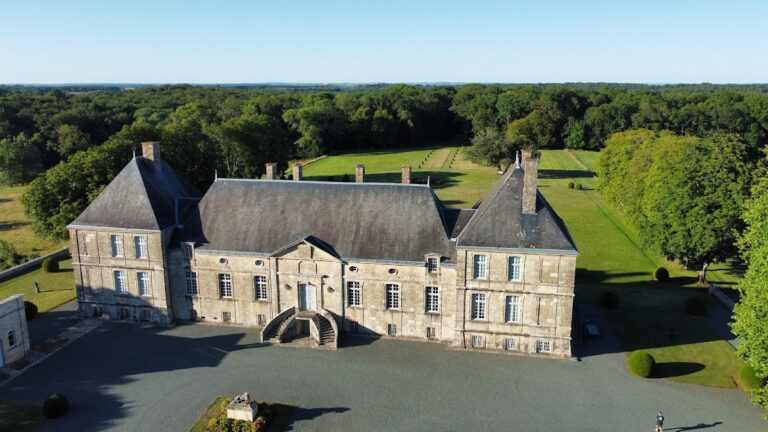
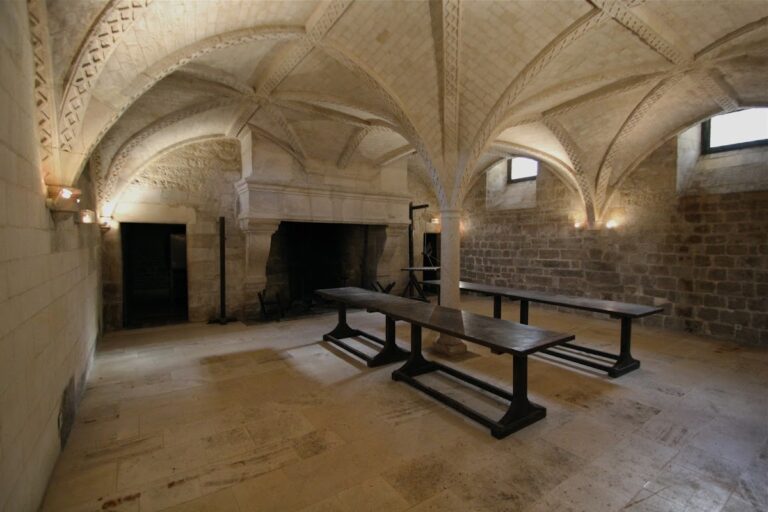
The surviving château retains the L-shaped plan of the original residence and its principal elevations. It opens onto a terrace that ends in a staircase leading to the park. The building combines sixteenth-century fabric with nineteenth-century alterations and architectural elements transferred from other regional buildings. Its interiors include the small salon, great salon, hall, dining room, former Rochebrune workshop, and rooms displaying Rochebrune’s office and bedroom furniture.
Original château and later façade
Renaissance residence
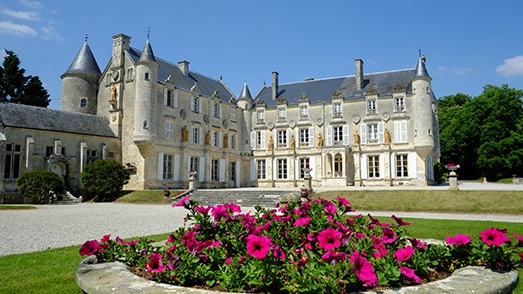
The original residence has an L-shaped layout, with a small projecting turret, or échauguette, flanking each end. These turrets were commonly associated with defensive or watch functions. The château was very sober in the sixteenth century and remained modestly furnished during the Lazarist occupation. From the first half of the nineteenth century, its owners transformed the interior and exterior without fundamentally changing the building’s distribution.
Principal elevations
The principal façade was altered using the western wing as a model. The windows were enlarged, the heights of the façades were harmonized, and pilasters and statues of the Muses were added. The resulting elevations preserve the form of the Renaissance residence while incorporating the visual language of Rochebrune’s nineteenth-century alterations.
Architectural elements from earlier buildings
Material from Coulonges
Rochebrune dismantled and reassembled elements from the former Château of Coulonges-les-Royaux, now Coulonges-sur-l’Autize. The transferred material includes the entrance porch, coffers and other ceilings, a dining-room door frame, workshop vaults, and a fireplace in the main living room. These pieces were rebuilt stone by stone, and some were restored before being installed at Terre Neuve.
Coulonges fireplace
The Coulonges fireplace is decorated, probably, with alchemical symbols representing the major stages in the creation of the philosopher’s stone. Above the symbols is the Latin inscription “Nascendo quotidie morimur,” meaning “By being born, we die each day.” Fulcanelli studied the fireplace. Its placement at Terre Neuve illustrates Rochebrune’s practice of giving historic architectural fragments a new setting while preserving their decorative and interpretive features.
Fontenay-le-Comte fireplace
Another fireplace came from the former seneschal’s house of Fontenay-le-Comte. It was removed in 1856 and described as the only preserved element of that building’s interior decoration. Rochebrune restored and reassembled it in the dining room, where it became part of the château’s collection of reused regional architectural work.
Chambord woodwork and panels
Material from Chambord includes woodwork, a door reputed to have come from the study of François I, and sixteenth-century panels decorated with salamanders and François I’s monogram. A group of thirteen panels has central motifs of gilded wooden suns and dates from alterations commissioned by Louis XIV. The Marshal of Saxe, Maurice de Saxe, had removed these Chambord elements and replaced them with other woodwork.
Another acquired piece is reportedly the stage pediment from the first performance of Molière’s The Bourgeois Gentleman at Chambord in 1670. The theatrical decoration was designed by Carlo Vigarani, an Italian-born designer and engineer who worked for Louis XIV. The Chambord woodwork and sun panels were incorporated into Terre Neuve’s great salon and dining-room door. Their installation in rooms smaller than their original settings produces an out-of-scale and sometimes overloaded effect characteristic of nineteenth-century historicism.
Textiles, furniture, and collections
Chancellery tapestry
A salon contained a tapestry known as a “chancellery” tapestry, photographed there in the late nineteenth century by Jules-César Robuchon. Woven in wool and silk around 1680 for Michel Le Tellier, Marquis of Louvois, it was later modified for the Marquis d’Argenson. Its blue field bears the royal arms supported by two winged figures, with gold fleurs-de-lis. The border includes seals, maces, swords, scales, and the royal cipher in crowned cartouches.
Rochebrune furniture and museum
Octave de Rochebrune designed a bed in response to an imposing canopy bed he had created for the Count of Chambord, which is conserved at Chambord. The Terre Neuve bed was later displayed in the museum. The museum occupies a château dependency and presents approximately 300 objects from the Fontenioux-Rochebrune collections, including decorative-art objects and weapons. The château itself also contains the rooms devoted to Rochebrune’s office and bedroom furniture, alongside the salons, hall, dining room, and former workshop.