Carberry Tower: A Scottish Tower House and Country Estate


Site at a Glance
- Rating
- 4.6
- Popularity
- Low
- Country
- United Kingdom
- Primary era
- Modern
- External website
- Open
- Eras represented
- Medieval, Early Modern, Modern
- Civilizations
- British, Kingdom of Scotland
- Site type
- Domestic
- Remains
- Castle
On this page14 sections
History
Carberry Tower is a historic Scottish country house in the United Kingdom, near Musselburgh in East Lothian, whose present form developed around a medieval fortified tower house. The estate is associated with the surrender of Mary, Queen of Scots, in June 1567 and with successive phases of ownership, enlargement, religious use, and restoration.
Medieval origins and early owners
The lands of Carberry were first mentioned in the eleventh century, when King David I of Scotland granted “Caerbairin” to the monks of Dunfermline Abbey. David I was a twelfth-century Scottish king known for expanding royal administration and supporting monasteries. John de Crebarrie was the first recorded landowner or lessee, while the Johnstone family became the first owners of Carberry Tower.
The original building was a compact Scottish tower house, a fortified residence arranged vertically for domestic life and defence. Its exact construction date is uncertain. The structure was built primarily for strength rather than ornament, and it formed the core around which the later country house developed.
The Rigg lease and the surrender of Mary, Queen of Scots
In 1541, Hugh Rigg, the King’s Advocate, leased the lands from Dunfermline Abbey under an agreement apparently intended to last until 1585. A King’s Advocate was the Crown’s principal legal representative in Scotland. John Knox and George Buchanan later associated Rigg with controversial advice given to Regent Arran during the Battle of Pinkie Cleugh in 1547. Knox suggested that Rigg had wished to keep the English army away from Carberry.
Carberry’s most prominent historical association came in June 1567, when Mary, Queen of Scots, confronted an army assembled by a confederation of her lords on Carberry Hill within the estate. Mary surrendered and was taken prisoner. The event led to her imprisonment and effectively ended her personal rule in Scotland. The nearby Queen’s Mount commemorates the surrender.
Reformation, charters, and changing tenure
After the Scottish Reformation, the sixteenth-century transformation that established Protestantism in Scotland and altered church ownership and landholding, the Crown annexed the lands and tower in 1587. The Maitlands of Lauderdale were appointed the new superiors, meaning that they held superior rights over the land within Scotland’s feudal system. The Rigg family was later reinstated.
In 1599, Mungo Rigg of Carberry and James Rigg became involved in a legal dispute over the purchase of the ship Angel and its cargo of Norwegian timber. On 1 April 1600, the Riggs received a charter from Anne of Denmark confirming their tenure of the lands at Carberry.
In 1659, the estate passed to Sir Adam Blair of Lochwood. His family occupied it for about thirty years before transferring it to Sir Robert Dickson of Inveresk. Dickson’s son, also Robert, was Chief Baillie of Musselburgh in 1745. A Chief Baillie was a senior civic and judicial official in a Scottish burgh. That year, Jacobite troops passed between Musselburgh and Carberry on their way to the Battle of Prestonpans on 21 September.
Expansion and the Elphinstone estate
John Fullerton moved into Carberry Tower in 1760 and began enlarging and altering the building. His niece Elizabeth married the Hon. William Elphinstone in 1774, and the house passed to the Elphinstone family in 1801. Further work on the old tower began in 1830. Nineteenth-century alterations reshaped the house in the Scottish Baronial style, a revival of features associated with Scotland’s medieval castles and fortified residences. Some of this work is attributed to the architect David Bryce, who was particularly associated with the style.
William Elphinstone, 15th Lord Elphinstone, inherited the estate in 1861 and was principally responsible for its complete redesign and major landscape development. His son, Sydney Herbert, 16th Lord Elphinstone, married Lady Mary Bowes-Lyon, the sister of Queen Elizabeth the Queen Mother. The future Queen Elizabeth II visited Carberry Tower as a young member of the British royal family and assisted at a Red Cross bazaar held there in 1915.
Sydney and Lady Mary Elphinstone made extensive improvements to the house and grounds, including the creation of a formal garden in 1911. Sydney died in 1955 and Lady Mary in 1961. She bequeathed Carberry Tower to the Church of Scotland, which used it as a conference centre and added an annexe to the house and a chapel in the park. Much of the wider estate was divided into small parcels and sold, although most of it is now owned by Buccleuch Estate.
Religious, charitable, and modern use
The Carberry Festival, a Christian arts festival, was held at Carberry Tower from 1986 until 2008. Resident wardens Jock and Margaret Stein developed the festival, which reached its height in the 1990s. It combined worship, music, artistic activities, and retreat opportunities, particularly for young families. The festival ended after the Gartmore House charitable trust acquired the estate.
Carberry Tower was sold to the Gartmore House charitable trust in 2004 and underwent major refurbishment in 2008. Clarenco LLP acquired it in April 2011, carried out extensive restoration, and operated it as a hotel and venue for weddings and other events under the AmaZing Venues brand. In June 2015, it was offered for £3 million and sold to Kingsland Estate Ltd.
The house was designated a Category B listed historic building in 1971. In Scotland, this category identifies a structure of regional or more than local architectural or historical importance. Its designed grounds were added to Scotland’s Inventory of Gardens and Designed Landscapes in 1987, the national register of gardens and designed landscapes recognized for their importance.
Remains
The central tower and country house
Fortified tower house
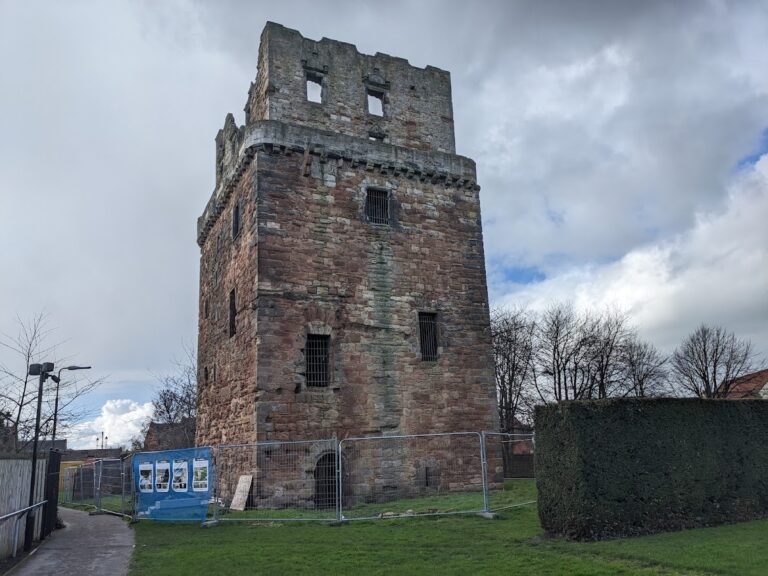
Carberry Tower’s surviving form is organized around an approximately square central tower built of local stone. Its thick walls, narrow openings, and vertically arranged interior reflect the character of a late-medieval Scottish tower house. Such buildings combined domestic accommodation with defensive strength, and the original tower was constructed more for protection than ornament. Its uncertain date is preserved in the building’s position as the older core of the later complex.
Scottish Baronial additions
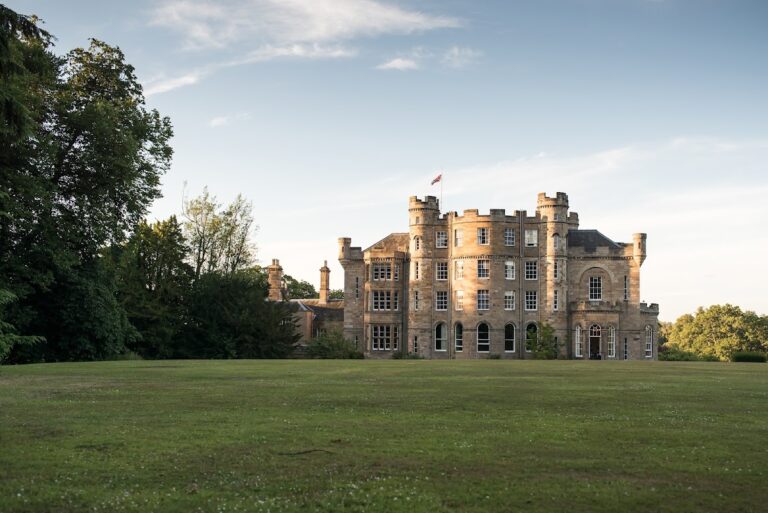
From the eighteenth century, and especially during the nineteenth century, lateral additions incorporated the tower into a much larger residential complex. The extensions were reportedly built piecemeal in an anticlockwise direction, creating an asymmetrical composition in which the earlier defensive structure became enclosed within the later house. Nineteenth-century work added corner turrets, crow-stepped gables, steeply pitched roofs, and decorative chimneys, all characteristic of the Scottish Baronial revival. Later twentieth- and twenty-first-century refurbishment and restoration adapted the house for hotel use and for weddings and other events.
Park, gardens, and associated buildings
Landscape and arboretum
The estate includes a landscaped park with gardens and woodland. During William Elphinstone’s tenure, an arboretum, a managed collection of trees and woody plants, was begun. Specimen trees and other plant varieties were planted throughout the park, extending the designed landscape beyond the house itself. A formal garden was laid out in 1911 as part of the improvements made by Sydney and Lady Mary Elphinstone.
Church of Scotland additions
The Church of Scotland added an annexe to the house and a chapel in the park after Lady Mary Elphinstone bequeathed the estate to the church. The chapel later served as a venue for small concerts during the Carberry Festival, linking the building’s religious use with the festival’s programme of music and artistic activity.
Queen’s Mount
Near Carberry Hill, within the historic estate, Queen’s Mount marks the place associated with Mary, Queen of Scots’ surrender in June 1567. The commemorative monument relates the surviving landscape to the confrontation between the queen and the confederation of her lords, after which Mary was taken prisoner.