St Michael’s Kirk, Inveresk: A Church of Scotland Parish Church
Site at a Glance
- Popularity
- Low
- Country
- United Kingdom
- Primary era
- Modern
- Eras represented
- Early Modern, Modern
- Civilizations
- British
- Site type
- Religious
- Remains
- Church
On this page14 sections
History
St Michael’s Kirk, Inveresk, is an active Church of Scotland parish church serving Musselburgh, in the United Kingdom. Its present building was constructed between 1803 and 1805 in Georgian style, the British architectural manner associated with the eighteenth and early nineteenth centuries.
Early churches and medieval patronage
At least three successive churches have occupied the site. The earliest is thought to have been a wooden church beside the remains of a Roman fort. Local tradition links its foundation to Modwenna, an Irish missionary nun, and places it in the sixth century.
Around 1128, David I, king of Scots, placed the church establishment under Dunfermline Abbey, a major medieval religious house in Scotland. A stone church from the medieval period stood at Inveresk before 1547.
Reformers and military occupation
During the sixteenth century, the Scottish Protestant reformers George Wishart and John Knox visited the church. In later campaigns, Oliver Cromwell’s forces and those of Charles Edward Stuart each took over the medieval building. Stuart, known as Bonnie Prince Charlie, led the Jacobite rising of 1745, an attempt to restore the Stuart line to the throne. Contemporary depictions show cannon positions at the church, although it is uncertain which force placed them there.
The present church and parish
By the turn of the nineteenth century, the medieval church had deteriorated and no longer had enough room for the growing congregation. The Kirk Session, the congregation’s local governing body, chose to replace it on the same site, aiming to keep parishioners from worshipping elsewhere. The new church was built between 1803 and 1805, with its bell tower completed in 1805.
Major work in the 1890s reoriented and remodelled the interior to make room for a pipe organ donated by the Kirkwood family of Haddington. Mary Lusk served as the church’s deaconess for four years from 1954. Later known as the Reverend Mary Levison, she became the first woman minister in the Church of Scotland. The interior was restored in 1988, and further changes followed in 2002.
In July 1999, the church sold four silver communion cups, then about 380 years old, because it could no longer afford their storage and insurance. The proceeds went towards roof repairs and mission work. St Michael’s was listed in Category A, Scotland’s highest listed-building category, in 1971.
Remains
The church is a three-storey rectangle of grey stone in Georgian style. It stands on high ground at the western edge of Inveresk, where it can be seen from several miles away. Its hilltop position gave it the local nickname the Visible Kirk.
Church architecture
Bell tower
A tall, pointed bell tower projects from the south side. Five sections, marked by horizontal bands called string courses, divide the tower’s exterior. The lower three sections are square in plan, while the upper two are octagonal. Round-arched windows include partly blind openings, where the arch forms a recess rather than a fully open window. The third section has Ionic pilasters, shallow classical columns, and triangular pediments. A horizontal decorative band, or frieze, finishes the fourth section, while small dormer-like openings pierce the stone spire.
Entrances and stair projections
The tower’s ground-level entrance has a high round arch and a transom window, a window placed above a door. Ionic pilasters flank the doorway and support a triangular pediment; a single round-arched window sits above it. The original entrance was on the north side, whose three bays are sections of the facade marked by openings. Tuscan columns framed that doorway. During the 1890s work, masonry partly blocked the entrance and it was turned into a window. Rectangular projections on the east and west sides contain internal stairways. These additions are built of yellow sandstone, contrasting with the church’s grey stone. The roof is slate-covered and slopes down on all sides.
Stained glass
The church has numerous stained-glass windows. The window titled ‘God in Creation, Providence and Redemption’, designed by Douglas Strachan, was installed in 1923.
Graveyard
Layout and extensions
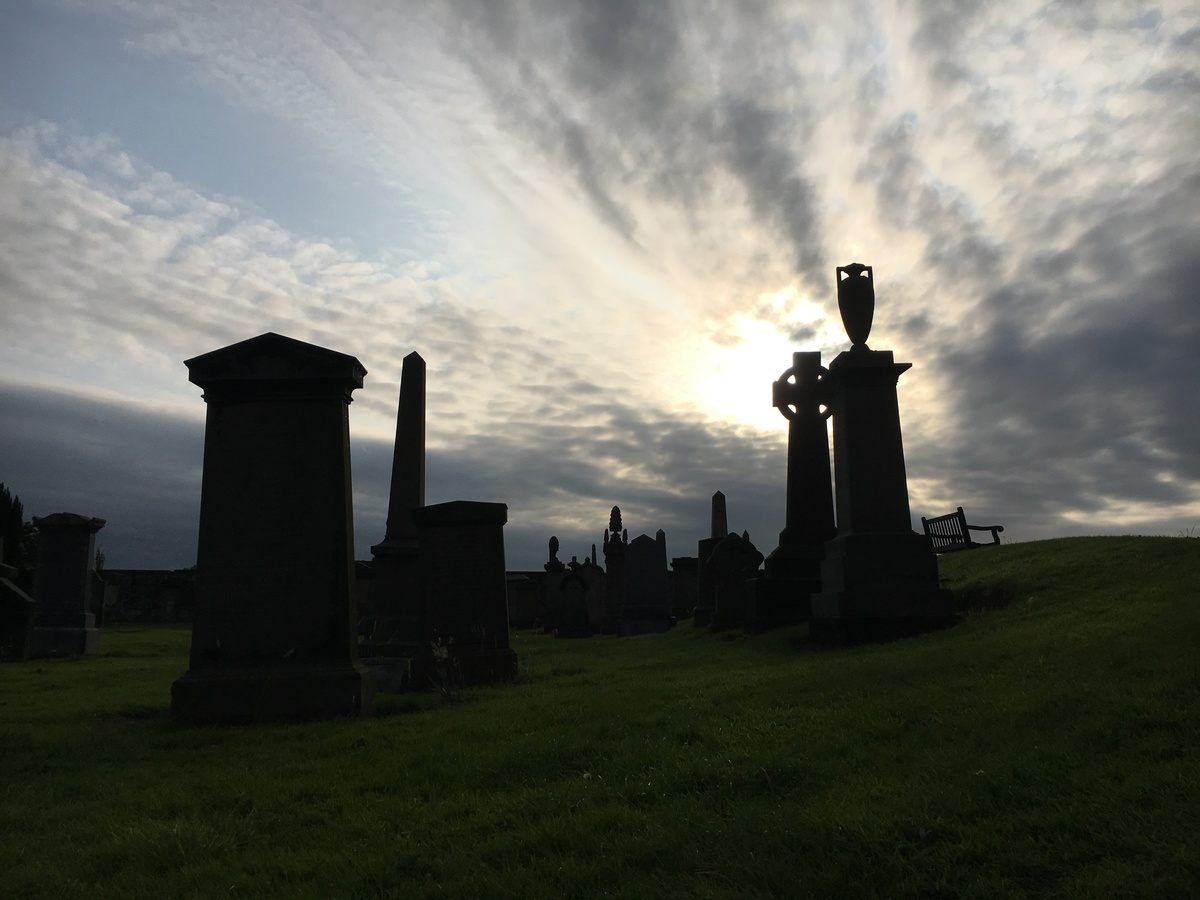
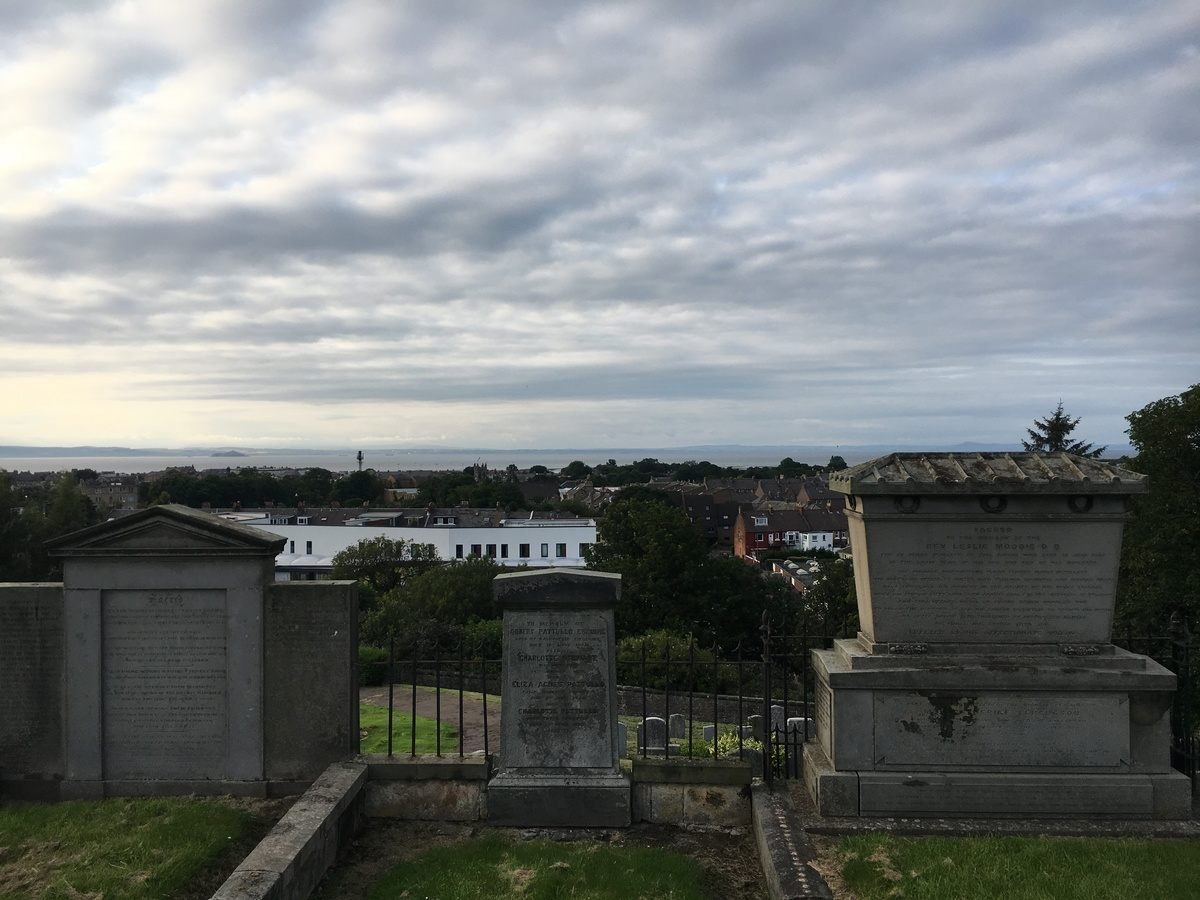
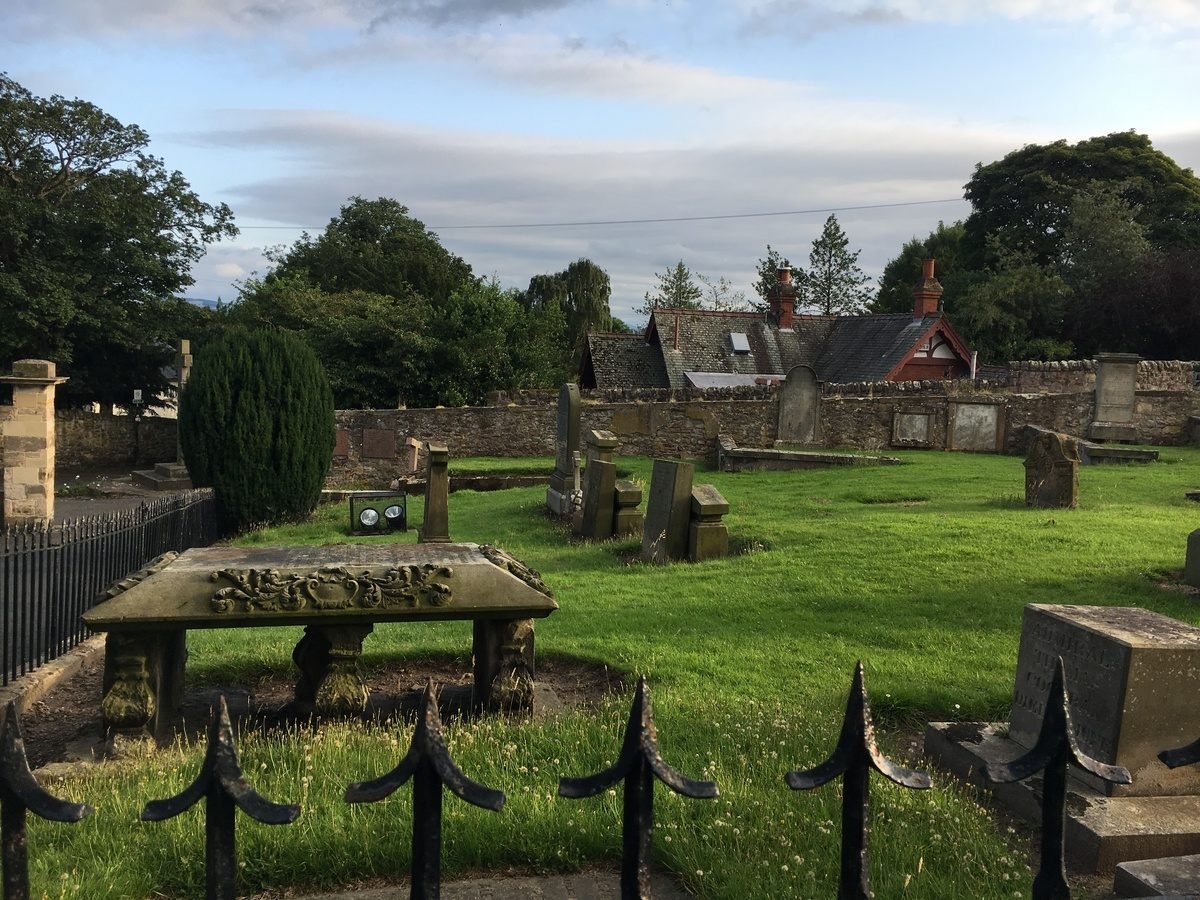
The graveyard surrounds the church and extends nearly 300 metres to the west. Walls divide it into areas formed by successive extensions. The original ground is mainly eighteenth-century; a late nineteenth-century section lies beyond it, an early twentieth-century area is to the north, and a modern extension occupies the far west.
Memorials and tombs
South of the church, a white-painted cast-iron sculpture of a coffin draped in military regalia rests on a full-sized cannon and cannonballs. It marks Major William Norman Ramsay’s grave. A separate memorial honours seven Fisherrow fishermen lost when the Alice, a fishing boat from Boddam in Aberdeenshire, sank in the storm of 14 October 1881, known as the Eyemouth Disaster. Cubic gravestones mark the burials of Admiral Archibald Cochran and his son, Admiral Thomas Cochran. At the east end of the late nineteenth-century section, the sarcophagus-shaped Buller-Elphinstone tomb commemorates William Elphinstone, 15th Lord Elphinstone, and Sidney Elphinstone, 16th Lord Elphinstone.
Family and naval monuments
A large monument against the graveyard’s far eastern wall commemorates several Hope baronets of Craighall, including Sir Archibald Hope, 9th Baronet. A marker for Major General Sir Patrick Lindesay stands among yew trees. The Wedderburn family monument names Sir David Wedderburn, 1st Baronet (1775–1858), Sir John Wedderburn, 2nd Baronet, and Sir David Wedderburn, 3rd Baronet (1835–1882). On the west wall of the late nineteenth-century section, a stone marks the grave of James Greenlees, a rugby player and scholar (1870–1951).
Other marked graves
Other graves include Edwin Alexander (1870–1926), an artist and son of Robert Alexander; theologian William Lindsay Alexander (1808–1884); wire-maker John Brunton (1837–1917); the Very Reverend Alexander Carlyle (1722–1805); shipbuilder John Cran (1849–1940); Sir Charles Dalrymple, 1st Baronet; Mark Dalrymple, 3rd Baronet (1915–1971); Sir Charles Dalrymple Fergusson, 5th Baronet; and sculptor Alexander Handyside Ritchie (1804–1870).
Military and naval graves include John Grieve, awarded the Victoria Cross for bravery at the Battle of Balaclava; Admiral Sir David Milne (1763–1845), his son Admiral Sir Alexander Milne (1806–1896), and geologist David Milne-Home (1805–1890). David Rae, Lord Eskgrove (1724–1804), and his son Sir William Rae, 3rd Baronet (1769–1842), are also buried here. Private Alexander Sinclair (1896–1915) survived the Quintinshill rail disaster but was killed at Gallipoli months later. Major Robert Vernor, a captain in the Scots Greys, was wounded at Waterloo.