Kámen Castle: A Medieval Castle and Baroque Chateau in Czechia


Site at a Glance
- Rating
- 4.6
- Popularity
- Medium
- Country
- Czechia
- Primary era
- Medieval
- External website
- Open
- Eras represented
- Medieval, Early Modern, Modern
- Civilizations
- Habsburg, Holy Roman Empire, Kingdom of Bohemia
- Site type
- Military
- Remains
- Castle
On this page14 sections
History
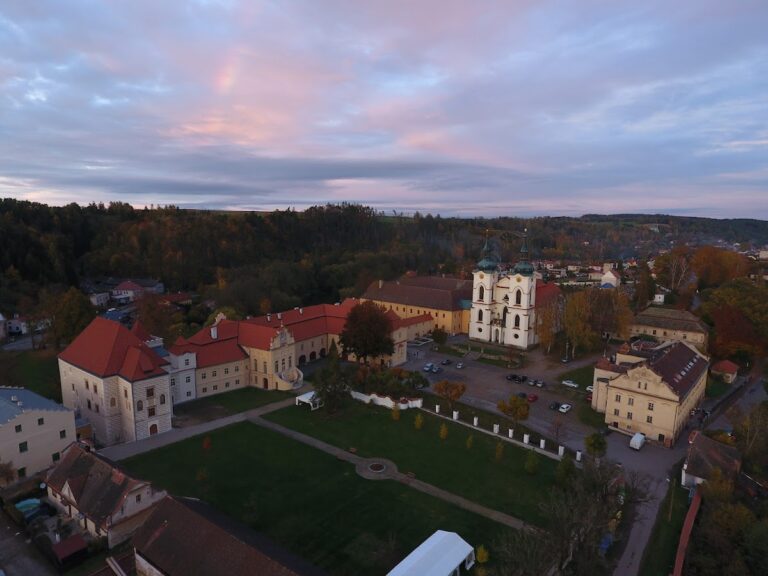
Kámen Castle is a medieval castle in the village of Kámen, Czechia, first recorded in 1316 and later transformed into a Baroque chateau with nineteenth-century Romantic and Neo-Gothic alterations. Its Old Palace dates from the first half of the thirteenth century, while the castle itself had been built before its first written record. Positioned between Tábor and Pelhřimov, it became an important stronghold during the Hussite Wars, the fifteenth-century religious and political conflicts in Bohemia.
Medieval Lords and the Hussite Wars
The Tluksa family of Vokov held Kámen for most of the period from 1318 to 1437. In 1327, King John of Luxembourg granted Bušek Tluksa the castle as a feudal holding, meaning property held from a monarch in return for obligations. Around the middle of the fourteenth century, Přibík Tluksa possessed Kámen jointly with his brothers.
Jindřich of Ciglheim acquired the castle in 1356, with the sale approved by Emperor Charles IV on 2 June that year. Charles later allowed Jindřich to establish gold mines in the surrounding area on 7 October 1366. Between 1356 and 1366, Jindřich rebuilt the palace. After he gave up his South Bohemian estates, Kámen returned to the Tluksas.
Jan Tluksa and his wife Anna were living at Kámen in 1408. Jan died at the beginning of the Hussite Wars, leaving an orphaned son, Hynek. Maršík Tluksa may have become Hynek’s guardian and apparently administered the property for the widow Anna as well. Přibík Tluksa of Kámen supported the Taborites, the radical Hussite faction associated with Tábor, and took part in the capture of Bechyně. During the conflict, Kámen served as an important Hussite stronghold between Tábor and Pelhřimov.
Changes of Lordship in the Fifteenth and Sixteenth Centuries
In 1437, Anna and Hynek sold Kámen to Purkart of Žirovnice for 600 kop of groschen. On 4 August 1450, George of Poděbrady and Jindřich of Rožmberk concluded a peace agreement at the castle. Purkart sold the estate in 1456 to the brothers Burián, Zdeněk, and Mikuláš Trčka of Lípa for 700 kop of groschen.
Jan Sádlo of Smilkov bought Kámen in 1460 for the same price. His will, dated 23 September 1464, assigned the castle and estate to his brothers-in-law Petr Břekovec of Ostromeč and Kozí hřbet and Hertvík of Nestajov and Žehušice, as well as to his uncles Svatomír and Nedamír of Březí. After Jan’s death in 1465, Kámen passed to Petr Břekovec. Petr’s son Bohuslav sold it in 1468 to Oldřich Fifka of Vydří, who was accused of counterfeiting money. The charge was not proved, apparently partly because of Oldřich’s early death. His son Albert later sold Kámen to Jan of Vojslavice in 1479.
Markvart of Vojslavice inherited the castle from Jan and obtained its release from feudal tenure from King Vladislaus in 1504. This ended Kámen’s feudal status. Before 1513, Markvart’s probable son Petr of Vojslavice sold half of the castle, half of the town, and part of the estate to Jan Zručský of Chřenovice. The other half later passed to Petr’s sister Kateřina, who married Petr Malovec of Malovice after leaving her first husband, Habart of Baště. Petr Malovec won a lawsuit over her share in 1524 and bought the remaining half from Jan Zručský, bringing the estate together again.
The Malovec Family and the Baroque Chateau
In 1557, the Malovec inheritance was divided among the brothers Jiří, Malovec, and Václav. Malovec received Kámen, its lower town, Eš, Vysoká Lhota, and additional property. Later family settlements included an agreement in 1612, when Petr the Elder and Vilém Malovec resolved the claims of their mother, Aléna of Paběnice. Kámen subsequently passed to Václav Malovec and probably around 1640 to his elder son, Jan Kryštof.
Jan Kryštof Malovec converted the aging castle into a Baroque chateau. His coat of arms and those of his wives, Marie Veronika Švihovská and Anna Barbora of Kokořov, were carved above the entrance to the castle core. When the Malovec inheritance was divided in 1690, Kámen and its estate, valued at 25,600 Rhenish gulden, went to Jan Kryštof, who sold it to František Karel Kresl of Kvaltenberk.
Nineteenth-Century Alterations and State Ownership
Kresl, who was in debt, sold the estate in 1747 to Jan František Bauler of Hohenburk for 36,000 Rhenish gulden. František Karel Streit acquired it in 1756 for 24,000 gulden and held it with his wife until 1774, when Jan Nepomuk Gynter of Šterneka became owner for 48,000 Rhenish gulden. Later owners included František de Paula from 1793, Václav Pitschmann from 1799, Štěpán von Hackhl Edler von Rosenstein zu Peschwitz from 1806, and Alois von Hackhl from 1826. These frequent changes were accompanied by the castle’s deterioration.
Václav Enis of Atter and Iveaghe carried out major repairs and Romantic alterations between 1860 and 1870. A Neo-Gothic rebuilding began during his ownership, which lasted from 1860 to 1872, and Antonín Fleissig completed the work after acquiring Kámen in 1916. From the end of the nineteenth century, the castle belonged to bourgeois families.
Kámen became state property in 1948 after its confiscation from Fleissig. From 1951, the Czechoslovak Sokol organization, a Czech physical-education and civic association, used the castle. In 1953 it was placed under the local cultural-education institution, and in 1962 it passed to the Pelhřimov District National Committee, a local administrative body of the Czechoslovak socialist state. Repairs to the dilapidated complex continued into the 1970s.
Museum Use and Current Administration
A motorcycle museum opened at Kámen on 22 June 1974. Since the 1990s, the complex has also developed an exhibition on life in the chateau from the second half of the nineteenth century to the beginning of the twentieth. In 2020, Kámen was a branch of the Vysočina Museum in Pelhřimov, established by the Vysočina Region, and the motorcycle museum remained at the castle. Kámen is protected as a cultural monument and passed to the Vysočina Region after the abolition of Czech district administrations, effective from 2003.
The nearby Chapel of Our Lady of Sorrows became part of the castle complex in February 2018, when ownership passed from the Roman Catholic parish of Věžná to the Vysočina Region. Reconstruction began at the start of 2019. The chapel served as the burial chapel of the Malovec family.
Remains
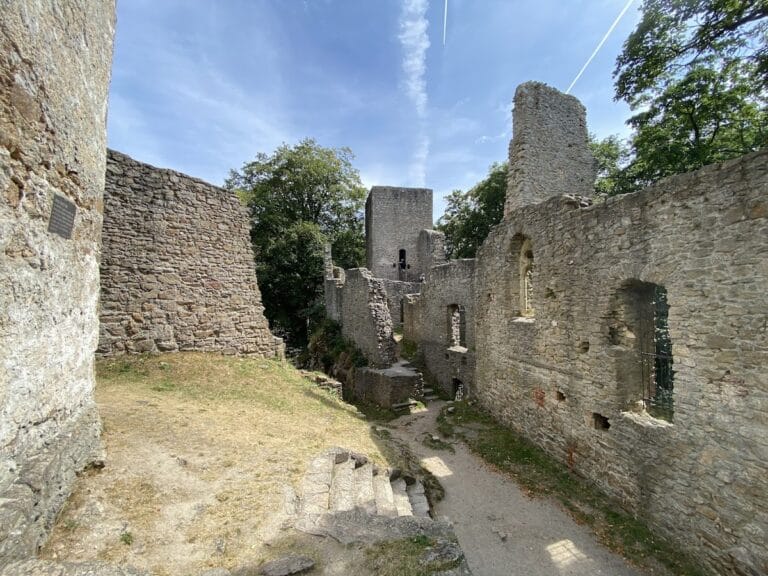
Kámen is a block-type castle, with towers directly adjoining the palace wings. From its earliest arrangement, the complex was divided into a strongly defended inner castle core and a lower outer bailey. The core occupies a rocky formation, while surviving walls, later additions, and the surrounding Romantic park preserve elements from several periods of the site’s development.
Outer Bailey and Castle Core
Outer Bailey
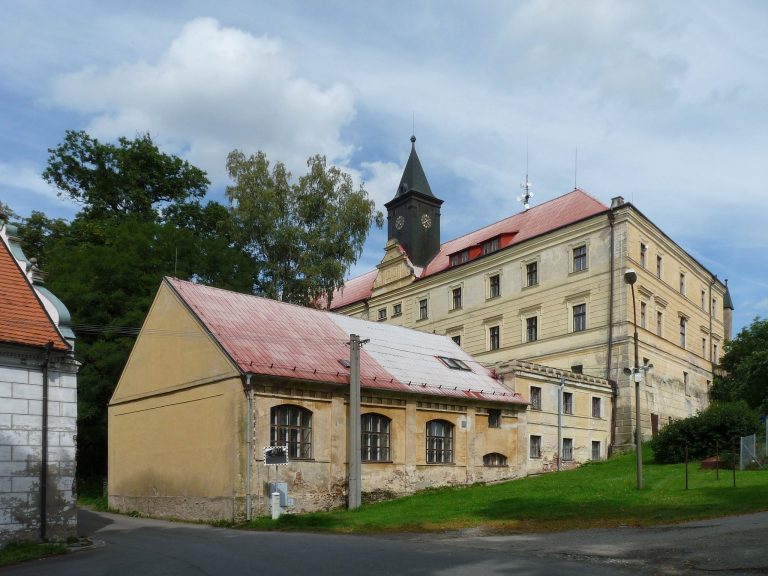
The outer bailey was entered through a slender gate tower. Sections of its perimeter wall survive on the west and southeast sides, and the basement of a building remains on the north side. During the nineteenth-century Romantic rebuilding, the gate tower was raised. A brewery building was added to its right, while a new Neo-Gothic gate was placed on its left.
Castle Core
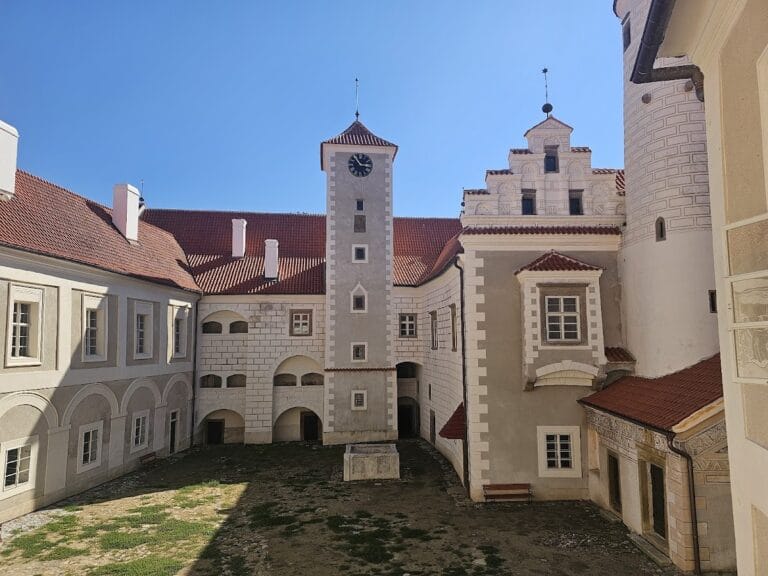
The castle core is entered through a second tower on the east side. Its dominant feature is a residential tower with a trapezoidal ground plan on the west. A small quarter-round bastion projects farther west from it. A third tower-like building stands on the south side and probably served as a kitchen. The palace occupies the northwestern part of the core. It originally contained three rooms and gained a fourth section in the second half of the fourteenth century.
By the fourteenth century, the entire perimeter had been enclosed except for a short wall section immediately behind the gate tower. Part of the courtyard masonry on the south side dates from the Renaissance. Around 1670, a passage or gallery was built around the first floor of the courtyard and covered with a cross vault. Painted ceilings in the first floor of the north wing date from the same period. The Baroque rebuilding also affected the south residential wing, and a tower was erected above the former staircase in 1673.
Interiors, Park, and Collections
Chateau Interiors
The rooms used for the historical chateau-life exhibition include the Knights’ Hall, castle chapel, entrance hall, Small Salon, Great Salon, bedroom, dining room, and library. The Old Palace contains a historical exhibition. Other displays cover aristocratic domestic life at the transition from the nineteenth to the twentieth century, stones from the Vysočina Museum, and folk religious paintings in a service building.
Motorcycle Collection
The motorcycle exhibition includes a 1894 Hildebrand and Wolfmüller, a 1904 Slavia CCD, a 1904 Jelínek, a 1913 Walther B, a 1925 Poustka 250, and a 1928 BD 500. These motorcycles are loans from the collection of the National Technical Museum in Prague.
Park and Chapel
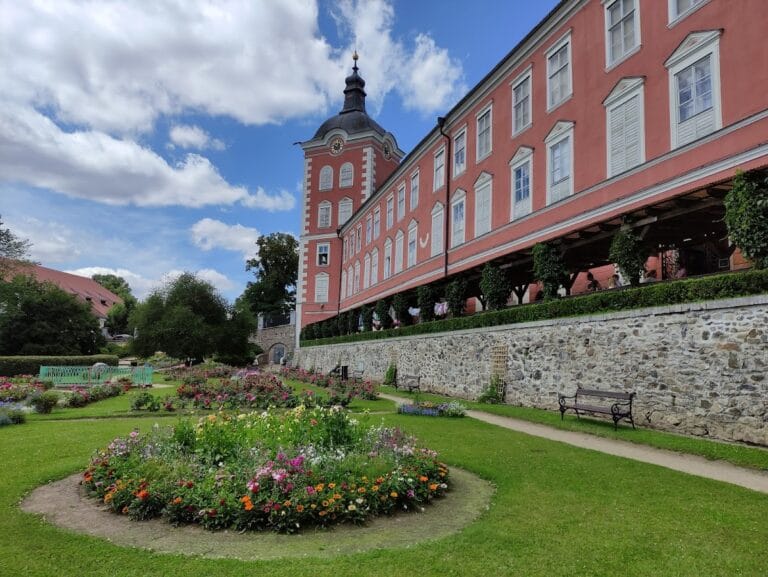
A Romantic park surrounds the castle and contains a collection of alpine plants and a Nootka false cypress. The nearby Chapel of Our Lady of Sorrows forms part of the complex and retains its connection with the Malovec family as their burial chapel.