Cornatel Castle: A Medieval Fortress in León, Spain


Site at a Glance
- Rating
- 4.4
- Popularity
- Medium
- Country
- Spain
- Primary era
- Medieval
- External website
- Open
- Eras represented
- Medieval, Early Modern
- Civilizations
- Kingdom of León
- Site type
- Military
- Remains
- Castle
On this page10 sections
History
Cornatel Castle is a medieval fortress at Villavieja in León, Spain, whose construction and successive transformations broadly span the ninth to the sixteenth centuries. Its origins are uncertain, but the strongest interpretation identifies it with the medieval Castle of Ulver, a stronghold that became important in Christian Spain during the ninth and tenth centuries.
Origins and the Castle of Ulver
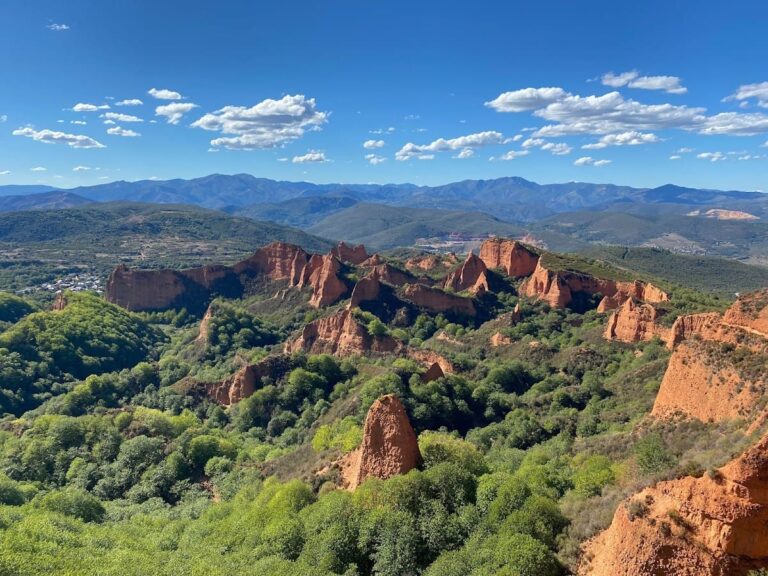
One interpretation places an earlier Roman military outpost at the site, associated with the nearby gold workings of Las Medulas. After the Romans abandoned those workings, the site appears to have had little or no known role under Suevic and Visigothic rule. It later re-emerged as a significant fortress during the expansion and consolidation of Christian power in the ninth and tenth centuries.
Cornatel was prominent during the reign of Bermudo II of León, from 985 to 999. Its medieval administration is reflected in the officials who held authority there. Rapinato Ectaz was the first known lieutenant of the Castle of Ribera de Ulver, serving from 1023 to 1047. A lieutenant was an official who governed a castle or district for a superior lord or ruler. Pedro Velázquez held the office during a dispute of 4 December 1080 between the Monastery of Samos and the lieutenant of Ulver over possessions near the Sil River, at or near present-day Villadepalos. Count Munio Muñiz, an important landholder in the Bierzo, was also associated with the castle.
Jimena Muñiz served as lieutenant of the fortress from 1093 to 1108. She had a relationship with Alfonso VI of León and Castile and was the mother of Teresa and Elvira. These associations place Ulver within the network of aristocratic authority that shaped the Bierzo during the central Middle Ages.
Templar and aristocratic lordship
In 1211, Alfonso IX of León granted Ponferrada to the Knights Templar after making peace with the order. The Templars were a medieval religious-military order whose members combined monastic life with the defense and administration of fortified places. They strengthened Ponferrada and later took possession of Ulver. A charter from 1228 in the Cartulary of San Pedro de Montes records their control of the castle. Their lordship continued until the suppression of the order in 1312.
In 1327, Alfonso XI of Castile granted the castle to Álvar Núñez Osorio. It later passed to Pedro Fernández de Castro, and the name Cornatel first appears for the castle in 1378. In 1388, John I of Castile returned it to the Osorio lordship by granting it to Pedro Álvarez de Osorio.
After Rodrigo Álvarez Osorio died in 1430, the castle passed to his namesake, Pedro Álvarez Osorio, who became the first Count of Lemos. Pedro’s marriage to Beatriz de Castro united Osorio and Castro inheritances in the Bierzo and contributed to his acquisition of the titles Count of Lemos and Count of Trastámara.
Revolt, siege, and succession
During the Second Irmandiño Revolt of 1467, Cornatel was captured and almost completely destroyed. The Irmandiño revolts were late-medieval uprisings in Galicia directed largely against noble abuses and fortified aristocratic power. Pedro Álvarez Osorio ordered the reconstruction of his castles, including Cornatel, in 1469.
Pedro Álvarez Osorio died at Cornatel in 1483. His death led to a violent succession dispute involving his widow, María de Bazán, their daughter Juana Osorio and her husband Luis Pimentel, and Rodrigo Enríquez Osorio, the new Count of Lemos and a claimant to the castle. Rodrigo’s troops subjected Cornatel to a two-year siege.
In 1486, Isabella I of Castile and Ferdinand II of Aragon, known as the Catholic Monarchs, created the Marquessate of Villafranca del Bierzo for Juana Osorio and Luis Pimentel. Their joint rule reshaped the political organization of late-fifteenth-century Spain. They also compelled Rodrigo to surrender Ponferrada. Rodrigo retook Ponferrada in 1507 and opposed the settlement by besieging the castles of Corullón and Cornatel. Cornatel subsequently remained within the lordship of the Marquess of Villafranca until the abolition of the marquessate’s seigneurial jurisdictions.
Abandonment and restoration
In 1823, Cornatel became part of the municipality of Ponferrada. In 1843, the castle served as a Romantic setting for El Señor de Bembibre, a historical novel by the Bierzo writer Enrique Gil y Carrasco.
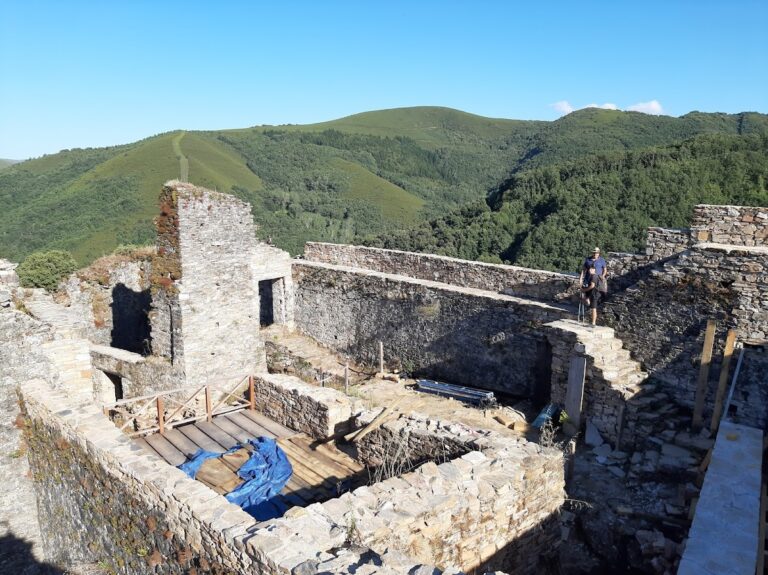
After years of nineteenth-century abandonment, the Counts of Peña Ramiro, described as the castle’s legitimate heirs, transferred the castle and several associated lands to the Villavieja local council on 29 November 1900. The castle was then used to shelter Villavieja’s livestock, a use that contributed to its deterioration. A major restoration in 2002 secured the most damaged areas and added safety elements that made public visitation possible. The castle was externally illuminated in 2003 and is now partially restored.
Cornatel was declared a Spanish Property of Cultural Interest on 22 April 1949. This designation is a formal heritage protection category for cultural sites and objects. The castle belongs to the Villavieja local council. Its museum presents the history of the fortress, its construction phases, and its successive lordships. From January 2010, it also displayed a collection of medieval polearms belonging to the local Caballeros de Ulver association. A polearm is a weapon fixed to a long shaft, such as a spear or halberd.
The medieval-themed Noches Mágicas de Cornatel festival began in 2003. A related project promoted in 2008 by the associations Baucan and Templespaña with the municipality led to the creation of Caballeros de Ulver, founded on 12 October 2009. The association conducts medieval fencing and archery activities, makes Templar-style equipment, and organizes a procession carrying an image of Saint James the Pilgrim from Villavieja church to the castle chapel. Its activities at the castle began in January 2010.
Remains
Promontory and defenses
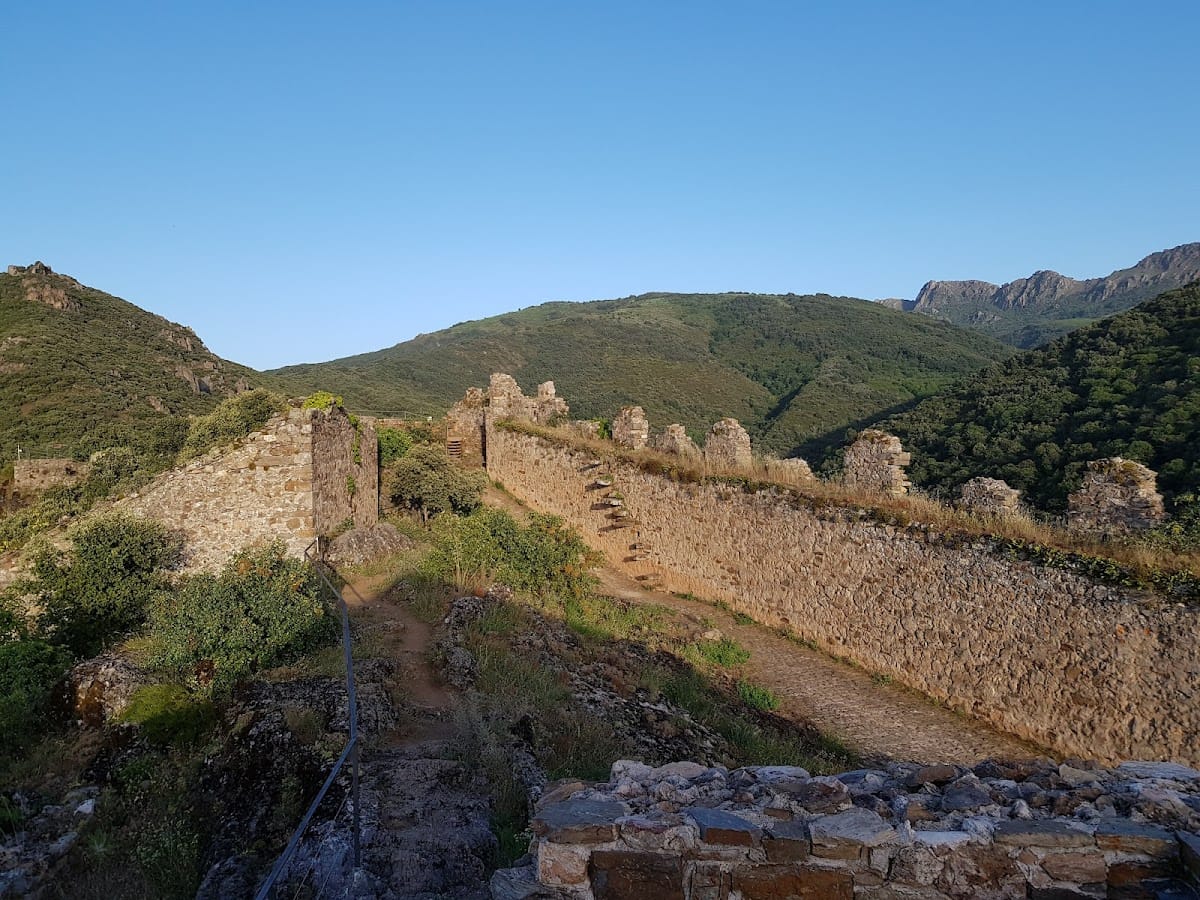
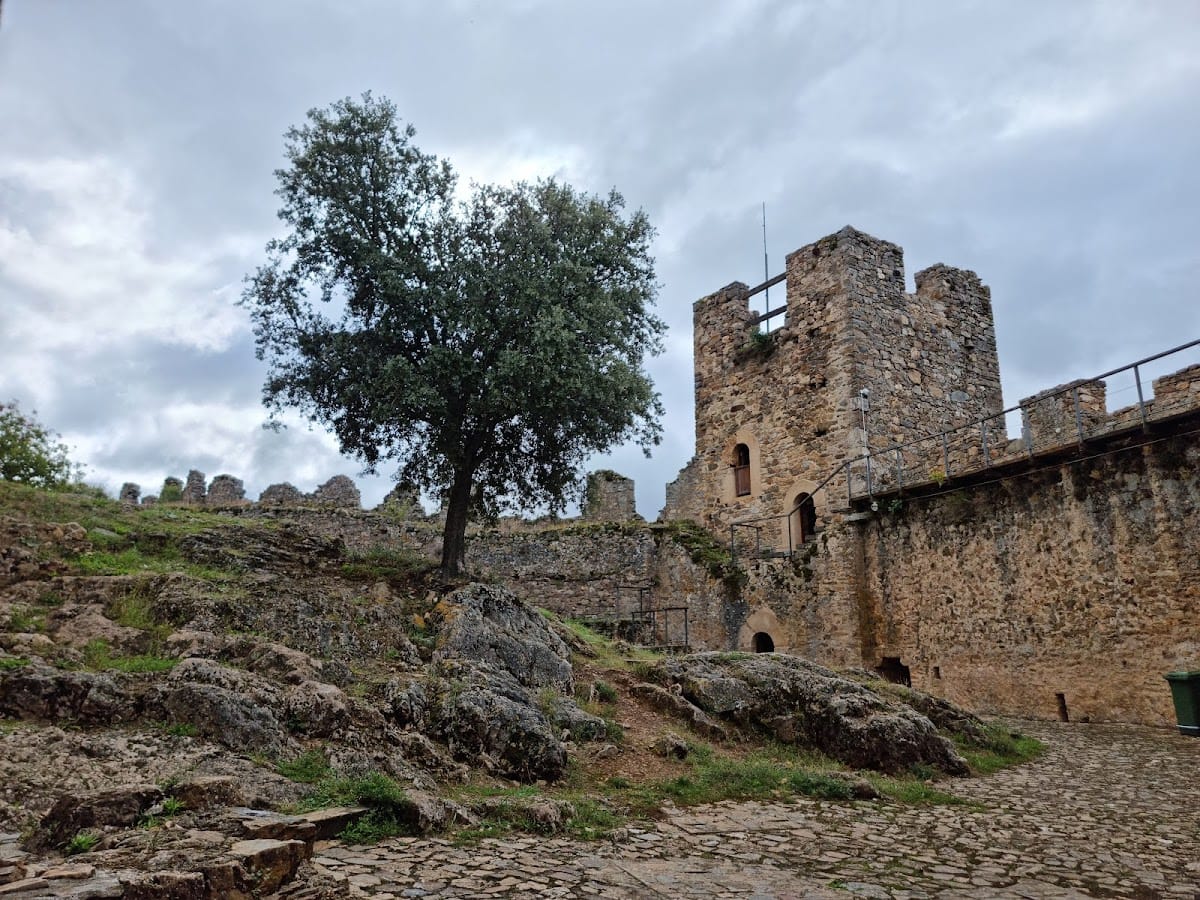
Cornatel Castle stands at approximately 786 metres above sea level on a rocky promontory. A ravine more than 180 metres deep cuts off its eastern and northern sides, with the Rioferreiros stream running through it. The two more accessible sides are protected by a single defensive wall with a crenellated wall-walk. A wall-walk, or adarve, is a passage along a fortification used for movement and defense, while crenellations are the raised and open sections along the parapet.
Terraced structures
Terraced structures below the western building may be Roman in origin. They have been interpreted as the podium of a classical Roman temple, enclosed on three sides by thick walls and possibly fronted by a colonnade. This interpretation remains uncertain, but the terraces form part of the archaeological setting below the medieval castle.
Gallery and chapel
The castle includes a gallery and a chapel. The gallery is currently closed to the public. The chapel is associated with the procession of Saint James the Pilgrim, a Christian devotional representation of Saint James the Greater linked with pilgrimage to Santiago de Compostela.
Museum and surviving stonework
The museum contains a reconstruction of the castle’s past and its successive construction phases. Its associated exhibition includes medieval weapons kept and displayed by Caballeros de Ulver. The castle’s limestone stonework supports Petrocoptis viscosa, a plant found at Cornatel and on the cliffs of Ferradillo and Paradela de Muces in connection with their climatic conditions and elevation.
Nearby sites