Castle of Villafranca del Bierzo: A Marquises’ Fortified Palace in Spain


Site at a Glance
- Rating
- 4.3
- Popularity
- Low
- Country
- Spain
- Primary era
- Early Modern
- Eras represented
- Early Modern
- Civilizations
- Crown of Castile, Spanish
- Site type
- Domestic
- Remains
- Castle
On this page7 sections
History
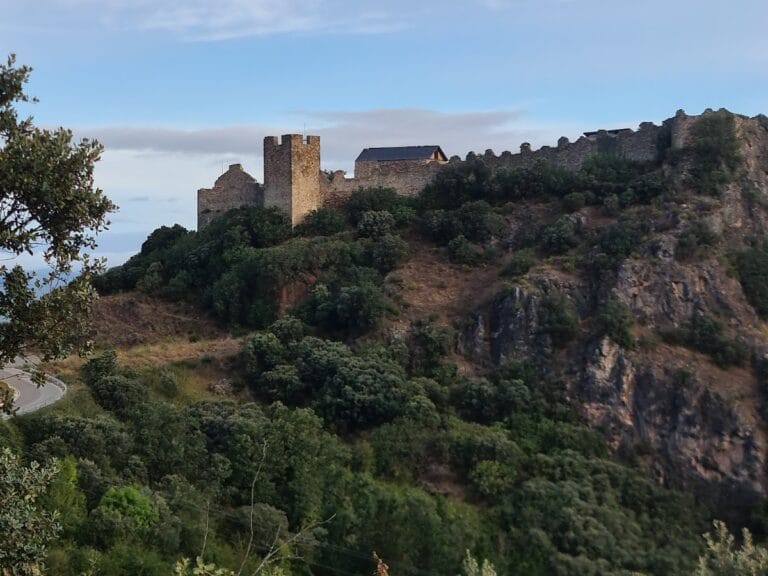
The Castle of Villafranca del Bierzo is a fortified residence and palace in Villafranca del Bierzo, Spain, rebuilt in the sixteenth century for the Marquises of Villafranca. Its history began with an earlier fortress known as the Fuerza, and the complex later became an Italianate palace, a style inspired by architectural forms associated with Renaissance and later Italy.
The Earlier Fortress and Sixteenth-Century Rebuilding
The Fuerza was attacked and destroyed in 1507 by the illegitimate son of Pedro Álvarez Osorio, the first Count of Lemos. In 1515, Juana I of Castile, a Castilian queen of the early sixteenth century, authorized Pedro Álvarez de Toledo y Zúñiga to rebuild the castle. He was the husband of María Osorio Pimentel, the second Marquise of Villafranca del Bierzo. The reconstructed complex was intended to serve as a residence for the marquises.
Transformation into a Palace
From 1600, Pedro Álvarez de Toledo Osorio, the fifth Marquis of Villafranca del Bierzo, remodeled the property. The work transformed the earlier feudal building into a substantial Italianate palace, enlarged the complex, and introduced fountains, pergolas, and niches decorated with sculpture.
Wartime Damage and Later Protection
During the Peninsular War, the Iberian campaign of the Napoleonic Wars fought chiefly in Spain and Portugal between 1807 and 1814, English troops dismantled and plundered the castle in 1809 while marching toward Lugo. French armies plundered and burned it again in 1815 and 1819.
The castle has been protected as a Bien de Interés Cultural, a Spanish heritage designation, since 22 April 1949. In 2015, it entered Spain’s retrospective inventory of associated components for the UNESCO World Heritage extension covering the French Way and the Northern Routes of the Way of Saint James, Christian pilgrimage routes leading to Santiago de Compostela in northwestern Spain. The property belongs to the heirs of pianist María Manuela Caro y Carvajal (1932–2017), the first pianist of the National Orchestra. She was the daughter of Mariano Caro del Arroyo, the fourth Count of Peñarramiro, and represented a minor branch of the Marquises of Villafranca. She was married to composer and conductor Cristóbal Halffter (1930–2021). The castle has been partly rehabilitated.
Remains
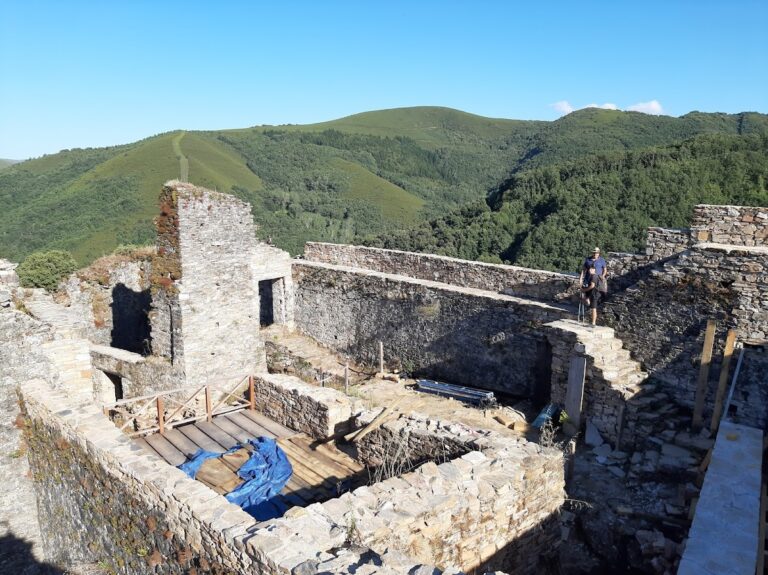
Fortified Layout
The surviving complex follows a quadrangular plan with four large circular towers at its corners. Each tower is divided into three wooden floors. The circular keep, the principal fortified tower of a medieval castle, is built in rubble masonry, a wall construction technique using irregular stones set in mortar, and is crowned by a slate roof, a roofing form characteristic of the region. Stone, masonry, and slate make up the stated construction materials of the castle.
Entrance and Palace Features
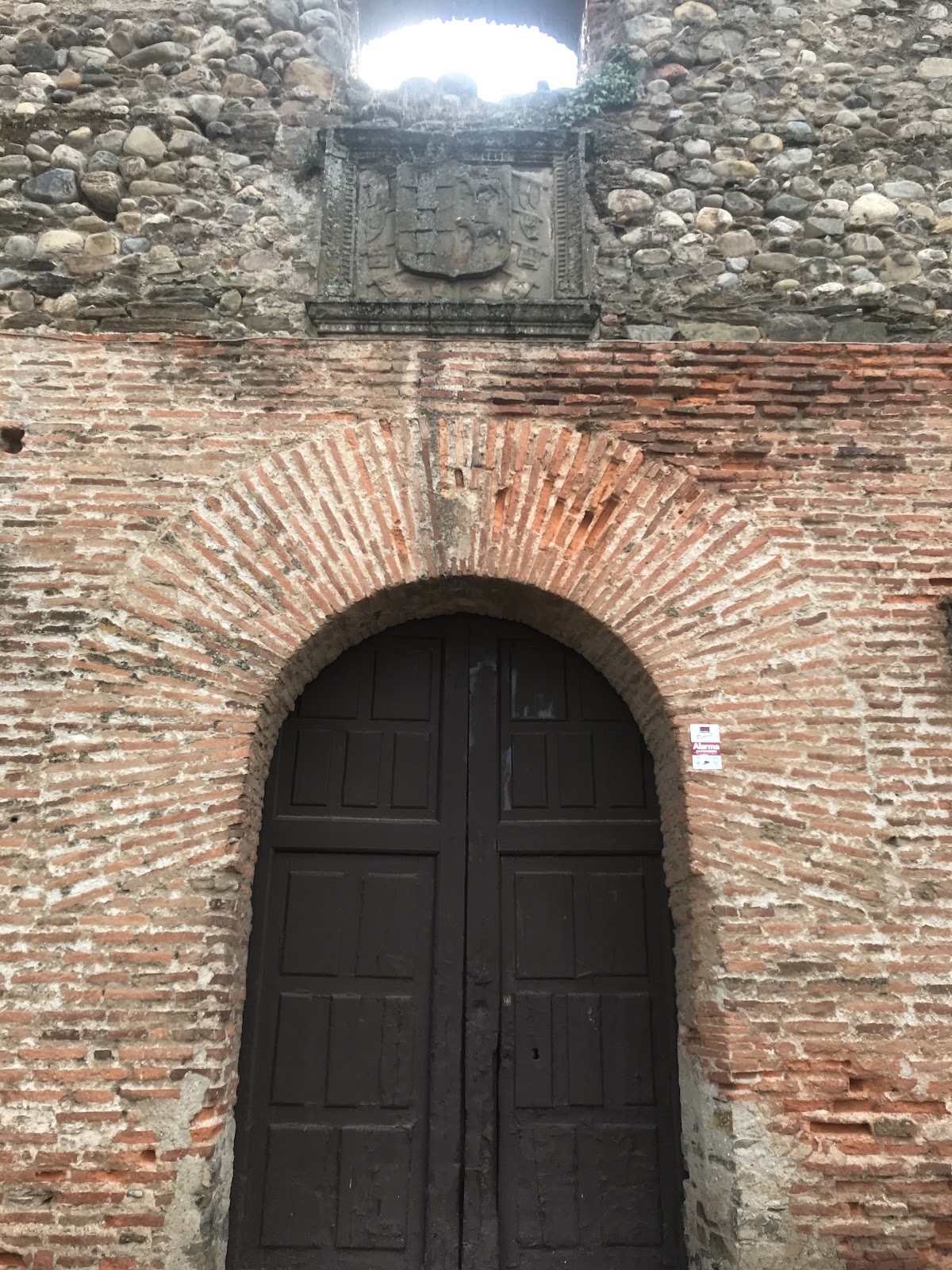
The principal entrance is made of brick and bears the heraldic coat of arms of Fadrique Álvarez de Toledo Osorio, the third Marquis of Villafranca del Bierzo. The palace transformation is also represented by sculpture-decorated niches, fountains, and pergolas added during the remodeling from 1600. These features belong to the enlarged residential complex created from the earlier feudal building.
Nearby sites