Moussa Castle: A Twentieth-Century Castle in Lebanon


Site at a Glance
- Rating
- 4.4
- Popularity
- Medium
- Country
- Lebanon
- Primary era
- Modern
- External website
- Open
- Eras represented
- Modern
- Civilizations
- Unclassified
- Site type
- Military
- Remains
- Castle
On this page7 sections
History
The Dream of a Castle
Moussa Castle is a twentieth-century castle in Lebanon, situated between Deir el-Qamar and Beit ed-Dine. Built in a pseudo-medieval style, it was the life project of Moussa Abdel Karim Al-Maamari, who devoted approximately six decades to its conception and construction.
Moussa was born on July 27, 1931. At about fourteen, while still a student, he became fascinated by the Middle Ages and began imagining a castle of his own. He drew plans during lessons and later explained that his modest background, together with a young woman’s refusal to marry a man whose father did not own a castle, helped drive him to build one himself. His father had served in the French Army.
Training and Early Work
After leaving school, Moussa walked to Saida, where he worked with his uncle on the restoration of the city’s fortress. In 1947, Emir Maurice Chehab, an emir being a high-ranking ruler or official, assigned Moussa and his uncle to renovate castles and excavate archaeological discoveries for exhibition at the National Museum of Beirut.
Moussa later worked at Beit ed-Dine Palace, restoring the museum of Emir Bashir Chehab II and supervising the installation of the emir’s collections of weapons, clothing, and jewellery. The museum opened in September 1951 during the presidency of Beshara Khalil Al-Khoury. These experiences gave Moussa practical knowledge of historic buildings, collections, and restoration before he began work on his own castle.
Construction and Public Opening
Between 1951 and 1962, Moussa acquired the land and completed the administrative procedures required for his project. He laid the foundation stone in 1962 and completed the building in 1969, with assistance from his wife. The castle opened to the public that same year.
Moussa described the project in his book The Dream of My Life. He received several distinctions, including appointment as a Knight of the National Order of the Cedar, Lebanon’s highest state order of merit for national or public service, and membership in the Patriarchal Order of the Holy Cross of Jerusalem, a Christian order of merit under patriarchal authority. Moussa died on January 31, 2018.
Remains
Fortified Exterior
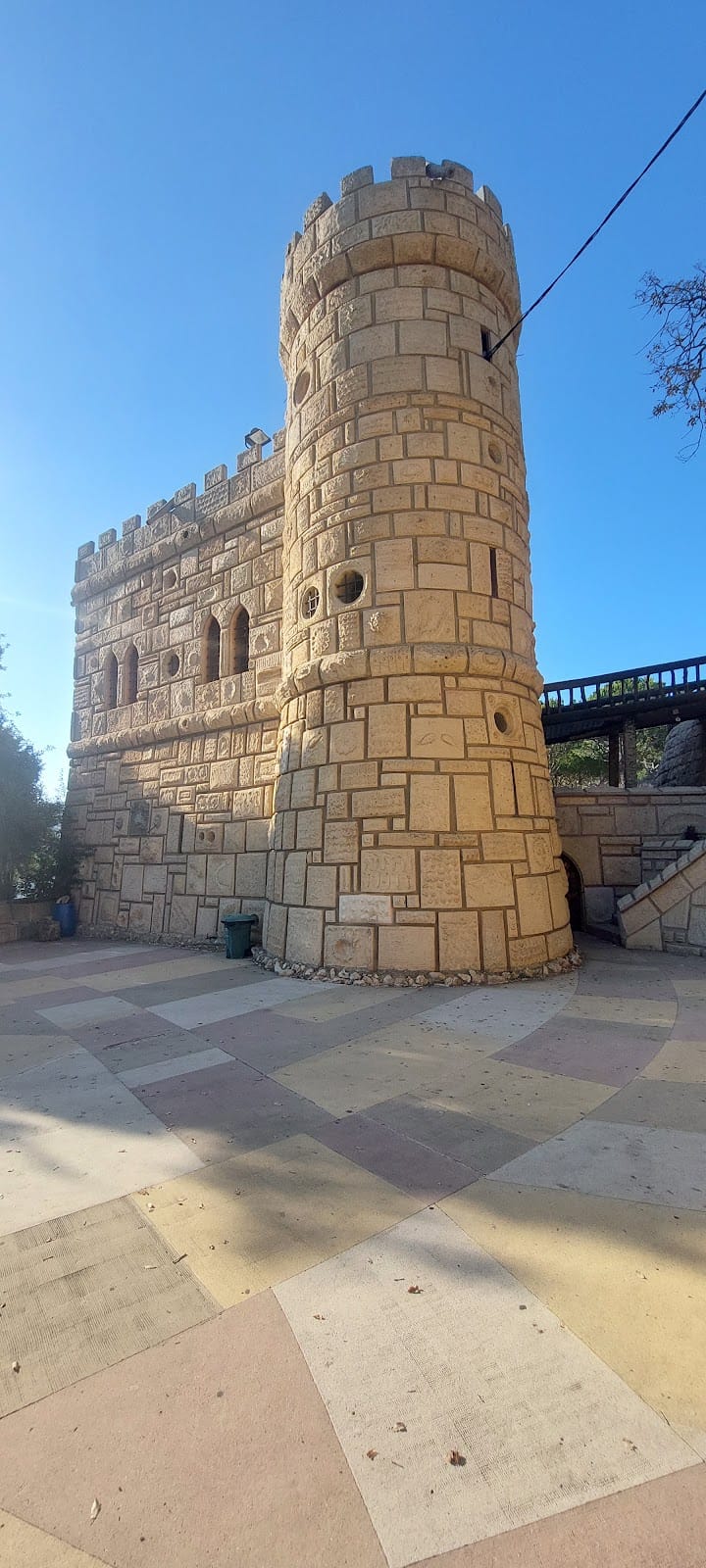
The castle occupies approximately 3,500 square metres on a hill between Deir el-Qamar and Beit ed-Dine. Its design presents a pseudo-medieval appearance through towers, fortified walls, a moat, and a drawbridge. It is organized as a concentric castle, a defensive arrangement formed by successive enclosures that allowed defenders to withdraw inward if an outer wall was breached.
Approximately 6,500 stones make up the building. Moussa personally sought out and laid the stones during construction, and his beliefs and ideas are engraved on them. The resulting structure combines the appearance of a fortified medieval residence with the personal authorship of its twentieth-century builder.
Scenes of Lebanese Village Life
Clay sculptures made by Moussa fill the interior and portray scenes from everyday life in a typical nineteenth-century Lebanese village. Among the figures are a baker, a man smoking a hookah, and a schoolmaster. These sculptures form part of the castle’s interior presentation and connect its medieval architectural theme with Moussa’s depiction of Lebanese social life.