King’s Court in Prague: A Medieval Royal Residence



Site at a Glance
- Rating
- 4.6
- Popularity
- Medium
- Country
- Czechia
- Primary era
- Medieval
- External website
- Open
- Eras represented
- Medieval
- Civilizations
- Holy Roman Empire, Kingdom of Bohemia
- Site type
- Domestic
- Remains
- Palace
On this page8 sections
History
King’s Court was a royal complex in Prague, Czechia, created within the medieval Bohemian kingdom for King Wenceslas IV around 1380. It served as the official residence of the kings of Bohemia from 1383 to 1485 and stood on the site now occupied by the Municipal House in Prague’s Old Town.
Foundation and Royal Residence
The complex was built on the site of an earlier bourgeois house and had previously been associated with the Lords of Koldice. It stood beside the Gate of Nicholas by the Tower, later called the Mountain Gate and now known as the Powder Gate. The road from Prague to Kutná Hora began there, giving the court an important position beside a major route.
Wenceslas IV, son of the Holy Roman Emperor Charles IV and king of Bohemia, probably moved to the area because of disagreements with the queen dowager, who also lived at Prague Castle. He first stayed near the Old Jewish School before moving to the Old Town fortifications in 1383. The complex came into his possession sometime after 1386, and it belonged to the Crown from that year until 1631.
After Wenceslas IV, King’s Court was occupied by his brother Sigismund of Luxembourg, who later became king of Bohemia and Holy Roman Emperor, as well as by Sigismund’s son-in-law Albert II of Habsburg, Ladislaus the Posthumous, and George of Poděbrady. Vladislaus II Jagiellon stayed there briefly before moving to Prague Castle after the disturbances later called the Second Defenestration of Prague in 1485. In 1490, after becoming king of Hungary, he moved to Buda.
Royal Ceremonies and the Poděbrady Court
King’s Court became closely associated with royal processions and political events. Four coronation processions departed from the palace along the Royal Route, the ceremonial route between the royal residence and Prague Castle. Albert II’s procession left on 28 June 1438, followed by the procession for Ladislaus the Posthumous on 28 October 1453, George of Poděbrady’s on 7 May 1458, and Vladislaus II’s on 22 August 1471. Albert II was crowned on the following day in 1438.
Two royal funeral processions also began at the palace. Ladislaus the Posthumous’s procession departed on 25 November 1457, while George of Poděbrady’s left on 25 March 1471. Ladislaus died at King’s Court. George, a Hussite nobleman who became king of Bohemia in 1458, also died there on 22 March 1471. He had lived at the court while serving as provincial administrator, a temporary governor exercising royal authority, from 1453 to 1458, and throughout his reign from 1458 to 1471.
The court was an important political center during George’s reign. A memorial inscription recalls foreign embassies, assemblies, and provincial diets held there. It also records George’s religious and political conflicts, including his declaration on 12 August 1462 that he was willing to sacrifice his throne and life for the chalice. This Hussite symbol referred to communion in both kinds, including wine for laypeople. On 14 April 1467, George appealed to a general council against Pope Paul II, who had condemned him as a heretic and deprived him of his throne.
Land Records and Later Institutional Use
From the beginning of the fifteenth century until 1512, the Bohemian Land Tables were kept at King’s Court. These were official legal records concerning land ownership, noble rights, and other matters of the kingdom. They were prepared for transfer back to Prague Castle and deposited there in 1515, but were destroyed in the great fire of 1541.
In 1515, part of the palace was pledged, while the Lobkowicz family used the remaining sections. Cardinal Ernst Adalbert von Harrach, the archbishop of Prague, acquired both parts in 1631. He established an archiepiscopal seminary there in 1636. The complex burned to its foundations in 1689 and was rebuilt immediately afterward.
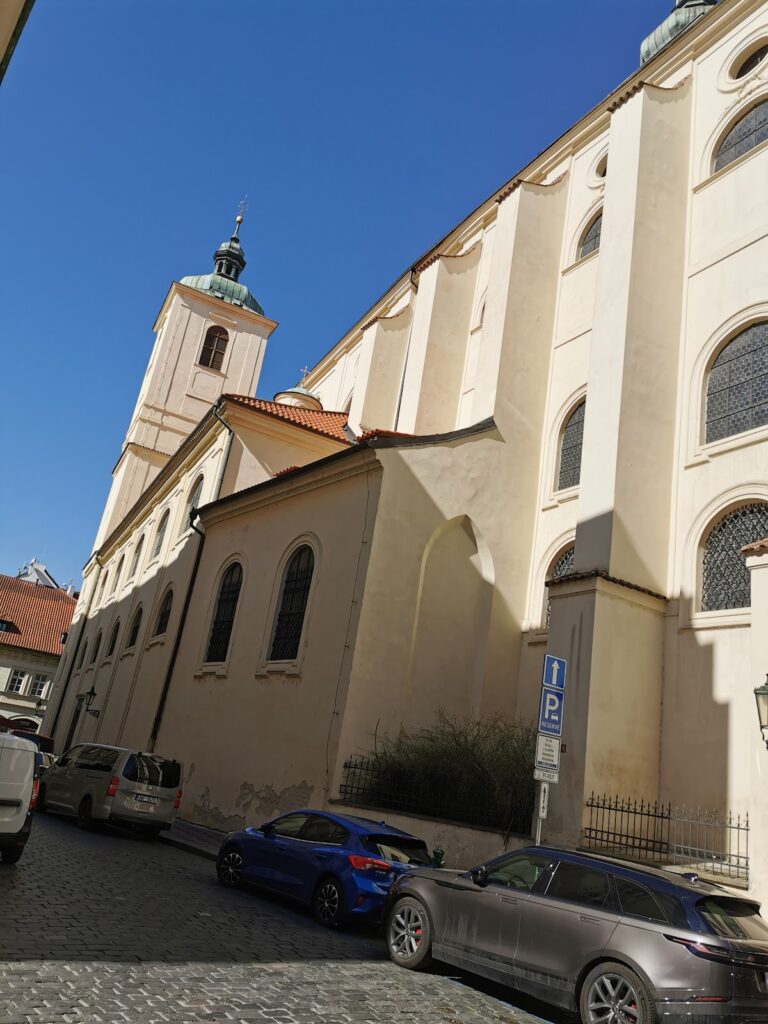
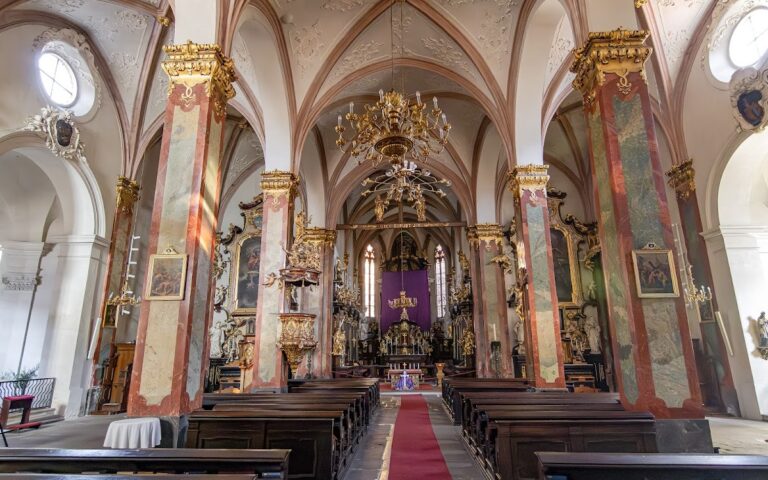
A Baroque Church of St. Adalbert was added to the seminary. It was designed by Jean Baptiste Mathey, a French-born architect active in Bohemia, and consecrated in 1705. After the suppression of the Jesuit order, a Catholic religious order, in 1773, the seminary moved to the Clementinum. The church was later abolished during the Josephine reforms, the religious and administrative measures introduced by Emperor Joseph II.
From 1869 to 1900, military authorities used the complex as a cadet school. The remaining buildings were demolished in 1902 and 1903 to clear the site for the Municipal House. The former court is preserved in historical representations, including an ink drawing made around 1750 by F. B. Werner and Langweil’s model of Prague.
Remains
Palace Complex
The palace had a triangular ground plan. Its southwestern wing contained a tower palace, while the wider complex included a large hall, gardens, houses for courtiers and servants, baths, and a lion house. The large hall hosted royal meetings and other important events. The surviving physical evidence consists of archaeologically identified foundations of the palace masonry.
Associated House and Commemorative Evidence
An associated house stood on the opposite side of today’s Celetná Street. It had previously belonged to the Velflovic family, members of Prague’s wealthy urban elite, and Wenceslas IV used it for court purposes. By 1454 at the latest, it had temporarily passed to Queen Joanna, George of Poděbrady’s wife, and became known as the Queen’s Court. Their daughter Ludmila of Poděbrady was born there. Joanna continued to stay in the house after George’s death in 1471, leaving around 1473 for Mělník.
The street name Králodvorská preserves the memory of King’s Court. The street was formerly called Benediktská Street after the nearby Church of St. Benedict, which stood on the site of today’s Kotva department store until its demolition in 1792. A bronze plaque on the Municipal House, on the wall facing U Obecního domu, commemorates George of Poděbrady, his residence, and his political activity at the former court.
Church of St. Adalbert
The Church of St. Adalbert formed part of the Baroque rebuilding that followed the fire of 1689. Mathey designed the church, which was consecrated in 1705. Its history reflects the later institutional development of the complex, first as part of the archiepiscopal seminary and later as a church abolished during the Josephine reforms.