Kaiserpfalz Kaiserswerth: An Imperial Palace and Fortress in Düsseldorf


Site at a Glance
- Rating
- 4.6
- Popularity
- Medium
- Country
- Germany
- Primary era
- Medieval
- Eras represented
- Medieval, Early Modern
- Civilizations
- Holy Roman Empire
- Site type
- Military
- Remains
- Castle
On this page12 sections
History
Kaiserpfalz Kaiserswerth is a former royal and imperial palace complex in Germany, in the Kaiserswerth district of Düsseldorf. Its origins reach back to a monastery founded around 700 by the Anglo-Saxon Christian monk Suitbert, and the site later became a fortified customs stronghold on the Rhine. The name derives from the Middle High German word werth, meaning “island,” and can therefore be understood as “imperial island.”
Monastery and Frankish estate
Suitbert’s monastery occupied an artificial Rhine island created by enclosing an old river channel. Pepin II, known as Pepin the Middle, and his wife Plectrude granted Suitbert the island, which already contained a Frankish estate protected by an earthwork, moat, and palisade. The position offered a clear view over the Rhine and lay where the Hellweg met the old Roman trade route between Xanten and Neuss. These conditions helped the religious foundation develop into a strategically placed fortified settlement and customs station.
The Salian palace
Kaiserswerth and its castle were first mentioned in 1016, when Emperor Henry II granted them to Count Palatine Ezzo of Lotharingia as part of a reconciliation. Ezzo’s son Otto returned the possession to King Henry III in 1045, receiving the duchy of Swabia in exchange. Henry III then enlarged Kaiserswerth into a royal palace. By 1050 it was developed enough for the king to stay there with his retinue, and he visited it four more times before his death in 1056.
The first Salian palace complex later disappeared completely, although its development helped Kaiserswerth become a suburb of the Duisburg-Kaiserswerth county. After Henry III died, his widow Agnes of Poitou governed as regent for their underage son, Henry IV. Her regency aroused opposition among imperial princes, and Kaiserswerth became the setting for a decisive political seizure.
The abduction of Henry IV
In 1062, Archbishop Anno II of Cologne led a coup against the regency. During a visit to Kaiserswerth, the eleven-year-old Henry IV was abducted and taken to Cologne, allowing Anno to control the young ruler. Henry recovered power in 1065 and visited Kaiserswerth only once more, at a princely assembly in 1101. The site consequently lost much of its political importance for almost a century.
The Hohenstaufen fortress
In 1174, Emperor Frederick I Barbarossa transferred the Rhine customs station from Tiel in the Netherlands to Kaiserswerth and ordered a powerful new fortress. The work was probably completed in 1193 under his son, Emperor Henry VI, rather than in 1184, a date sometimes assigned to its completion. Most of the surviving ruins belong to this Hohenstaufen-period complex. The fortress was not intended as a permanent residence. Barbarossa’s only documented stay took place on 22 April 1158, although documents issued at Kaiserswerth record visits by Henry V, Conrad III, Henry VI, Otto IV, and Henry VII.
After Henry VI died, Kaiserswerth became contested by Cologne and Welf interests. During the German throne dispute, Otto IV held Otto I of Oldenburg, bishop of Münster and a supporter of Frederick II, at the fortress in 1214 and 1215. Count Adolf III of Berg made five unsuccessful attempts to free him by attacking from the water. In 1215, Adolf diverted the artificial Rhine channel south of the town, draining the riverbed and permitting an assault from the less strongly defended landward side. After a four-month siege, the garrison surrendered on 24 July 1215, and Kaiserswerth passed to Frederick II.
In 1247, Count William II of Holland, Frederick’s elected counter-king, besieged the fortress for a year. The defenders eventually surrendered, probably after their food supplies were exhausted. These conflicts established Kaiserswerth as a repeatedly contested stronghold during the struggles over the German kingship.
Cologne control and destruction
As imperial power declined, Kaiserswerth and its palace were repeatedly pledged from 1273 onward. Dutch, Cologne, Cleves, and Jülich-Berg interests alternated in control until 1424, when Cologne acquired the town and palace for 100,000 guilders. Cologne retained them for approximately 350 years, making Kaiserswerth an important Cologne electoral enclave within the Duchy of Jülich-Berg. An elector was a prince entitled to participate in choosing the German king, while an electorate was the territory governed by such a prince.
Under Salentin von Isenburg, Archbishop and Elector of Cologne, the palace complex was expanded and altered between 1567 and 1577. A gunpowder explosion destroyed several palace buildings, including the chapel, in 1655. During the Cologne succession dispute of 1688 and 1689, French forces occupied Cologne territories, including Kaiserswerth, in support of Wilhelm Egon of Fürstenberg-Heiligenberg against Elector Joseph Clemens of Bavaria. Brandenburg, Dutch, and Münster forces besieged and bombarded the palace in April 1689. The French commander Marconier capitulated on 25 June after fire destroyed the town’s food stores, and the palace was repaired after Kaiserswerth returned to Cologne control in 1692.
Joseph Clemens again sided with France during the War of the Spanish Succession. Brandenburg, Dutch, and English forces captured Kaiserswerth on 15 June 1702 after about 12,000 cannon shots devastated much of the town and badly damaged the palace. On the orders of Johann Wilhelm II, the complex was demolished, and the main tower, or bergfried, was blown up on 9 August. The landward defenses were destroyed as well. The Treaty of Rastatt returned Kaiserswerth to the Electorate of Cologne in 1714, but the palace was never rebuilt.
Ruins, interpretation, and conservation
The palace and adjoining land passed into municipal ownership in 1838. For almost two centuries, masonry from the ruins was reused in Kaiserswerth’s buildings. By the mid-nineteenth century, the eastern side of the complex had been dismantled to its foundations, and an 1884 flood-control dam crossing the grounds destroyed additional fabric. Apart from the restoration of St. Suitbert’s Church in 1717, the palace itself remained unreconstructed.
Provincial conservator Paul Clemen began excavation and restoration in 1899. The campaign continued until 1908, with Edmund Renard assisting, Gisbert Erkens recording the buildings and serving as architect, and Emil Hasenjäger acting as technical adviser. Further archaeological investigation and conservation followed from 1967 to 1974. Kaiserswerth became part of Düsseldorf in 1929, and the palace ruins entered Düsseldorf’s monument list on 23 December 1982 as a protected historic complex of castles, manor houses, fortifications, and palaces.
During the Third Reich, the ruins were used as a national memorial and as a meeting place for the Düsseldorf Hitler Youth, where propaganda events and torchlight ceremonies took place. Baldur von Schirach inaugurated a Hitler Youth “place of honor” there in 1933. It included a plaque commemorating 21 dead Hitler Youth members and a perpetual flame dedicated to Albert Leo Schlageter. In 1958, the French painter Georges Mathieu used the ruins for a performance about the abduction of Henry IV by Archbishop Anno of Cologne. From 1997 to 2001, restoration connected with Kaiserswerth’s 1,300th anniversary repaired and conserved the surviving northern and southern sections as far as possible.
Remains
The surviving ruins stand beside the Rhine in northern Düsseldorf. The original island was formed by enclosing an old Rhine channel, and later defenses incorporated the river and a surrounding water system. The Hohenstaufen fortress consisted of a three-storey palas, the principal residential and representative building of a medieval palace, together with a powerful central bergfried, a large fortified tower used chiefly for defense and display. A semi-circular enclosure wall, two corner towers, and a landward moat protected the inner fortress.
The palas
The Rhine-facing western front of the palas survives for about 50 metres in width, 14 metres in height, and 6 metres in thickness. The building originally had an additional storey. It was constructed from irregular basalt blocks brought from Drachenfels and volcanic tuff, a porous stone formed from consolidated ash. Large bricks were used in the round arches and vaults, while grey trachyte formed the corners and window surrounds. An old inscription connects the trachyte with Drachenfels and refers to doors opening toward sailors and settlers.
The ground floor probably contained utility rooms. The upper floor held representative and residential spaces with masonry vaulted ceilings, whose springing points remain visible. The great hall had a broad balcony facing the Rhine, and a monumental main staircase two metres wide connected the floors. Only one cellar room is currently known; it could be flooded when necessary and may have functioned as a fish tank.
The central tower and entrance
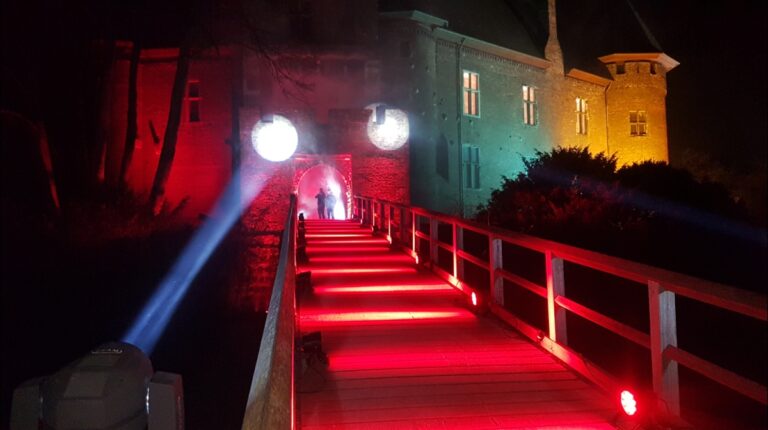
An area paved with bricks, measuring 8 by 8 metres, marks the interior of the former bergfried. The tower probably reached about 55 metres in height and had walls approximately 4.5 metres thick before its destruction in 1702. The main entrance to the inner fortress was in the north-eastern Klever Tower, which faced the road to Cleves. The tower was reconstructed during the most recent restoration to clarify the former entrance arrangement. A permanent wooden bridge now occupies the position of the former drawbridge, beneath which an entrance led to a small inland harbor fed by the Rhine.
The portal stone that once served as the lintel above the Klever Tower entrance was removed to Düsseldorf as war booty. It was displayed at Benrath Palace for 150 years before returning to the Kaiserpfalz grounds. Its inscription, dated 1184, states that Emperor Frederick enlarged the empire with this adornment while seeking to strengthen justice and establish peace.
Outer defenses and water systems
A large outer bailey extended in a sickle-shaped form around the inner fortress. Excavation revealed its foundations, including a ring wall built of tuff blocks, a northern double tower, a southern circular shell tower, and a broad water moat on the landward side. A shell tower was a rounded defensive tower with a more open interior than a solid tower.
The western defensive wall along the Rhine was destroyed in 1702, but large masonry blocks remain visible in the gravel bed beside the river when the water level is low. In the southern part of the complex, a cylindrical cistern structure survives to about 9 metres in height. Built from brick and tuff, it formerly reached the second floor. The cistern stood over a 13-metre-deep well lined with trachyte blocks. A surrounding layer of sand filtered collected rainwater for drinking, particularly during sieges.
Later additions
A bronze sculpture titled Sidu by Rudolf Heekers was installed at a corner of the Klever Tower’s enclosing wall in 1980. In 2014, Peter Schwickerath created Im Kontext, a walk-through sculpture made from a single steel slab. Its form refers to the Romanesque round arch and introduces a contemporary structure into the surviving ruins.