Castle of Estremoz: A Portuguese Frontier Fortress


Site at a Glance
- Rating
- 4.4
- Popularity
- Medium
- Country
- Portugal
- Primary era
- Medieval
- External website
- Open
- Eras represented
- Medieval, Early Modern
- Civilizations
- Portuguese
- Site type
- Military
- Remains
- Castle
On this page15 sections
History
Castle of Estremoz is a fortified complex in Estremoz, Portugal, whose medieval Portuguese development began in the mid-thirteenth century on a hill overlooking the Alentejo frontier. The site had earlier been important during the Roman invasion of the Iberian Peninsula and was later occupied by Muslim forces, who are believed to have fortified it. Its central purpose was to defend the frontier, a role that shaped its history through repeated conflicts and military rebuilding.
From Muslim fortification to Portuguese stronghold
During the Christian Reconquista, the Christian reconquest of territories in the Iberian Peninsula ruled by Muslim powers, Estremoz was probably captured in 1165 by forces associated with Geraldo Sem Pavor’s seizure of Évora. The town was lost soon afterward and became permanently incorporated into Portuguese territory only in the mid-thirteenth century, during the reign of Sancho II. Reconstruction of the castle began in this period.
In 1258, Afonso III granted Estremoz a foral, a municipal charter defining a town’s rights, obligations, and administration. The charter sought to increase the population and defensive capacity of the settlement. It ordered the rebuilding and strengthening of the defenses and the construction of the town’s enclosing walls. The keep was erected around 1260, establishing the main medieval focus of the complex.
Royal residence and medieval conflict
Construction of the walls continued during the reign of Dinis, who also ordered a Royal Palace beside the castle. Queen Isabel of Portugal died there on 4 July 1336. Her body was later transferred to the Convent of Santa Clara-a-Velha in Coimbra. During her lifetime, Isabel had prevented an imminent confrontation at Estremoz between her son, Afonso IV of Portugal, and Alfonso XI of Castile.
The keep was completed around 1370, during the reign of Fernando I. The castle soon became involved in the crisis of 1383–1385, a struggle over the Portuguese succession that led to the establishment of the Avis dynasty. João Mendes de Vasconcelos, the castle’s senior warden, supported Castile. The population forced him to leave, and the castle was handed to the squire Martim Pires on behalf of the Master of Avis, the title held by the future João I before his accession and reflecting his leadership of the Order of Avis.
In 1384, Nuno Álvares Pereira, the Portuguese constable and leading commander of the Avis cause, established his headquarters at Estremoz. Portuguese forces departing from the town defeated the Castilian army at the Battle of Atoleiros, giving the castle a direct place in the military history of the succession crisis.
Sixteenth-century crisis and the Restoration War
Manuel I granted Estremoz a new charter in 1512. In the Portuguese succession crisis of 1580, António, Prior of Crato, claimed the throne after the Portuguese royal line failed. The castle and its senior warden remained loyal to him. Castilian troops commanded by the Duke of Alba besieged Estremoz, which was the only Alentejan stronghold to resist. Admiral João de Azevedo eventually surrendered because the disparity in forces threatened the town and its population. He was then held prisoner at the Castle of Vila Viçosa.
After Portugal restored its independence in 1640, Estremoz again became a headquarters for Portuguese troops. During the Restoration War, a conflict fought to preserve the restored Portuguese monarchy against Spain, forces connected with Estremoz contributed to victories at the Lines of Elvas in 1659, Ameixial in 1663, and Montes Claros in 1665. The victory at Montes Claros ended the war. During the siege of Elvas in 1658, most of the Portuguese relief army departed from Estremoz.
Military engineers began a major modernization of the defenses in the seventeenth century. In 1642, João Pascácio Cosmander, Rui Correia Lucas, and Jean Gillot were commissioned by the War Council of João IV to inspect the Alentejan strongholds and organize the necessary works. Cosmander directed the initial improvements. After his death in 1648, Nicolau de Langres, assisted by Pierre de Saint-Colombe, continued the work, probably from 1662. Additional fortified lines, including those of the Lower Square, were added later.
During the Restoration period, Regent Queen Luísa de Gusmão, the mother of Afonso VI, converted the rooms where Queen Isabel had died into a chapel. The chapel expressed her gratitude for Portuguese victories over Spanish forces in the Alentejo and preserved the royal association of that part of the complex.
Eighteenth-century military rebuilding
Fortification work continued in the eighteenth century. From 1736, the former Royal Palace was rebuilt and adapted as War Stores to a design by António Carlos Andreis. Between 1738 and 1742, João V established the Sala de Armas in the new Baroque building. It was then regarded as one of Europe’s notable arms museums. João V also substantially improved the chapel dedicated to Queen Isabel.
War, damage, and conservation
During the War of the Oranges in 1801, a conflict between Portugal and Spain, Estremoz assisted Portuguese forces besieged in the fortress of Elvas. French troops under General Kellermann briefly occupied the town during the Peninsular War, the conflict in which Portugal and its allies fought French occupation in the Iberian Peninsula, and withdrew on 12 July 1808. Several decades later, during the Liberal Wars, Miguelist forces killed 39 Liberal prisoners in the castle’s dungeons.
Urban expansion led to the demolition of a large section of the northern wall to make way for the railway station. On 17 August 1898, an explosion in a gunpowder magazine severely damaged the War Stores, the former Royal Palace, and the medieval castle.
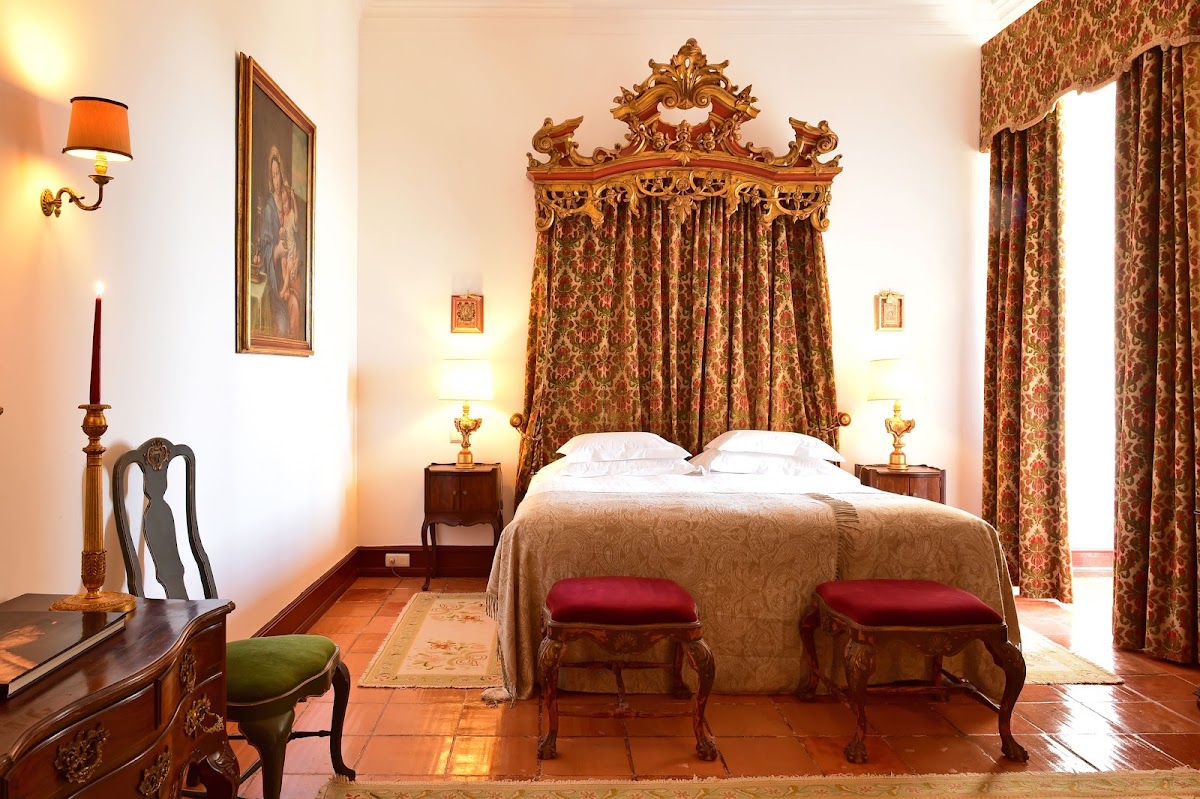
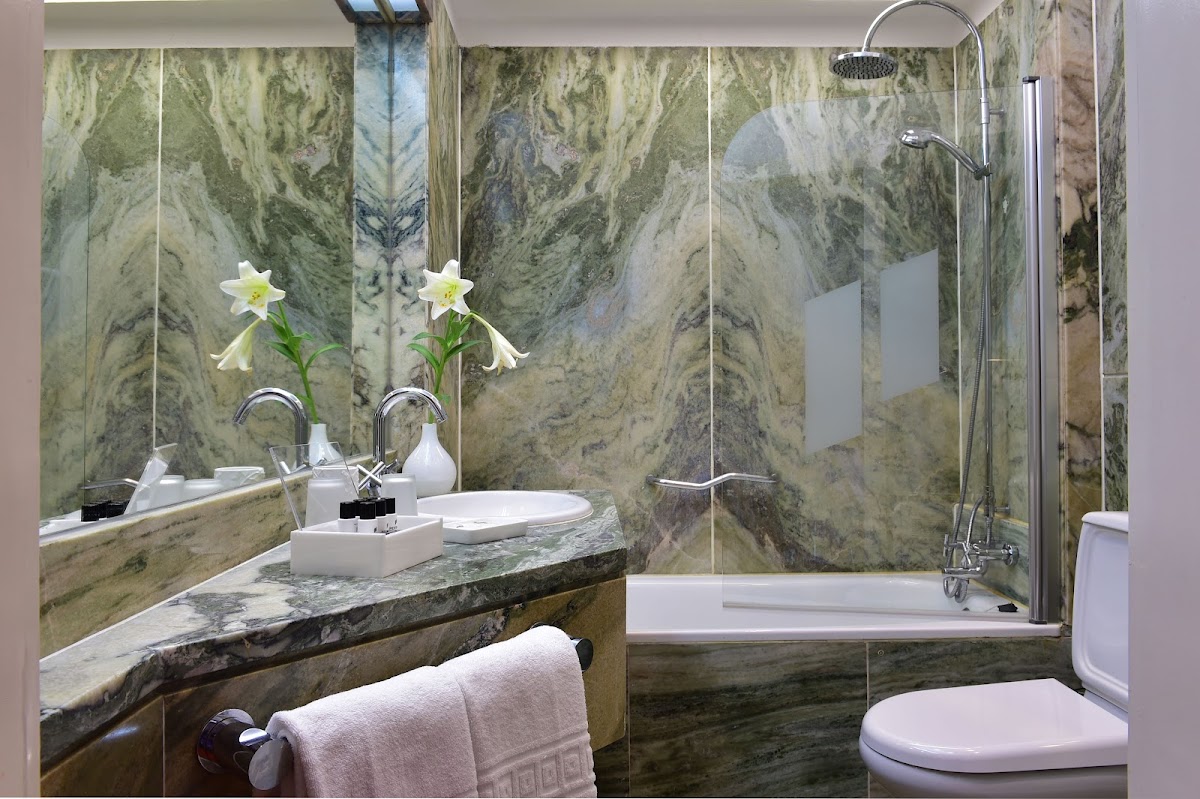
The castle complex, the town walls, Torre das Couraças, and the Chapel of Queen Isabel were designated a National Monument by decree published on 23 June 1910. Portugal’s former General Directorate for National Buildings and Monuments began consolidation and conservation work in 1939, followed by roof repairs in 1961. Between 1967 and 1988, the War Stores, formerly the Royal Palace, were adapted for use as an inn. The complex now combines cultural and religious functions: the former Dinis Audience Hall houses the Estremoz Municipal Drawing Gallery, while the Chapel of Santa Isabel remains a religious space. In 2014, the castle entered the Ministry of National Defence’s Turismo Militar project, which presents historical routes based on Portuguese heroes.
Remains
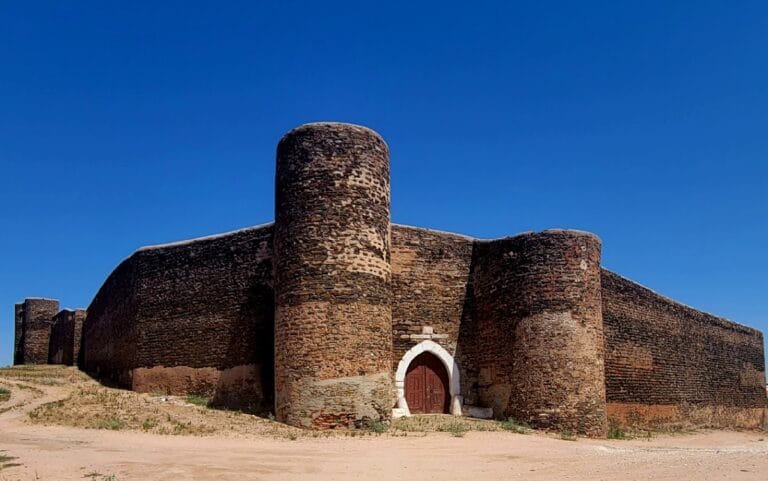
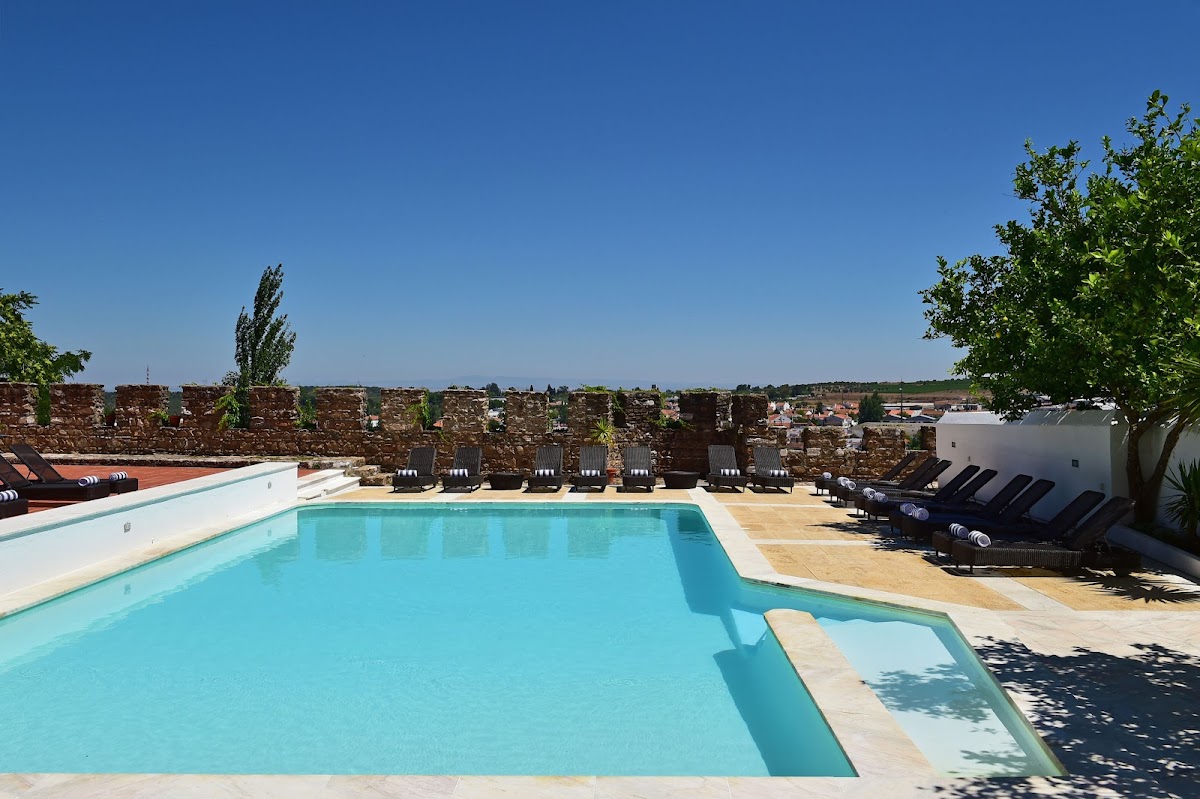
The fortified complex has an organic pentagonal plan shaped by the terrain. The medieval castle occupies the summit of a limestone hill and combines Gothic, modern, and Neoclassical elements. A low crenellated enceinte, or enclosing defensive wall, surrounds the castle. Its broad wall-walk, the passage along the top of a defensive wall, is accompanied by four semi-cylindrical turrets.
Medieval defenses
The keep
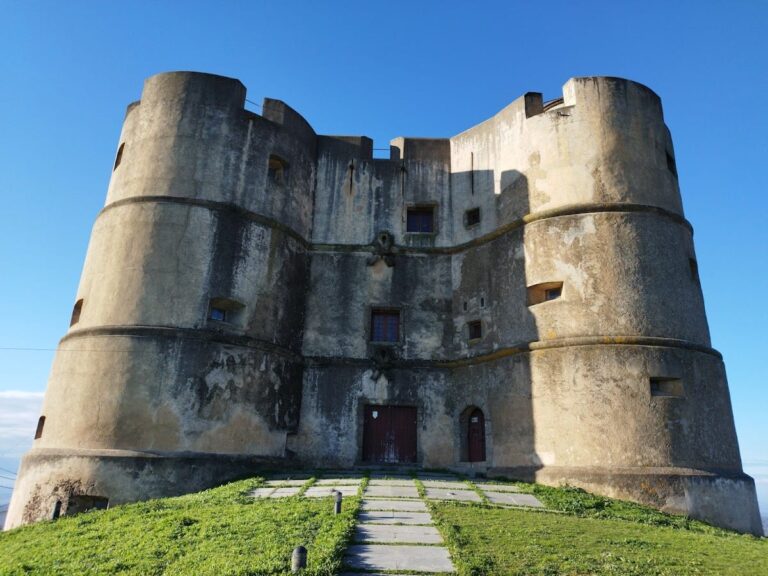
The keep stands on the southern side of the complex and rises 27 metres. It is also known as the Tower of the Three Kings or the Tower of the Three Crowns. Completed around 1370, it has three floors and is crowned by prismatic merlons. Three crenellated balconies project from the tower, with machicolations, openings used to defend the base of a wall, supported on corbels, which are projecting structural supports. The large room on the second floor is octagonal and covered by a ribbed vault.
The town walls and gates
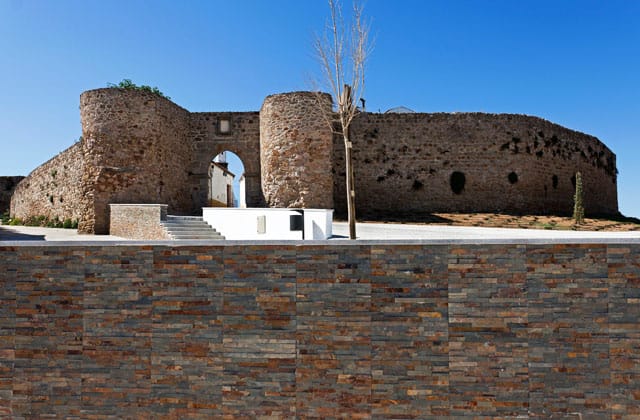
The wider town enceinte includes the Santarém Gate and the Frandina Gate. These entrances form part of the defensive perimeter that developed as the settlement was enlarged and strengthened under the medieval Portuguese kings. The northern wall was later altered when urban expansion made way for the railway station, while the surviving fortified complex retains the irregular plan imposed by the hilltop terrain.
Civic and royal buildings
The Audience House
Within the walls, the Audience House has an imposing ogival gallery. Its double arcade rests on marble colonnettes with historiated capitals, whose carved decoration presents narrative scenes. The building also incorporates the former coat of arms of the town. The former Dinis Audience Hall now accommodates the Estremoz Municipal Drawing Gallery.
The Royal Palace and War Stores
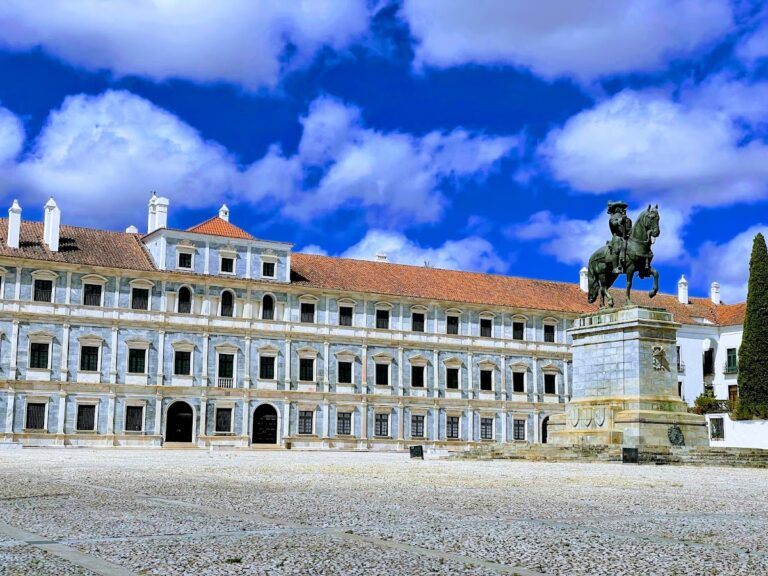
The Royal Palace ordered by Dinis stood beside the medieval castle. Rebuilt from 1736 and adapted as War Stores, it received the Sala de Armas between 1738 and 1742. This Baroque building was severely damaged by the gunpowder-magazine explosion of 1898 and later adapted as the Pousada da Rainha Santa Isabel between 1967 and 1988.
The granary and Clock Tower
The former Common Granary dates from the reign of Manuel I and survives with an ogival rib vault. The Clock Tower also belongs to this period, providing another surviving element of the early sixteenth-century complex.
Chapel of Queen Isabel
The rooms associated with Queen Isabel’s death were converted into a chapel during the Restoration period by Regent Queen Luísa de Gusmão. João V later substantially improved the chapel, which is dedicated to Isabel and remains a religious space within the complex.