Nitra Castle: A Medieval Episcopal Fortress in Slovakia

Site at a Glance
- Rating
- 4.6
- Popularity
- Medium
- Country
- Slovakia
- Primary era
- Medieval
- External website
- Open
- Eras represented
- Medieval, Early Modern
- Civilizations
- Habsburg, Hungarian
- Site type
- Military
- Remains
- Castle
On this page17 sections
History
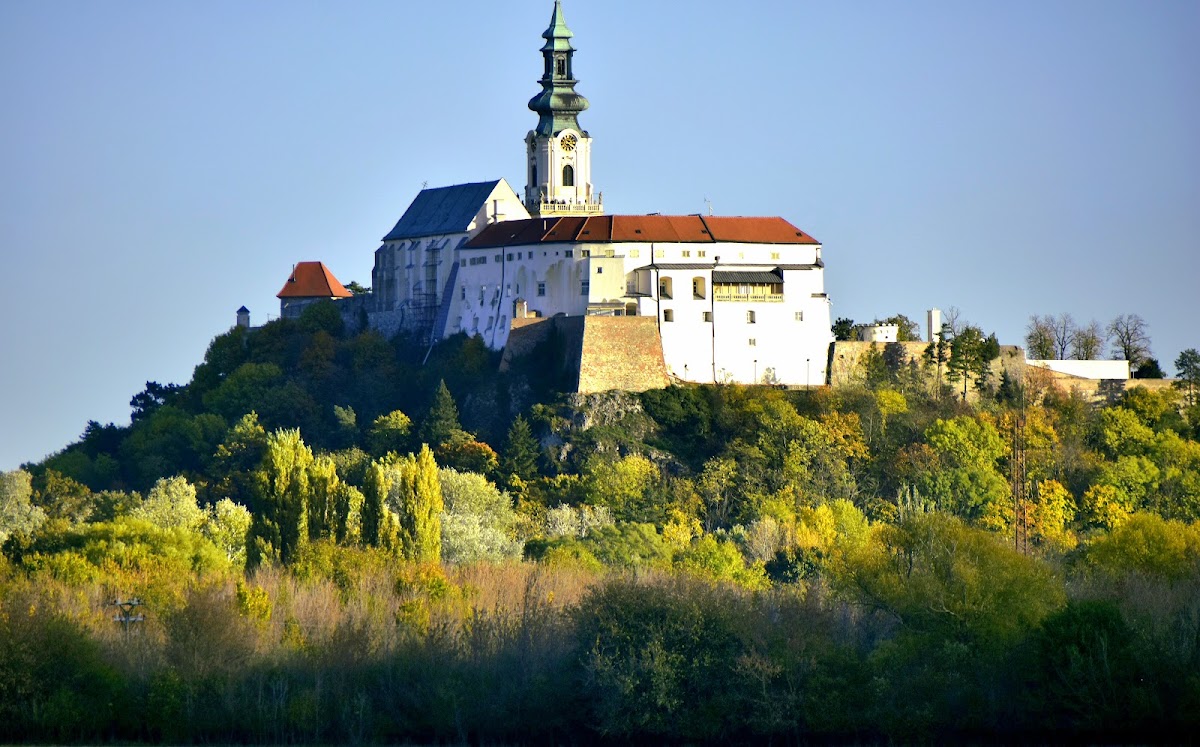
Nitra Castle is a preserved castle complex in Nitra, Slovakia, developed from a fortified settlement associated with Great Moravia at the end of the eighth century. Its origins lie in the rise of the Principality of Nitra, while its present architectural character reflects medieval Gothic, Renaissance, Baroque, and late-Baroque phases. Protected on three sides by the Nitra River, Castle Hill became a political, administrative, religious, and military center whose importance continued through the formation of the Kingdom of Hungary.
Origins and Great Moravia
At the end of the eighth century, the hill became the center of the emerging Principality of Nitra. A church traditionally identified as Pribina’s church probably stood here, and the site is associated with the earliest written mention of Nitra and the principality. In 833, Mojmír I captured Pribina’s political center at Nitra. After the principality was incorporated into Great Moravia, a ninth-century Central European polity, Nitra became a princely seat and administrative center. The fortified settlement was enlarged and strengthened during this period.
Nitra is securely mentioned in writing from 871. By the middle of the eleventh century, the Chronicle of Mavro referred to the Basilica of St. Emeram, which remains part of the castle complex. After the death of Svatopluk, the Magyar commander Lél settled in Nitra in 920. By 955, the castle had passed to the Árpád dynasty, the Hungarian ruling house that established and governed the medieval Kingdom of Hungary. The dynasty retained elements of the Principality of Nitra’s administrative system while developing its own state organization.
Medieval struggles and episcopal rule
The fortified settlement probably developed into a castle during the formation of the Kingdom of Hungary. Nitra and its hill were repeatedly contested by the Mojmír, Árpád, Hungarian, Polish, Bohemian, Habsburg, Ottoman, and Transylvanian powers. In 892, Arnulf of East Francia and Braslav, prince of the Principality of Sava, unsuccessfully raided Svatopluk’s territory with Magyar support. The Principality of Nitra, governed successively by members of the Pribina, Mojmír, and Árpád dynasties, ceased to exist by 1108.
Bolesław the Brave captured the Nitra region in 1001 after defeating the Hungarian duke Stephen, but King Stephen I of Hungary reconquered it in 1029. Following the Hungarian defeat by King Henry III of Germany and Duke Břetislav of Bohemia in 1042, the inhabitants accepted Domoslav as prince of Nitra. After the allied armies withdrew, King Samuel expelled him. Domoslav returned in 1046 and ruled until his death in 1048.
Béla I became prince of Nitra and Bihar in 1048 and established his seat at Nitra Castle. He probably ordered repairs to the castle, and later ruled as king of Hungary from 1060 to 1063. In 1074, the castle resisted the forces of Emperor Henry IV and his Hungarian ally Solomon, although the surrounding area was ravaged. In 1109, Duke Otto I of Olomouc and his son Svatopluk captured and devastated the town and the settlement below the castle, including property belonging to Zobor Monastery, but failed to take the castle.
The castle also resisted the Mongol invasion of 1241. King Béla IV briefly sought refuge there after the Hungarian defeat at the Slaná River, although the Mongols pursued him to Nitra. They did not capture the town, but they completely plundered the abbey and destroyed its valuable archive. During the war between King Stephen V of Hungary and King Přemysl Otakar II of Bohemia, Přemysl Otakar captured Nitra in 1271 and devastated the castle. The Church of St. Emeram burned, requiring the rebuilding of the church and fortifications. Přemysl Otakar returned in 1273, again captured and devastated Nitra, and caused the cathedral and much of the historical records to burn.
In 1296, King Andrew III of Hungary granted the castle and its surroundings to Bishop Pascház. The bishop repaired the damaged castle and walls, and the complex thereafter became episcopal property. The Nitra bishopric, a Christian institution headed by a bishop, administered the castle and helped shape its later identity as a religious and administrative center.
Late medieval conflicts
The nobleman and vojvoda, a military or territorial commander, Matthew Csák of Trenčín attacked Nitra in 1311 and 1317 during his conflict with King Charles Robert of Hungary, the papacy, and Bishop Ján of Nitra. His forces plundered the town, demolished parts of the fortifications, burned the cathedral archive with valuable documents, and carried away the remains of Svorad and Benedict to Trenčín.
Bishop Meško Piastovec ordered a new cathedral at the castle in 1328, and construction continued until 1355. Stibor of Stiborice captured Nitra in 1403. In 1431, the Orphans, a Hussite military faction associated with the reform movement of the Bohemian preacher Jan Hus, captured the town but not the castle. The Hussite army of Ján Jiskra of Brandýs captured Nitra again in 1440.
King Matthias Corvinus devastated the castle in 1465. After the death of King Ladislaus the Posthumous, part of the Hungarian nobility invited Prince Casimir, younger son of King Casimir IV Jagiellon of Poland, to claim the Hungarian throne in 1471. Casimir occupied much of Slovakia and selected Nitra Castle as his seat. Matthias Corvinus captured Nitra after a siege in 1472, and Casimir escaped.
Sixteenth- and seventeenth-century warfare
After the disputed succession to the Hungarian throne in 1526, Nitra supported Archduke Ferdinand of Austria against John Zápolya. Zápolya’s army captured Nitra in 1528, placed Valentin Török in charge of the castle, and appropriated property. In 1530, after the death of Bishop Podmanický, the imperial general Katzianer captured Nitra and removed the episcopal treasures to Vienna, including a reliquary, a container for preserving or displaying religious relics, associated with the town’s patron saints.
After the Treaty of Varadin in 1538, Nitra and the episcopal estates passed to the Turzo brothers, Alexej, a county and royal official, and Francis, Bishop of Nitra. They exploited the town and the bishopric’s property. Ottoman incursions, the westward military expansion of the Ottoman Empire, threatened southern Slovakia during the sixteenth century and led to stronger defenses at Nitra. Ottoman forces besieged Nitra in 1588.
Bocskay’s rebel army plundered the area around Nitra in 1606, although the town surrendered and avoided plunder. In 1620, the forces of Bethlen, a Transylvanian prince and rival Hungarian king, briefly occupied Nitra before handing it to the imperial general Bouquoi. Bethlen unsuccessfully tried to recapture it with Ottoman support in 1623. Bishop Ján IV Telegdy completed a church and built the Upper Church in 1624.
In 1663, after the German commander of Nitra and the castle betrayed the town, Ottoman forces besieged and captured Nitra. Imperial troops under General de Souches expelled them in May 1664, but the fighting left both town and castle completely devastated. Bishop Tomáš Pálffy rebuilt Nitra’s defenses by 1673. The massive walls visible today largely date from this reconstruction.
Early eighteenth-century reconstruction and later role
During the Thököly uprising in 1697, rebels attacked the area and captured only the lower town. In 1703, the rebel army of the Transylvanian magnate Francis II Rákóczi, commanded by General Ladislav Očkaj, occupied the lower town. Rákóczi’s principal general, the Hungarian count Nicholas Bercsényi, captured the castle in 1704. The rebels held it until 1708, when the castle commander Revaj surrendered to the imperial forces of General Heister.
Centuries of alteration, fortification, and rebuilding transformed the complex. Nitra Castle is now the seat of the Nitra bishopric and the bishop’s administrative office. The complex was registered in 1963 as a National Cultural Monument of Slovakia, a protected designation covering Nitra Castle as a whole.
Remains
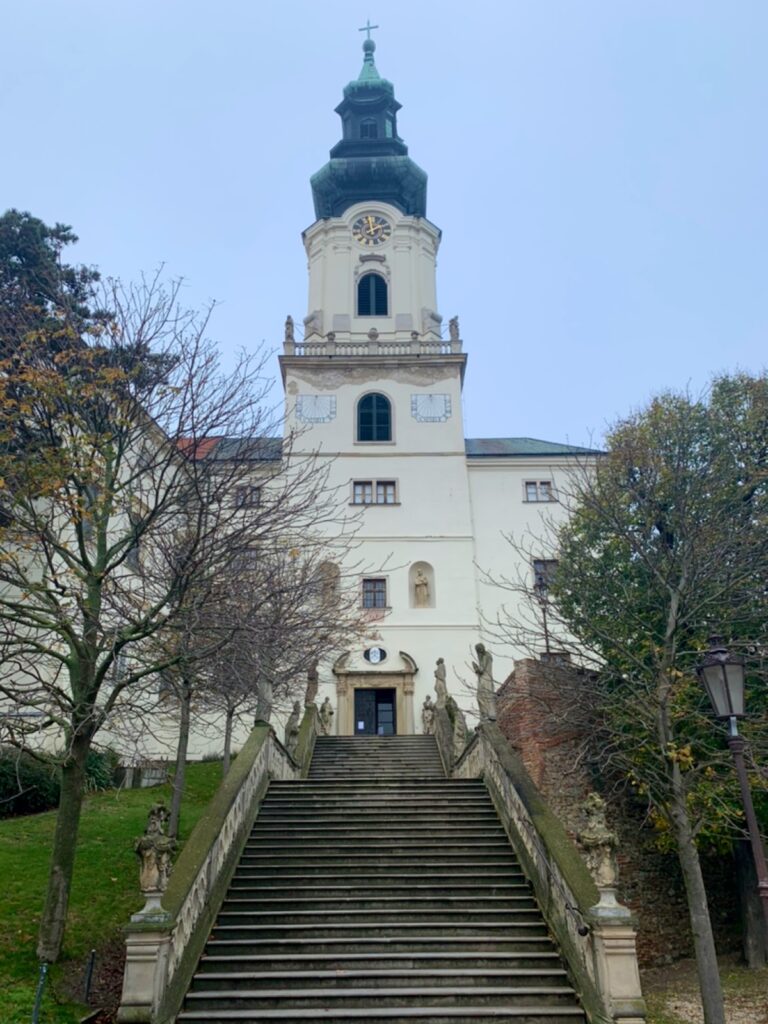
Nitra Castle occupies Castle Hill in the center of Nitra at an elevation of about 220 meters, beneath the southern foothills of the Tribeč Mountains. The original fortified area probably covered the entire hill and the upper town, approximately 8.5 hectares. The Nitra River naturally protected the site on three sides. The preserved complex is built of stone and is organized around the Basilica of St. Emeram, the bishop’s palace, and massive fortifications with projecting bastions. A bastion is a projecting defensive structure that allows fire to cover adjoining walls.
Fortifications and entrances
Castle walls and bastions
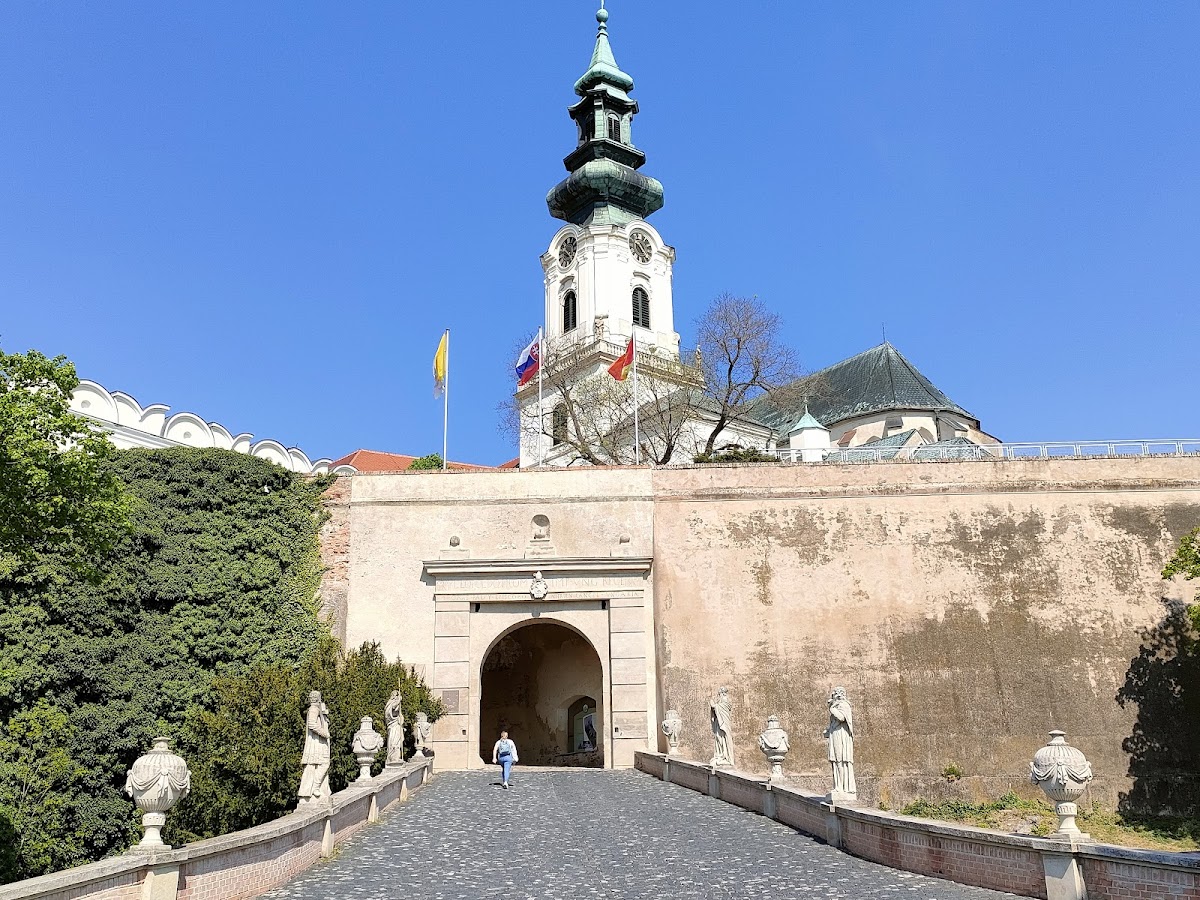
Parts of the castle wall retain an appearance close to the earlier fortifications, while the massive walls largely reflect rebuilding after the Ottoman occupation. Projecting bastions form part of the defensive system. Together, the walls and bastions enclose the upper castle area and preserve the military character created by repeated early modern strengthening campaigns.
Inner castle gate
The inner castle gate dates from the sixteenth century and was built during the strengthening of the defenses. It is among the elements that retain an appearance close to an earlier phase of the complex. Its position within the fortified enclosure reflects the Renaissance reorganization of the castle’s entrance system.
Churches and cathedral
Basilica of St. Emeram
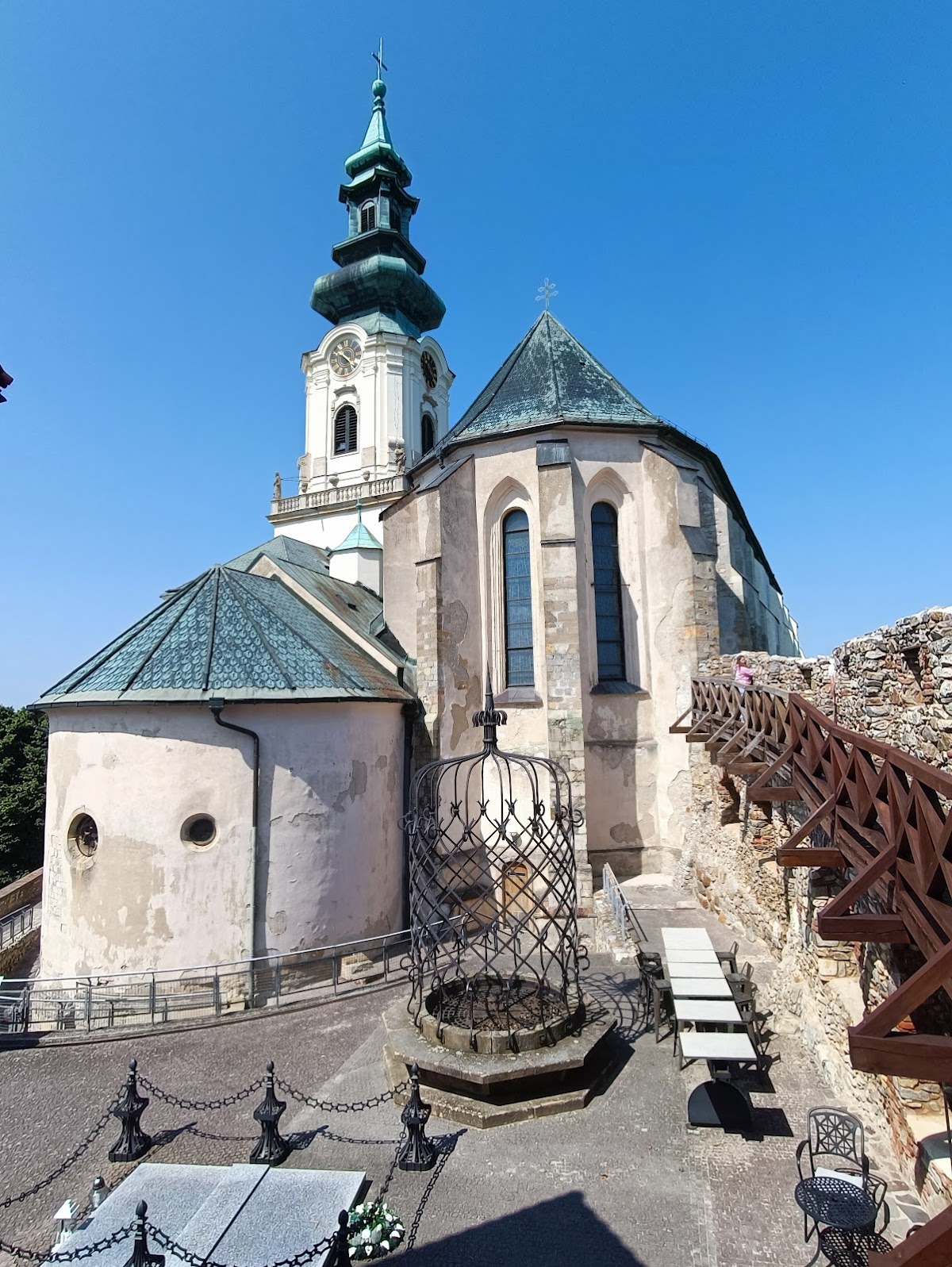
The Basilica of St. Emeram is the component that most closely preserves the complex’s earlier appearance. It is mentioned in records from the middle of the eleventh century, while the surviving basilica dates from the first half of the thirteenth century. The church formed part of the religious center that developed within the fortified hill and remains one of the principal buildings of the castle.
Upper Gothic Church
The Upper Gothic Church dates from the first half of the fourteenth century. Gothic architecture was a medieval tradition associated with pointed arches, ribbed vaults, and an emphasis on vertical form. The church is another part of the complex that closely preserves an earlier appearance and belongs to the period when Bishop Meško Piastovec ordered the construction of a new cathedral between 1328 and 1355.
Upper Church
The Upper Church was built by Bishop Ján IV Telegdy in 1624 and rebuilt in the early eighteenth century. Its preserved form belongs to the later reconstruction of the castle complex after the seventeenth-century destruction. The church stands among the buildings from the end of the seventeenth and the eighteenth centuries that retain an almost original appearance.
Palace and later buildings
Renaissance castle palace
A Renaissance castle palace was built during the sixteenth-century strengthening of the defenses. It forms part of the early modern transformation of the medieval castle and survives within a complex whose original appearance was altered by successive fortification and rebuilding campaigns.
Bishop’s palace
The bishop’s palace was added during the early eighteenth century, after the Upper Church was rebuilt. Its preserved fabric belongs to the late seventeenth- and eighteenth-century building phase and retains an almost original appearance. The palace reflects the long-term episcopal administration of the castle and remains part of the complex’s principal architectural group.
Apart from the Basilica of St. Emeram, sections of the wall, the Upper Gothic Church, and the inner gate, most of the complex has been substantially altered from its original appearance. The surviving buildings and defenses therefore present Nitra Castle as the result of repeated medieval and early modern reconstruction rather than as a single-period structure.
Nearby sites