Sümeg Castle: A Medieval Fortress in Hungary


Site at a Glance
- Rating
- 4.8
- Popularity
- High
- Country
- Hungary
- Primary era
- Medieval
- External website
- Open
- Eras represented
- Medieval, Early Modern, Modern
- Civilizations
- Habsburg, Hungarian
- Site type
- Military
- Remains
- Castle
On this page15 sections
History
Sümeg Castle is a medieval fortress in Sümeg, Hungary, built during the second half of the thirteenth century as a strong stone castle on Castle Hill. King Béla IV ordered the Bishop of Veszprém to establish the fortress, and King Stephen V later granted it to the Diocese of Veszprém, a territorial administrative jurisdiction of a Christian church headed by a bishop. The castle became an important defensive centre in western Hungary and remained associated with the diocese for centuries.
Foundation and medieval expansion
The earliest written references to Sümeg Castle date from 1301. By the beginning of the fourteenth century, the Kőszegi family had seized it, but their control ended after Charles Robert of Anjou, also known as Charles I of Hungary, defeated them in a victorious royal campaign in 1318. Charles Robert was the Angevin king who consolidated royal authority in Hungary during the early fourteenth century.
The castle was besieged during the conflict of 1440, when Queen Elizabeth of Luxembourg and nobles supporting King Władysław fought over the Hungarian succession. Sümeg was successfully defended. During the second half of the fifteenth century, Bishop Albert Vetési ordered a major reconstruction and enlargement, turning the fortress into one of the strongest stone castles in its surrounding region. The works expanded the fortifications and added residential buildings within the defensive circuit.
Ottoman expansion and seventeenth-century warfare
After the Ottoman army captured Veszprém in 1552, Sümeg became the principal residence of the local diocese. Bishop András Kövesi then ordered extensive strengthening of the fortress, including the construction of a powerful artillery bastion on the northeastern side. A bastion is a projecting fortification that allows defenders to use artillery and firearms along the faces of surrounding walls.
Sümeg played an important defensive role during the Ottoman expansion into Central Europe. Ottoman forces besieged the castle several times but did not capture it. In 1664, troops returning from their defeat at the Battle of Saint Gotthard entered the town and set it on fire. The flames spread to the castle and caused serious damage. Bishop István Senn oversaw a complete restoration after the fire, including the thickening of the walls and their reinforcement with buttresses.
In spring 1605, before the later restoration, the hajduk army of the Transylvanian nobleman István Bocskai occupied the castle. Bocskai led a major uprising against Habsburg rule, and his forces included hajduks, armed irregular soldiers active in the region. The rebels captured and killed the Bishop of Veszprém and threw his severed head down the castle hill.
Kuruc occupation and abandonment
During the uprising led by Francis II Rákóczi from 1703 to 1711, the castle was occupied by the rebels. From 1705, it served as an important base for the insurgent forces, known as the Kuruc, and gunpowder was manufactured there for their troops.
Imperial forces regained control in 1709 when the Kuruc garrison surrendered without an artillery assault. In 1713, the imperial command ordered the castle buildings to be burned. The fortress then lost its military importance and was abandoned. The bishop’s residence moved to a palace southwest of the hill’s foot, while Sümeg Castle remained in ruins for more than two centuries.
Archaeology and conservation
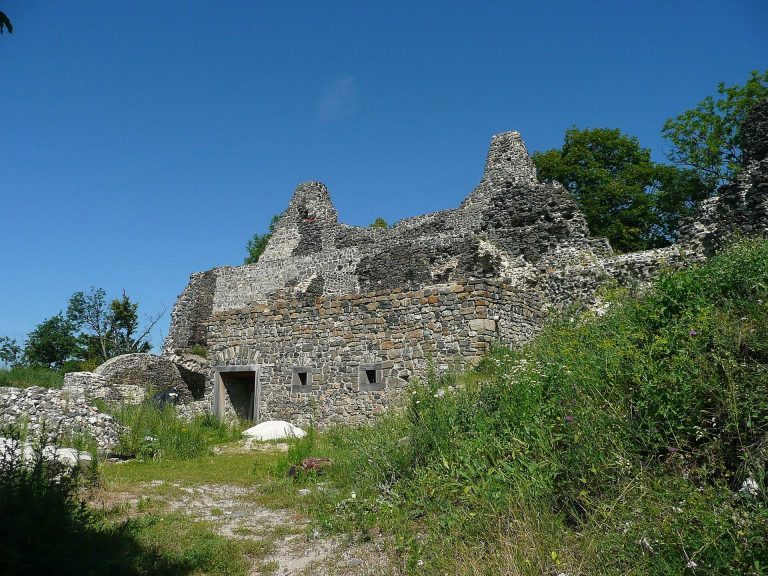
By the mid-twentieth century, sections of the walls had collapsed, valuable contents had been removed, and local residents were quarrying stone from the abandoned fortress for house foundations. Archaeological excavations and conservation began in the 1960s. The excavations established that the earliest stone fortifications on the hill dated from the thirteenth century.
Restoration began in 1989. The inner area was cleared, walls were repaired, and stairways were installed to provide access to the towers. Beginning in 2016, further renovation took place within Hungary’s National Castle Programme. The work created connected exhibition spaces, adapted parts of the eastern wing for cultural and visitor use, and reconstructed selected building volumes and defensive walkways. Sümeg Castle is recognized in Hungary as a protected architectural monument under identification number 10292.
Remains
Sümeg Castle stands on the summit of an isolated hill known as Castle Hill, above Sümeg in Veszprém County, within the Balaton Uplands of western Hungary. The hill rises to approximately 245 metres above sea level and lies about 20 kilometres north of Lake Balaton. The fortress follows an irregular triangular plan along a north-south axis, measuring approximately 125 metres from north to south and 80 metres across.
Fortification layout
Citadel and early tower
The fortress has a three-part composition. Its earliest core was the lower level of the old tower, built in the 1260s. The walls of the citadel, the central or strongest fortified part of a larger complex, were completed about a century later. The earliest arrangement consisted of a single defensive tower, a rock-cut water cistern, and several service buildings.
Outer walls and towers
During the second half of the fifteenth century, an outer circuit of stone walls with towers was added, and a residential building was established within it. The principal buildings are attached to the inside of the defensive walls, leaving a comparatively spacious inner courtyard. The fortress has two principal towers, while an internal path enclosed by walls leads to an inner gate opening onto the main courtyard.
Western entrance
The only entrance lies on the western side and passes through a defended entrance passage. A drawbridge stands in front of the main gate. From the entrance, the internal wall-enclosed route leads toward the inner gate and the main courtyard.
Major towers and defensive works
Keep
The southern part of the complex contains a massive square tower that functioned as the keep. Its interior now holds a permanent exhibition on Sümeg’s history, including historical weapons and knightly armour. Some rooms are furnished in a medieval style.
Kövesi Bastion
The northeastern side contains the Kövesi Bastion, a thick-walled, multilevel artillery bastion constructed during the sixteenth-century strengthening of the castle. Its form reflects the later need to position artillery and firearms along the fortress’s defensive perimeter.
Csabi Tower and Rendeki Tower
The eastern wing includes the barracks, the castellan’s house, a medieval kitchen, and the Csabi Tower. A castellan was the official responsible for administering and defending a castle. The Csabi Tower provides passage between the two sections of the northeastern wall-walks and the exhibition spaces. Along the eastern side, the wall-walks connect the new or reconstructed building mass between the castle core and the Rendeki Tower. A wall-walk is a passage along the top of a defensive wall, allowing guards to move and defend the fortification.
Present physical condition
The castle is partially restored. Its surviving fabric includes repaired walls, cleared internal areas, and reconstructed or installed stairways and defensive circulation routes. The modern works also reconstructed selected volumes and sections of the northeastern wall-walks, linking parts of the eastern wing with the castle’s older core.