Castel Sant’Elmo: Medieval Fortress and Military Prison in Naples


Site at a Glance
- Rating
- 4.6
- Popularity
- Very High
- Country
- Italy
- Primary era
- Early Modern
- Eras represented
- Medieval, Early Modern, Modern
- Civilizations
- French, Kingdom of Naples, Spanish
- Site type
- Military
- Remains
- Castle
On this page11 sections
History
Castel Sant’Elmo is a medieval fortress in Naples, Italy, developed by Norman, Angevin, and Spanish rulers on Vomero Hill. Its recorded construction began in 1329, and the fortress was completed in 1343 during the reign of Joanna I of Anjou. Its present form chiefly reflects a major sixteenth-century rebuilding that made it a crucial military position above the city.
Origins and Angevin construction
The fortress occupies the site of Paturcium, an ancient place where a church dedicated to Saint Erasmus stood from the tenth century. The saint’s name later contributed to the forms Eramo, Ermo, and Elmo. A Norman observation tower called Belforte preceded the castle. In 1329, Robert of Anjou, king of Naples from 1309 to 1343, ordered Giovanni de Haya, regent of the Vicaria, to build a palace-fortress known as the Palatium castrum on the summit of Sant’Erasmo Hill.
Francesco de Vico and Tino di Camaino successively directed the work. After Camaino’s death in 1336, Attanasio Primario took over, followed in 1340 by Balduccio de Bacza. The building was completed in 1343. Its first siege came in January 1348, when Louis I of Hungary attacked Naples after the murder of his brother Andrew of Hungary. Following Queen Joanna I’s surrender, Charles of Durazzo occupied the castle.
Aragonese possession and Spanish rebuilding
In 1416, Joanna II of Anjou-Durazzo sold Castel Sant’Elmo to Alfonso V of Aragon for 10,500 ducats. The fortress later became a major military objective in the struggle between France and Spain for control of the Kingdom of Naples. At the request of Emperor Charles V, the Spanish viceroy Pedro de Toledo ordered its reconstruction in 1537. Pedro Luis Escrivá directed the fortification of the wider height of San Martino, and Gian Giacomo dell’Acaya completed the work in 1546.
A lightning strike hit the gunpowder magazine in 1587. The explosion killed 150 people and damaged Naples, while destroying the church of Saint Erasmus, the castellan’s residence, and the military quarters. Domenico Fontana directed the restoration, which began in 1599 and ended in 1610. Afterward, the fortress was converted into a prison. The philosopher Tommaso Campanella was held there from 1604 to 1608, and Giovanna di Capua, Princess of Conca, was imprisoned there in 1659.
Revolts, sieges, and political imprisonment
During the Neapolitan revolution of 1647, Rodrigo Ponce de León, Duke of Arcos and viceroy of Naples, took refuge inside the fortress. With the castellan Martino Galiano, he organized its defense. Divisions among the rebel forces prevented them from capturing the castle. From its position above the city, the duke bombarded Naples, although the damage remained relatively limited and did not reach the densely populated central districts.
Austrian forces besieged Castel Sant’Elmo in 1707, and Bourbon forces did so in 1734. During the period of the French Revolution, its prison held pro-Jacobin patriots, including Mario Pagano, Giuliano Colonna, Gennaro Serra di Cassano, and Ettore Carafa. In the uprisings of 1799, the people seized the fortress before republicans occupied it. From there, republican forces bombarded the Neapolitan lazzari, members of the city’s urban popular classes who opposed the French occupation.
After the last resistance was suppressed, the first tree of liberty was planted at the castle on 21 January, and the flag of the Neapolitan Republic, the short-lived republican government established in Naples in 1799, was raised there on 22 January. After the republic fell, the fortress held Giustino Fortunato, Domenico Cirillo, Francesco Pignatelli di Strongoli, Giovanni Bausan, Giuseppe Logoteta, Luisa Sanfelice, and others. During the Risorgimento, the nineteenth-century movement that led to Italian unification, it also held or accommodated Pietro Colletta, Mariano d’Ayala, Carlo Poerio, and Silvio Spaventa.
Military prison and museum
Castel Sant’Elmo remained a military prison until 1952. It then passed into military state ownership and housed sailors and their families until 1976, when a major restoration campaign began under the Campania public-works authority. The castle opened to the public on 15 May 1988 and was converted into a museum. It now accommodates temporary exhibitions, fairs, cultural events, and conferences, as well as the permanent Museo Napoli Novecento 1910-1980. The museum administration has managed the complex since December 2014, and this administration became the Regional Museums Directorate in December 2019.
Remains
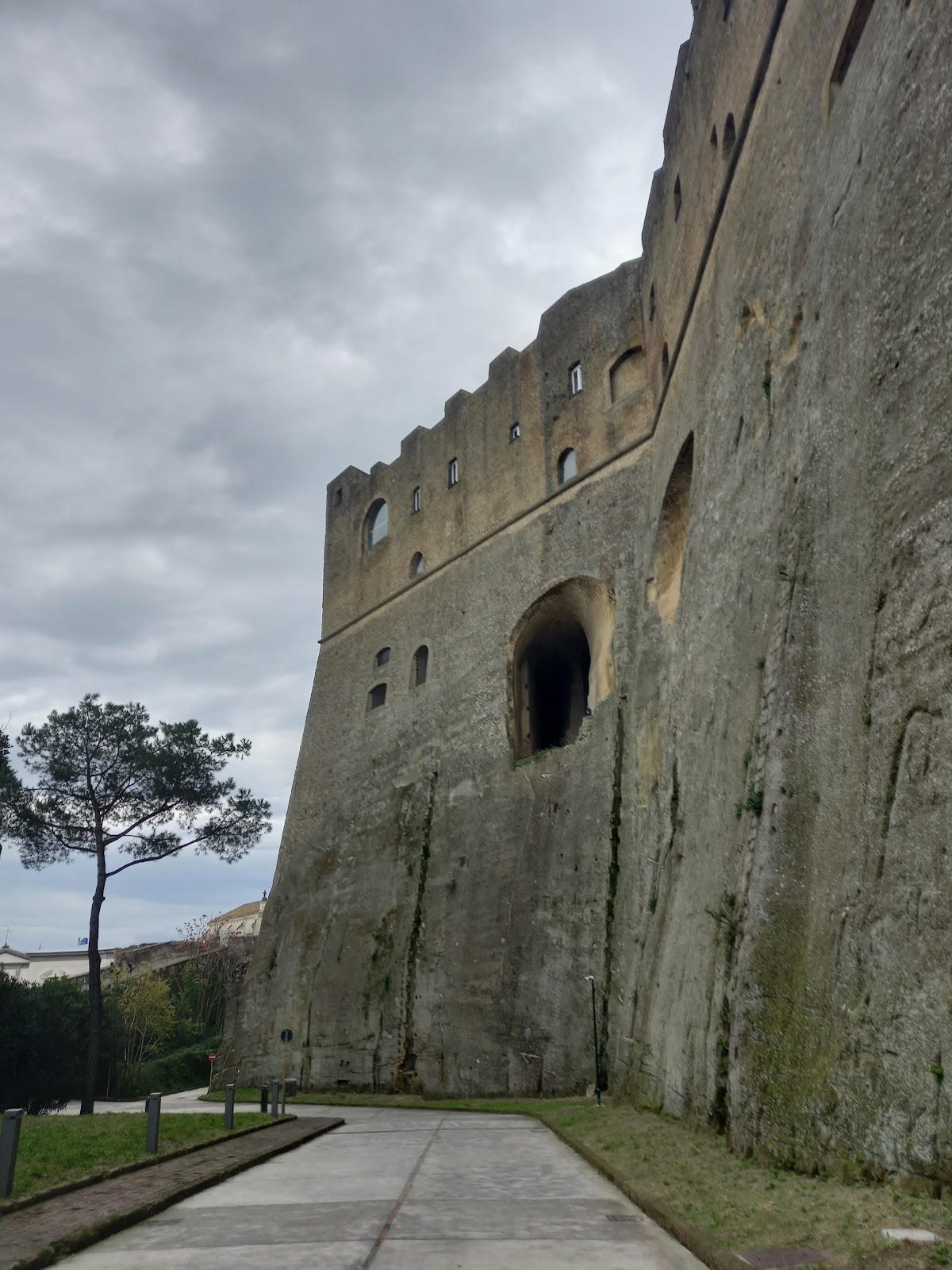
Castel Sant’Elmo stands at approximately 250 metres above sea level on Vomero Hill. Partly cut from the living rock, it is built mainly from Neapolitan yellow volcanic tuff and piperno, a hard volcanic stone traditionally used in buildings and fortifications around Naples. The sixteenth-century fortress has a six-pointed star plan, with six projecting arms extending about 20 metres beyond the central section. Its inward angles contain large open gun emplacements, and the fortress is surrounded by a moat and supplied by a large water cistern.
Approach and defensive works
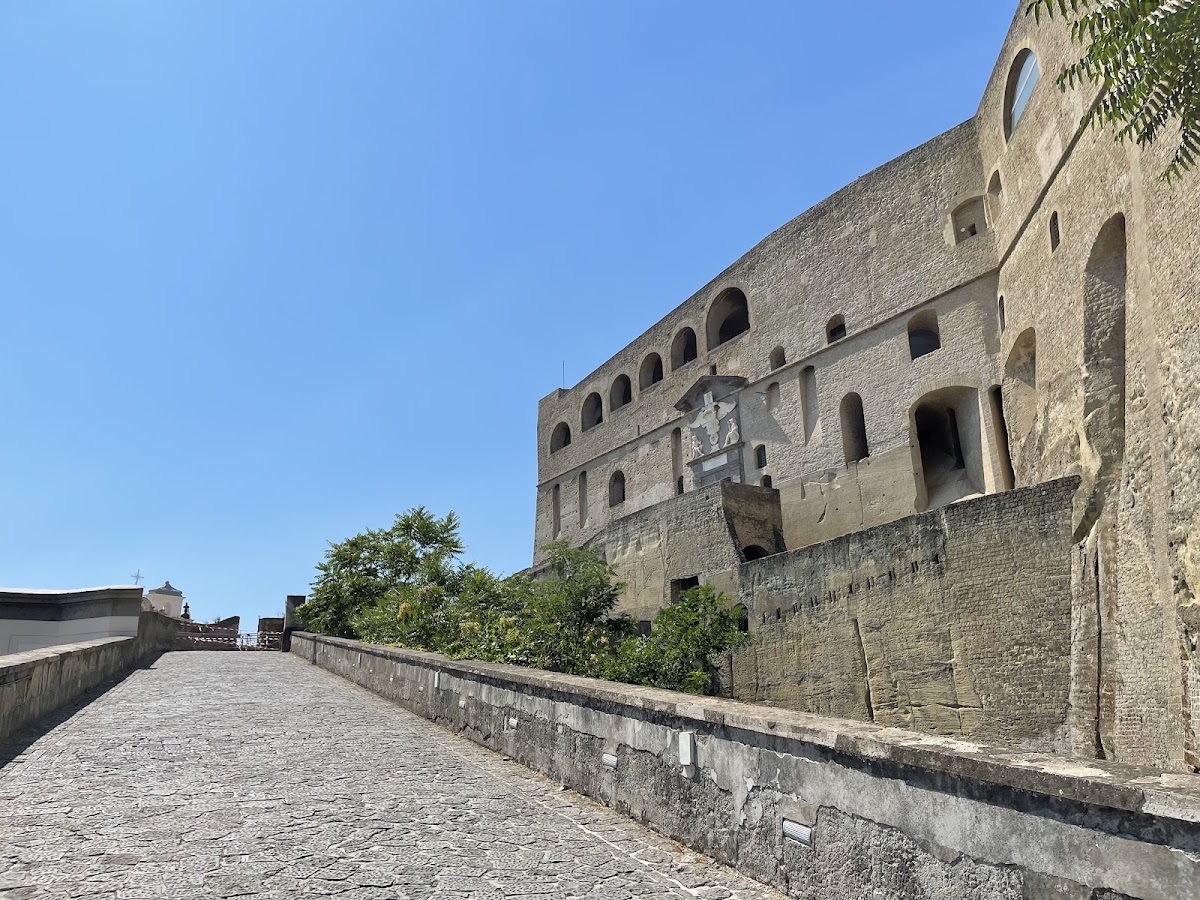
Access to the fortress begins with a steep ramp and a small bridge enclosed by side walls. Each side contains twelve loopholes, narrow openings for weapons or observation, while seven additional loopholes protected guards defending the drawbridge. Beyond the bridge lies the Grotta dell’Eremita, or Hermit’s Grotto, a cave traditionally said to have sheltered an anchorite in ancient times. The piperno entrance portal carries the imperial coat of arms of Charles V, including the double-headed eagle, together with a marble inscription commemorating his reign and Pedro de Toledo’s period as viceroy. A guillotine-style gate installed during the Napoleonic period stands to the left of the entrance.
Prison route and military spaces
The final entrance ramp includes a large window overlooking Naples and the historic centre, followed by a portal of tuff and piperno leading to former prison rooms. These spaces include rooms with large windows, a view toward the common-prison section, and a broad staircase leading to two further cells and the common prison. Prison services stand beside the cell associated with Luisa Sanfelice. Farther along the route, seven large arcades open toward the Gulf of Naples and the historic centre. Three additional openings before the Piazza d’Armi extend views from Capodichino and Capodimonte to Camaldoli Hill.
Piazza d’Armi and water supply
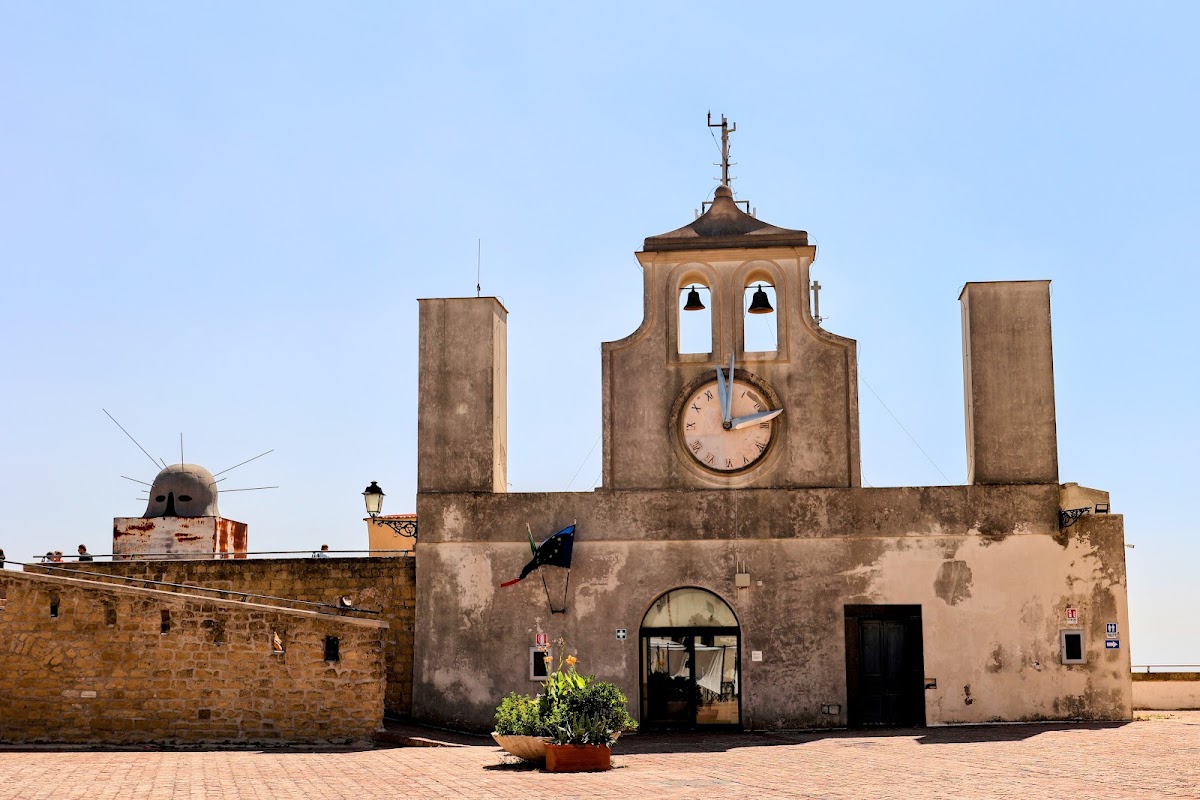
The Torre del Castellano rises on the Piazza d’Armi. Its rooms preserve the remaining accommodation of the commander and castle personnel, while the paving of the parade ground belongs to the fortress’s construction period. Beneath the parade ground, two enormous cisterns supplied the garrison with water during a siege. A small ramp beside the tower leads to a terrace overlooking western Naples and to rooms used as a military prison from 1915. A modern tank with a capacity of 400 cubic metres was installed within the thickness of the walls to supply the Vomero district. At an outer corner of the route, a Bourbon-period piperno sentry box overlooks the area between Posillipo, Nisida, Cape Miseno, and the Phlegraean region.
Churches and surviving decoration
A small church dedicated by the Spanish to Our Lady of Pilar in 1682 stands outside the moat. The church of Saint Erasmus on the upper parade ground was built in 1547 by Pietro Prato and later rebuilt by Domenico Fontana. Its interior contains a Neapolitan-style floor of maiolica and terracotta, wall paintings attributed to Luca Giordano, Antonio De Bellis, and Francesco De Maria, and a painting of Saint Barbara by an unidentified late-Mannerist artist. Behind the altar are tombstones of castellans, including Martino Galiano, Giovanni Buides, dated 1721, and Francisco Vasquez, dated 1776. An eighteenth-century vault fresco depicts the Assumption of the Virgin, three funerary slabs lie in the floor, and a sculpture of Saint Erasmus stands on the high altar.
Modern cultural spaces
A spacious modern room was created without altering the castle’s original structures and serves as a conference hall. Other rooms contain Museo Napoli Novecento 1910-1980, whose collection includes approximately 170 sculptures, paintings, and graphic works made between 1910 and 1980. The displays focus chiefly on artists from Naples or associated with the city. Arranged chronologically, the collection traces developments in twentieth-century Neapolitan art and includes Futurism and Neorealism.