Church of the Visitation of the Blessed Virgin Mary in Kraków: A Baroque Carmelite Church
Site at a Glance
- Rating
- 4.8
- Popularity
- Medium
- Country
- Poland
- Primary era
- Early Modern
- Eras represented
- Medieval, Early Modern
- Civilizations
- Kingdom of Poland, Polish–Lithuanian Commonwealth
- Site type
- Religious
- Remains
- Church
On this page15 sections
History
Legend and medieval foundation
The Church of the Visitation of the Blessed Virgin Mary in Kraków is a Roman Catholic Carmelite church in Poland, with a Gothic predecessor begun in 1395 and a present Baroque form. Dedicated to the Visitation of the Blessed Virgin Mary, it observes its liturgical feast on 31 May. It became Kraków’s first Carmelite church and served both parishioners and the Carmelite community.
Tradition attributes an earlier church on this site to Duke Władysław I Herman in the 11th century. According to the legend, a vision brought the duke to sandy ground northwest of Kraków’s walls, where flowering violets cured his scurvy. The sand gave rise to the alternative name Carmelite Church in Piasek, with Piasek meaning sand in Polish.
Construction began in 1395 at the initiative of Queen Jadwiga of Poland and King Władysław II Jagiełło, with Kraków bishops Jan Radlica and Piotr Wysz also involved in the foundation. In 1397, the Polish monarchs entrusted the church to Calced Carmelites invited from Prague. The Calced, or ‘shod,’ Carmelites were a branch of the Catholic religious order.
Sieges and Baroque rebuilding
During the 1587 siege of Kraków, the church suffered serious damage. The attack was led by Maximilian Habsburg, an Austrian prince who claimed the Polish crown. Queen Anna Jagiellon provided financial help for the rebuilding. In 1588, Henry XI, Duke of Legnica and a claimant to the Polish crown, was buried in the church.
Swedish forces largely destroyed the church during their mid-17th-century invasion of the Polish-Lithuanian Commonwealth. The building was reconstructed in Baroque form in the second half of the century and consecrated by Bishop Mikołaj Oborski on 23 April 1679. The adjoining chapel was also destroyed and later rebuilt with funds left for that purpose in Bishop Piotr Gembicki’s will. On 15 August 1683, King Jan III Sobieski prayed at the church before departing on the campaign that culminated in the Battle of Vienna, where Polish troops joined a coalition fighting Ottoman forces.
Conflict and religious life
Bishop Michał Szembek consecrated the main altar in 1711. In 1772, during the Bar Confederation, a Polish nobles’ coalition active amid Russian intervention in Polish affairs, Russian troops occupied the church and used it as an artillery position to fire on Kraków. The fighting damaged the walls, and Bishop Kajetan Sołtyk helped finance repairs. In 1785, Bishop Kajetan Ignacy Sołtyk paid for a Neoclassical altar for the chapel.
Later history and conservation
In 1864, the painter Jan Matejko married Teodora Giebułtowska at the church. On the bicentenary of the victory at Vienna, in 1883, Bishop Albin Dunajewski crowned the image of Our Lady of Piasek with papal crowns.
Conservation work took place from 1929 to 1939 and again in 1983. After 1945, a painting of Christ carrying the cross was brought here from the Church of the Visitation of the Blessed Virgin Mary in Lviv. In 1994, the church was included in Poland’s Historic Monument designation for Kraków’s historic city complex. It received the honorific papal status of minor basilica in 1997.
Remains
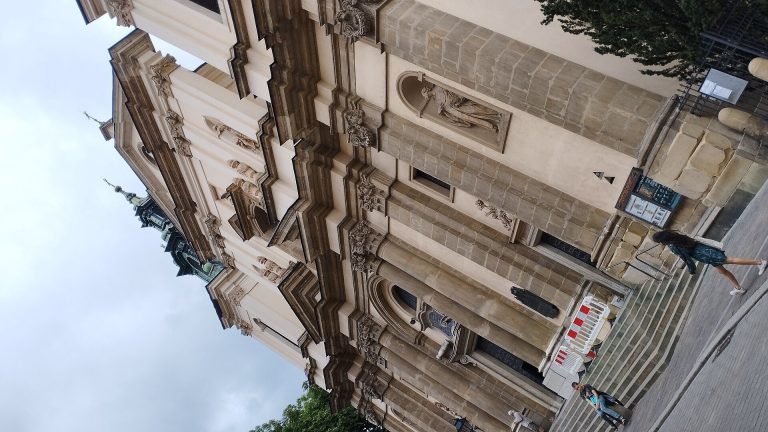
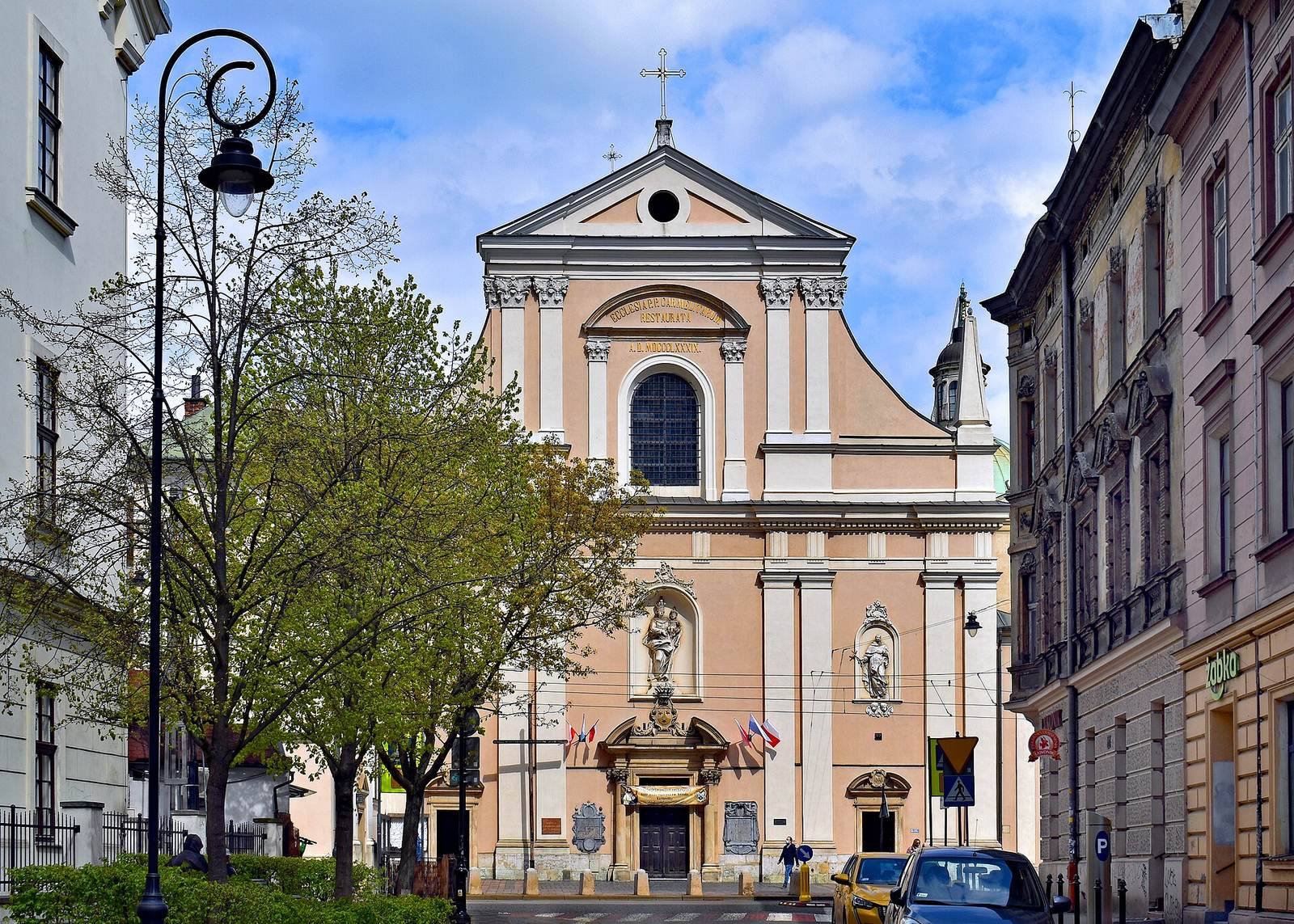
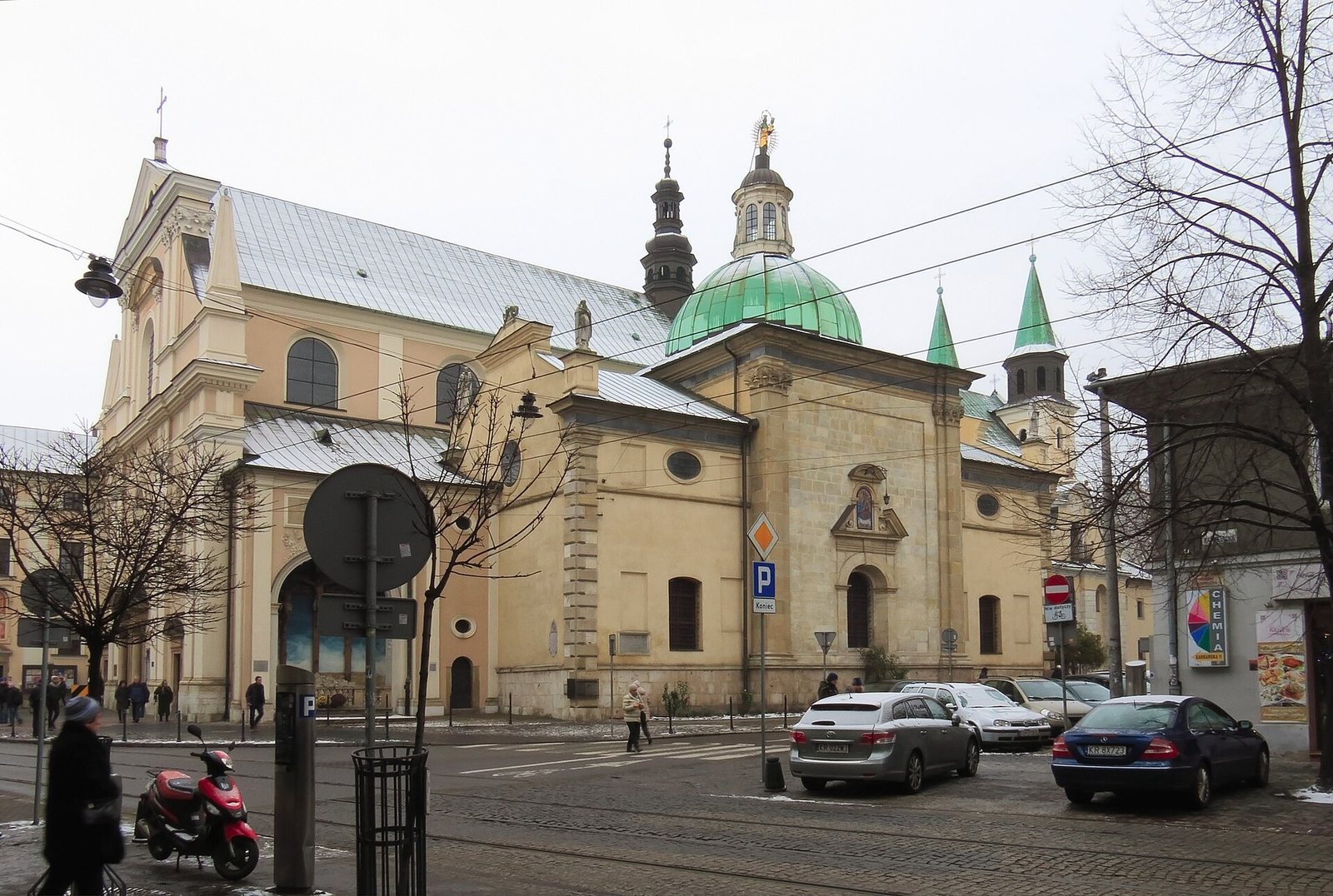
The church is a three-aisled brick building in Baroque form, with three towers. Its façade follows the model of Il Gesù, a Jesuit church in Rome whose design influenced other church fronts. The elongated presbytery, the area around the main altar, is as wide as the central nave and ends in a flat wall.
Main church interior
Altar, choir, and painted ceilings
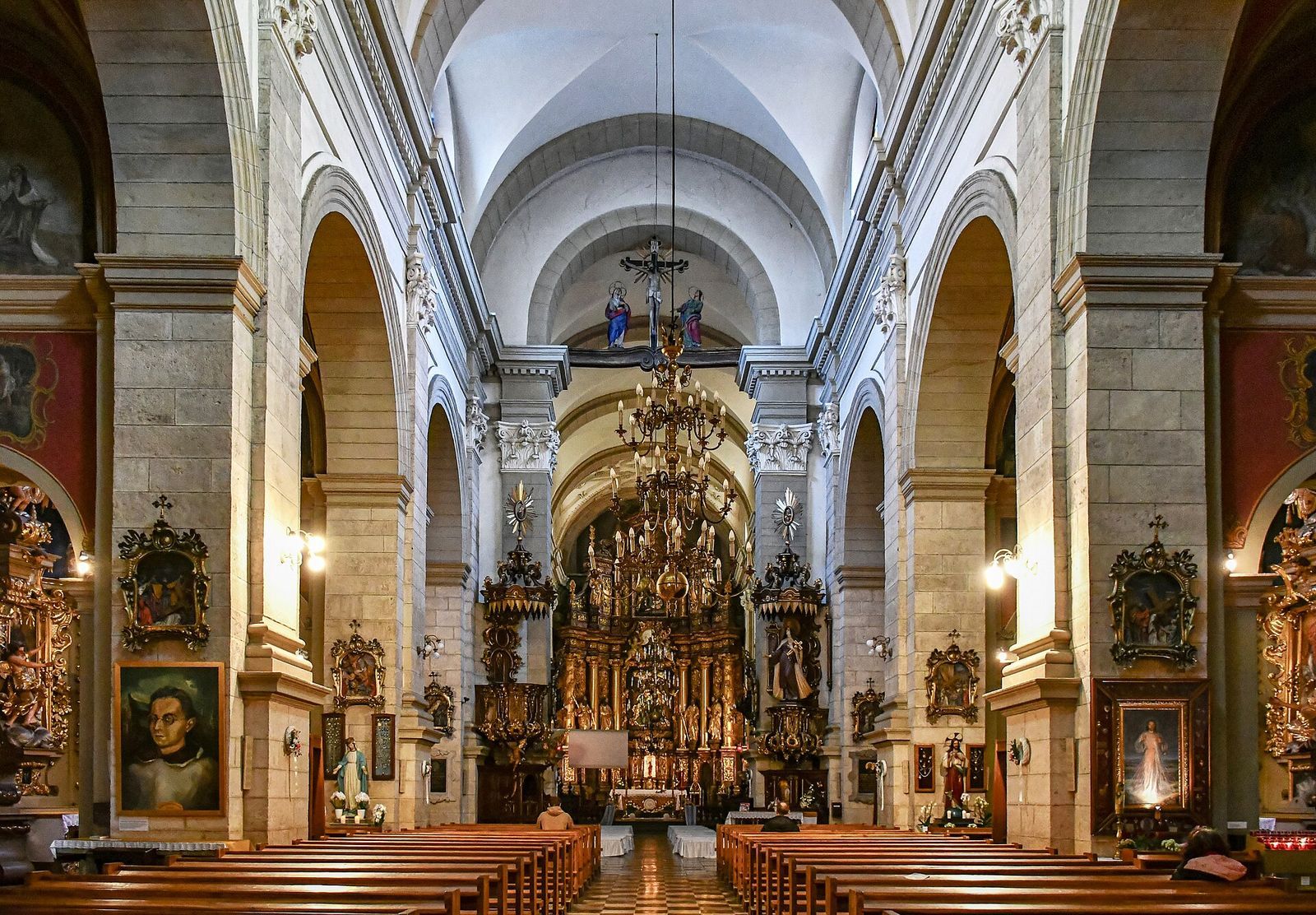
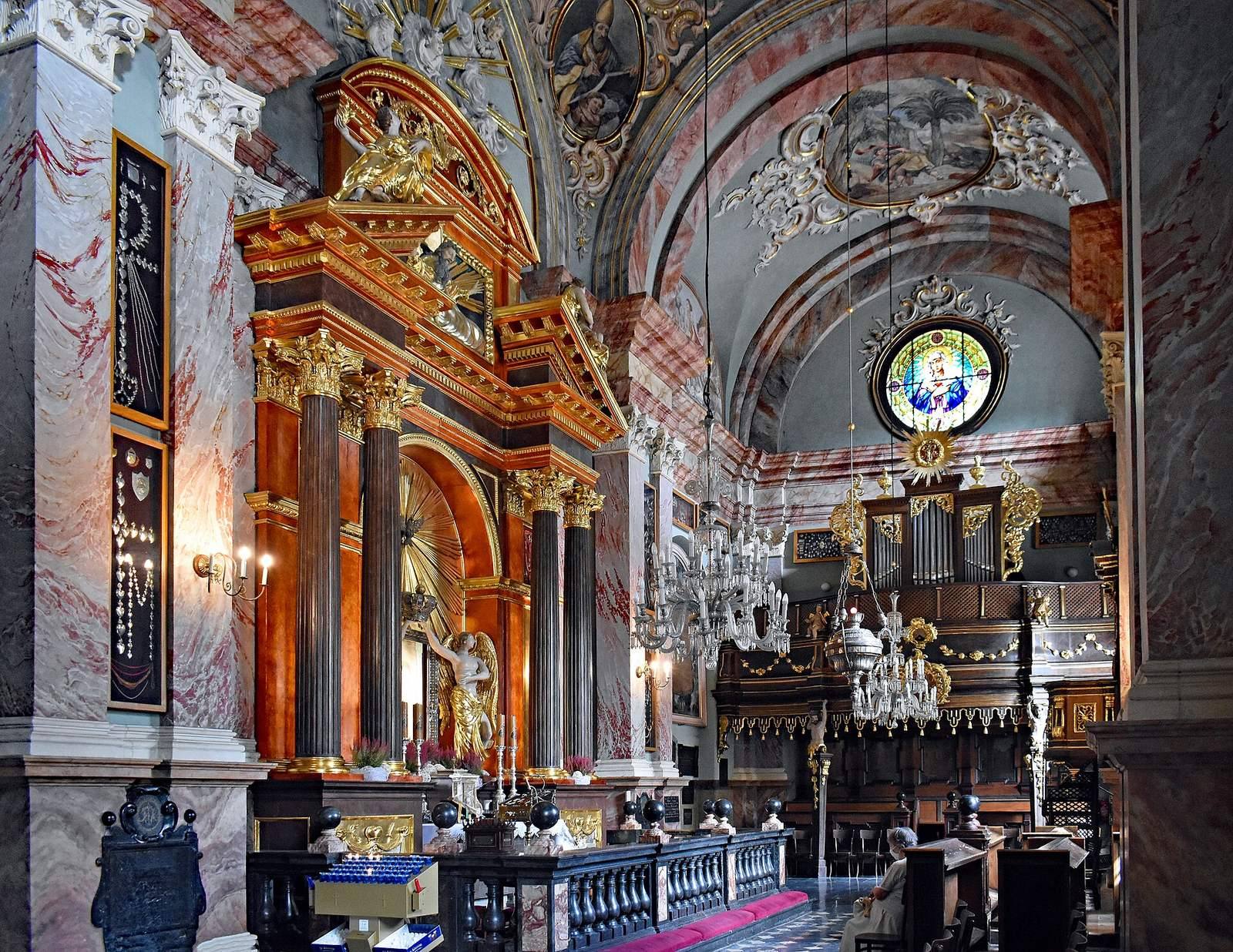
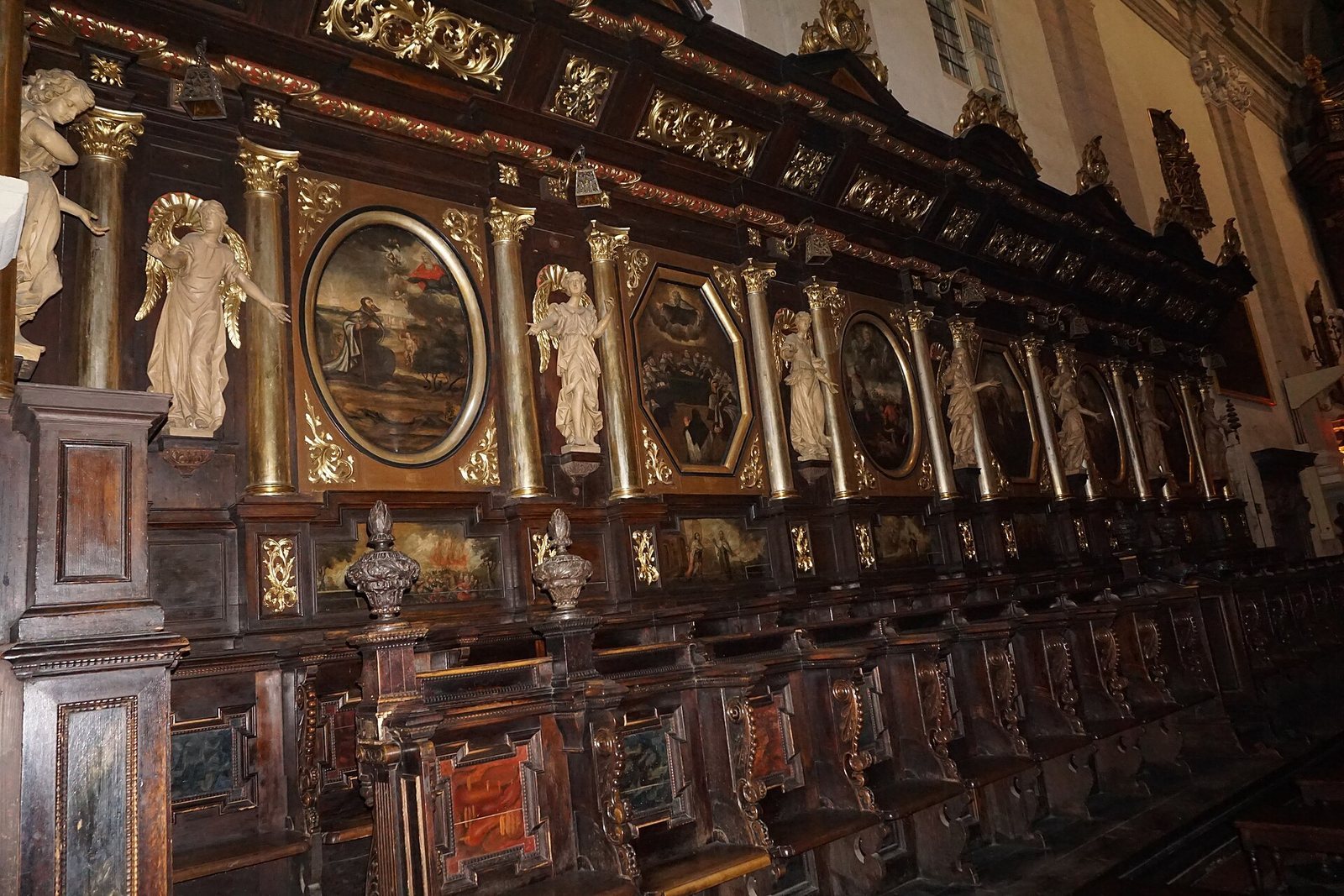
The main altar depicts the Visitation of Mary to Elizabeth and is among Kraków’s largest works of Baroque woodcarving. The church also preserves choir stalls from the mid-17th and 18th centuries. Paintings from the mid-18th century cover the cloister’s vaulted ceilings, illustrating the church’s history and that of the image of Our Lady of Piasek. The church organ has 30 registers, or sets of pipes with shared controls, and two manuals, the keyboards played by hand.
Chapel of Our Lady of Piasek
Chapel structure and furnishings
The chapel adjoins the church on the Garbarska Street side. Its dome carries a lantern topped by a gilded Madonna and Child dated 1678. A Neoclassical altar stands inside, along with two organs set on matching choir galleries in the chapel’s side sections. A plaque is set into the chapel façade.
The image of Our Lady of Piasek
The chapel’s south-side wall painting depicts the Virgin Mary and is also known as the Lady of Kraków. Attributed to an unknown monk, it dates to the late 15th century. Tradition says its painter left the work unfinished and that it was completed miraculously. The image is also said to have survived the Swedish destruction of the surrounding walls intact. Papal crowns designed by Jan Matejko were later fitted to it.
Exterior sculpture and associated grounds
Golgotha group
An 18th-century sculptural group called Golgotha stands along the church’s south side, at the corner of Garbarska Street. It consists of three figures, with the Crucifixion at the center.
Monastery and orchard
The adjoining Carmelite monastery dates to the 17th century and has a Baroque design. It was enlarged by two storeys in the first half of the 20th century. Behind the church, a surviving fragment of the former Carmelite orchard is screened from view by surrounding buildings.
Carved footprint
A stone set into the church’s exterior wall on the Garbarska Street side bears a carved footprint. Tradition links it to Queen Jadwiga’s visit to the building site and a gift she made to a stonemason.
The church also contains the painting of Christ carrying the cross brought from Lviv after 1945.