Porth Hellick Down: A Prehistoric Burial Cemetery in the Isles of Scilly
Site at a Glance
- Rating
- 4.9
- Popularity
- Low
- Country
- United Kingdom
- Primary era
- Bronze Age
- Eras represented
- Bronze Age
- Civilizations
- Unclassified
- Site type
- Burial
- Remains
- Necropolis
On this page9 sections
History
Porth Hellick Down is a prehistoric burial cemetery on St Mary’s in the Isles of Scilly, United Kingdom, with Neolithic and Bronze Age activity dated broadly to around 1750 BC. The Neolithic was the later part of the Stone Age, while the Bronze Age was a prehistoric period associated with the use of bronze for tools and other objects.
Prehistoric burial use
An entrance grave is a prehistoric burial monument whose chamber is reached through an entrance passage. Porth Hellick Down’s surviving entrance graves form the largest group of this type in the world.
Excavation and protection
Earlier digging had disturbed The Great Tomb before the antiquarian and archaeologist George Bonsor excavated it in 1899. Bonsor’s work was the first excavation on Scilly to receive a detailed written record. The Ministry of Works, a British government department responsible for public works, later restored the tomb, altering its fabric. Porth Hellick Down was designated a scheduled monument in 1975, a legally protected archaeological site or historic structure in England. It is now cared for by English Heritage, an organization that looks after historic sites in England.
Remains
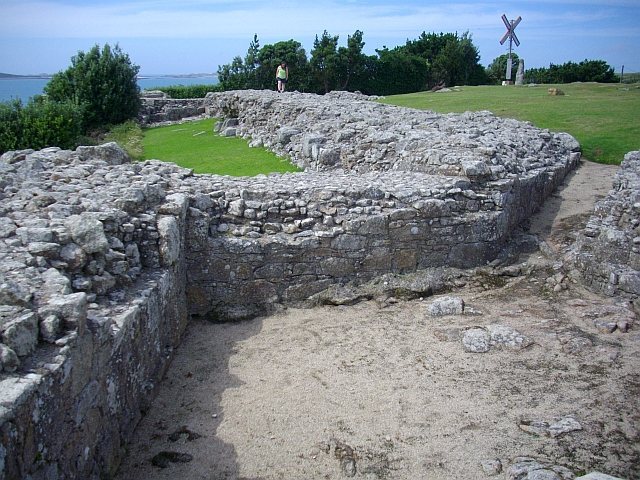
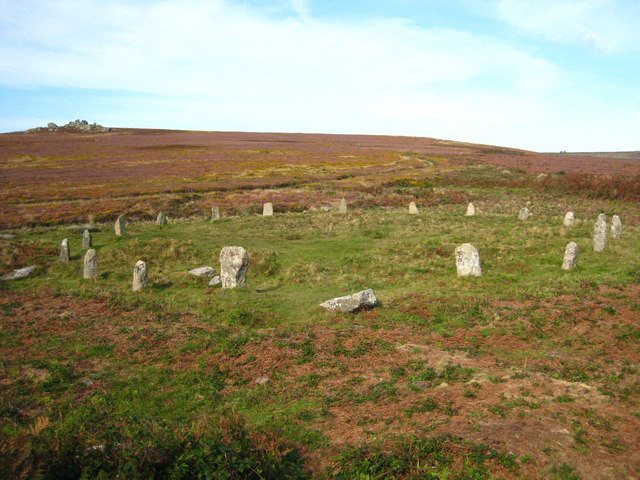
The cemetery overlooks Porth Hellick Bay. It contains at least six entrance graves, stone mounds without burial chambers, and a group of eight monuments built with large stones, four of them well preserved. Traces of prehistoric field divisions extend across the northern and northwestern parts of the Down. A linear stone boundary crosses its eastern slope.
The Great Tomb
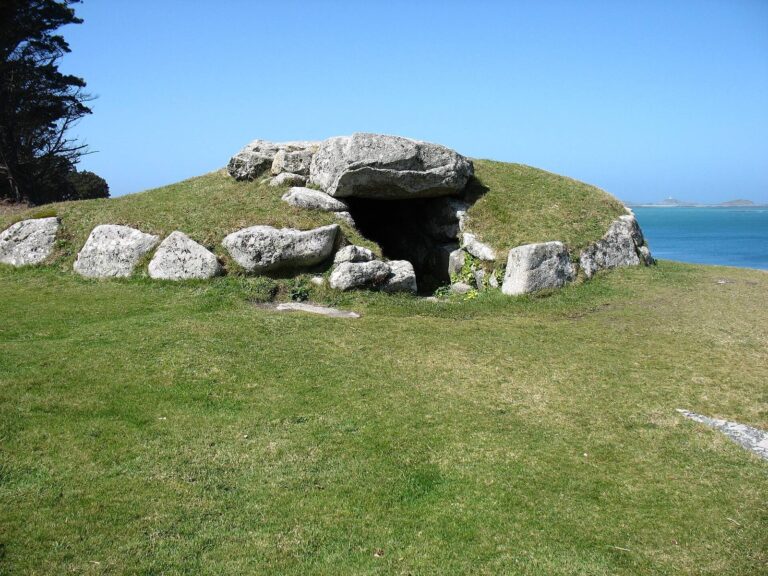
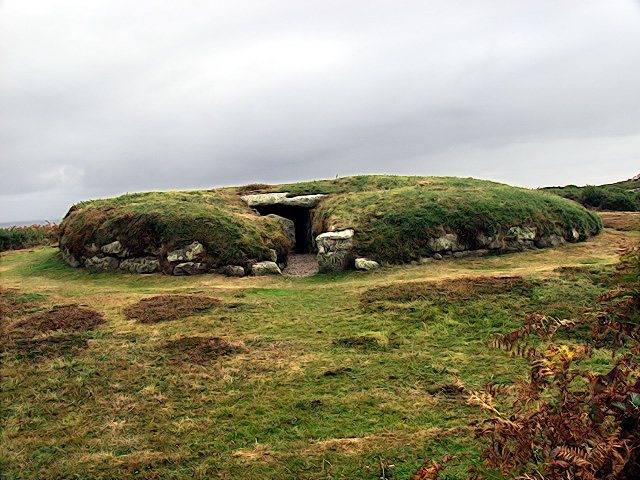
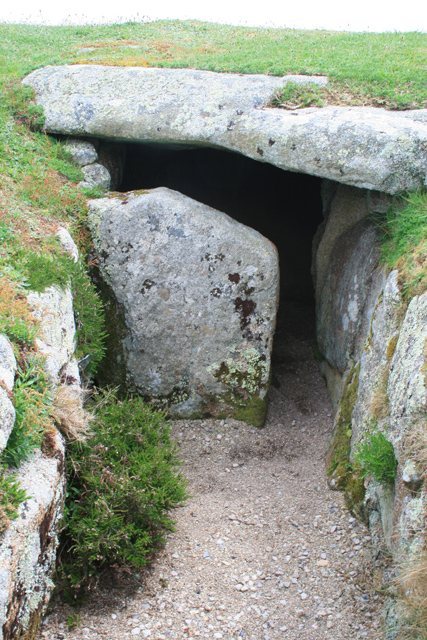
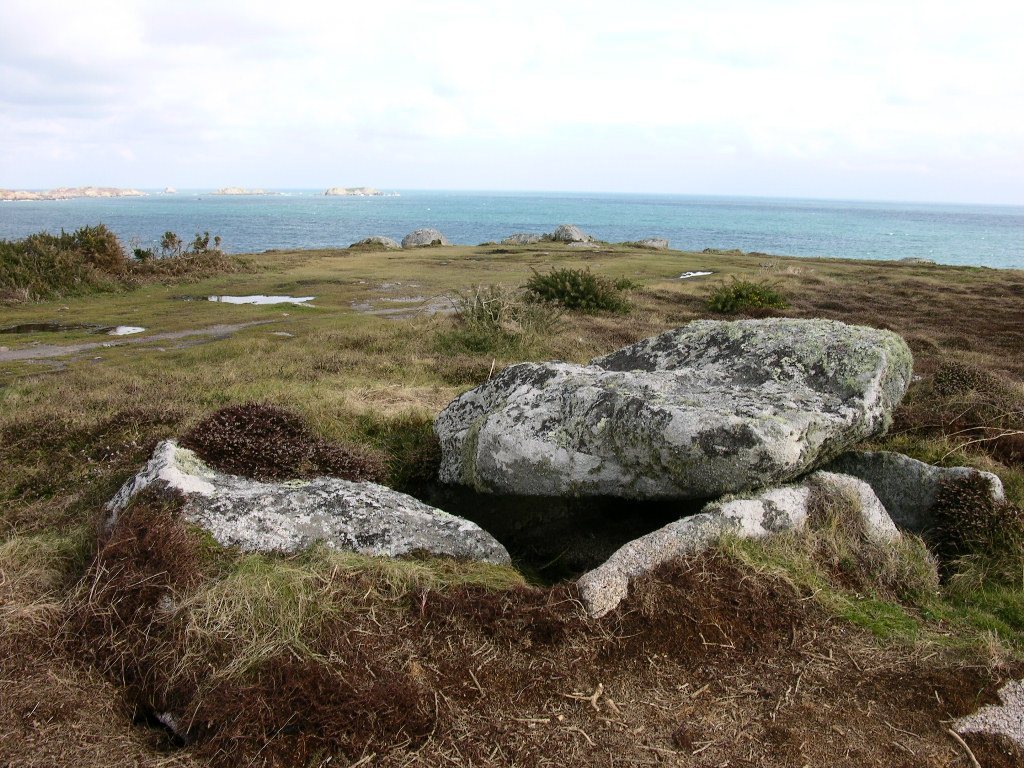
The Great Tomb, a Bronze Age monument dated to 2000 to 1500 BC, stands on the northwestern slope near the prehistoric field system. Its mound rests on a low circular platform, measures 12.25 m across, and rises to 1.6 m. Large slabs originally formed a ring around the mound. The burial chamber is D-shaped, with sides inclining westward toward the inner end of its passage. The chamber is 3.5 m long, 1.5 m wide, and 1 m high; a passage about 3.6 m long leads into it.
Four capstones, measuring 2.5 m long and 1.25 m wide, roof the chamber, while the entrance passage is uncovered. Finds from the chamber included a piece of pumice and a few fragments of late Bronze Age pottery. During restoration, protective turf was laid over the chamber and the ring of large stones was removed.
Other entrance graves
The coffin grave
At the cemetery’s westernmost point, the coffin grave has a mound whose stone edging measures 8.3 by 8 m. Four capstones cover its coffin-shaped chamber, which is oriented east to west and entered from the east. The chamber is 7 m long and nearly 1.5 m wide at its middle. Its stone-lined sides curve inward, narrowing to 1 m at the western end and 65 cm at the entrance, which is partly blocked. The boat- or coffin-shaped design is an especially clear example of this form.
Rock-outcrop grave
Another entrance grave incorporates a massive natural rock outcrop. Its circular mound, built from stacked rubble, measures 13 m across and 1 m high. At the southern end of the chamber, large slabs line the western side and a boulder forms the eastern side. A further slab rests across the stone sides as a roof. Most of the grave’s original form and arrangement survives.
Linear boundary
The boundary is made up of small upright stones, up to 50 cm high and spaced between 1.5 and 6 m apart. From the Down’s eastern edge, it runs southeast to northwest for 17 m, then continues for another 23 m. The boundary is up to 1 m wide and 10 cm high, and most of it lies beneath heather turf.