Innisidgen: Bronze Age Entrance Graves on the Isles of Scilly
Site at a Glance
- Popularity
- Medium
- Country
- United Kingdom
- Primary era
- Bronze Age
- Eras represented
- Bronze Age
- Civilizations
- Unclassified
- Site type
- Burial
- Remains
- Burial Mound
On this page7 sections
History
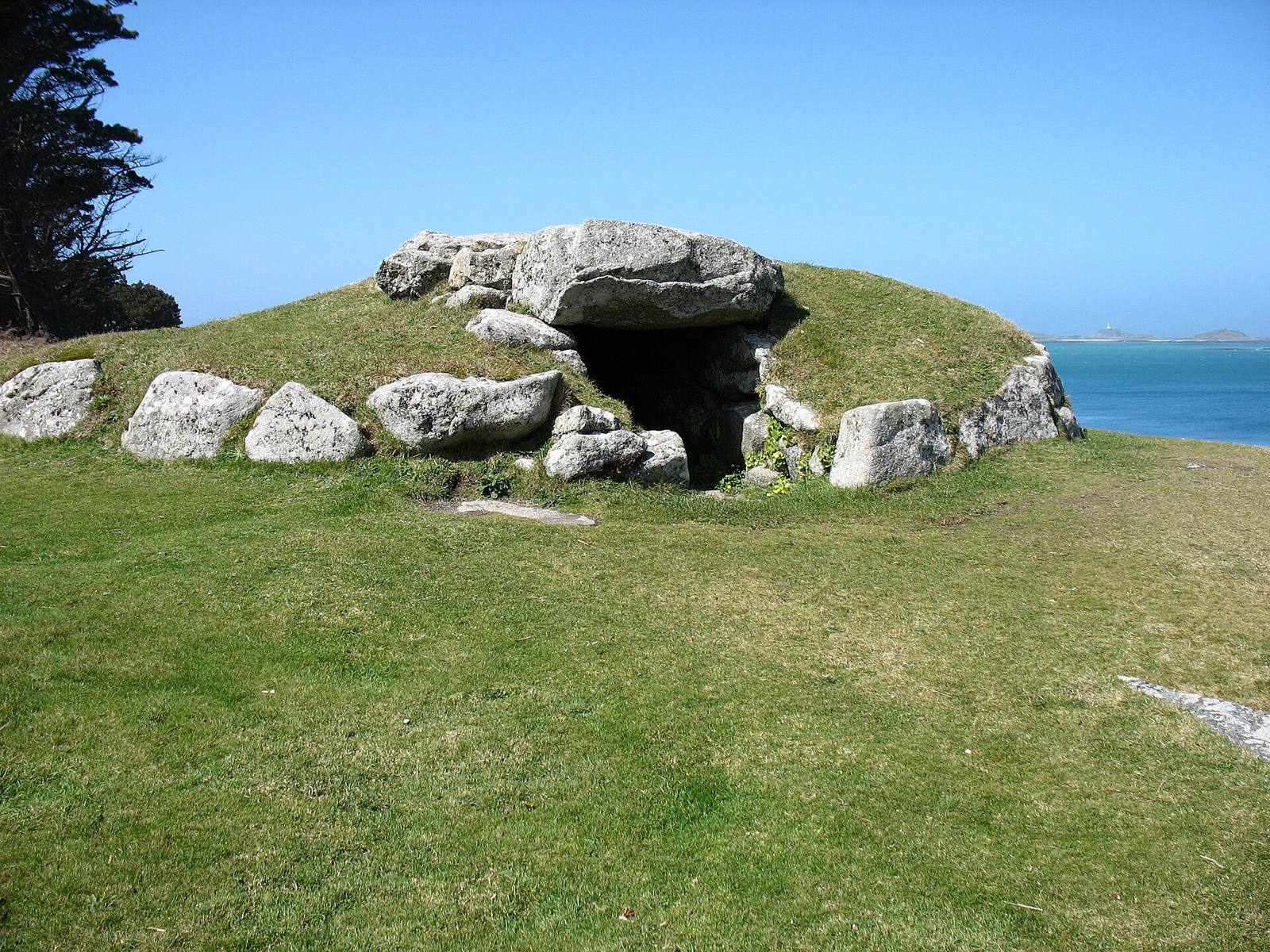
Innisidgen is a pair of Bronze Age entrance graves on Innisidgen Hill, on St Mary’s in the Isles of Scilly, United Kingdom. An entrance grave is a burial mound whose chamber is reached through an opening at its edge.
Bronze Age setting
The graves were built when their chambers overlooked a coastal inlet later known as Crow Sound. The site’s Cornish name, Enys Ojyon, means “Ox Island.”
Later investigation and protection
Both graves had been robbed by the time modern investigations began. Their first recorded excavation took place in 1854. In 1950, an unauthorized excavation removed earth and rubble from the Lower Innisidgen chamber. Innisidgen Hill is a scheduled monument, a historic or archaeological site protected by law in the United Kingdom. The site also includes an archaeological area dating to the English Civil War, the conflict between Royalist and Parliamentarian forces in England from 1642 to 1651.
Remains
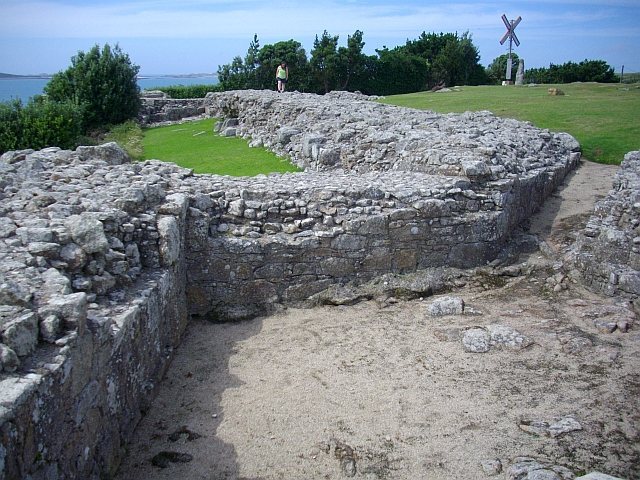
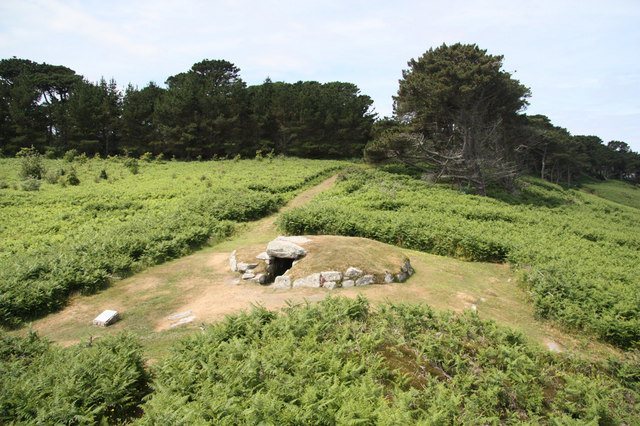
The graves stand on the steep slope of Innisidgen Hill, overlooking Crow Sound and the Eastern Isles. The hill is northeast of Hugh Town and near Trenowieh. Upper Innisidgen occupies the summit; Lower Innisidgen lies on the lower northern slope, about 90 metres northwest of it. Both monuments consist of earth-and-rubble mounds covering stone chambers. Remains of a prehistoric field system lie beside them on the northern slope, visible as earthworks and piles of rubble.
The entrance graves
Upper Innisidgen
Also known as the Giant’s Grave and Innisidgen Carn, Upper Innisidgen is among the best-preserved entrance graves on Scilly. Its slightly oval mound measures about 9 by 8 metres and stands approximately 1.8 metres high. Turf covers the mound, with roof slabs showing slightly through the surface. The stone edging rises to nearly 1 metre on the north side, and traces of an outer platform extend up to 2 metres wide.
The mound covers a rectangular chamber about 4.5 to 4.6 metres long, 1.5 metres wide and 1.2 metres high. Large slabs line its walls. Smaller slabs laid in courses and rubble line the north-northeast wall, while a large upright slab blocks the west-northwest end. A short, open passage leads to the eastern entrance, which is covered by a large slab. Five large slabs form the roof.
Lower Innisidgen
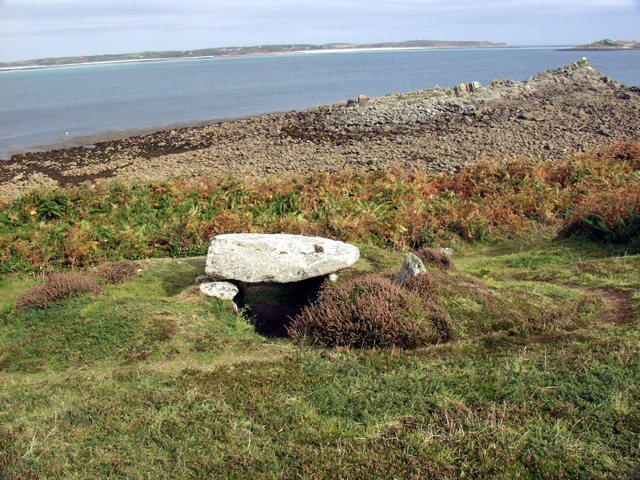
The lower grave is more damaged than the upper one. Its circular mound of earth and rubble is 8.5 metres across and 1.7 metres high. Sections of its stone edging survive, and small rock outcrops are incorporated into the mound. Two original roof slabs remain.
The central chamber measures 5.4 metres long, 1.3 metres wide and 1 metre high, with walls lined in layers of rubble. A large stone stands at its northern end, and large slabs edge the central and northern parts of the east wall. The surviving roof slabs cover the chamber’s central and southern parts. Its entrance is on the south side of the mound and faces north.