Serbian Orthodox Cathedral in Sarajevo: Principal Church of Dabar and Bosnia
Site at a Glance
- Rating
- 4.5
- Popularity
- High
- Country
- Bosnia and Herzegovina
- Primary era
- Modern
- Eras represented
- Modern
- Civilizations
- Ottoman
- Site type
- Religious
- Remains
- Cathedral
On this page16 sections
History
In Bosnia and Herzegovina, the Serbian Orthodox Cathedral in Sarajevo serves as the principal church of the Metropolitanate of Dabar and Bosnia, a district of the Serbian Orthodox Church, an Eastern Orthodox Christian church. A metropolitan, or senior bishop, leads the district. The cathedral is dedicated to the Nativity of the Theotokos, the birth of the Virgin Mary, whom Orthodox Christians honor as the mother of Jesus. It is one of the largest Serbian Orthodox churches on the Balkan Peninsula.
Construction and consecration
The decision to build the cathedral came in early 1859, as European powers pressed the Ottoman Empire to extend religious freedoms to its Christian population. The 1856 Treaty of Paris had recognized equality between Muslims and Christians, allowing new churches, repairs to existing ones, and the reopening of Christian schools. Land and building materials were gathered from 1859 to 1862. Construction began in 1863 with Sultan Abdülaziz’s approval and was entrusted to Andreja Damjanov, a master builder from Veles. The foundation was blessed on 11 June 1863, and the completed building was ready on 1 May 1874.
Voluntary gifts from Orthodox Serbs in Sarajevo and nearby villages, Serbian merchants, and donors in Belgrade, Dubrovnik, Vienna, and Trieste paid for the work. Local merchant Manojlo Jeftanović led fundraising and gave 2,000 ducats, gold coins used in European trade. The total cost was 36,000 ducats. Sultan Abdülaziz, Serbian Prince Mihailo Obrenović, and the Serbian government also contributed. Sava Kosanović raised funds in Russia, while Russian Emperor Alexander II sent skilled craftsmen to work on the icon screen.
A dedication planned for May 1871 was delayed after imam Salih Vilajetović, a Muslim prayer leader known as Hadži Lojo, and his followers tried to prevent the ceremony. The Ottoman governor ordered arrests; six people were detained and others fled. When the ceremony took place the following summer, Ottoman authorities deployed more than a thousand troops and placed a cannon above the city, both to protect the event and to demonstrate force. Metropolitan Pajsije consecrated the cathedral on 20 July 1872, and the ceremony passed without incident.
War and repairs, 1914-1922
On 29 June 1914, the day after the assassination in Sarajevo, Austro-Hungarian police and local auxiliary forces known as the Schutzkorps organized anti-Serbian demonstrations. The Orthodox Seminary and Metropolitan Palace, buildings in the cathedral complex, were damaged. Many clergy and worshippers were arrested, and several were killed.
During the First World War, Austrian authorities removed the lead roof and bells, replacing the roof with inferior sheet metal. The building deteriorated, and repairs began in May 1921. Work finished by Christmas 1922, when the cathedral was consecrated again and its first post-repair liturgy was held.
Second World War
German and Ustaša forces entered Sarajevo in April 1941. The Ustaša were a Croatian fascist movement whose regime ruled the Independent State of Croatia during the war. Its authorities banned the Serbian Orthodox Church and sent most of Sarajevo’s clergy to concentration camps, particularly Jasenovac and Jadovno; only a few survived. In May 1941, the authorities also prohibited Cyrillic writing and established a daily rail route carrying Orthodox Serbs from Sarajevo toward Jasenovac.
Metropolitan Petar Zimonjić was arrested at the Metropolitan Palace on 12 May and taken to Zagreb days later. It remains uncertain whether he died at Jasenovac or Jadovno. The cathedral sustained serious damage during the war and was renovated afterward.
War and recovery after 1992
During the 1992-1995 war, the cathedral was damaged and services there stopped from 1992 to 1996. The Metropolitan Palace was shelled and looted in 1992, and part of it, including its library and archive, burned. About 200,000 Orthodox Serbs left the Metropolitanate’s territory. The cathedral was later renovated inside and out, with the Republic of Greece supporting reconstruction of its exterior.
Because of the conflict, Metropolitan Nikolaj temporarily moved the district’s seat from Sarajevo to Sokolac, where the Church of St Elijah served as its cathedral church. After peace stabilized, the seat returned to Sarajevo, and major services, including Christmas and Easter liturgies, resumed at the cathedral. The Serbian Orthodox Church has sought the return of the former seminary, later converted into Sarajevo’s Faculty of Economics; the dispute remains unresolved.
The Serbian Orthodox singing society Sloga has sung at the cathedral since 1888. During the war, when Sarajevo’s Serbian Orthodox churches were closed except for the Old Orthodox Church in Baščaršija, Sloga’s singers gathered at that church. The cathedral was designated a National Monument of Bosnia and Herzegovina in 2006.
Remains
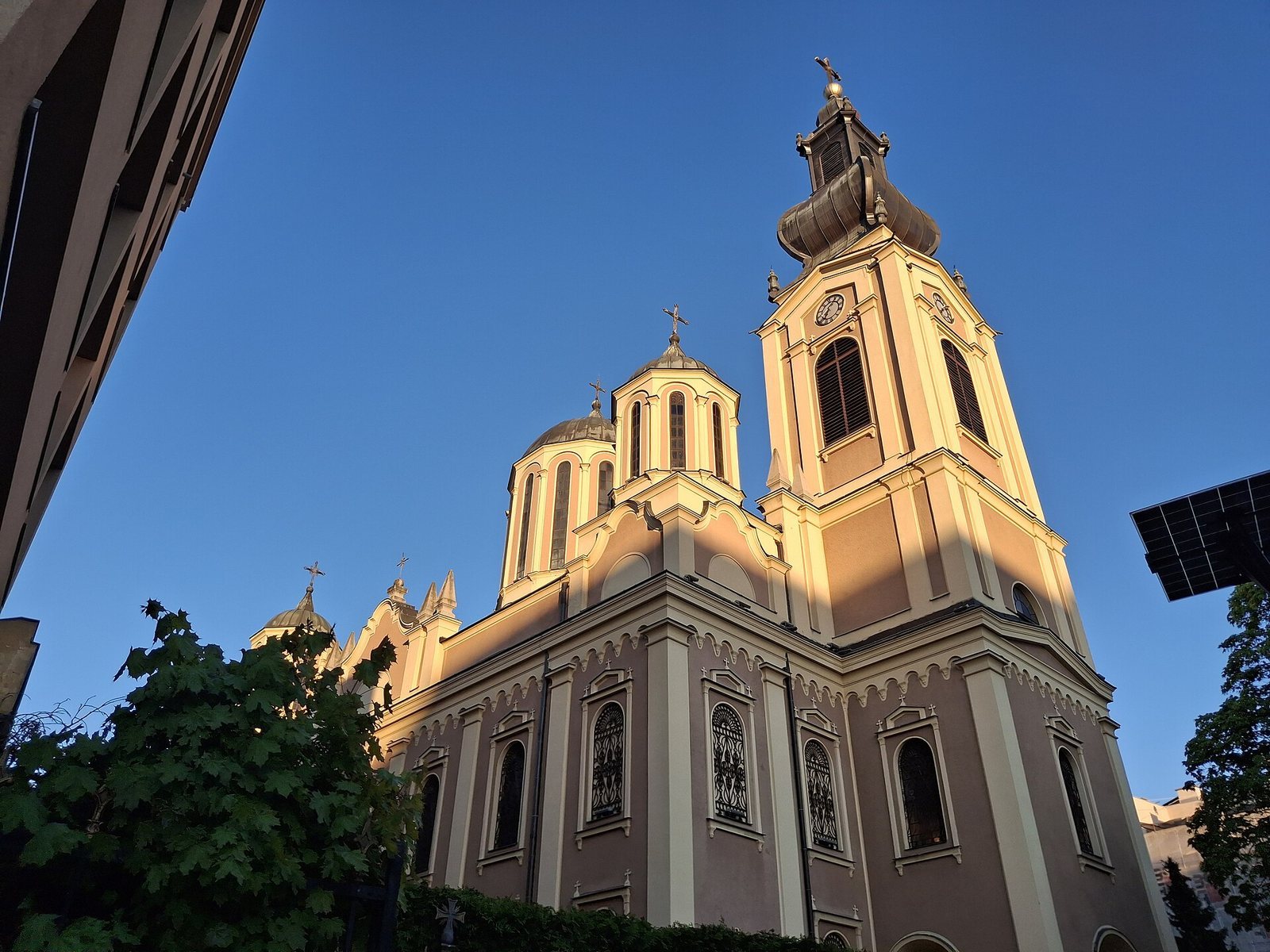
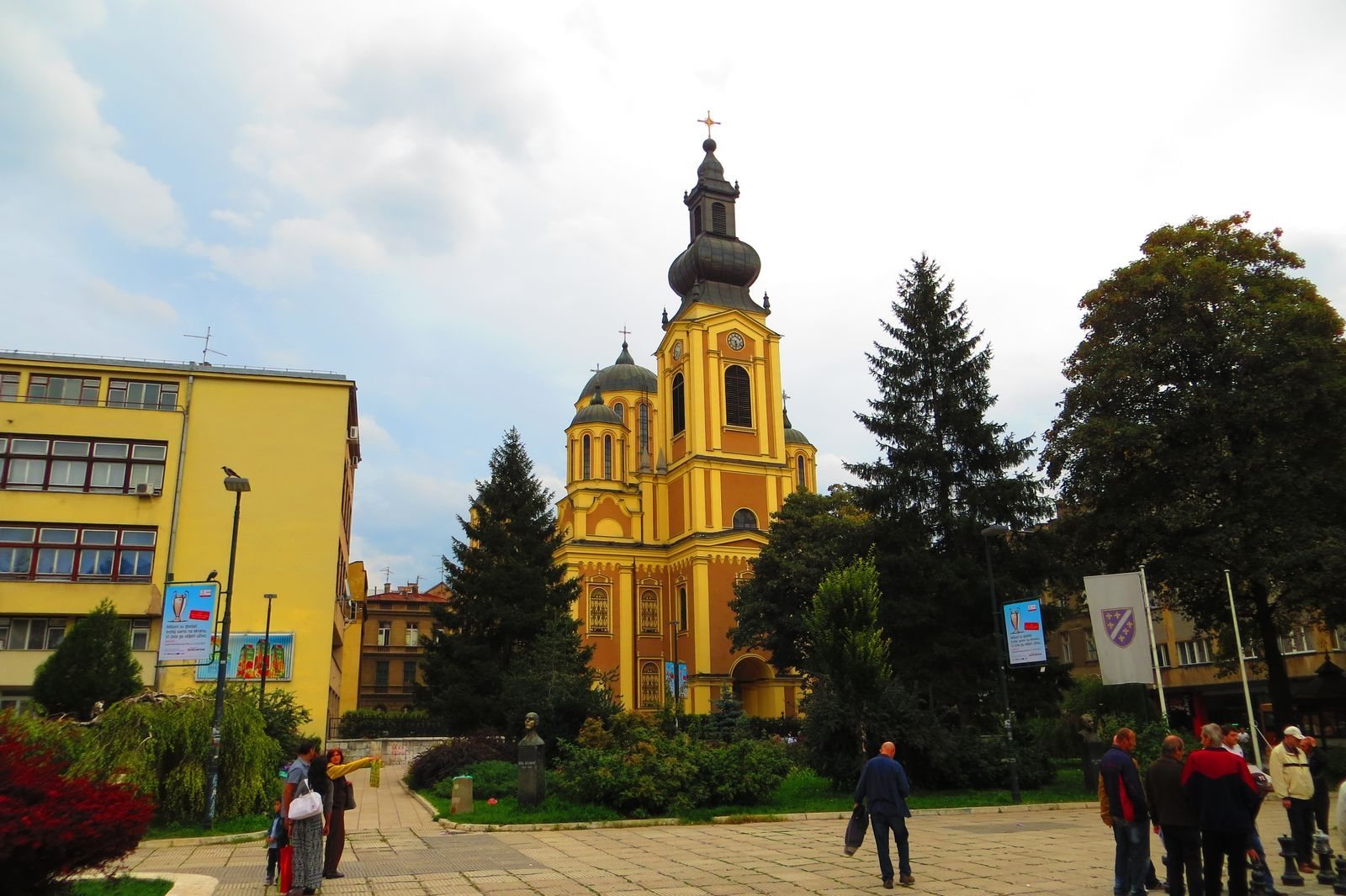
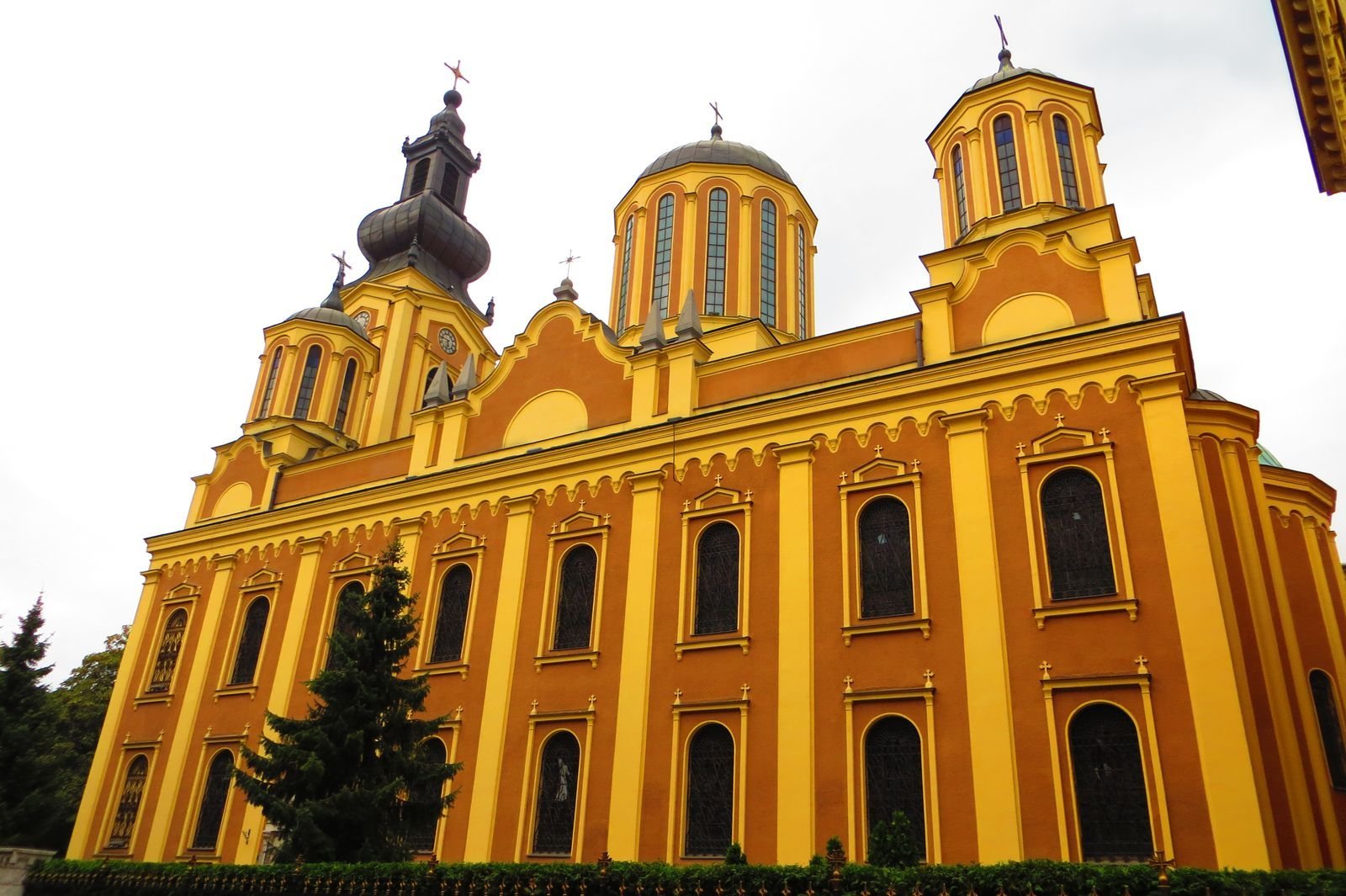
The cathedral stands in central Sarajevo on the right bank of the Miljacka River, near the Faculty of Economics. Its stone church has a three-aisled basilica plan, divided into a central aisle and two side aisles, shaped as an elongated Greek cross with extended arms. The church, churchyard, Metropolitan Palace, and Orthodox Seminary form the complex.
Church structure
Plan and elevations
The building is 37 metres long and 22.5 metres wide, with walls 15.5 metres high. It has six doors and eight domes: five large domes, including a central dome higher than the four side domes, and three smaller domes over the altar. The central dome reaches 34 metres, while the smaller domes reach 20 metres. The five large domes represent Christ and the four Evangelists, traditionally regarded as the authors of the four canonical Gospels. The three smaller domes refer to the Trinity, the Christian belief in one God as Father, Son, and Holy Spirit.
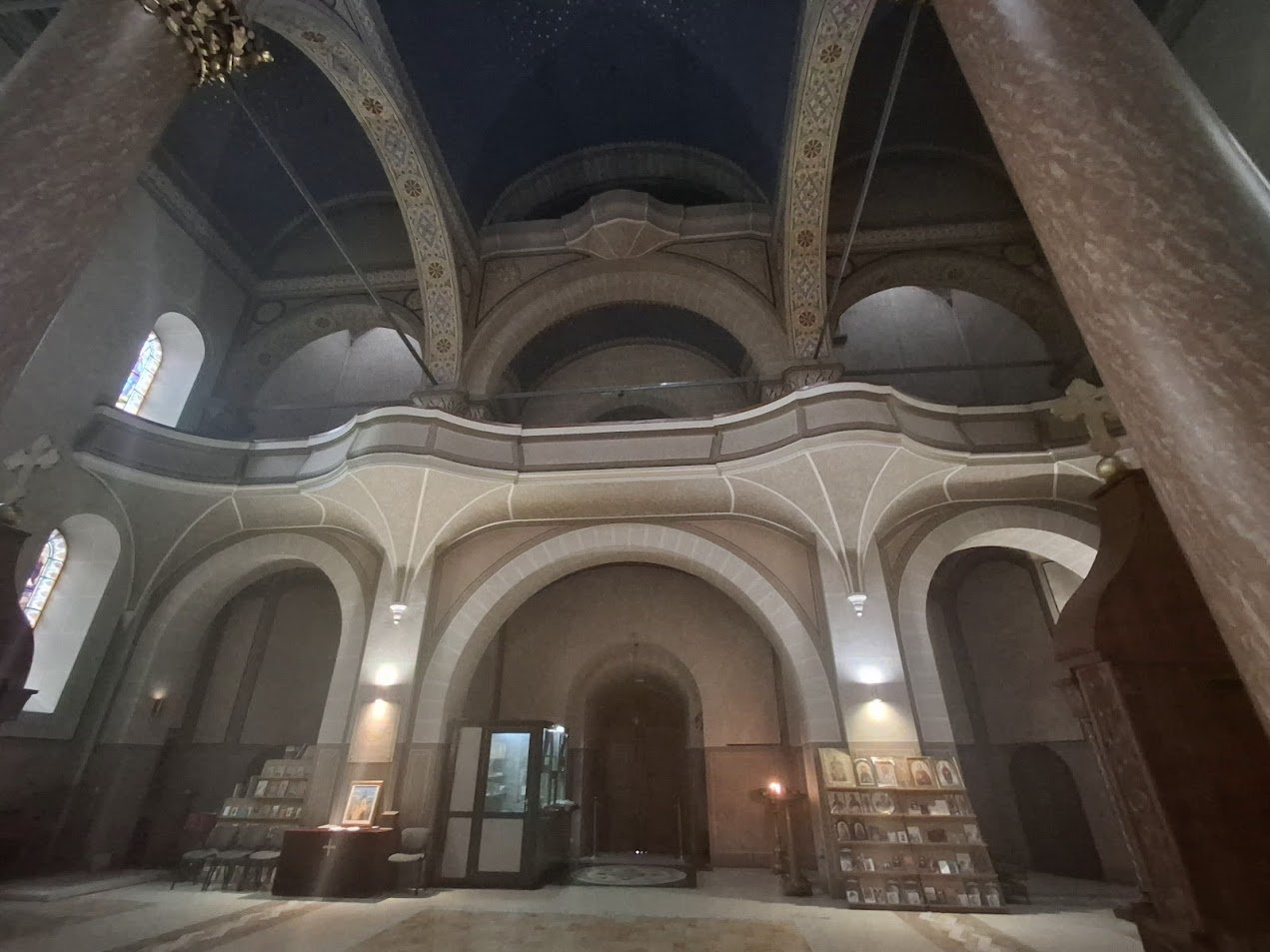
Two rows of windows run along the walls, with four more in the altar area. Round arches and vaults carry ornament, and painted decoration on the lower walls imitates marble. The altar and the space before it stand three steps above the floor, which is laid with cut stone slabs. The slabs were replaced during repairs completed in 1922.
Bell tower and churchyard
A 45-metre bell tower in the Baroque style, an ornate European artistic style, stands before the entrance. Wealthy women of Sarajevo donated its cross and orb. A low wall and iron railing enclose the churchyard, where roses and fragrant lime trees were planted; a fountain is also part of the grounds.
Interior and furnishings
Altar and furnishings
Wooden benches line the walls for elderly and infirm worshippers. Beside the right pillar stands a gilded throne for the metropolitan; opposite it is a smaller gilded table for an archimandrite, a senior Orthodox monastic. Above the table is a gilded ambo, a raised platform for readings and preaching, with an open golden book used for reading the Gospel and delivering sermons. A chalice is also present at the ambo.
Icon screen and artworks
The gilded iconostasis, a screen of icons separating the sanctuary from the worship area, bears icons brought from Russia in 1873 by Sava Kosanović, then an archimandrite. The cathedral also contains work by painters including Paja Jovanović and a stained-glass image of Saint Sava, donated by the Despić family. Saint Sava was a medieval Serbian monk and the first archbishop of the Serbian Orthodox Church.
Buildings in the complex
Metropolitan Palace
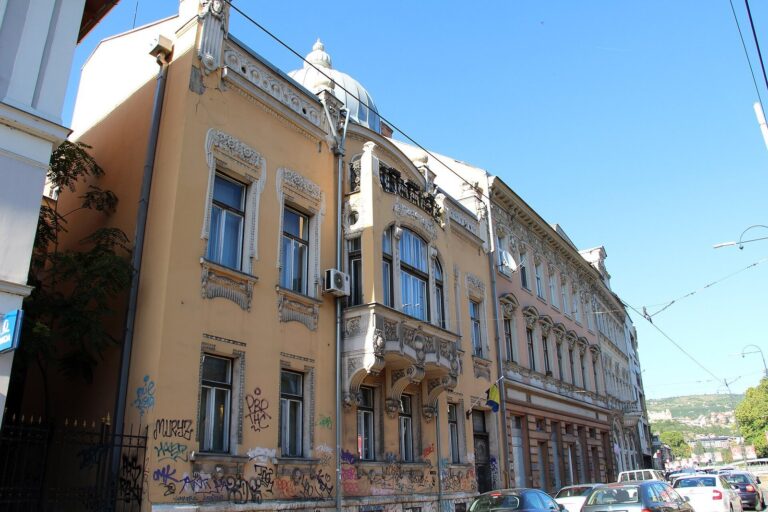
The Metropolitan Palace adjoins the church and was built in 1898. It forms part of the cathedral complex.
Orthodox Seminary
The Orthodox Seminary, a school for educating and training clergy, also adjoins the church as part of the complex.
Commemorative monument
A monument associated with the cathedral commemorates Serbian clergy killed by Austria-Hungary and its subjects.