Bakr-babina Mosque: An Ottoman Mosque Complex in Sarajevo


Site at a Glance
- Rating
- 4.7
- Popularity
- Very Low
- Country
- Bosnia and Herzegovina
- Primary era
- Early Modern
- External website
- Open
- Eras represented
- Early Modern, Modern
- Civilizations
- Ottoman
- Site type
- Religious
- Remains
- Mosque
On this page14 sections
History
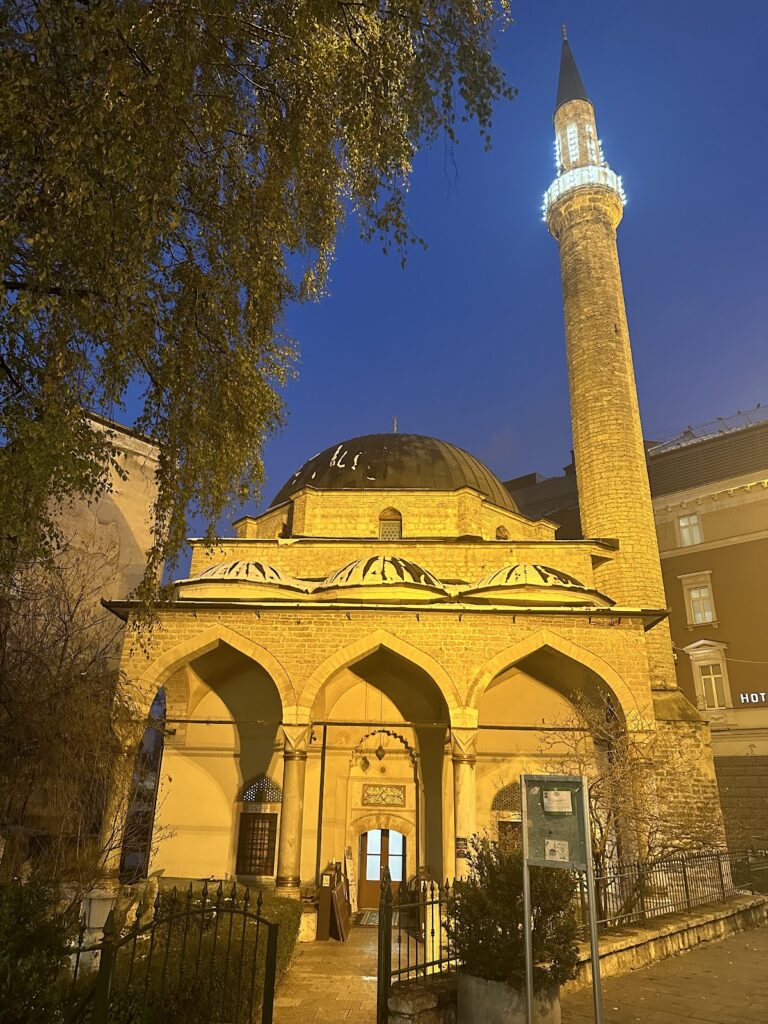
Bakr-babina Mosque is an Ottoman mosque in Sarajevo, Bosnia and Herzegovina, built in 1544 by the Sarajevo merchant Hadzi Alija Bakr-baba. It stands beside Atmejdan Archaeological Park on the left bank of the Miljacka River. The mosque formed part of an important Ottoman religious and educational complex, which also included an elementary Islamic school, a madrasa, a library, a cemetery, and several fountains.
Foundation and Ottoman Sarajevo
Hadzi Alija Bakr-baba founded the mosque at Atmejdan in 1544 and established a mekteb, or elementary Islamic school, beside it. At the time, Bakr-babina Mosque was regarded as one of Sarajevo’s largest and most beautiful mosques. Its original building had a stone minaret, and its position within the Atmejdan area placed it among the religious and civic institutions of the Ottoman city.
The complex expanded during the eighteenth century. On the eastern side of the mosque, beside the cemetery, Hadzi Ismail Misrija founded the Misrija Madrasa in 1741–42. A madrasa was an institution of advanced Islamic learning, and this one became one of Sarajevo’s important centers of education during the eighteenth and nineteenth centuries. It was supported through Misrija’s endowment, which included several thousand akçe, an Ottoman silver coin, and a khan at Mackovac, a commercial or roadside building providing accommodation and related services.
The instructor Abdulah Kantamirija later strengthened the madrasa’s financial and intellectual resources. He endowed a house in Magoda and directed part of its income to his library, the madrasa, and its students. Hadzi Mehmed Goro also left 10,000 akçe to the institution. The madrasa produced works in several literary forms, particularly manuscript copies. Among its notable manuscripts was an Arabic–Turkish dictionary written by Osman Dzumhur in 1713.
War, rebuilding, and the changing Atmejdan
Bakr-babina Mosque was completely burned in October 1697 during Eugene of Savoy’s campaign against Sarajevo. Eugene of Savoy was an Austrian imperial commander whose military expedition brought the destruction of parts of the city. Hadzi Mehmed Medbesarovic, a resident of the neighborhood, rebuilt the mosque in 1700.
Abdulah Kantamirija also established a public library, known as a kutubhana, at Atmejdan in 1774–75. The library stood opposite the mosque and madrasa, near Cumurija Bridge. It was one of three public Oriental libraries in Sarajevo during Ottoman rule. Kantamirija served as an instructor at Misrija Madrasa, a preacher, and chief secretary in the court, and he also copied books. He died in 1774–75 and was buried beside the mosque.
The fountains associated with the complex remained in use until 1878. One fountain was restored in 1797–98, while a Sarajevo chronicler recorded the construction of another at Atmejdan by Hadzi Ibrahim Tolo in 1766–67. Tolo brought water to it from the Pjenkovac spring at Bentbasa. These works connected the mosque complex with the practical provision of water as well as with religious and educational life.
Demolition and revival
The Atmejdan area lost importance in the early nineteenth century. After the Austro-Hungarian occupation of Bosnia in 1878, the mosque was converted into a military storehouse. Poor maintenance followed, and both the mosque and its mekteb were demolished in 1895. The Kantamirija Library building was demolished in 1897, after which its books were transferred first to the Osman Shahidi Library and later to the Gazi Husrev-beg Library.
The cemetery beside the mosque was later exhumed in 1939. The idea of rebuilding Bakr-babina Mosque was advanced by Hadzi Hafiz Halid Hadzimulic. The restored mosque was formally reopened on 27 June 2011, and a memorial tomb for Hadzimulic was built in its courtyard in 2013. The Atmejdan Archaeological Area was declared a National Monument of Bosnia and Herzegovina at a meeting of the Commission to Preserve National Monuments held from 25 to 31 January 2005.
Remains
The mosque and courtyard
Bakr-babina Mosque
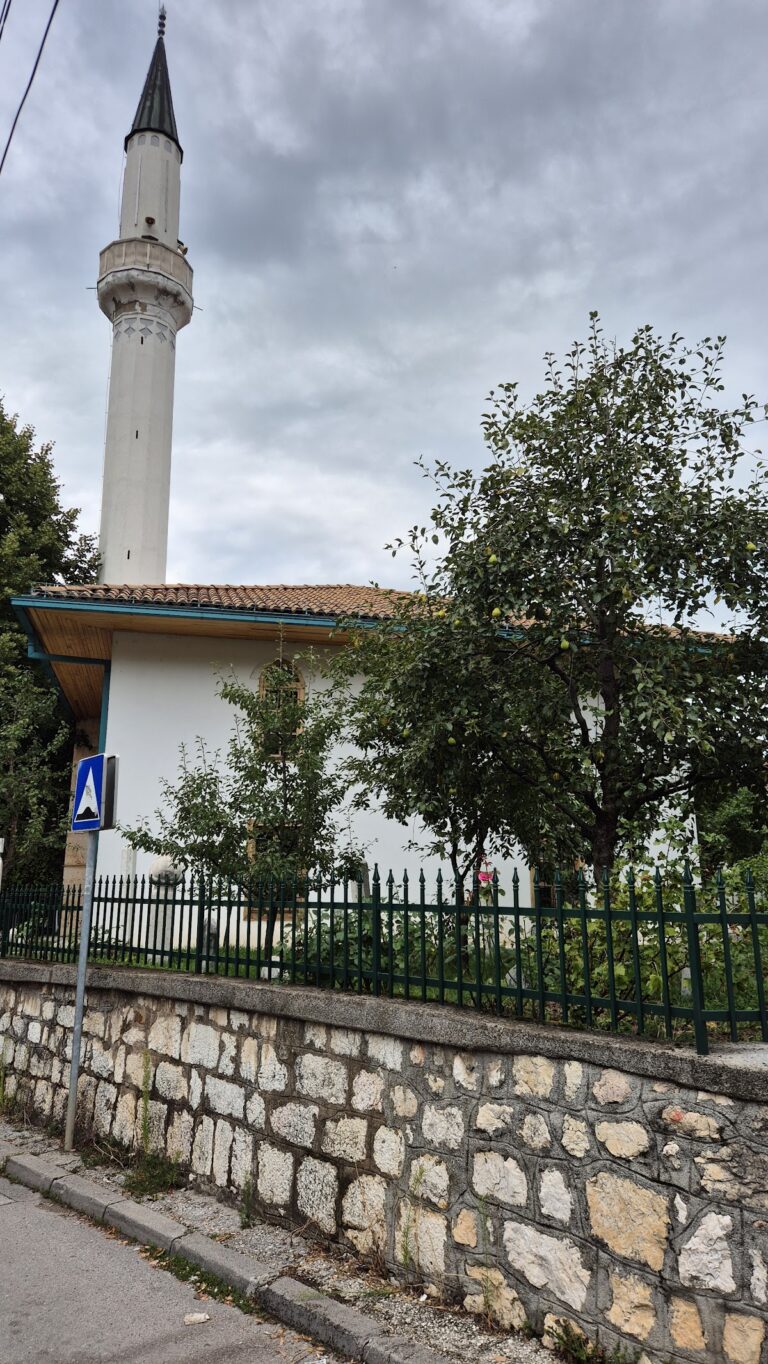
The mosque is an Ottoman-style building constructed of stone and adobe, with one minaret. Its present form follows the restoration that led to its reopening in 2011. The wider complex historically gathered religious, educational, commemorative, and water-related features around the mosque, while its position beside Atmejdan Archaeological Park places it within the archaeological setting of the former Atmejdan institutions.
Hadzi Hafiz Halid Hadzimulic’s turbe
The open-sided turbe, or memorial tomb, for Hadzi Hafiz Halid Hadzimulic was built in the mosque courtyard in 2013. It measures 4 by 4 metres and stands on a concrete, planter-like base reaching up to 90 centimetres in height. The grave markers are installed within the base, which is finished in stone and white marble. Relief verses from the Masnavi, the major Persian Sufi poem by Jalal al-Din Rumi, decorate the facade. The lighting combines indirect illumination with direct light from the corners.
Educational and library buildings
Misrija Madrasa
Misrija Madrasa stood east of the mosque beside the cemetery. Its plan included a dershane, or lecture room, and ten rooms for students. Founded in 1741–42, the madrasa was supported by endowments and became an important place of advanced Islamic learning in Sarajevo. It was destroyed before the Second World War. Its intellectual life included the production of manuscript copies, among them Osman Dzumhur’s Arabic–Turkish dictionary of 1713.
Kantamirija Library
The Kantamirija Library stood across from the mosque and madrasa, close to Cumurija Bridge. Founded in 1774–75, it served as a public Oriental library and formed part of the intellectual landscape of Atmejdan. The building was demolished in 1897, and its books were subsequently moved to the Osman Shahidi Library and then to the Gazi Husrev-beg Library.
Fountains and cemetery
Fountains
Several fountains formed part of the mosque complex. A double fountain was built into the courtyard wall to the right of the entrance to the mosque courtyard. Six additional fountains stood in the mosque courtyard, and another stood within the madrasa. The original date of the double fountain is unknown. An inscription preserves the date of its restoration as 1212, corresponding to 1797–98.
The inscription is an eight-verse Turkish poem that compares the fountain’s water with Abi-Hayat, the life-giving spring, and Kawthar, the paradisiacal spring. It describes the fountain as neglected, states that water was brought from a spring, and invokes the souls of Mustafa and the thirsty students of the madrasa. A copy of the inscription is preserved in the collection of Muhamed Enveri Kadić.
Cemetery and gravestones
The cemetery beside the mosque remained after the demolition of the mosque and was exhumed in 1939. Inscriptions from its gravestones were preserved, including those of Munla Zulfikar, dated 1762–63; the calligrapher Misrija Hasan-efendi, dated 1769–70; Abdulah Kantamirija and his grandson Munla Mustafa, both dated 1774–75; Hadzi-Abdulah Hadziabdagic, dated 1795–96; Serdengecdija Tola Salih-aga, dated 1808–09; and Muharem-aga Ocaktan, dated 1810–11.