Tašlihan: An Ottoman Caravanserai in Sarajevo
Site at a Glance
- Popularity
- Medium
- Country
- Bosnia and Herzegovina
- Primary era
- Early Modern
- Eras represented
- Early Modern
- Civilizations
- Ottoman
- Site type
- Economic
- Remains
- Caravanserai
On this page12 sections
History
Tašlihan was an Ottoman caravanserai, an inn and service complex for merchants, travelers, and their animals, built in Sarajevo, Bosnia and Herzegovina, from 1540 to 1543. Gazi Husrev-beg, a sixteenth-century Ottoman provincial governor and benefactor, financed it through a vakuf, an Islamic charitable endowment. Attached to the western side of his bezistan, or covered market hall, the two buildings formed a commercial center until the city fire of 1879. Tašlihan was among Sarajevo’s largest Ottoman-era buildings and the largest caravanserai in the region.
Foundation and commercial use
The inn initially bore the name Gazi Husrev-beg Caravanserai. The later name Tašlihan is understood to combine Turkish words for “stone” and “inn.” It served merchants from Sarajevo and elsewhere, with trade apparently more central to its use than lodging for travelers. Tašlihan was Sarajevo’s third stone caravanserai; it was also described as the second of its type after the fifteenth-century Kolobaran Han. By the second half of the eighteenth century, the distinction between a caravanserai and a related kind of inn known as a han had fallen out of use in Sarajevo.
In 1659, Ottoman traveler and chronicler Evliya Çelebi counted three caravanserais and 23 hans in the city. By 1878, Sarajevo had 50 hans, most beyond the area of today’s old town. Historians Ćiro Truhelka and Hamdija Kreševljaković later linked Tašlihan and the bezistan with Sarajevo’s commercial prosperity, in 1912 and 1957 respectively.
Destruction and rebuilding
In 1697, Habsburg commander Prince Eugene of Savoy attacked Sarajevo, destroying much of the city, including Tašlihan. Merchants contributed to the inn’s reconstruction. A fire in 1832 melted its lead dome roofs, which were restored at considerable expense. The endowment raised funds from wholesalers, some of whom rented space in the building. Their shared involvement strengthened cooperation among the merchant elite. Historian Alija Bejtić later characterized this collective activity as merchant politics extending from the bazaar into the city.
The major fire of 1879 left Tašlihan unusable. It came a year after the Habsburg monarchy occupied Bosnia and Herzegovina, beginning the Austro-Hungarian period there, and cleared space for new construction west of Baščaršija.
The hotel and the changing site
Gligorije Jeftanović built Hotel Evropa on the western part of the Tašlihan site in 1881–1882. The hotel was among Sarajevo’s early buildings of the Austro-Hungarian period, and Jeftanović operated it until the Second World War. An addition in 1909 included a north wing and south balconies. In 1912, the remaining Tašlihan ruins, which had served as a garage for Vejsilaga Šaračević, were demolished. A replacement building was planned but was not constructed after war broke out. In 1914, riots following the assassination in Sarajevo targeted both the Jeftanović family and their hotel. A further hotel extension in 1960 occupied more of the former caravanserai site.
During the Bosnian War, the 1992–1995 conflict in Bosnia and Herzegovina, shell impacts set the hotel on fire and left it a burned-out ruin. It was rebuilt more than a decade later under the name Hotel Europe and restored in 2008. Archaeological investigations took place in the hotel’s summer garden in 1998, followed by a 60-day investigation and conservation effort in 2007 as hotel works proceeded.
Tašlihan’s remains were declared a national monument in 2004. A 2016 amendment allowed supervised conservation and cultural use, provided the remains were not impaired. In 2017, a proposal for a commercial building with a glass pavilion intended to keep the ruins visible prompted a demonstration and an online petition; the Stari Grad mayor and preservation advocates also opposed the proposal, citing concerns about the underground garage’s structural effects. That year, University of Sarajevo researcher Selma Rizvić presented a digital reconstruction of Tašlihan.
Remains
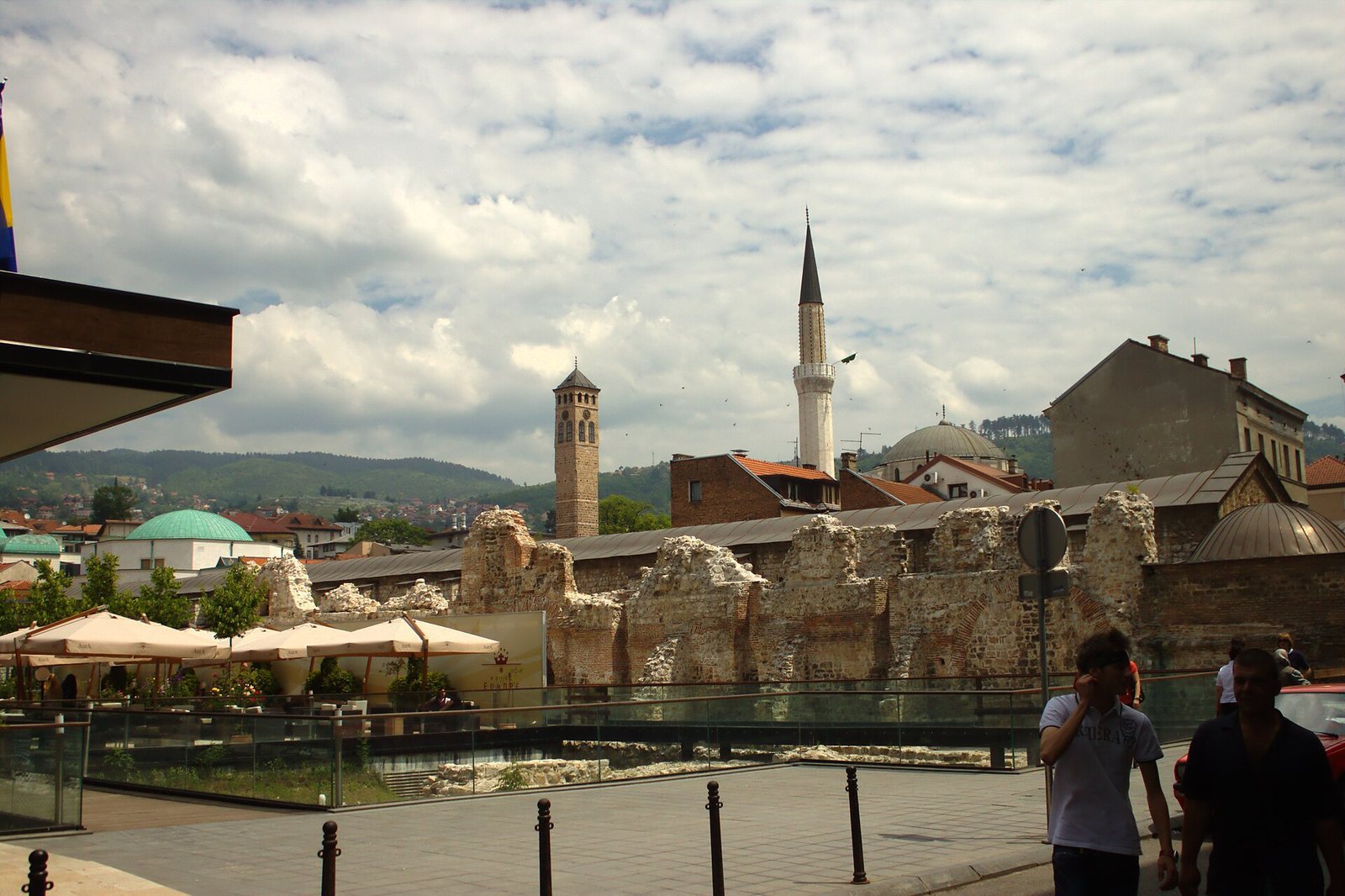
Tašlihan occupied a square measuring 47 by 47 metres, at the western end of Baščaršija beside Gazi Husrev-beg Bezistan and south of Ferhadija Mosque. Four wings enclosed a paved courtyard. The southern entrance front faced today’s Zelenih beretki Street, while the western side faced Vladislava Skarića Street. Hotel Europe occupies the adjoining street corner and extends over part of the former caravanserai site.
Courtyard, entrance, and wings
The southern entrance was vaulted and rose slightly above the surrounding roofline. Its porch had an arcade that appears to have continued directly into the bezistan’s southern annex, which the two buildings shared. Dozens of small domes covered the porch, while small chimneys marked the other roofs. Brick arches framed rooms along the ground floor.
Rooms and communal facilities
Ground-floor spaces
The ground floor held stables, storage areas, and shops. Archaeological evidence indicates that shops were added later in the southern part of the building.
Upper floor and courtyard
A wooden gallery ran along the upper floor, where about 30 residential rooms stood alongside meeting rooms used by individual wholesalers. Two stone staircases connected the courtyard to this level. A small mosque stood on supports above a ritual ablution fountain, used for washing before prayer, leaving the fountain unobstructed.
Surviving wall and foundations
East wall and foundations
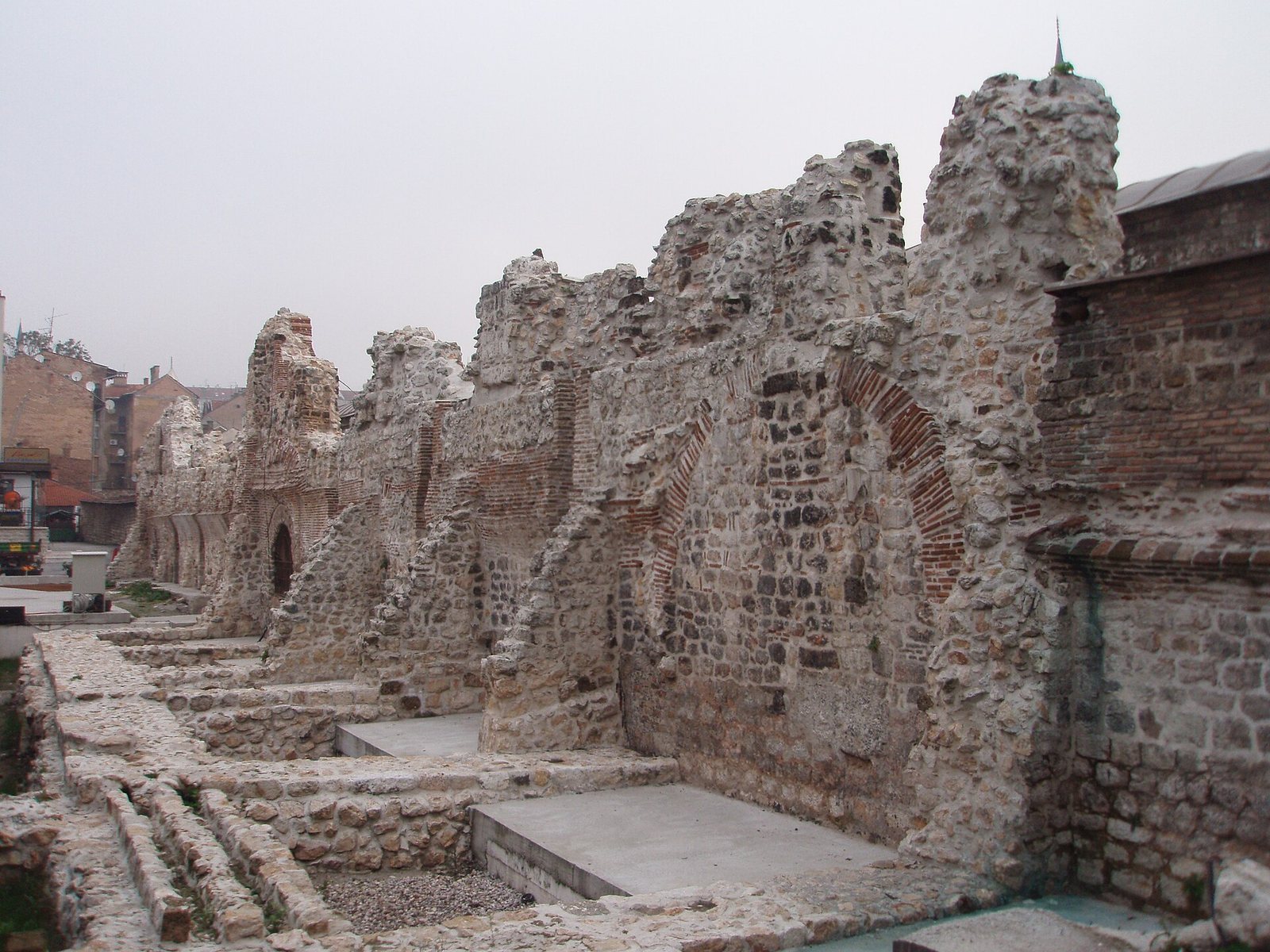
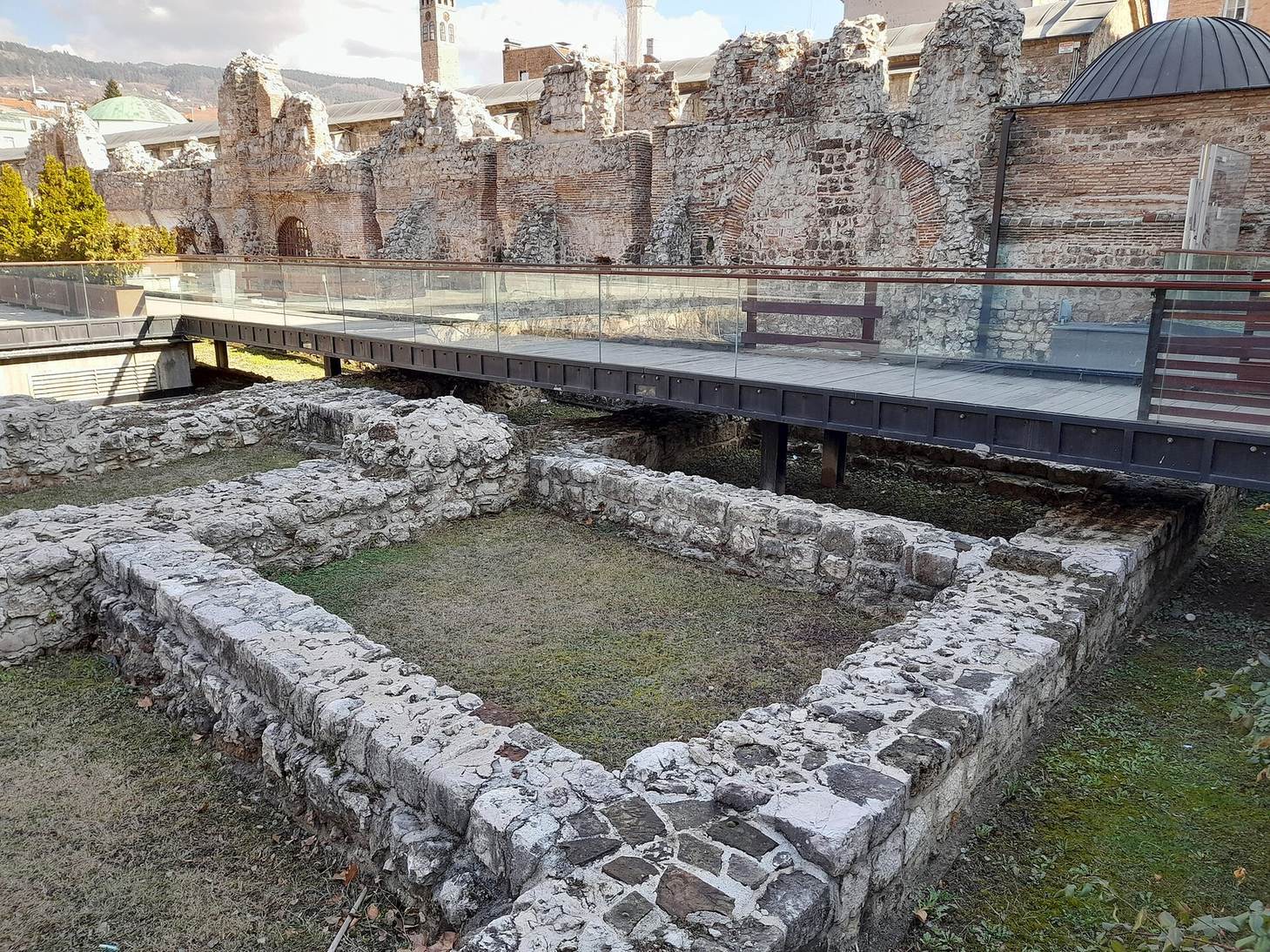
Excavations revealed parts of the foundations and massive walls, with ovens associated with the east wall. The surviving remains consist of that wall and part of the foundations beside it. In preparation for the hotel garage, the foundations were removed in December 2007, packed into 27 crates, and stored during construction. They were later placed on the garage’s concrete slab, while the east wall was braced and the foundations stabilized. Dedicated lighting illuminates the remains, and a pedestrian bridge runs beside and across them. The underground garage lies beneath most of the Tašlihan site.
Hotel buildings
The original block of Hotel Europe stands west of the former caravanserai site and is Neo-Renaissance in style. The hotel’s western section is intended to retain its historical character, while its modern eastern section extends over more of Tašlihan’s former footprint.