Odry: A Wielbark Culture Cemetery in Poland
Site at a Glance
- Popularity
- High
- Country
- Poland
- Primary era
- Classical
- Eras represented
- Classical
- Civilizations
- Unclassified
- Site type
- Burial
- Remains
- Necropolis
On this page7 sections
History
Odry is a cemetery near the village of Odry in Poland, on the eastern bank of the Wda River. It is associated with the Wielbark culture and the first centuries CE, when Goths and Gepids moved from Scandinavia toward the Black Sea. The Wielbark culture formed through interaction between newcomers and local communities. This reconstruction differs from the account of Jordanes, a Gothic historian, which does not describe extensive Gothic settlement in Pomerania.
Early dating and changing interpretations
In 1874, archaeologist Abraham Lissauer used fragments of flint tools from the site to assign it to the Neolithic. In 1914, at the request of archaeologist Gustaf Kossinna, geodesist Paul Stephan surveyed the circles and proposed that they served as a prehistoric observatory and calendar. That interpretation remained disputed. Prehistorian Józef Kostrzewski considered it highly implausible, while later surveys did not conclusively settle the question.
Kostrzewski rejected Lissauer’s Neolithic dating in 1926, assigning the circles, barrows, and burials to the beginning of the Common Era and attributing them to Proto-Slavs, a hypothesized ancestral Slavic population. In 1940, German authorities protected the cemetery as a ‘Germanic sanctuary.’
Migration and the purpose of the circles
Archaeological work led by Jerzy Kmieciński in 1962 produced a theory that a group of Goths from Scandinavia reached the area around AD 70. In this reconstruction, they settled in the Tuchola Forest region for 130 to 150 years before moving southeast through Ukraine toward the northern coast of the Black Sea.
The cemetery was used for burials, but the purpose of its stone circles has been debated. Archaeologist Ryszard Wołągiewicz argued that they served chiefly as places for tribal assemblies and courts, rather than as burial monuments. A ting was a Scandinavian assembly that could also exercise judicial functions. In Wołągiewicz’s interpretation, burials found within circles were placed there after their use for meetings had ended.
The cemetery lies within the Stone Circles Archaeological and Nature Reserve. Modern esoteric and ancient-astronaut ideas about the site have contributed to harmful treatment: stones have been stolen or moved, and rubbing or embracing them despite prohibitions has damaged rare protected lichens.
Remains
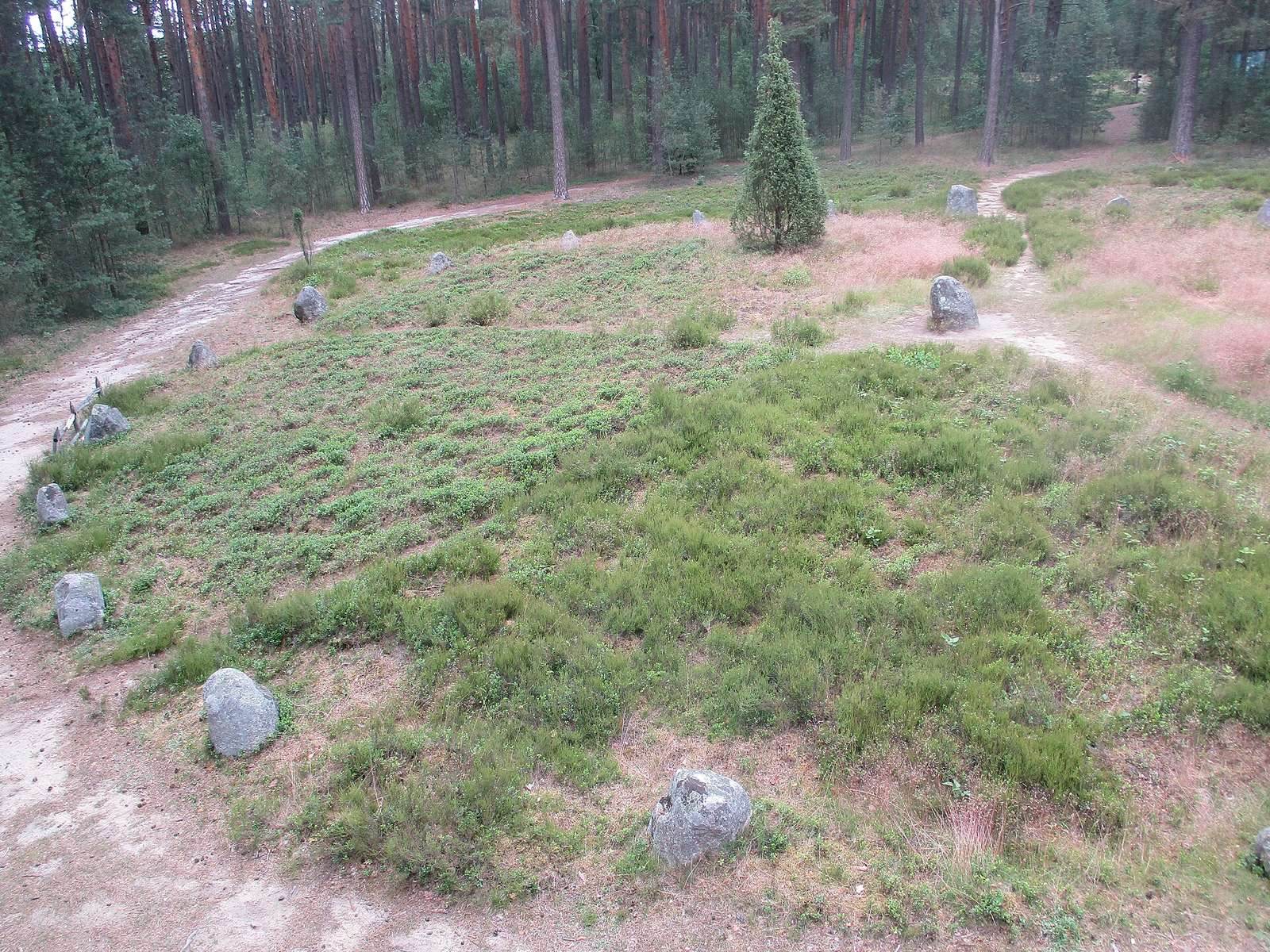
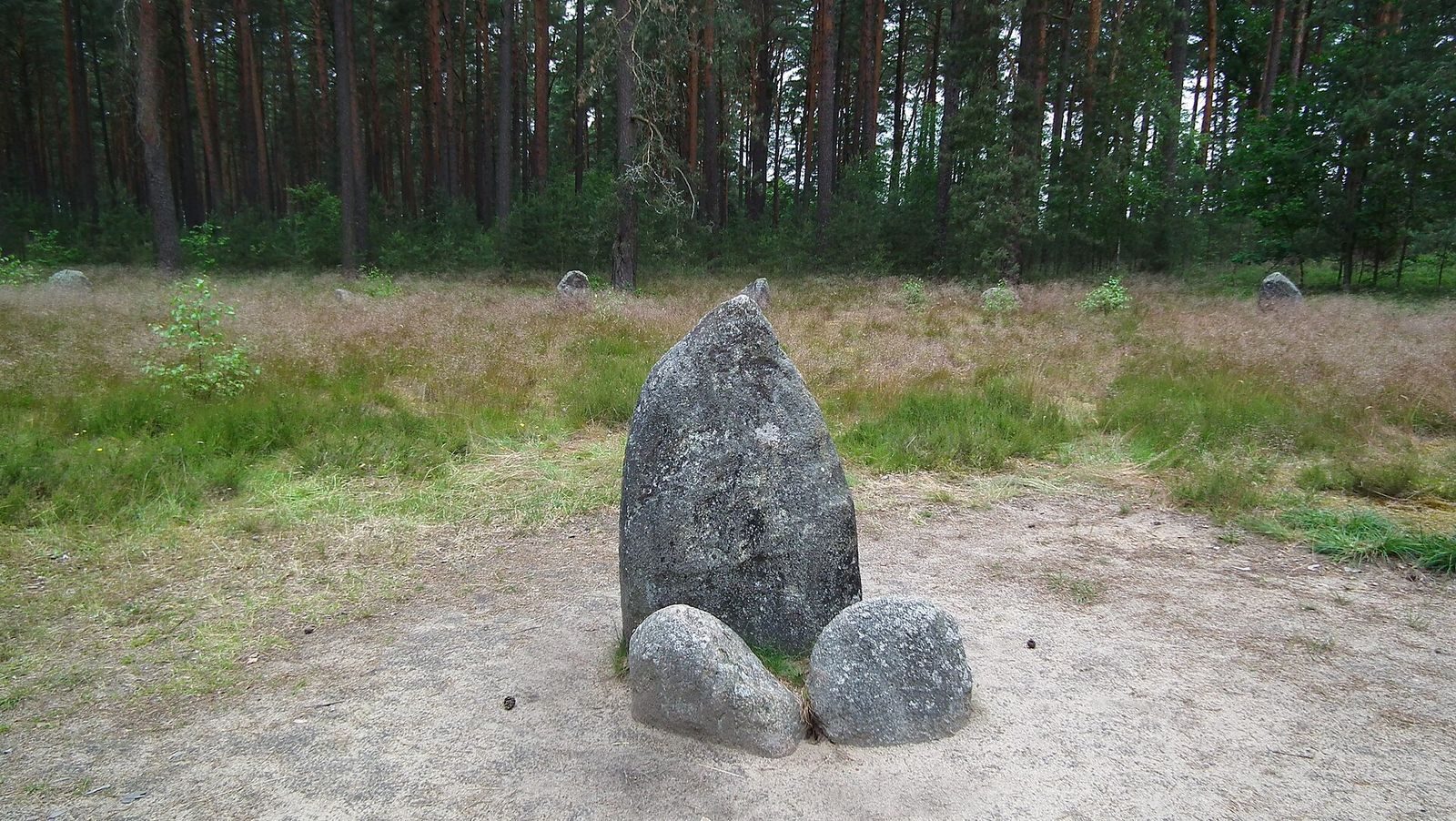
The 16.91-hectare cemetery contains 10 stone circles and 29 burial mounds, alongside other grave forms. Some mounds have an upright stone slab, or stele, as a marker. The remains also include graves marked by stelae, flat graves, and burials from earlier communities, including the Pomeranian culture.
Stone circles
Form and proposed alignments
Stephan reported that the stones around each circle could be fitted to a circular outline within a few centimeters, and that the circles’ internal diameters appeared to have proportional relationships, perhaps reflecting a chosen unit of length. He also noted that lines between the centers of selected pairs of circles, extended toward the horizon, roughly matched the Sun’s rising and setting directions at the solstices. He proposed that the circles and surrounding stones formed a system for observing and tracking the solstices, with paired central stones serving as sights.
One proposed alignment was thought to point toward the star Capella’s heliacal setting around 1800 BCE. A heliacal setting is a star’s last visible setting shortly before it disappears into the Sun’s glare. Stephan himself treated the Capella alignment as uncertain and in need of verification. Solar rise and set directions alone cannot date the circles, since their positions shift only slightly over several millennia. In 1992, a team from the Adam Mickiewicz University Astronomical Observatory found that the terrain along the proposed sightlines effectively prevented direct observation of the Sun against the horizon. The researchers concluded that the apparent orientations could also be coincidental.
Disturbance and surviving evidence
Excavations in 1926 irreversibly altered the stones’ original positions, making precise reconstruction of their earlier alignments impractical. Traces of ploughing occur at the location of one circle, and archaeologists judged that activity to predate the circle. Fragments of flint tools have also been found at the cemetery.