Beiyue Temple: A Taoist Temple in Quyang, China
Site at a Glance
- Rating
- 4
- Popularity
- Very Low
- Country
- China
- Primary era
- Medieval
- Eras represented
- Medieval, Early Modern
- Civilizations
- Ming, Song, Tang, Yuan
- Site type
- Religious
- Remains
- Temple
On this page10 sections
History
Beiyue Temple is a Taoist temple in Quyang, Hebei Province, China. Taoism is a Chinese religious tradition in which sacred mountains hold religious importance. The temple was established either during the Northern Wei or Tang dynasty, while the site may have been in use as early as the second century BCE, under the Han dynasty.
Early worship and Song-era rites
During the Song dynasty, the rival Liao dynasty, ruled by the Khitan, controlled Mount Heng. Song emperors used Beiyue Temple as an alternative place to sacrifice to the Northern Peak. The rites helped sustain their claim to political legitimacy and seek Taoist support, even though they lacked control of the mountain. They believed a geomantic vein, a supposed channel of forces within the earth, could carry offerings across Liao-controlled territory to the peak.
Destruction and rebuilding
Khitan forces destroyed the temple in the 950s. It was rebuilt in 991 and again in 1270. By 1672, it had acquired its present layout, which appears in a local history of Quyang written that year.
Many temple buildings were rebuilt in the late twentieth century. In 1982, Beiyue Temple was included in the second batch of China’s Major Historical and Cultural Sites Protected at the National Level.
Remains
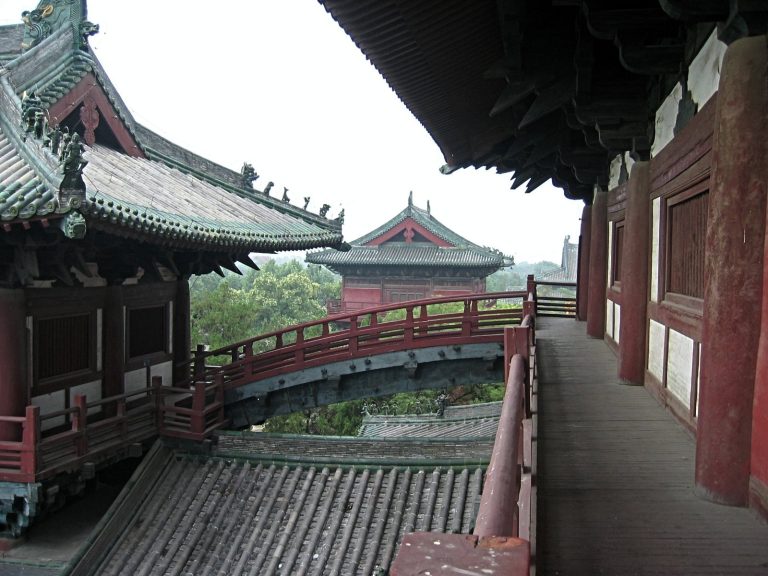
The surviving complex comprises six buildings arranged on a north–south axis, with Dening Hall as its main structure. The enclosure also incorporates a remnant of Quyang’s former city wall.
Other buildings and grounds
Gates and Tianyi Pavilion
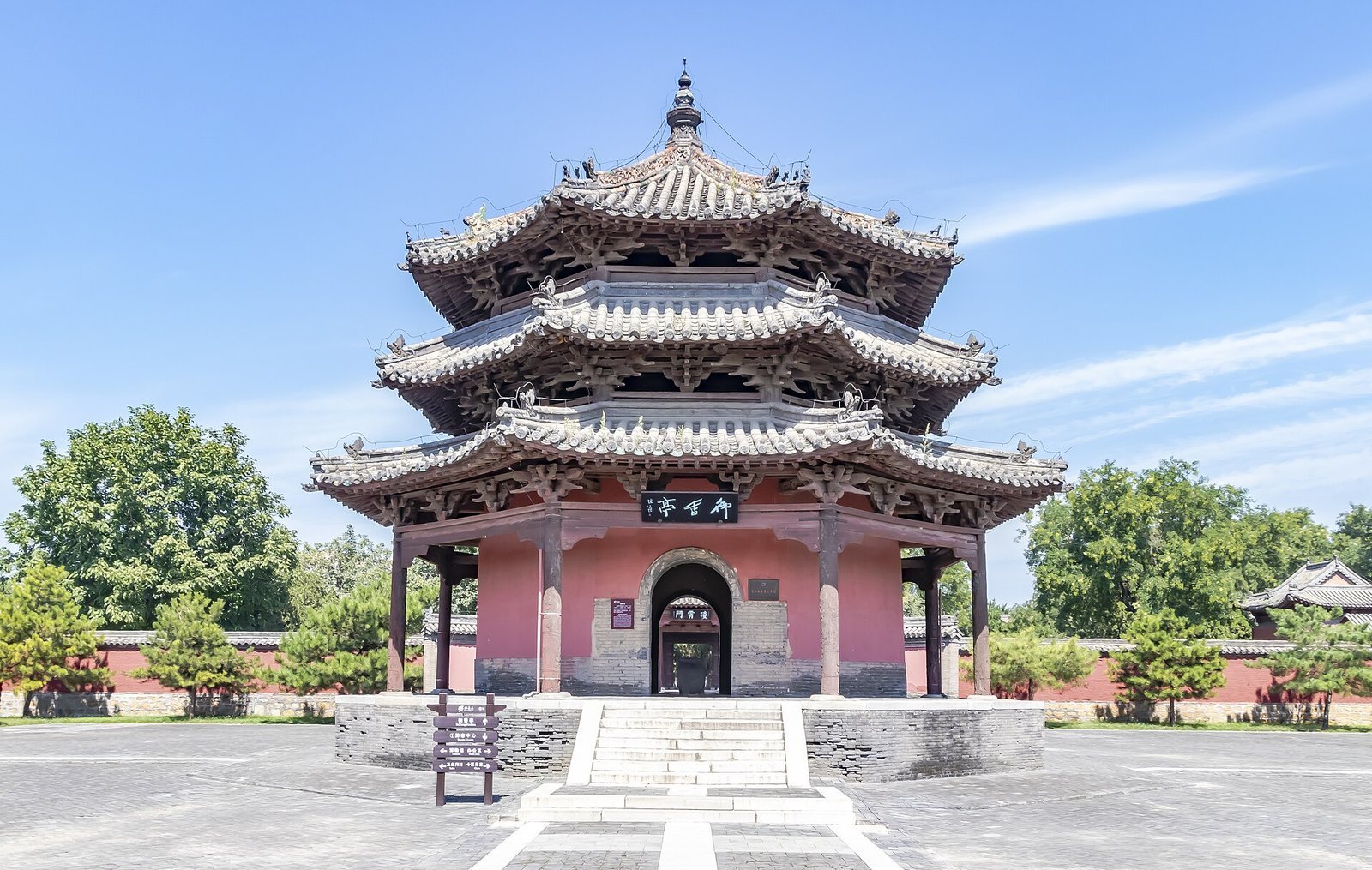
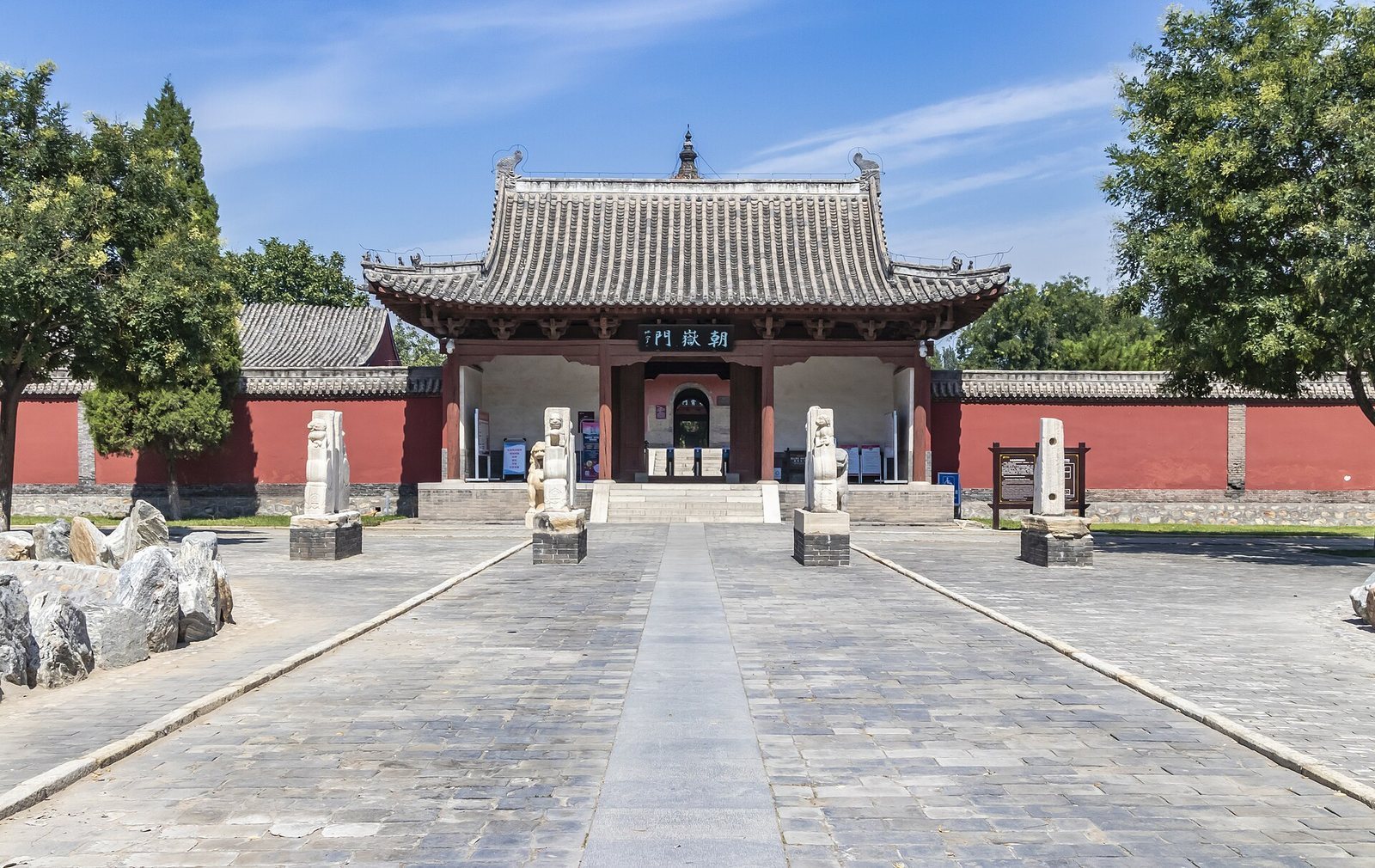
The buildings along the axis include a southern gate, the octagonal Tianyi Pavilion, two further gates, and Dening Hall at the northern end. Tianyi Pavilion dates to the Ming dynasty. The temple’s south gate formerly served as one of Quyang’s principal town gates, and part of the former city wall survives within the temple enclosure.
Stelae and earlier hall platform
More than 137 stelae on the temple grounds date from the Northern Wei through the Qing dynasty. A large platform in front of Dening Hall contains remains of stone sculptures and occupies the site of an earlier hall.
Dening Hall
Platform and architecture
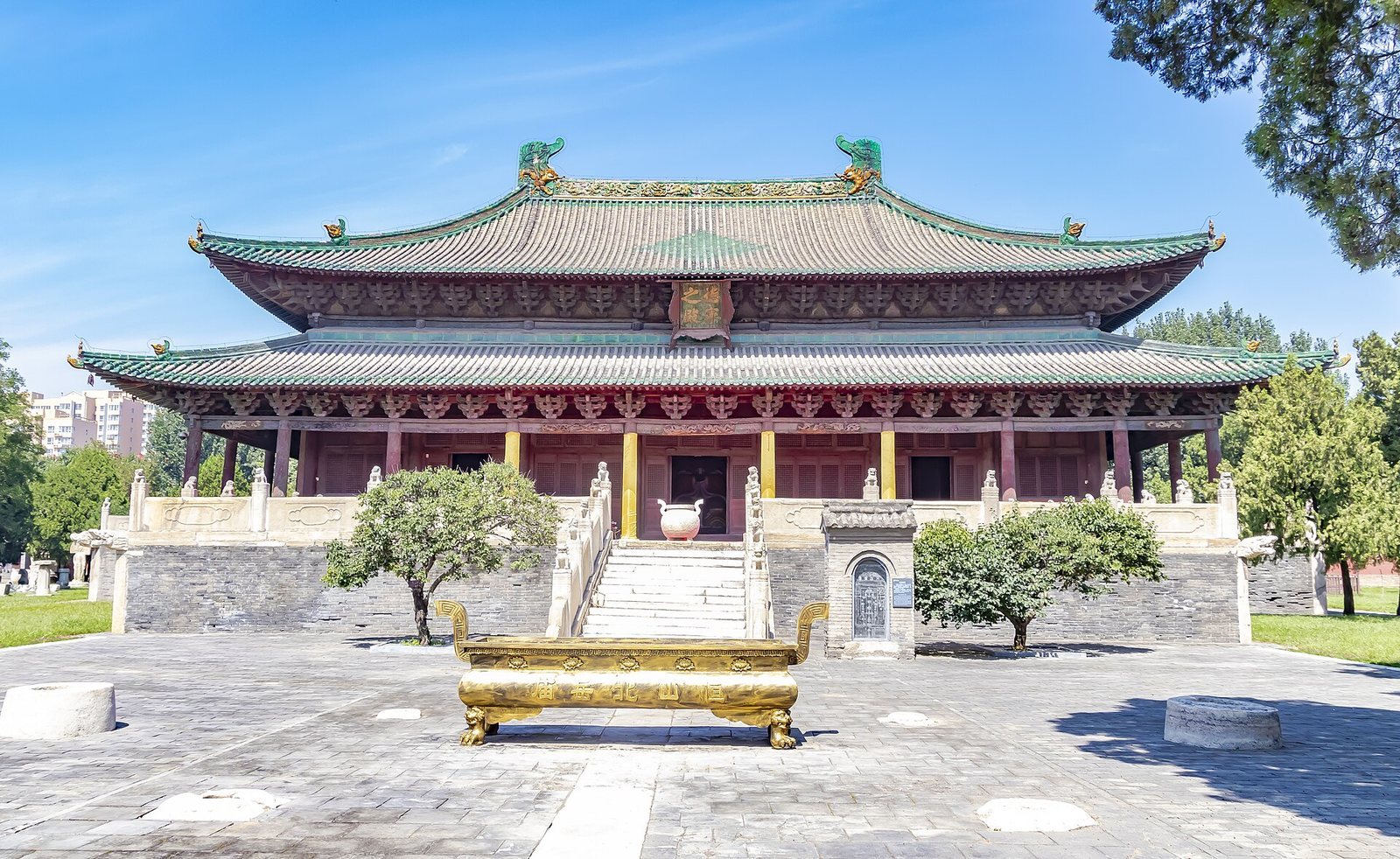
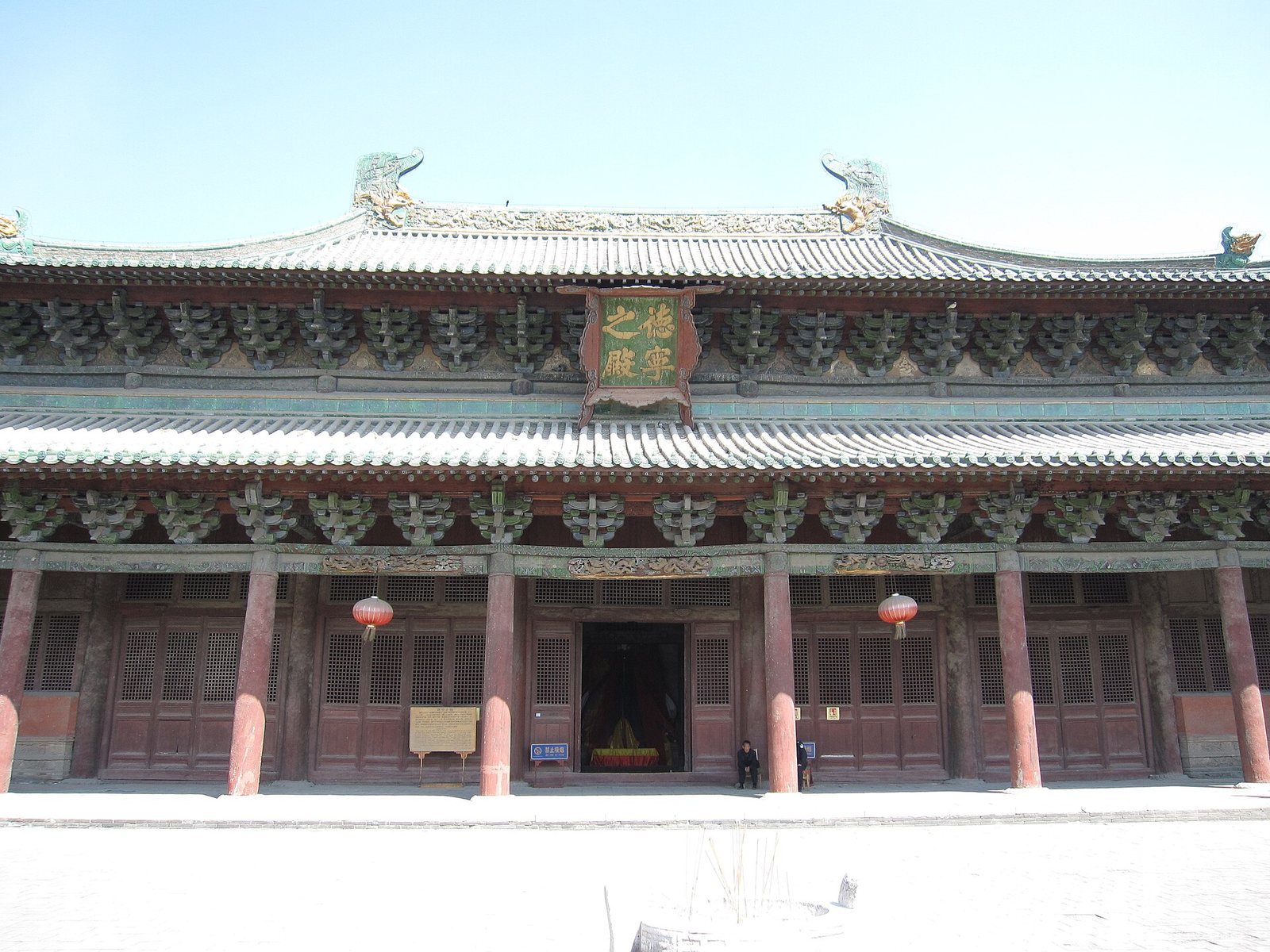
Built during the Yuan dynasty, Dening Hall is the largest and earliest surviving wooden building of that period, and one of its most important. It stands on a high platform fronted by a 25-by-20-metre moon platform, a raised terrace before the hall. A central staircase at the front and two side staircases provide access. A white marble balustrade topped with lions encloses the platform.
The hall measures seven bays across and four deep, with each bay spanning the space between columns. A covered arcade surrounds it. The roof rests on sixth-type puzuo, an interlocking system of roof-support brackets, with three transverse and three horizontal arms. This is the most complex bracket type surviving from the Yuan period. Architectural historian Nancy Shatzman Steinhardt identifies the hall as one of the two most eminent and important surviving Yuan wooden halls, citing its brackets, marble balustrade, and raised platform. Its features also closely match descriptions of buildings at Dadu, the Yuan capital on the site of present-day Beijing, and represent that capital’s lost building tradition.
Murals and statues
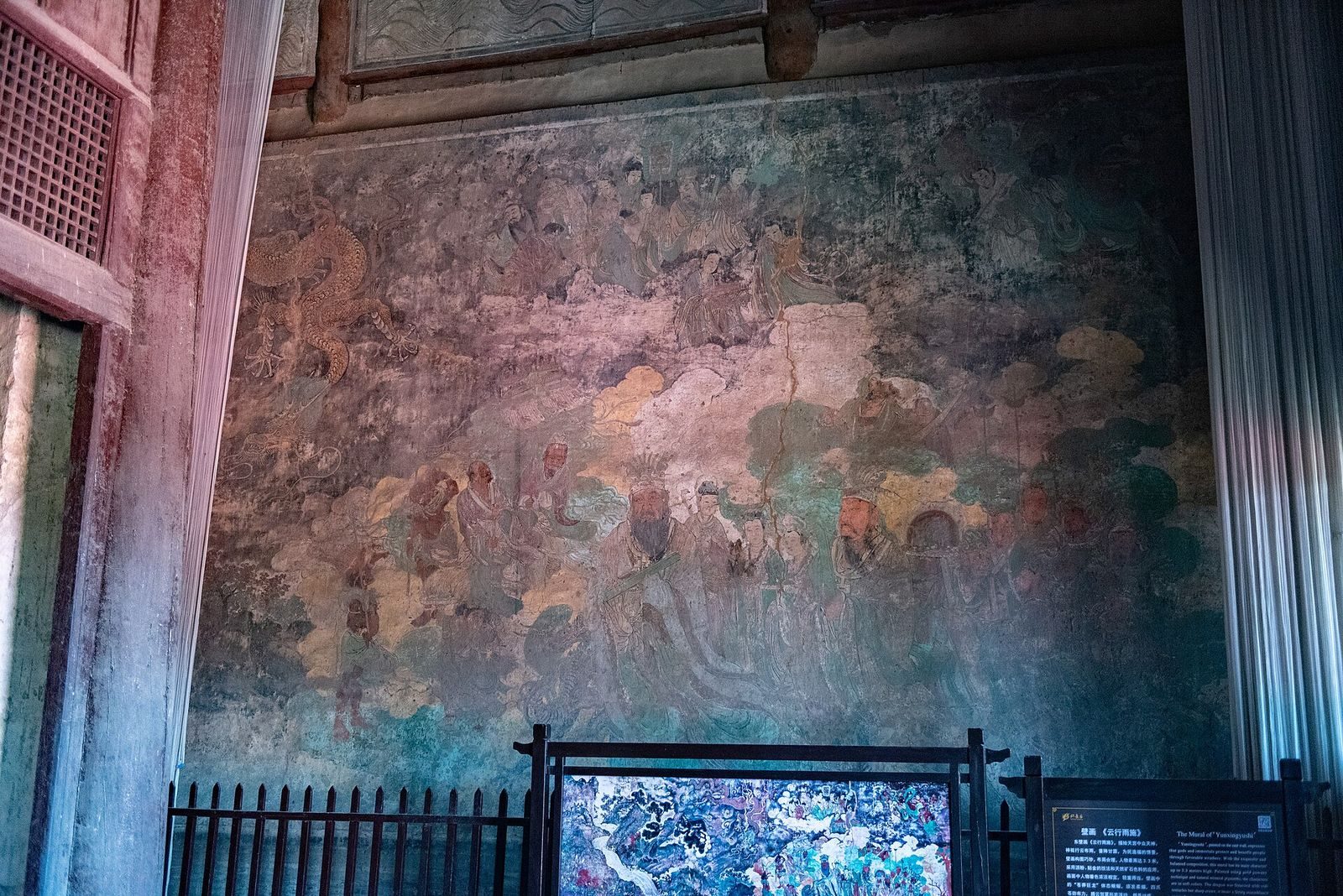
Taoist murals cover three walls of the hall. The western mural, attributed to the Tang dynasty, measures 17 by 7 metres and depicts a local water deity with a winged being above. A mural of similar dimensions on the eastern wall shows the Dragon King, a figure associated with water and rain. The hall also contains nine statues, all made later than the building.