Nikolajevska Church: A Serbian Orthodox Church in Novi Sad
Site at a Glance
- Popularity
- Medium
- Country
- Serbia
- Primary era
- Early Modern
- Eras represented
- Early Modern, Modern
- Civilizations
- Habsburg, Habsburg Austria
- Site type
- Religious
- Remains
- Church
On this page8 sections
History
Foundation and construction
Nikolajevska Church is a Serbian Orthodox church in Novi Sad, Serbia, built between 1726 and 1730 in a modest Baroque style. It is widely regarded as the city’s oldest surviving Orthodox church. Dedicated to the Translation of the Relics of Saint Nicholas, a feast commemorating the transfer of the saint’s relics, it belongs to the Diocese of Bačka, the church district serving the region.
A wooden predecessor probably stood here after the Great Migration of the Serbs in 1692, a large movement of Serbs from Ottoman lands into Habsburg territory. The present church was built slightly south of that earlier building. Its founders were the brothers Nedeljko and Stojić, wealthy merchants from Slavonia who lived in Petrovaradinski Šanac, the settlement that later developed into Novi Sad. Nedeljko Bogdanović built the church, which was intended as a family tomb and became known locally as Nedeljko’s Church. It was consecrated and first documented in 1730.
Worship and nineteenth-century damage
In the late eighteenth century, the church served Greek and Russian worshippers and, for a period, Greeks and Aromanians, a Romance-speaking people of the Balkans. Services alternated between Greek and Church Slavonic, a historical language used in Orthodox worship. Pavle Balta was the last priest to conduct services there in Greek.
On 12 June 1849, bombardment during the Hungarian Revolution of 1848–49 left the church severely damaged and close to destruction. The interior decoration was ruined, and the church books burned. The building was used as a military warehouse until 1854. After an appeal for restoration, Jovan and Marija Trandafil were among the first contributors in 1860; Jovan Polit and Ananije Dera also helped. Repairs started that year, and restoration work followed in 1861–62.
Endowment and later history
Marija Trandafil’s 1878 bequest established a fund for the church. It gave the church a house known as the House with an Icon, along with income from the house and from arable land measuring eight cadastral yokes in one locality and 73 in another. A cadastral yoke was a historical unit of land area. A third of the net income from a house in Osijek was assigned to the Poorhouse, then situated in the churchyard. The fund paid for a priest, sexton, and cantor, and provided lifetime support of 200 forints a year to a priest’s widow.
Local tradition holds that Hans Albert and Eduard, the sons of Albert Einstein and Mileva Marić, were baptized in the church on 20 September 1913 at the request of their maternal grandfather, Miloš Marić. Bombing of Novi Sad on 6 April 1941 caused substantial damage to the church. Its iconostasis received state protection in 1948, and the building was designated a cultural monument in 1959. In 1991 it was classified as an Immovable Cultural Heritage of Great Importance of the Republic of Serbia.
Remains
Exterior and setting
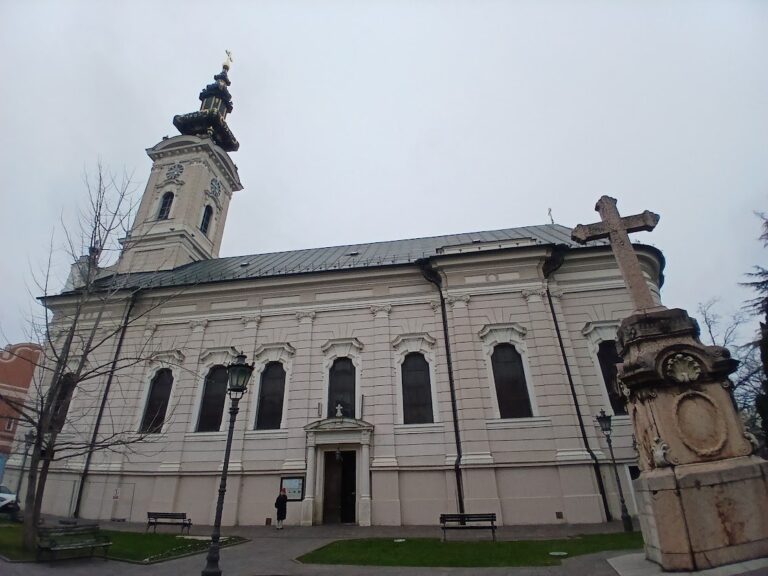
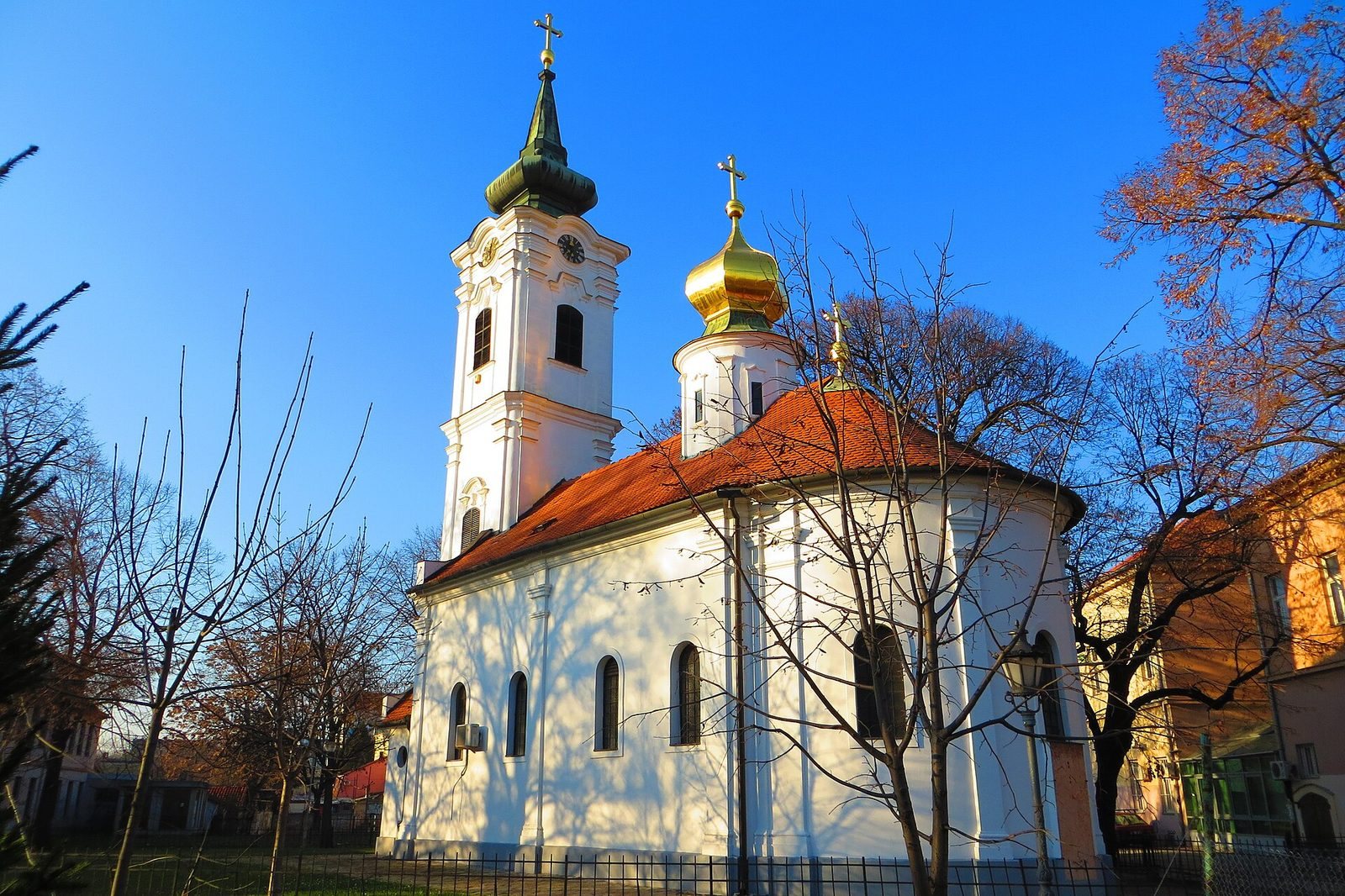
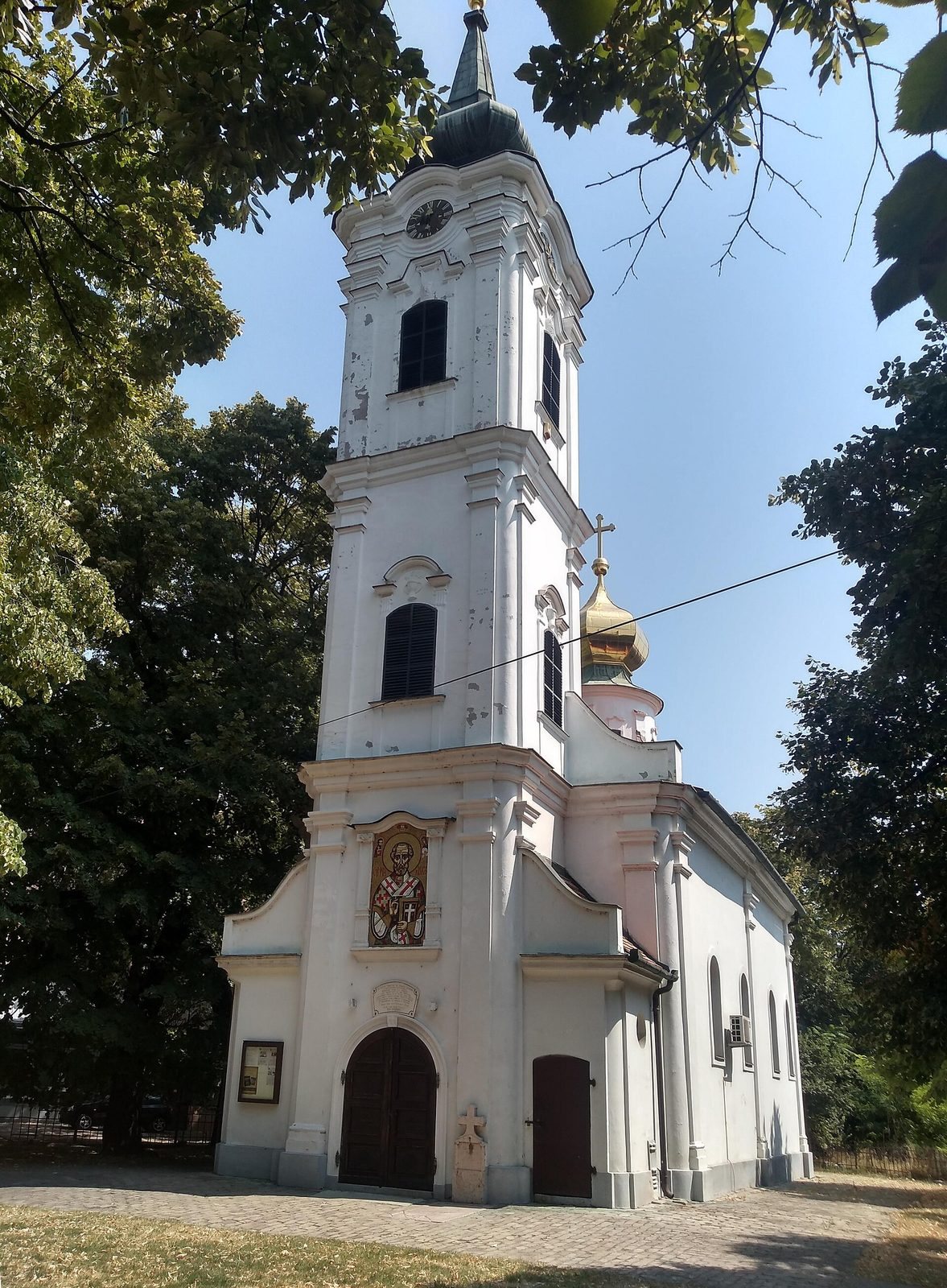
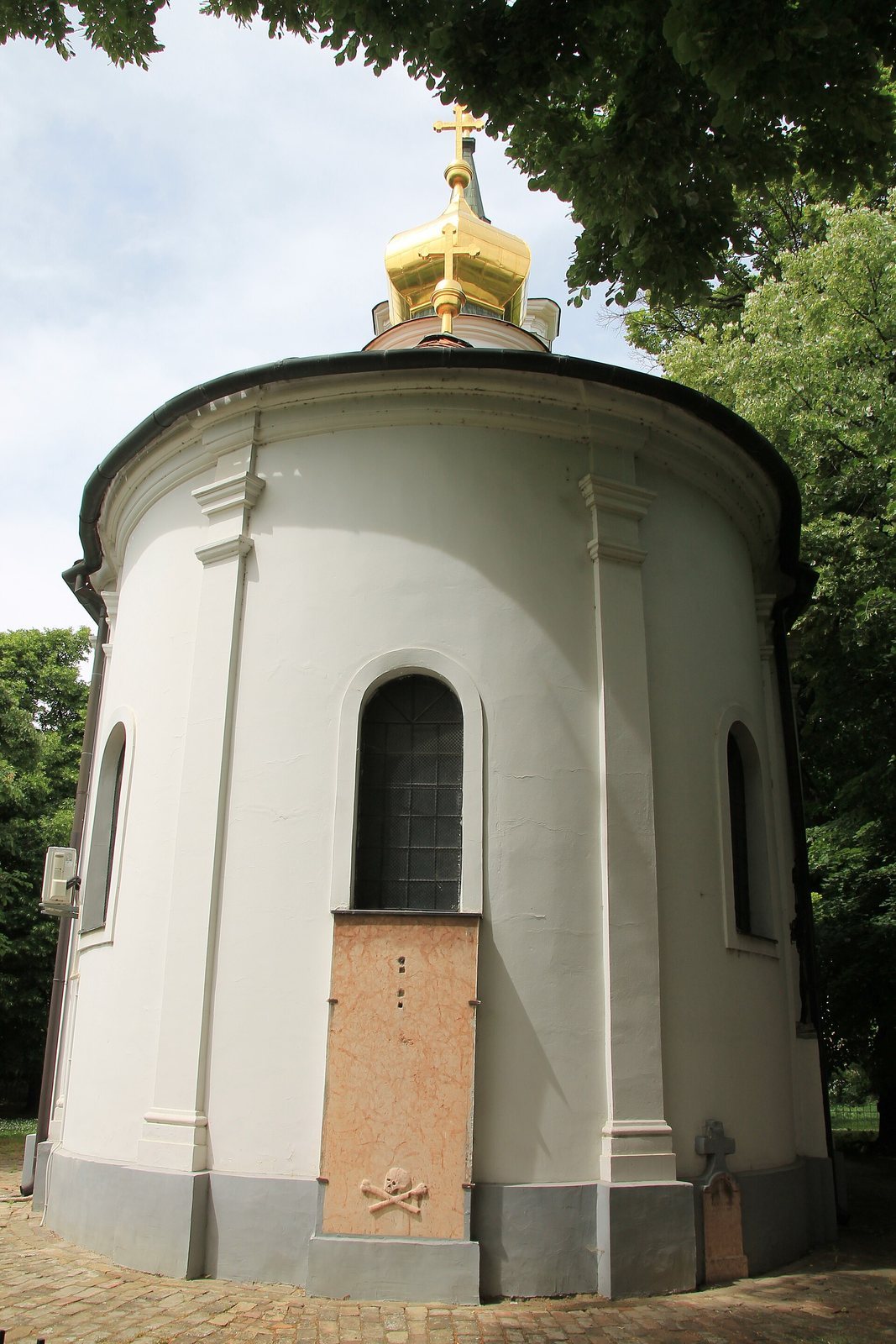
The church stands where Nikola Pašić Street meets Maria Trandafil Square, in Novi Sad’s Stari Grad district. It is described as the city’s smallest Orthodox place of worship. Its plan has a single nave (the main worship space) and a semicircular apse (a recess at the altar end) slightly narrower than the nave. The west-facing façade is dominated by a tall, massive bell tower with two projecting sections. A small decorative dome rises above the nave, while two gilded roof cupolas in the Russian imperial style date to the mid-eighteenth century. Shallow pilasters (attached, shallow wall supports) and profiled cornices (projecting horizontal mouldings) shape the exterior. The design reflects Central European influences found in Serbian Orthodox churches built under the Habsburg Monarchy, a Central European dynastic state that ruled the region.
Interior and painted decoration
The interior has white surfaces, little wall ornament, and sparse furnishings. Its simple iconostasis (a screen of icons separating the sanctuary from the main worship space) was painted by the Serbian artist Pavle Simić, with a style influenced by the nineteenth-century Nazarene movement, which drew on earlier Christian art. A principal icon of Saint Nicholas stands on the screen. Behind the Royal Doors, the central doors leading into the altar area, is an icon of the Black Madonna of Malta, a dark-colored depiction of the Virgin Mary, probably donated by a Greek worshipper. Wall paintings are attributed to Dimitrije Petrović Kerefeka, Nikola Dimšić, and Živko Petrović. Work in 1959 uncovered frescoes attributed to Dimšić.
Inscriptions and burials
An icon of Saint Nicholas is placed above the entrance, with an inscription above the entrance as well. A tombstone dated 1749 on an exterior wall bears the earliest known local inscription of the name Novi Sad. Tombstones also stand in the churchyard. Inside the church are the graves of Nedeljko Bogdanović and Jovan Trandafil with their families, as well as Marija Trandafil and her children Kosta and Sofija.