Hirabaru Site: Yayoi-Period Burial Mounds in Japan
Site at a Glance
- Rating
- 4.3
- Popularity
- Medium
- Country
- Japan
- Primary era
- Classical
- Eras represented
- Classical
- Civilizations
- Yayoi
- Site type
- Burial
- Remains
- Necropolis
On this page9 sections
History
Yayoi-period burials
The Hirabaru Site is a group of burial mounds from the Yayoi period in Arita, Itoshima, Fukuoka Prefecture, Japan. The Yayoi period is an archaeological period of Japanese prehistory. The mounds date to its later and final stages, and Tomb No. 1 is thought to have been built near the period’s end.
Discovery and interpretation
Tomb No. 1 came to light in January 1965, when an orchard was being cleared for cultivation. Archaeologist Dairoku Harada led the investigation that followed. Surveys carried out around the tomb from 1988 to 1999 identified four more mounds.
The burial has not been linked to a specific person. Its personal ornaments, together with the relative scarcity of weapons, have led to the interpretation that the deceased was a woman. The number of mirrors has also been understood as evidence of very high status. Theories placing Yamataikoku in Kyushu have proposed that Tomb No. 1 may have belonged to Himiko, the queen described in early Chinese records as ruler of that polity, whose location remains debated.
Harada identified one large mirror with Yata no Kagami, one of Japan’s Three Imperial Regalia, sacred objects associated with imperial legitimacy and traditionally linked to Ise Grand Shrine. He suggested that the mirror at Ise might originally have been of the same type. His comparison drew on a Shinto text associated with Ise that describes the sacred mirror as having an eight-petal form. A shrine in Nakagawa City holds a memorial rite for Ōhirume no Mikoto, an honorific name for Amaterasu, the Shinto sun goddess, each October 20, following Harada’s interpretation. A local festival is also held in October.
Protection and recognition
The Hirabaru Site forms part of the Sone Sites, a group of archaeological sites in Itoshima. The group was designated a National Historic Site in 1982, and its protected area was expanded in 2000. Finds from Tomb No. 1 received Important Cultural Property status in 1990 and were collectively designated a National Treasure in 2006, a higher-level Japanese cultural-property designation.
Remains
The burial mounds
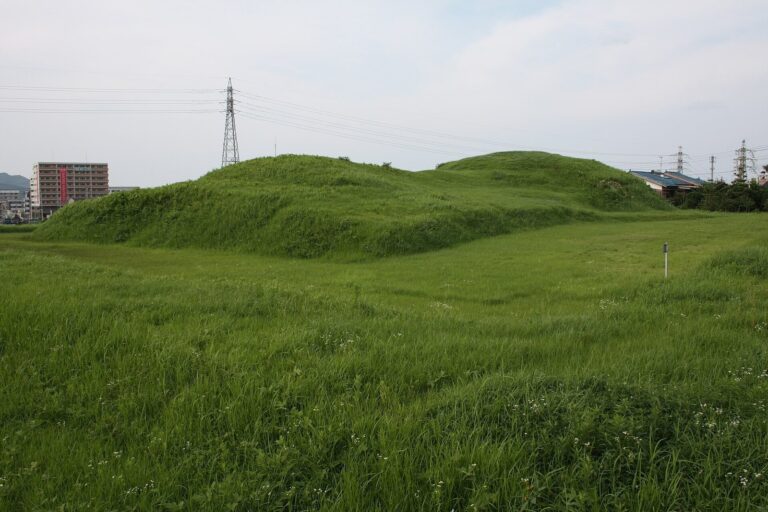
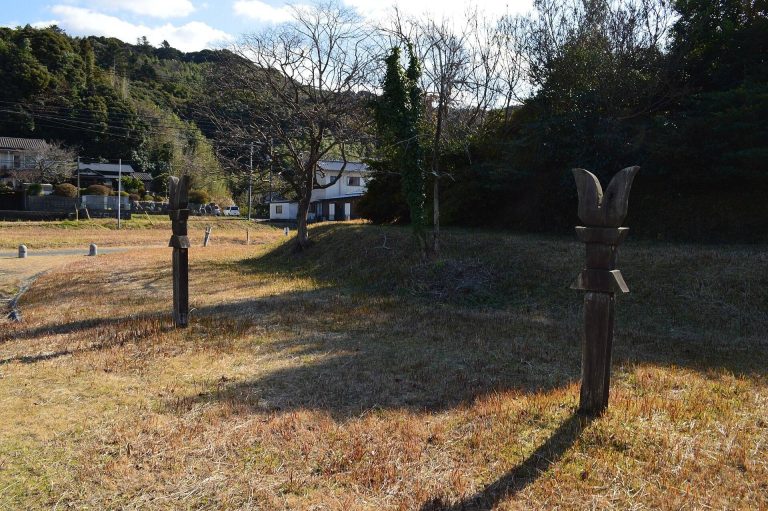
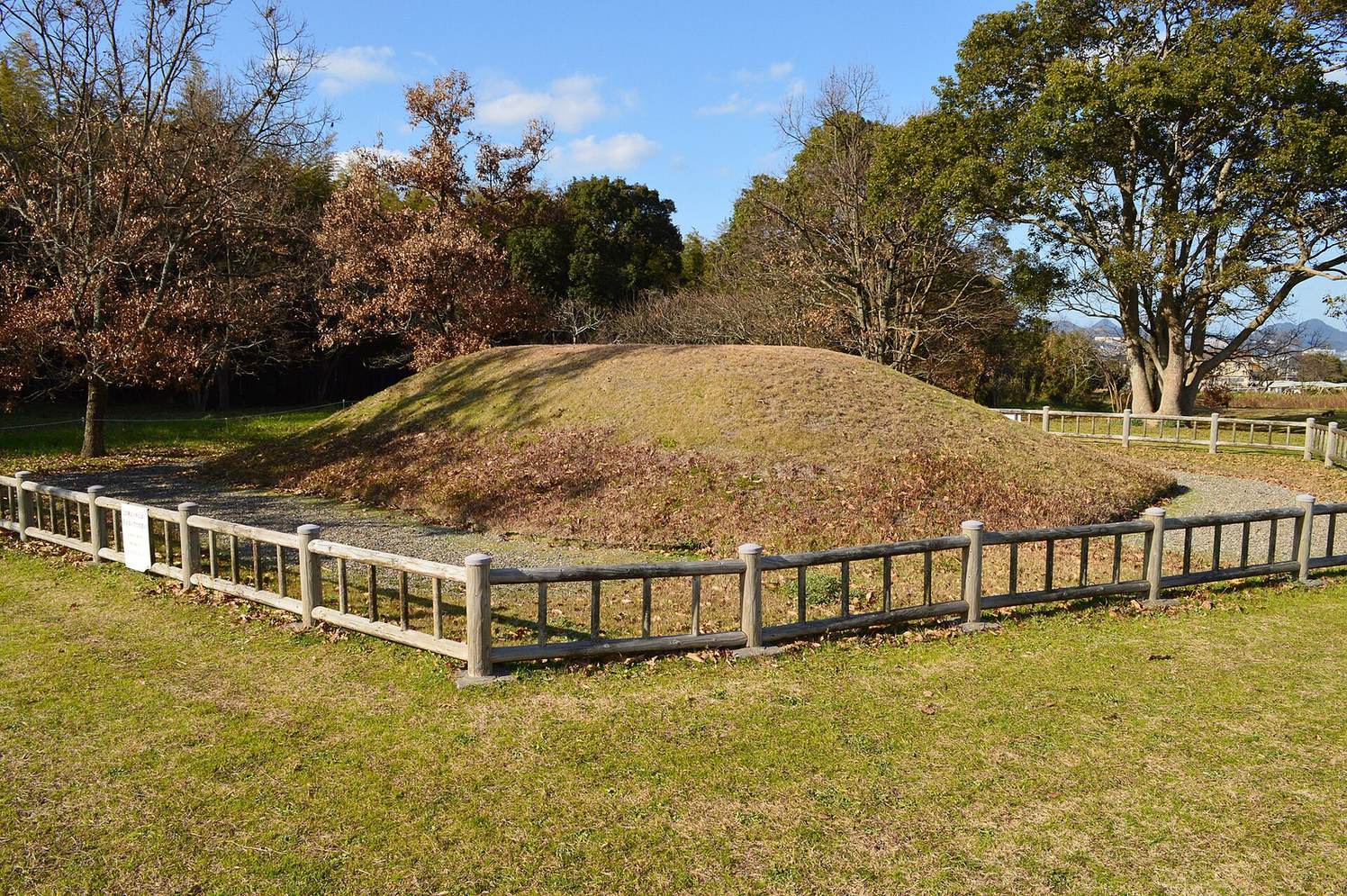
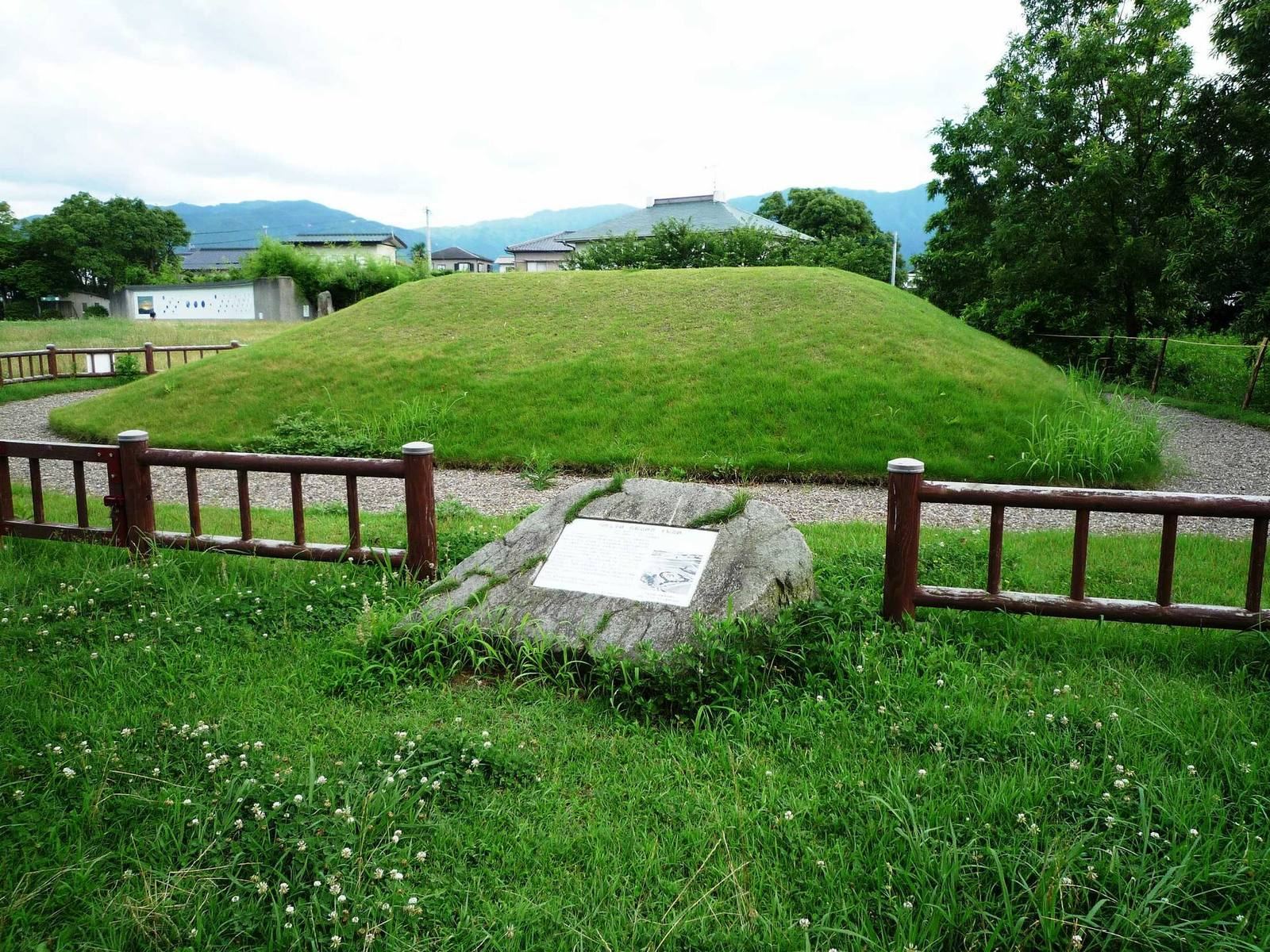
The site comprises three square mounds enclosed by moats and two circular moated mounds. Tomb No. 1 is square, measuring about 14 metres east to west and 10.5 metres north to south; its moat is about two metres wide. It is the only mound reconstructed as a burial mound and is maintained in Hirabaru Historical Park.
Tomb No. 1 and associated features
Excavation found traces of a wooden coffin about three metres long, shaped like a length of split bamboo. Twelve postholes around the burial pit have been interpreted as supports for a raised-floor building with a gabled roof and posts supporting its ridge. Similar buildings appear in depictions on Yayoi pottery and bronze bells, and Harada considered the structure possibly related to mortuary rites. A shaft about 70 centimetres across lies southeast of the tomb. Spring water led Harada to interpret it as a well; another interpretation identifies it as a large posthole. Its position toward a pass to the southeast has also prompted a possible association with sun worship.
Bronze mirrors
Fragments of Japanese- and Chinese-made bronze mirrors from Tomb No. 1 were reconstructed as 39 mirrors, while the 2006 National Treasure designation counted 40. A 1990 materials study proposed that fragments assigned to four large mirrors might represent five. These mirrors measure 46.5 centimetres in diameter and have an eightfold inward-facing floral pattern and eight leaves arranged around the central boss. The earlier count of large mirrors reflected four central bosses, although only two and two-thirds mirrors could be restored to complete form. Harada reported that the mirrors had not been deliberately broken. Their outer circumference was described as eight yata, a measure of mirror circumference. As of 2009, the tomb held the largest number of bronze mirrors recorded from a single tomb in Japan. The collection is owned by the Agency for Cultural Affairs and held at the Itokoku History Museum. One large mirror is displayed at the Kyushu National Museum and four at the Itokoku History Museum.
Other grave goods
Other finds include magatama beads, tubular beads, ear ornaments, an iron sword with a ring-shaped pommel, pottery fragments, glass beads and iron arrowheads. The collection also contains agate tubular beads and a large quantity of glass objects.