Church of the Assumption of Mary in Skaistkalne: A Baroque Pilgrimage Church
Site at a Glance
- Rating
- 4.8
- Popularity
- Medium
- Country
- Latvia
- Primary era
- Early Modern
- Eras represented
- Early Modern
- Civilizations
- Duchy of Courland and Semigallia, Polish–Lithuanian Commonwealth
- Site type
- Religious
- Remains
- Church
On this page8 sections
History
The Church of the Assumption of Mary in Skaistkalne is a Roman Catholic church in Latvia, built in the Baroque style during the late seventeenth century. It is a major Catholic center in Zemgale, the historical region of southern Latvia, and a leading pilgrimage destination devoted to Mary. Its pilgrimages have historically ranked second in popularity to those at the Basilica of Aglona.
The first church and Jesuit mission
Construction of Skaistkalne’s first Catholic church began in 1658 and finished in 1666. That year, the Jesuits, members of the Catholic Society of Jesus, established a permanent mission there. They founded a monastery in 1677. The first church was wooden and stood on a hill about 300 metres east of the present building. After the new church was built, the wooden structure was dismantled and moved to a village in Vecsaule Parish, where it continued to serve a Catholic congregation until the second half of the nineteenth century.
The present church and college plans
Work on the present church began in 1680 and was completed in 1692; it was consecrated in 1698. The church and parish were associated with the Jesuits. In 1710, plans were drawn up for a large Baroque college at Skaistkalne. The design, now held in the Jesuit archive in Rome, showed a two-storey building with four-storey domed towers at each end. The college was ultimately built on a much more modest scale.
Parish life and pilgrimage
From the eighteenth century until 1929, secular Catholic clergy served the parish. The Capuchins, a branch of the Franciscan order, took over the church that year. Their monastery closed in 1949, after which Catholic priests continued to serve Skaistkalne. At the request of Bishop Anton Justs, the Pauline Order, a Catholic monastic order, took responsibility for the shrine and parish in 2001. On 1 January 2022, priest Andrejs Mediņš began serving the parish at the request of Bishop Edvards Pavlovskis. The church is part of the Diocese of Jelgava within the Archdiocese of Riga.
Skaistkalne has also drawn Lithuanian Catholics, particularly from the Biržai region. During the Soviet period, families brought children there for baptism, First Communion, and Confirmation, and some services are held in Lithuanian. Congregations on opposite sides of the Nemunėlis River have also joined processions between the chapel at Germaniškis and the Skaistkalne shrine. The annual Kanepene, a local Catholic pilgrimage feast held around the first Sunday in August, includes prayers for the sick, married couples, and Latvian families. Pilgrims also walk from Riga, Jelgava, and Iecava for the Marian celebration on the first Sunday in May.
At the feast of Saint Hubert, the patron saint of hunters, a tradition described as ancient has involved bringing a freshly hunted deer to the altar and blessing hunters and their dogs after the service. The custom prompted public controversy in 2025.
War damage and later changes
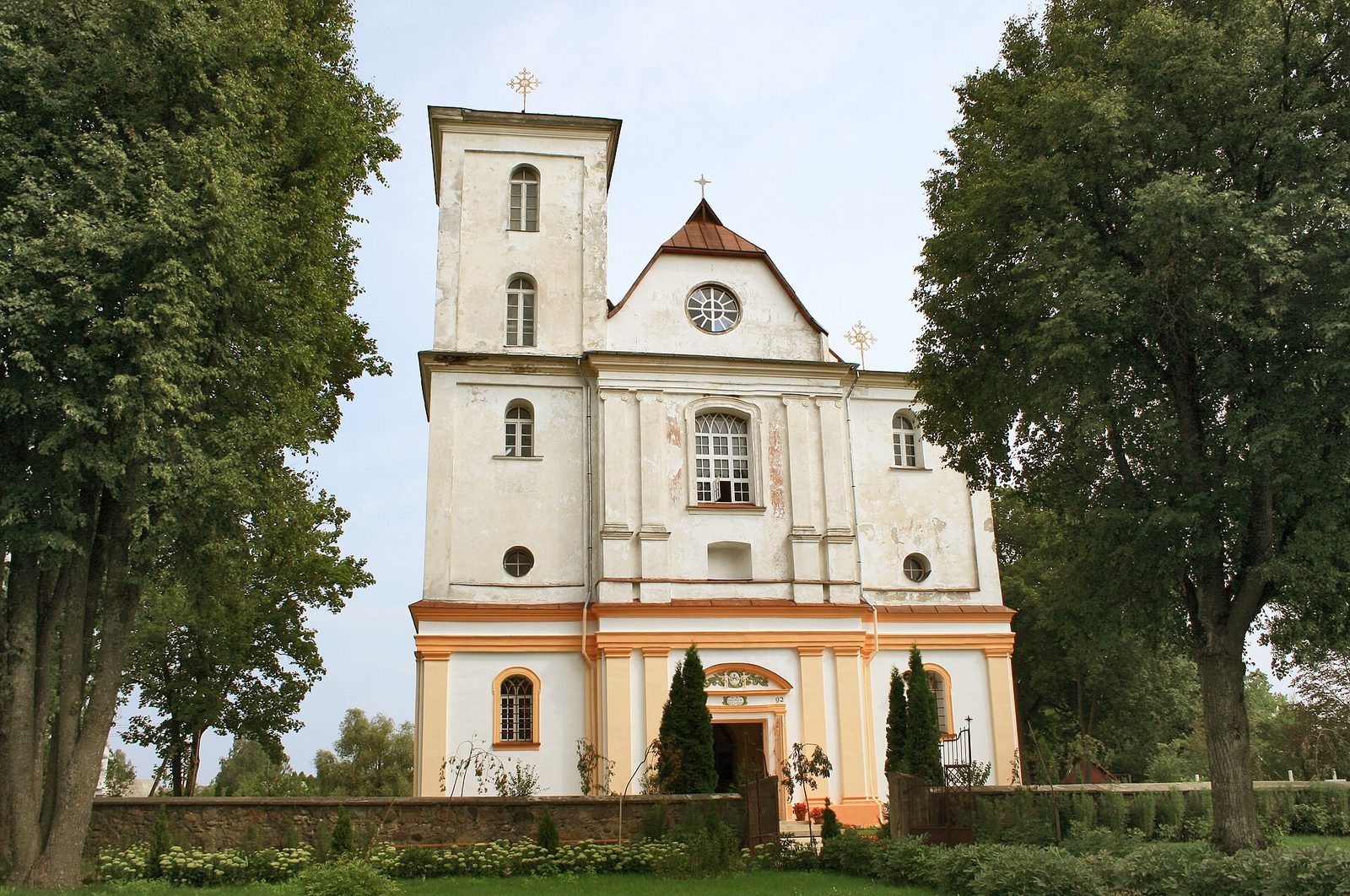
The church’s towers were destroyed during the Second World War. The church is protected as a state-level cultural monument, reflecting its place in Latvia’s architectural heritage.
Remains
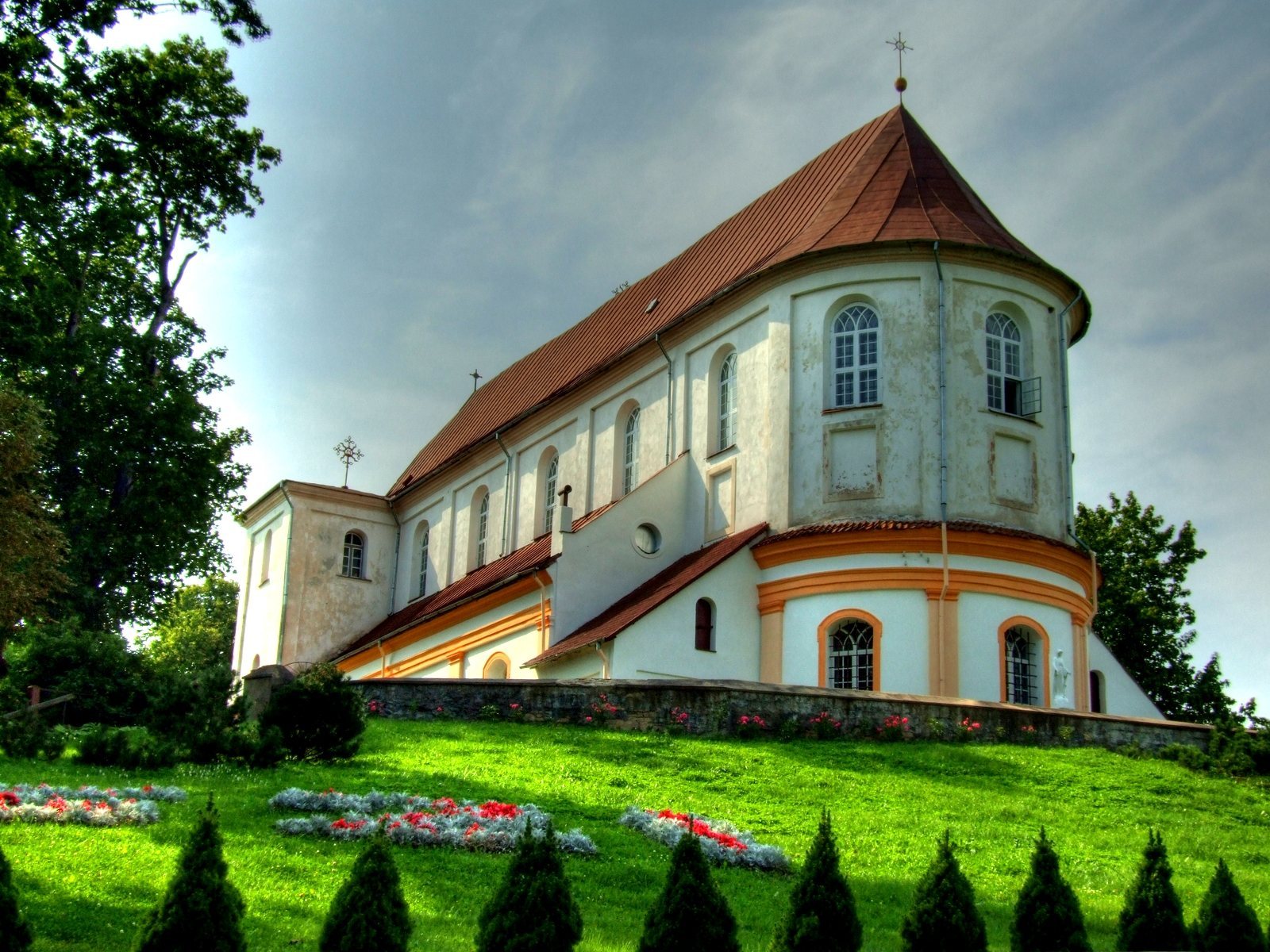
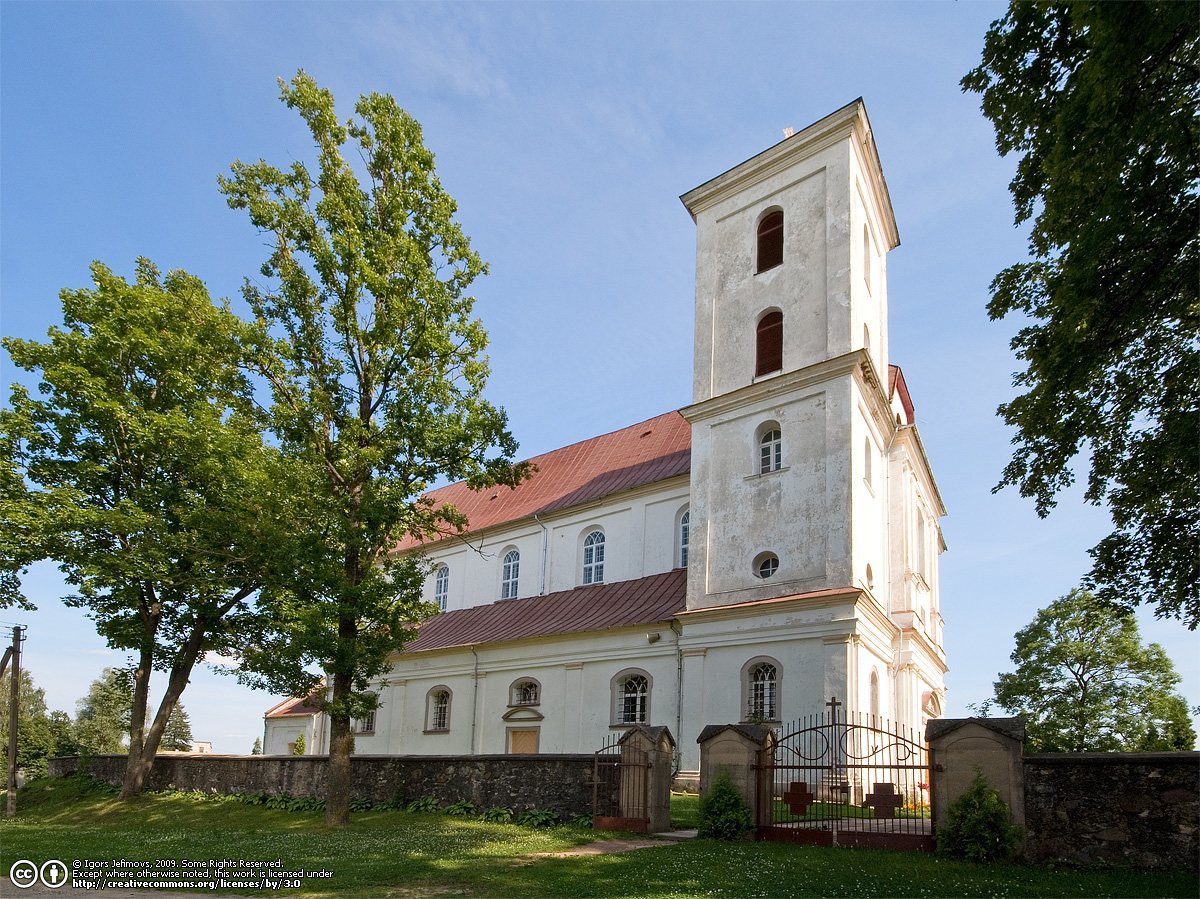
The white-painted masonry church is about 40 metres long and 20 metres wide, with a west-facing façade and two towers at its western end. Its three-aisled basilica plan has a central nave flanked by side aisles. The church is among Latvia’s earliest early-Baroque examples with a two-tower, cathedral-type design. Its form draws on Baroque churches in northern Germany, Poland, and Lithuania.
Interior and devotional features
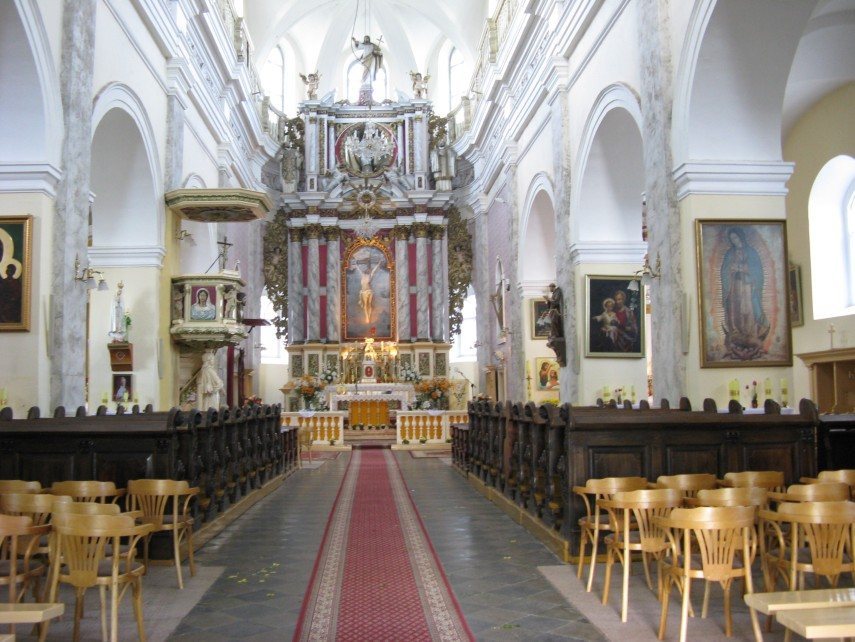
The interior is a distinctive example of Italian Baroque in Latvia. Cross vaults, formed where two barrel vaults intersect, cover its spaces, and a large carved wooden altar rises about 12 metres. Above the central entrance doors, an inscription gives the church’s construction date and the Jesuit motto Ad maiorem Dei gloriam, meaning “For the greater glory of God.” A side altar holds an image of the Virgin Mary venerated as the Wonderworking Lady and Patroness of Latvian Families. Couples and families have prayed before it for blessings. In 2023, the roof covering was replaced and the towers rebuilt, restoring the church’s historic appearance and volume.
Burial crypts
Vaulted crypts beneath the church served for burials during the Duchy of Courland period and continued in use until the nineteenth century. Those buried there include Pēteris Lasis, in 1751, and Georgs Brauns, in 1792, both Catholic governors-general of Vidzeme, or senior regional administrators. The crypts also hold the wife of Filippo Paulucci, a military officer and administrator who held the hereditary title of marquis, and members of Catholic noble families. After long being blocked, the crypts were cleared and restored in 2001–2002.