Natural Monument of La Fortaleza: A Volcanic Mountain and Archaeological Site
Site at a Glance
- Rating
- 4.8
- Popularity
- Medium
- Country
- Spain
- Primary era
- Classical
- Eras represented
- Classical
- Civilizations
- Unclassified
- Site type
- Religious
- Remains
- Sanctuary
On this page13 sections
History
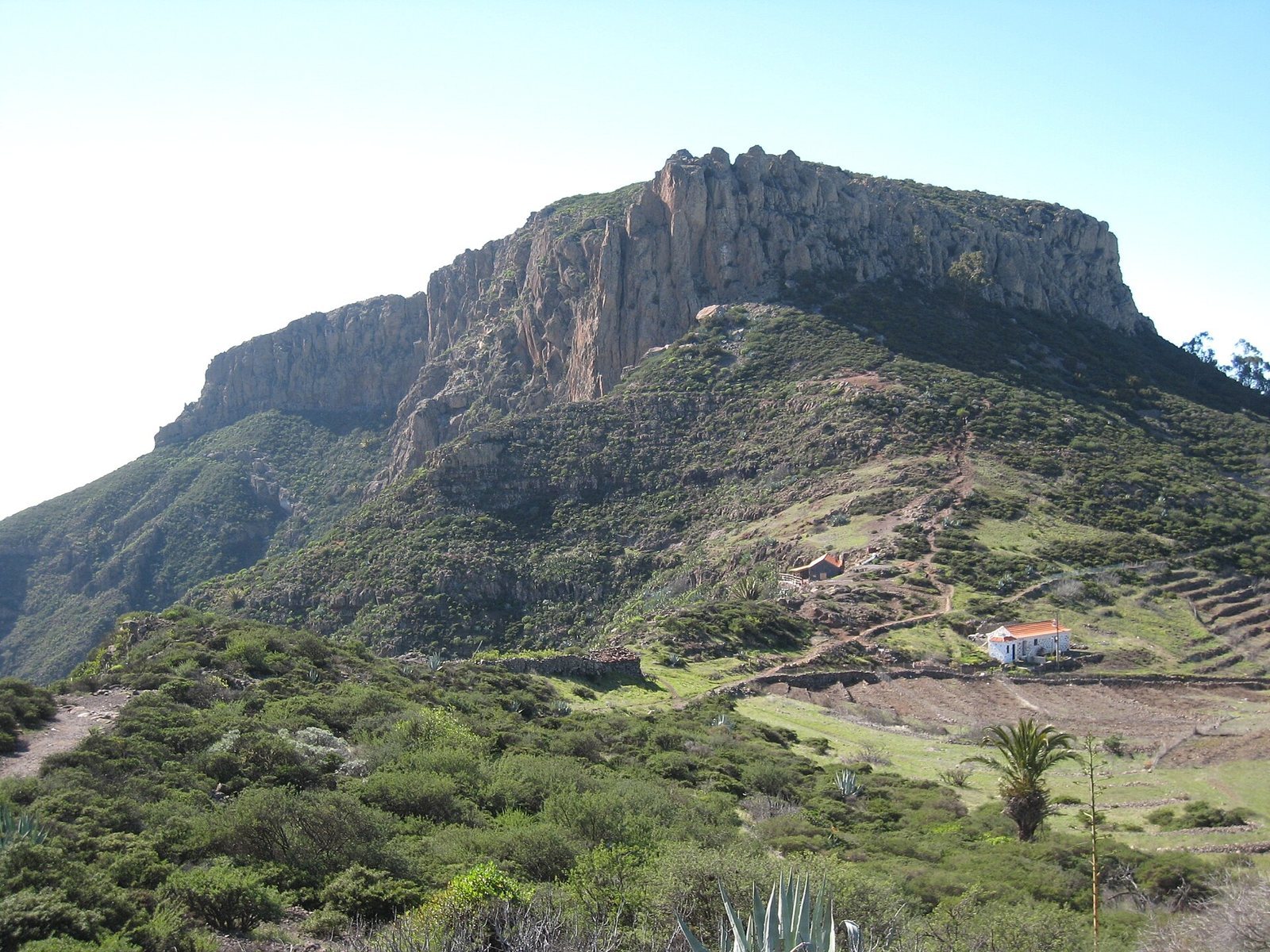
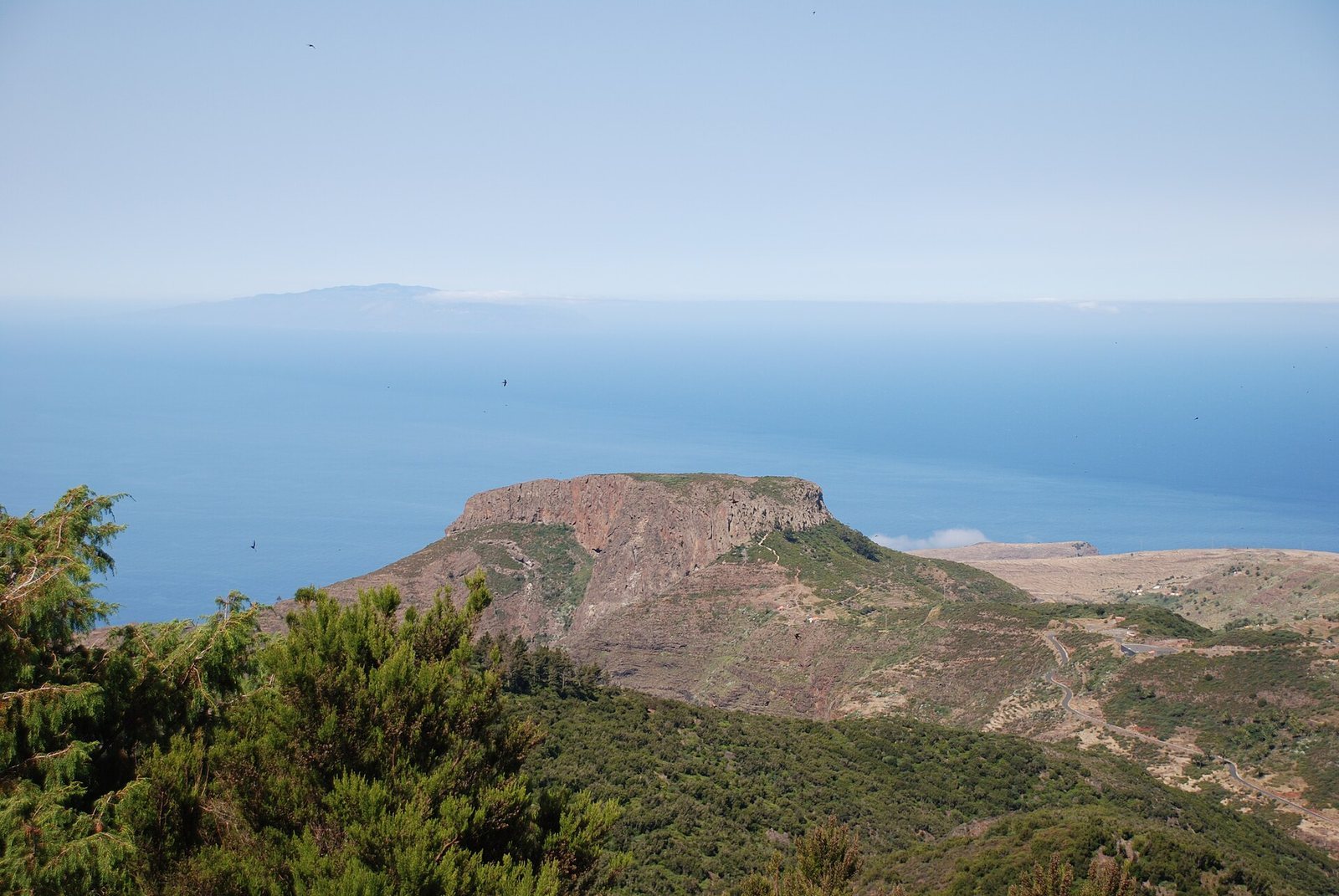
The Natural Monument of La Fortaleza is a table-shaped volcanic mountain on La Gomera, Spain. It formed about 4.36 million years ago, with an estimated uncertainty of 0.09 million years. Its summit preserves precolonial remains, and interpretations of its past include religious ritual, seasonal grazing, and refuge.
Pastoral use and the 1424 encounter
For many centuries, people grazed livestock on the summit plateau and cultivated terraces on the western slope. Sixteenth- and seventeenth-century chronicles describe a place called Argodey, which may have been La Fortaleza. They recount that Fernando de Castro, a conqueror involved in the European conquest of the Canary Islands, withdrew there after killing or wounding the brother of King Amaluige. Following a two-day siege, he and his men were allowed to leave in exchange for their clothes and weapons. The encounter is believed to have taken place in 1424.
Changing interpretations of the summit
The name Fortaleza de Chipude appears in a nineteenth-century work by Juan Bethencourt y Alfonso. A physician and researcher of the Canary Islands, he climbed the mountain in 1874, examined its archaeological remains, and published an account in 1881. He interpreted La Fortaleza as a sacred mountain of the Gomeros, the Indigenous people of La Gomera. French anthropologist René Verneau also supported this view.
In 1973, the Archaeology Department of the University of La Laguna excavated and studied the summit. Archaeologist Manuel Pellicer Catalán classified its structures as dwellings, livestock enclosures, and combinations of the two. He rejected a ritual interpretation and considered the site a seasonal pastoral settlement. In 1994, archaeologist Juan Francisco Navarro Mederos identified dwellings, altars, and other structures connected with religious ritual. Later interpretations have treated La Fortaleza as one of the religious centers of ancient Canarian culture on La Gomera, while also allowing for seasonal grazing and use as a refuge in times of danger.
Protection
La Fortaleza became part of the Barrancos de La Rajita Natural Park in 1987 and was classified as a Natural Monument in 1994. A Natural Monument is a Spanish protected-area category for places valued for natural features. In 2001, the plateau and cliffs received Spain’s Asset of Cultural Interest designation in the archaeological-zone category.
Remains
Volcanic landform and summit
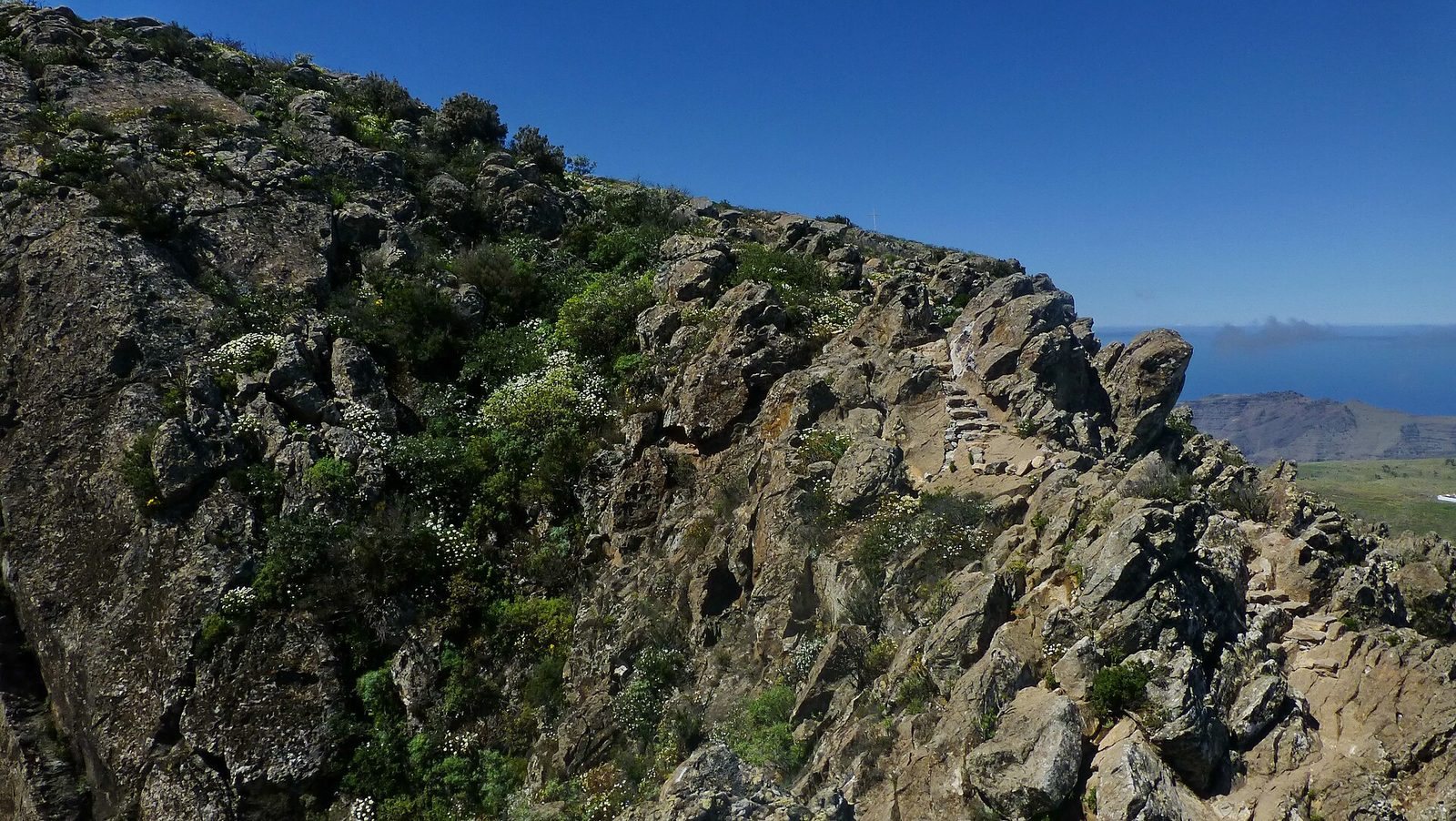
La Fortaleza rises to 1,243 metres above sea level on a ridge between the Barranco de Iguala to the west and the Barranco de Erques to the east. It lies about three kilometres west of Alto de Garajonay, the island’s highest peak at 1,485 metres, and the protected area covers 53.2 hectares. Steep slopes surround a summit plateau about 300 metres long and up to 200 metres wide. A narrow, steep passage on the north side provides the only access to the plateau and could readily be blocked. The large Cueva de San Blas lies halfway up the southern slope.
The mountain is a cryptodome, a dome-shaped mass formed when magma intrudes and solidifies below the ground. It developed during La Gomera’s most recent volcanic phase. Its resistance to weathering helped it endure erosion, while erosion on the eastern flank exposes its internal structure.
Precolonial structures
Two groups of dry-stone structures, built from stones laid without mortar, occupy the eastern edge of the summit plateau. One is near the northern access and the other at the southern tip. Together, the remains include dwellings, livestock enclosures, and 25 sacrificial altars, structures used for ritual offerings that could be burned.
Sacrificial altars
The more numerous altars are simple stone circles less than one metre across. Their hollow centers served as combustion chambers, and many were placed over natural hollows in the rock. The larger, more complex examples are built of solid masonry. Usually oval, and sometimes rectangular, they measure about 5 to 13 metres long and 3 to 6 metres wide, with several circular or polygonal combustion chambers in each.
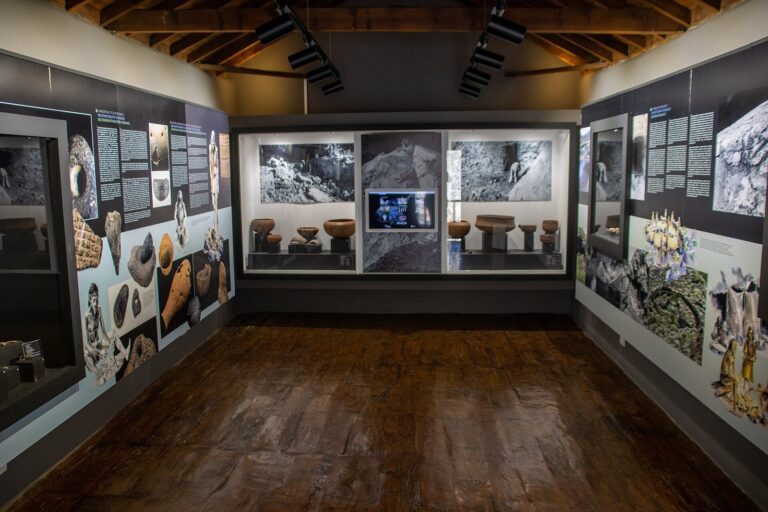
Ash from the altars contains heavily fragmented bones, chiefly from the skulls and limbs of goats and sheep, along with smaller numbers of pig and bird bones and limpet shells. Other finds include stone knives, charred wood, charcoal, and a small quantity of pottery fragments. Radiocarbon analysis dates a charcoal sample from one altar to around AD 470; this date applies to the sample, not necessarily to the altar’s construction.
Dwellings and livestock enclosures
Circular dry-stone structures between 2.10 and 4.00 metres in diameter are interpreted as the remains of huts. Rectangular buildings have been interpreted as livestock enclosures.
Burial caves
Several caves in the mountain’s steep rock faces were used for burials by ancient Canarians. Some have been partly looted.
Vegetation and wildlife
Vegetation
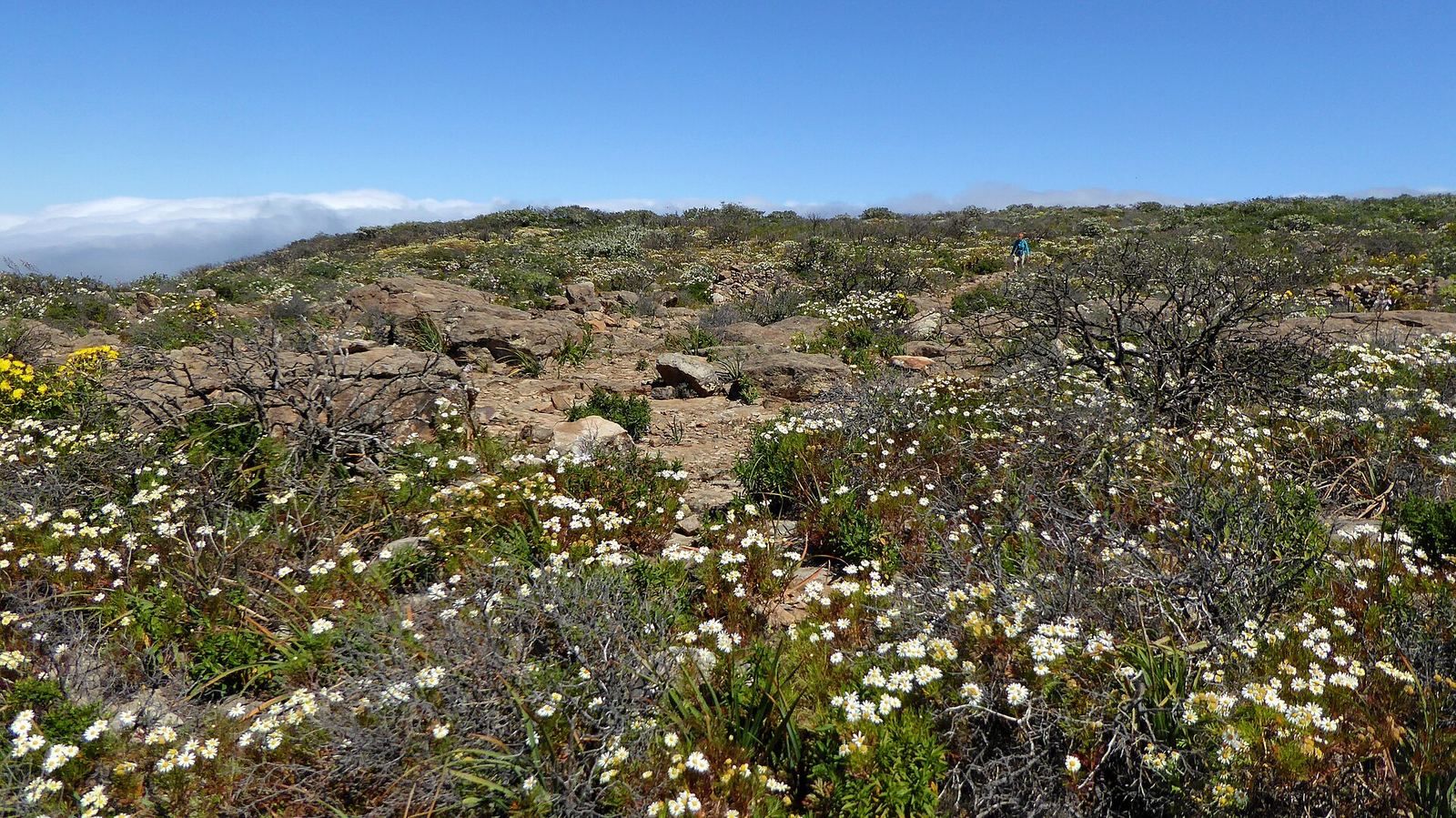
The mountain’s natural cover would have been transitional woodland between tree-heath scrub and juniper vegetation. Human activity substantially altered it and damaged the thin summit soil. Sparse, low scrub now dominates the summit, while thicker scrub covers the lower slopes. North- and northeast-facing slopes support tree heath, broom, and Montpellier cistus, with mosses and lichens indicating greater moisture. Broom and cistus grow on northwest- and south-facing slopes; southeast-facing slopes also have glandular broom, prickly pear, and agave. Almond and fig trees grow in scattered groups on old terraces and uncultivated ground, alongside scattered eucalyptus trees and palms.
The less accessible slopes have experienced less human pressure and support cliff vegetation rich in Canary Island and La Gomera endemics, including Sideritis lotsyi, Bystropogon origanifolius, Pimpinella junoniae, Polycarpaea filifolia, Ceropegia ceratophora, and Limonium redivivum. Euphorbias, junipers, and wild olive trees also grow there.
Wildlife
The cliffs and open scrub provide habitat for rock doves, kestrels, buzzards, Madeira bats, and plain swifts. Reptiles include Canary lizards, southern Canary skinks, and La Gomera geckos. Scrub at the mountain’s base supports chiffchaffs, canaries, blackbirds, rock partridges, quail, and Canary pipits. Semi-wild goats and sheep also live there. About 80 percent of the beetle and snail species are endemic.