Belmaco Archaeological Park: A Benahoarita Cave and Rock-Art Site
Site at a Glance
- Popularity
- Low
- Country
- Spain
- Primary era
- Medieval
- Eras represented
- Medieval
- Civilizations
- Unclassified
- Site type
- Domestic
- Remains
- House
On this page8 sections
History
Belmaco Archaeological Park is an archaeological complex in Lomo Oscuro, within Villa de Mazo on La Palma, Spain. The Benahoaritas, La Palma’s pre-Hispanic inhabitants, used the site between the eighth and fifteenth centuries. Belmaco is regarded as one of the Canary Islands’ most important archaeological sites.
Benahoarita occupation
The Benahoaritas raised livestock at Belmaco. Investigations have identified signs that pine needles from Canary pine trees were burned, possibly to help remove parasites from livestock. Ethnographic accounts also describe this practice. The rock engravings have been interpreted as symbolic or religious expressions connected with the islanders’ worldview.
Discovery and later study
In 1762, Domingo van de Walle, the island’s military governor, discovered Belmaco. It was the first archaeological site identified in the Canary Islands. European travellers and naturalists visited during the nineteenth century, while systematic study developed in the twentieth century with involvement from the Benahoarite Archaeological Museum and the Island Council of La Palma.
In 1986, Belmaco received Spain’s Asset of Cultural Interest designation in the archaeological-zone category. An archaeological park and interpretive center were established for conservation and public interpretation. The Island Council of La Palma manages the park.
Remains
Layout and landscape
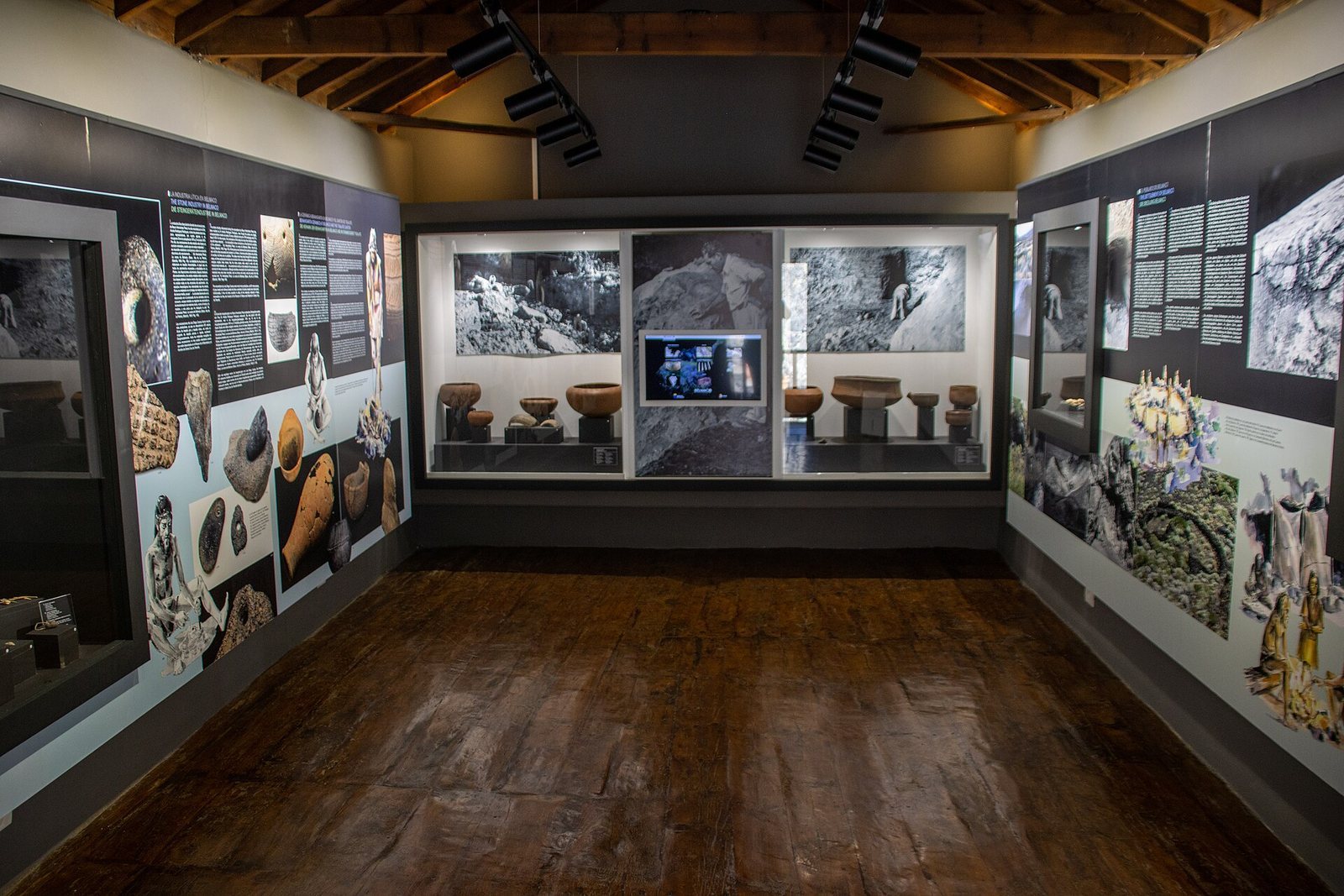
The complex includes ten natural habitation caves and a rock-engraving area nearby. It lies in the Tigalate ravine, about 350 metres above sea level and a few kilometres from La Palma’s eastern coast. Lava flows, pine forest and small agricultural terraces form the surrounding landscape, where traces of livestock activity have also been found. The interpretive center contains reproductions and explanatory panels.
Caves and rock engravings
Habitation caves
The ten natural caves show adaptations for domestic use. Hearth remains, stone tools and pottery fragments are among the features and materials found at the site.
Rock engravings
Carved into basalt, the engravings include geometric spirals and meander-like motifs characteristic of Benahoarita rock art.