Tyzenhauz Palace and Park: A Neoclassical Estate in Postavy, Belarus
Site at a Glance
- Popularity
- Medium
- Country
- Belarus
- Primary era
- Modern
- Eras represented
- Early Modern, Modern
- Civilizations
- Polish–Lithuanian Commonwealth, Russian
- Site type
- Domestic
- Remains
- Elite Residence
On this page11 sections
History
Family ownership and construction
The Tyzenhauz Palace and Park is an eighteenth-century Neoclassical estate in Postavy, Belarus, commissioned by Antoni Tyzenhauz in the 1760s. Neoclassicism revived forms from ancient Greek and Roman architecture. The estate became a residence for the Tyzenhauz family and later housed collections assembled by naturalist Konstanty Tyzenhauz.
The Despot-Zenowicz family held the estate during the sixteenth and seventeenth centuries. In 1686, it passed to the Biegański family as the dowry of Apolonia Zenowicz when she married Kazimierz Biegański. In the first half of the eighteenth century, Anna Biegańska’s marriage to Benedykt Tyzenhauz brought the property to the Tyzenhauz family, which kept it for more than 150 years. Their son Antoni (1733–1785), a senior financial officer and reformer in the Polish-Lithuanian Commonwealth, a state joining Poland and Lithuania from 1569 to 1795, established a residence at Postavy. He commissioned Italian architect Giuseppe de Sacco to design the palace.
An inventory made in 1788 notes that the side wings were already built, while work on the central section had reached its foundations. The palace was completed in the first half of the nineteenth century and expanded in its early decades. A monumental portico was added to the north wing in the 1830s, making that wing the principal part of the building. Around 1850, during the ownership of Konstanty Tyzenhauz, the palace reached its final form. After Antoni’s death, his brother Ignacy inherited the estate; Konstanty was Ignacy’s son.
Collections and later ownership
Konstanty Tyzenhauz assembled more than 3,000 exhibits at the palace. His ornithological collection contained over 1,000 specimens, including 280 stuffed birds and about 560 eggs representing 252 species. The birds came from every continent, with many from areas now in Belarus, Lithuania, and Ukraine. The palace also held a library, an archive, and a picture gallery with works attributed to Albrecht Dürer, Leonardo da Vinci, Peter Paul Rubens, Antonio Correggio, Paolo Veronese, and Jacopo Tintoretto.
After Konstanty’s death, his son Rajnold gave the collections to the Vilnius Archaeological Society in 1858. They were dispersed after the January Uprising of 1863–1864, an insurrection against Russian rule. Following Rajnold’s death in 1881, his sister Maria inherited Postavy. She was married to Count Aleksander Przeździecki, and the estate passed to the Przeździecki family, which held it until 1939. The family made its main residence in Rokiškis, Lithuania, and moved the Tyzenhauz archive and many paintings there. Other paintings collected at Postavy were kept in the Library of the Przeździecki Entail, a legally restricted hereditary estate, at the family’s palace in Warsaw. Rajnold Przeździecki was the estate’s last owner.
In the late nineteenth century, Józef Piłsudski secretly stayed in a palace room while avoiding the authorities. He later became Poland’s first Marshal.
War, reuse, and preservation
In 1915, Tsarist authorities ordered the remaining artworks and library materials in Postavy to be moved to Kyiv. A small portion returned under the 1921 Treaty of Riga, the peace settlement between Poland, Soviet Russia, and Ukraine, and was placed in the Przeździecki Palace in Warsaw. German bombing on 25 September 1939 destroyed the library’s holdings, with only a few volumes saved.
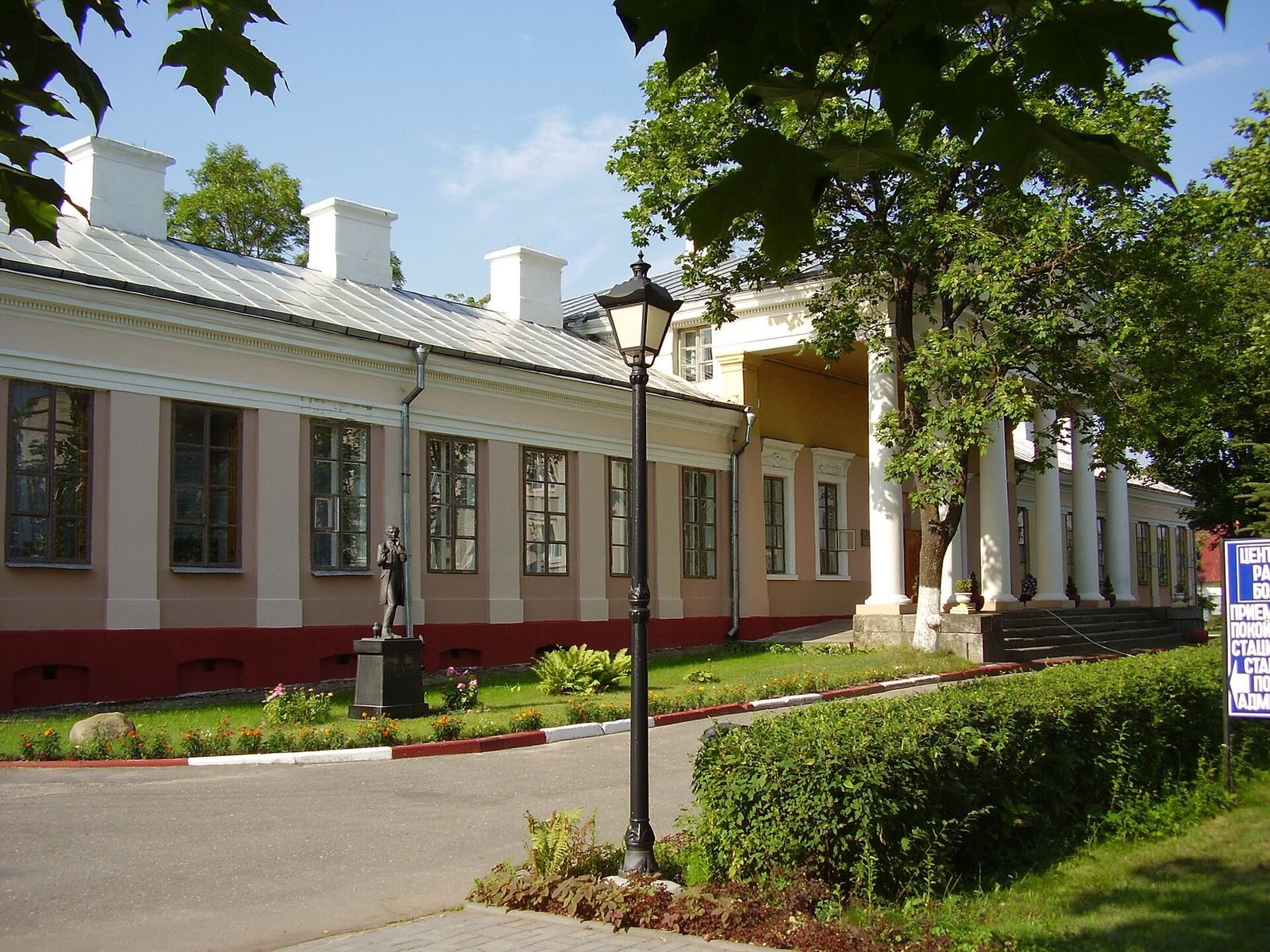
After the Second World War, the palace became part of the district hospital. Its interiors were extensively remodelled for hospital use in the 1960s, and the hospital still occupies the building. The façade was renovated in the 1980s with UNESCO funding. Repairs to the cellars took place in 2013, and a museum of Postavy history, focused chiefly on Konstanty Tyzenhauz, has occupied them since 2014. A monument to Konstanty was erected in front of the palace in 2006. The palace is listed as an architectural monument.
Remains
Palace
Exterior
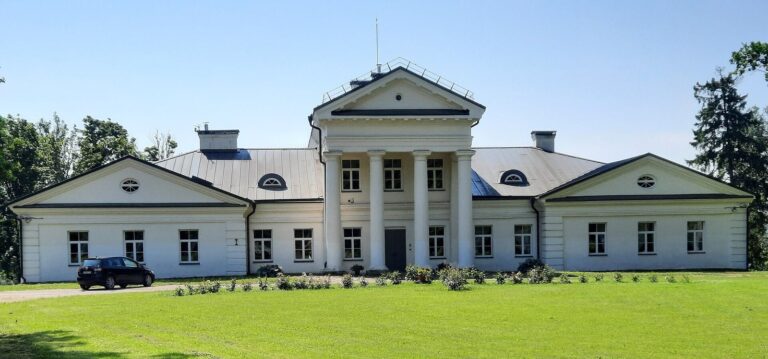
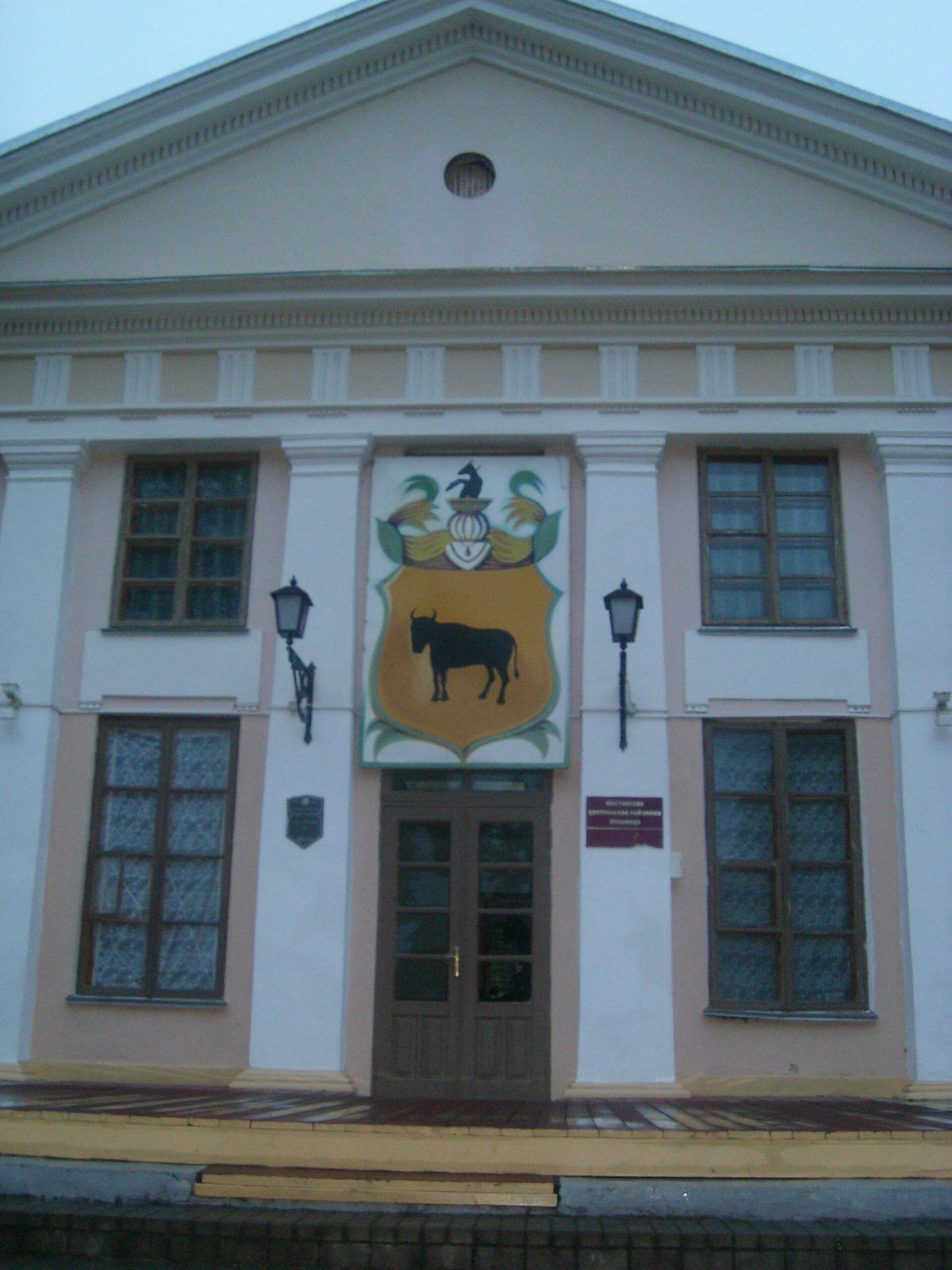
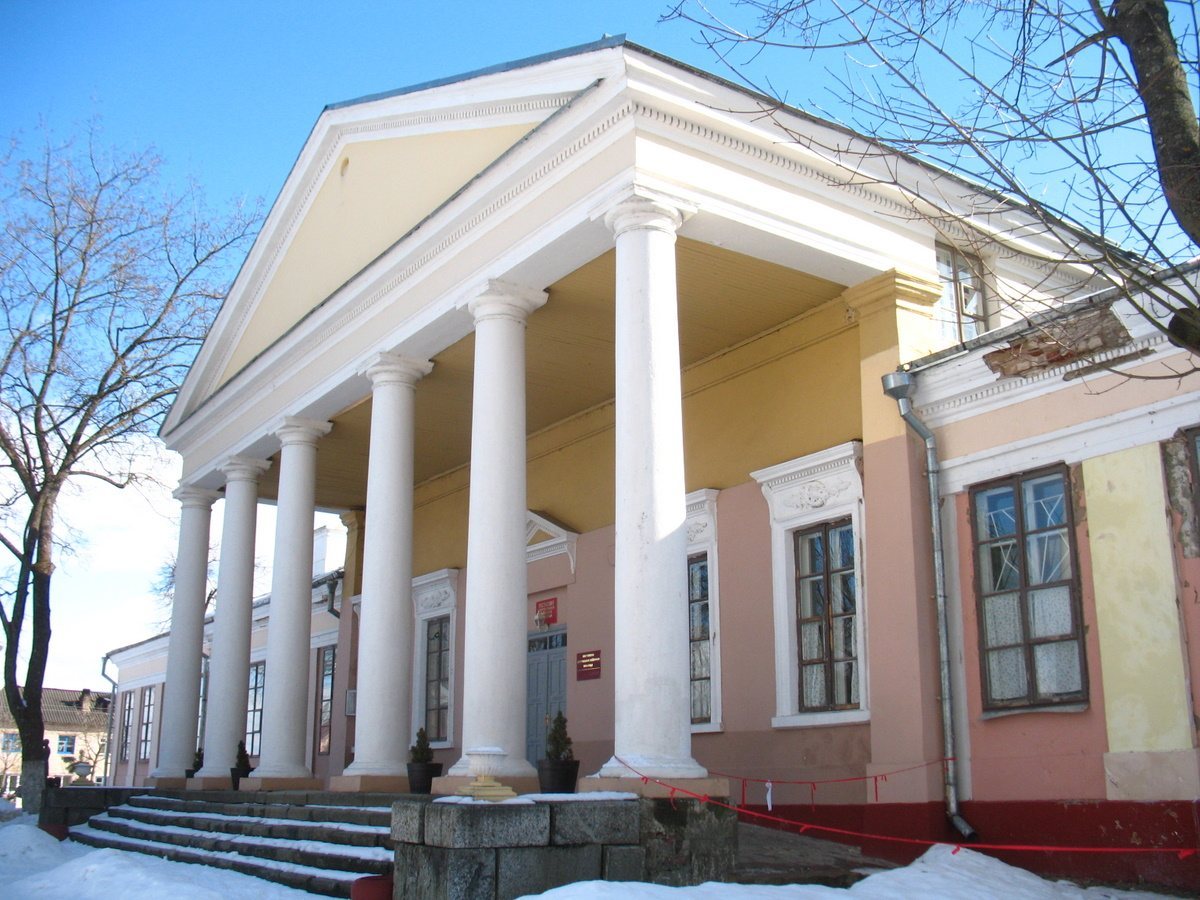
The one-storey palace has a central block and two symmetrical, very elongated side wings, forming a three-part composition. On the north façade, a staircase rises to a six-column Tuscan portico, a portico in a plain classical column style, crowned by a triangular pediment. A shallow projection at the center of the older block has six pilasters, or flattened wall-mounted columns, and another triangular pediment. The east façade has deep side projections and a central projection, each topped by a triangular pediment and a Doric entablature, the horizontal architectural structure above columns. Its decoration includes shallow vertical wall strips, rustication, a finish that emphasizes masonry joints or block faces, and a triglyph frieze marked by blocks with three vertical grooves. Rectangular windows have hoods and decorative-plaster garlands. The Tyzenhauz family’s Buffalo coat of arms appears on this façade.
Interior and cellars
The interior follows an enfilade plan, a suite of rooms linked through aligned doorways, with entrances on the north and east sides. Part of the plaster decoration survives. The south wing contained a chapel, and ribbed vaults, vaulted ceilings reinforced by projecting ribs, remain in the cellars.
Outbuildings and park
Service building
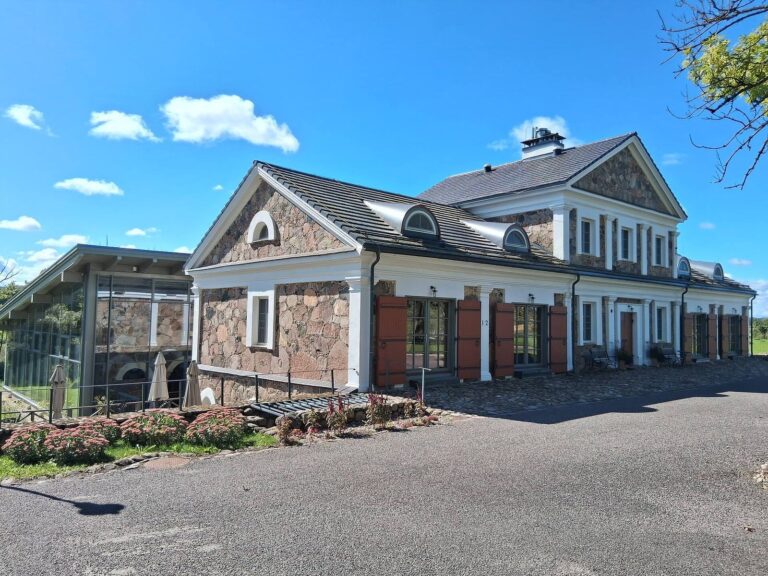
An elongated service building stands behind the palace on the same axis. It has decoration similar to the main building and is the surviving service building of the estate complex.
Park
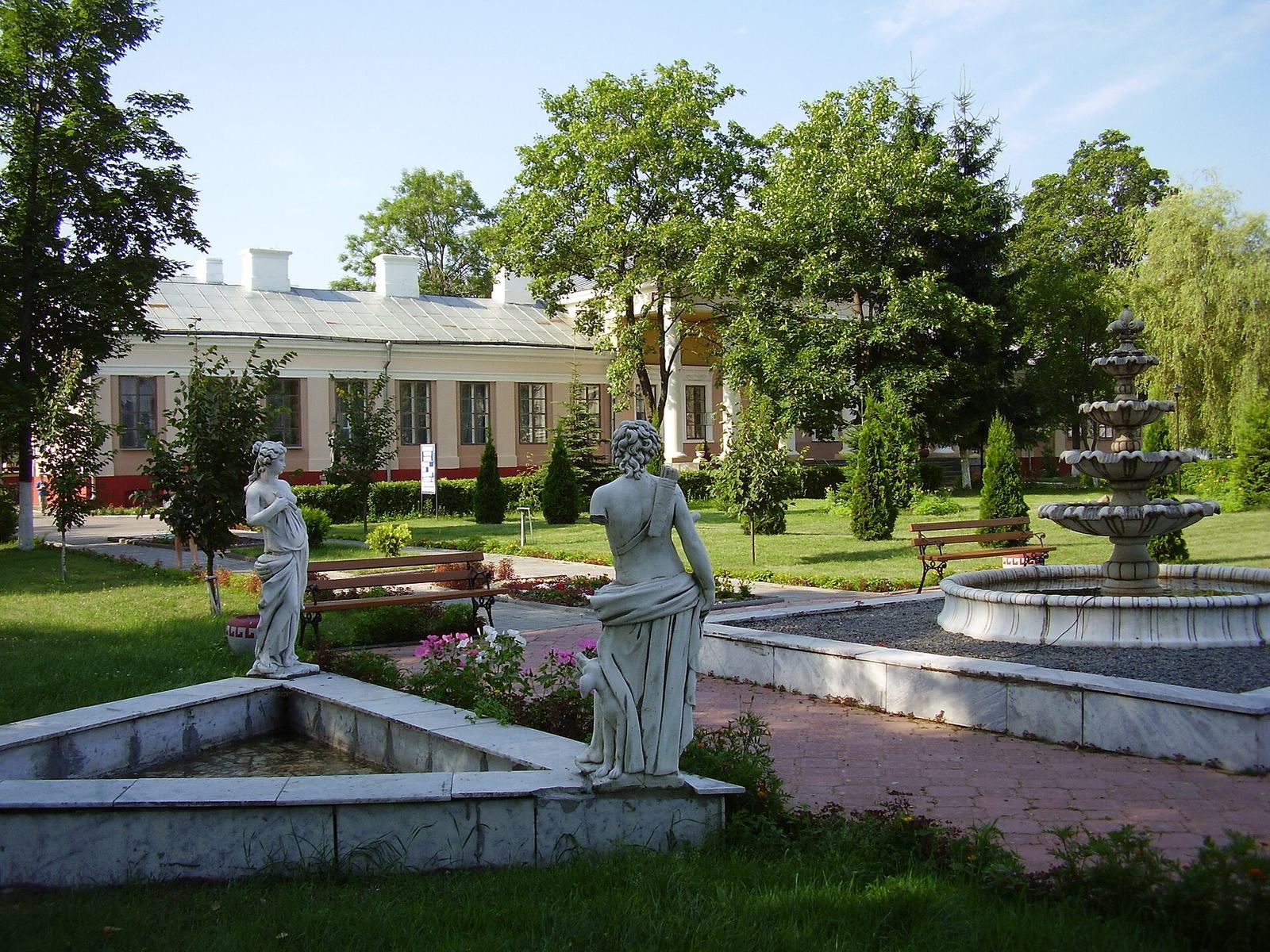
The palace park covers about 10 hectares and survives in fragments. It was formerly arranged in a combination of formal and landscape styles, with ponds, channels, and avenues. One surviving avenue led from the estate to a bridge over the Myadelka River. A fountain appears in depictions of the park, which also contains a sculpture of Konstanty Tyzenhauz and a monument to Antoni Tyzenhauz.