Ueyama Kofun: An Early Japanese Burial Mound in Kashihara
Site at a Glance
- Rating
- 3.7
- Popularity
- Low
- Country
- Japan
- Primary era
- Medieval
- Eras represented
- Medieval
- Civilizations
- Yamato
- Site type
- Burial
- Remains
- Burial Mound
On this page8 sections
History
Ueyama Kofun is a burial mound in Gojono, Kashihara, Japan. Built between the late sixth century and the first half of the seventh, it dates to the Kofun period, an era roughly spanning the third through seventh centuries and associated with large burial mounds. Its form and construction were characteristic of tombs in Asuka, an important early Japanese political center in what is now Nara Prefecture.
Construction and possible royal burials
Ueyama Kofun may have served as the joint tomb of Empress Suiko and her son, Prince Takeda, before their remains were moved to a larger tomb at Isonagatani, a group of burial mounds in historic Kawachi. The Nihon Shoki and Kojiki, eighth-century Japanese chronicles, give accounts that have informed this proposal. The Nihon Shoki places Suiko’s burial in her son’s tomb in 628, while the Kojiki describes a later transfer to Isonagatani, possibly to Yamada Takatsuka Kofun.
One interpretation is that Suiko had asked to be buried with Takeda, who died young, and that a larger tomb befitting an emperor was built afterward. Another interpretation connects the burial arrangements with the Soga clan, a powerful aristocratic family, and its possible effort to strengthen its influence by placing tombs of successive rulers within its sphere in southern Kawachi. These explanations remain possibilities rather than established identifications of the tomb’s occupants.
Robbing and modern study
The tomb was robbed before the modern period, and some of its construction stones were reused. During construction of Kashihara Shrine in the early Meiji period, which began in 1868, the east chamber’s single-block ceiling stone was repurposed as a water basin.
Kashihara City’s Board of Education excavated the mound in 2000. Japan designated it a National Historic Site in 2002, and the protected area was enlarged in 2003. On 15 January 2013, stones on the side of a burial chamber collapsed. Rain and snow seeping into the ground were thought to have swollen the mound’s fill and caused the collapse.
Remains
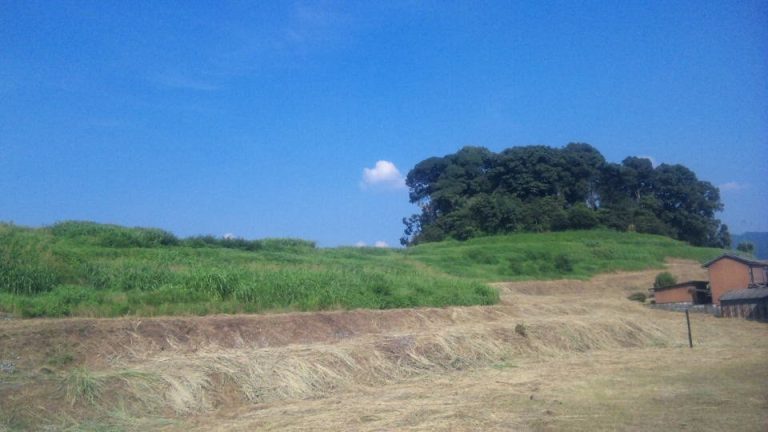
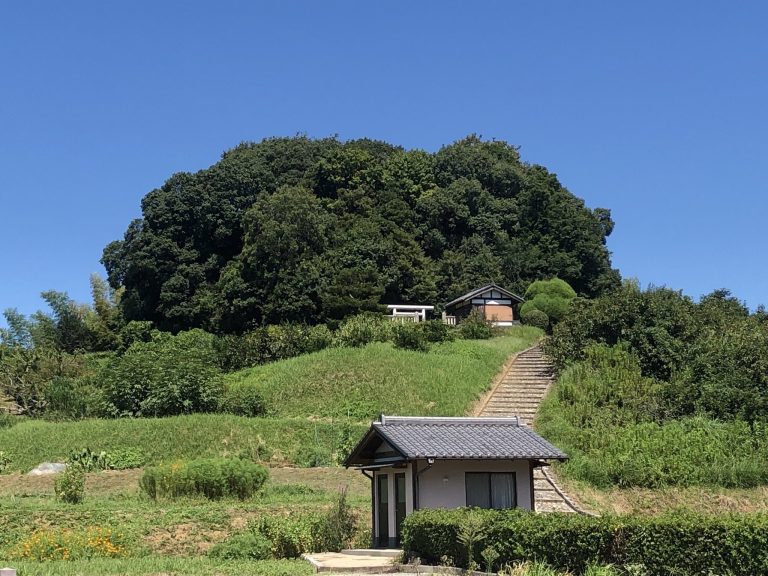
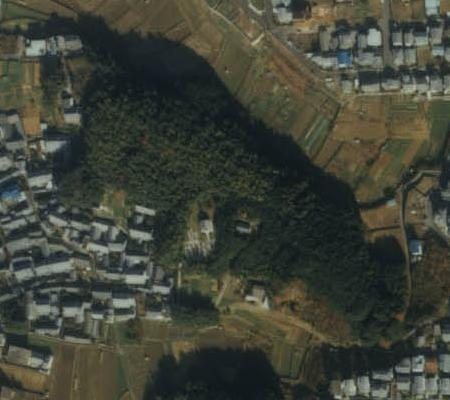
The site consists of a mound, a moat on three sides, and two stone burial chambers positioned side by side. Both chambers have passages leading horizontally into their burial spaces and face south. The mound occupies the western end of hills extending from Amakashi-no-oka, near the southern end of the Nara Basin.
Mound and moat
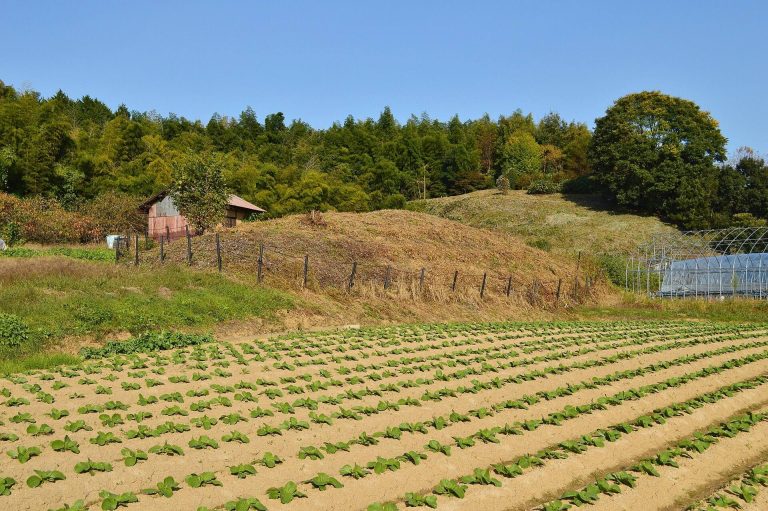
The mound measures 40 metres from east to west and 27 metres from north to south, and stands between three and six metres high. It was formed partly by cutting into the southern slope of a natural hill. Although its present plan is rectangular, it may originally have been circular. A U-shaped moat follows its eastern, western, and northern sides. Maruyama Kofun lies about 500 metres to the west, while Shōbuike Kofun is about 700 metres to the southeast.
Burial chambers
East chamber
The east chamber extends 13 metres in total. Its burial space measures 6.5 metres long and 3.0 to 3.2 metres wide, with a surviving height of 3.1 metres. The entrance passage is 6.5 metres long, 1.9 metres wide, and 2.2 metres high. Walls at the entrance project inward on either side. The chamber’s resemblance to the one at Makino Kofun suggests a date near the end of the sixth century.
A hollowed coffin shaped like a house, made from Aso welded tuff, volcanic rock formed from fused ash, was placed in the chamber. Finds from its drainage ditch include gilt-bronze fittings from horse harnesses and a crystal ornament of three linked rings used to decorate a sword.
West chamber
The west chamber also extends 13 metres overall. Its burial space is 5.2 metres long and 2.5 metres wide, and rises to 4.5 metres. The entrance passage measures 7.8 metres long, 2.3 metres wide, and 2.0 metres high. Its entrance walls project only slightly. A stone set at the centre of the burial space supported a door separating it from the passage.
Fragments of Aso welded tuff found inside suggest that this chamber may have held a stone coffin. Sue ware, a high-fired Japanese stoneware, was also found there. The chamber’s form and the pottery place its construction in an early phase of the first half of the seventh century.