Pellegrini Chapel: A Family Chapel in Verona
Site at a Glance
- Popularity
- Medium
- Country
- Italy
- Primary era
- Medieval
- Eras represented
- Medieval
- Civilizations
- Venetian
- Site type
- Religious
- Remains
- Chapel
On this page11 sections
History
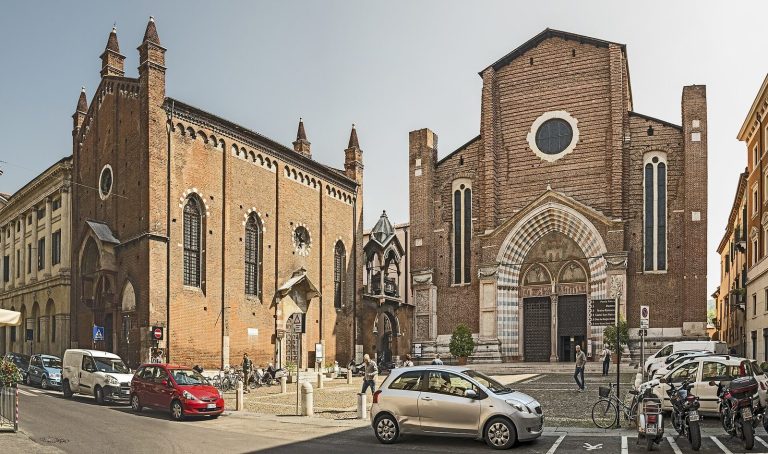
The Pellegrini Chapel is a family chapel in the apse area of the Basilica of Santa Anastasia in Verona, Italy. Its principal decoration was probably produced in the 1430s, and its terracottas reflect International Gothic, a late-medieval style noted for refined detail and elegant ornament. The chapel is known for Pisanello’s fresco of Saint George and the Princess, which Giorgio Vasari praised for its design, grace, and exceptional judgment.
Commission and interpretation
In his 1428 will, Andrea Pellegrini set aside 900 ducats for a monumental tomb chest in the family chapel. He died in 1429, and his mother fulfilled his wishes by commissioning the chapel’s decoration in celebration of his chivalric virtues. The dates of the frescoes and terracottas are uncertain. Michele da Firenze was in Verona from 1433 to 1438, and work on the terracottas is documented in 1436; Pisanello was also in the city for an extended period between 1433 and 1438. The two types of work were probably made at about the same time. Michele’s son Marsilio assisted with the terracottas and may also have helped with Pisanello’s fresco.
The fresco has also been interpreted as a possible reference to the Pellegrini family and to opposition to Venetian rule. In 1411, Sigismund of Hungary’s army entered the region with support from Brunoro della Scala. Venice had conquered Verona and other mainland territories, and a pro-Scaliger uprising followed in the city in 1412. Venice suppressed the revolt harshly, condemning many rebels to death by hanging. Under one uncertain interpretation, the fresco’s procession represents Sigismund and his entourage, its winged, amphibious dragon stands for Venice, and the princess is Laura Nogarola, the young wife of Cristoforo Pellegrini. Earlier interpretations differed, and these proposed identifications remain uncertain.
Burials and preservation
Tommaso Pellegrini’s 1492 will directed that he be buried in the family chapel. Wilhelm von Bibra, a German nobleman and diplomat, was also buried there after dying on his return from a journey to Rome. He is represented in armor.
Water entering from the roof severely damaged the fresco. Its right side was detached in 1891 and its left side in 1900. The work was divided into four sections, restored, mounted on canvas, and returned to its original position in 1996.
Remains
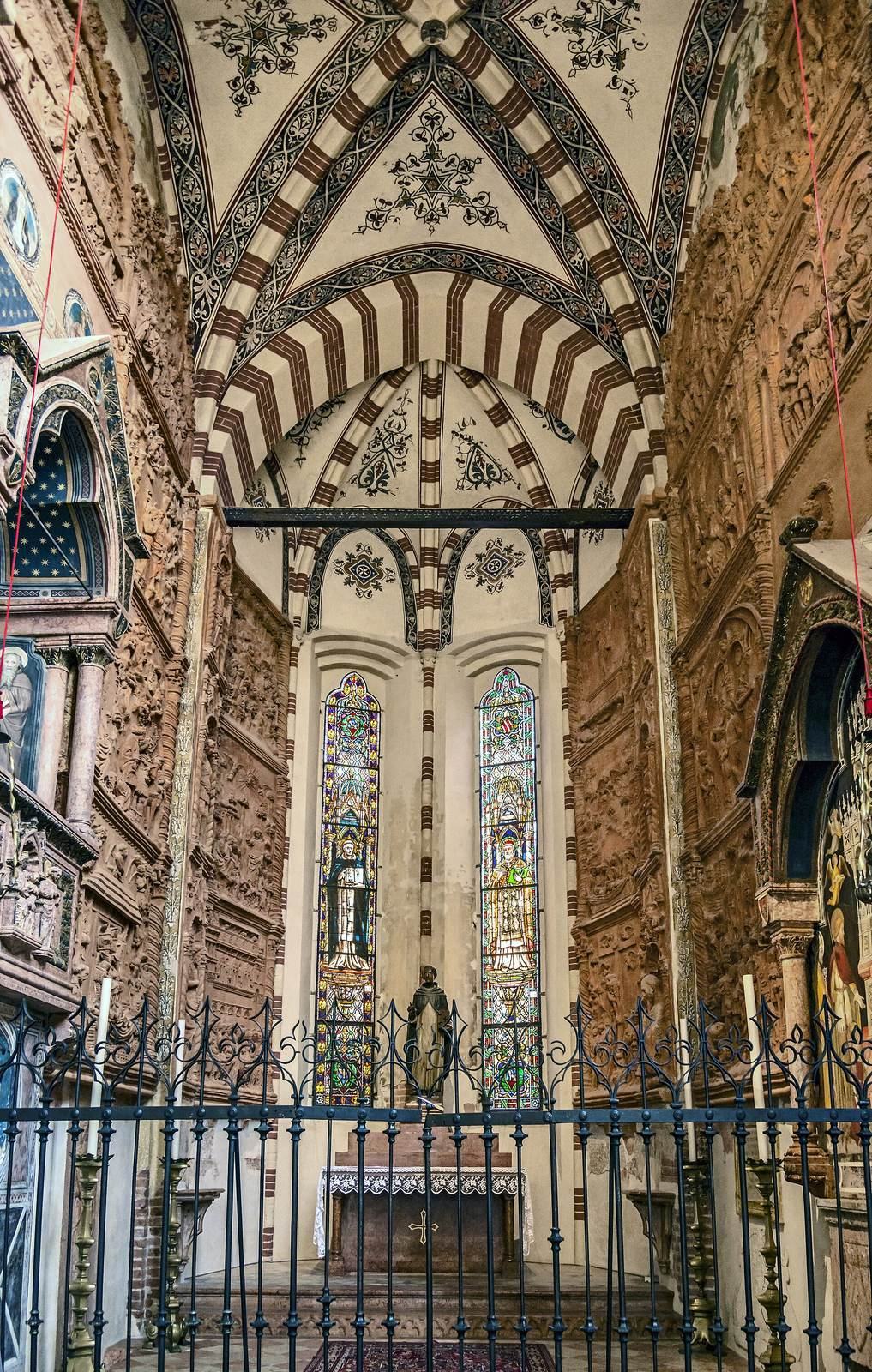
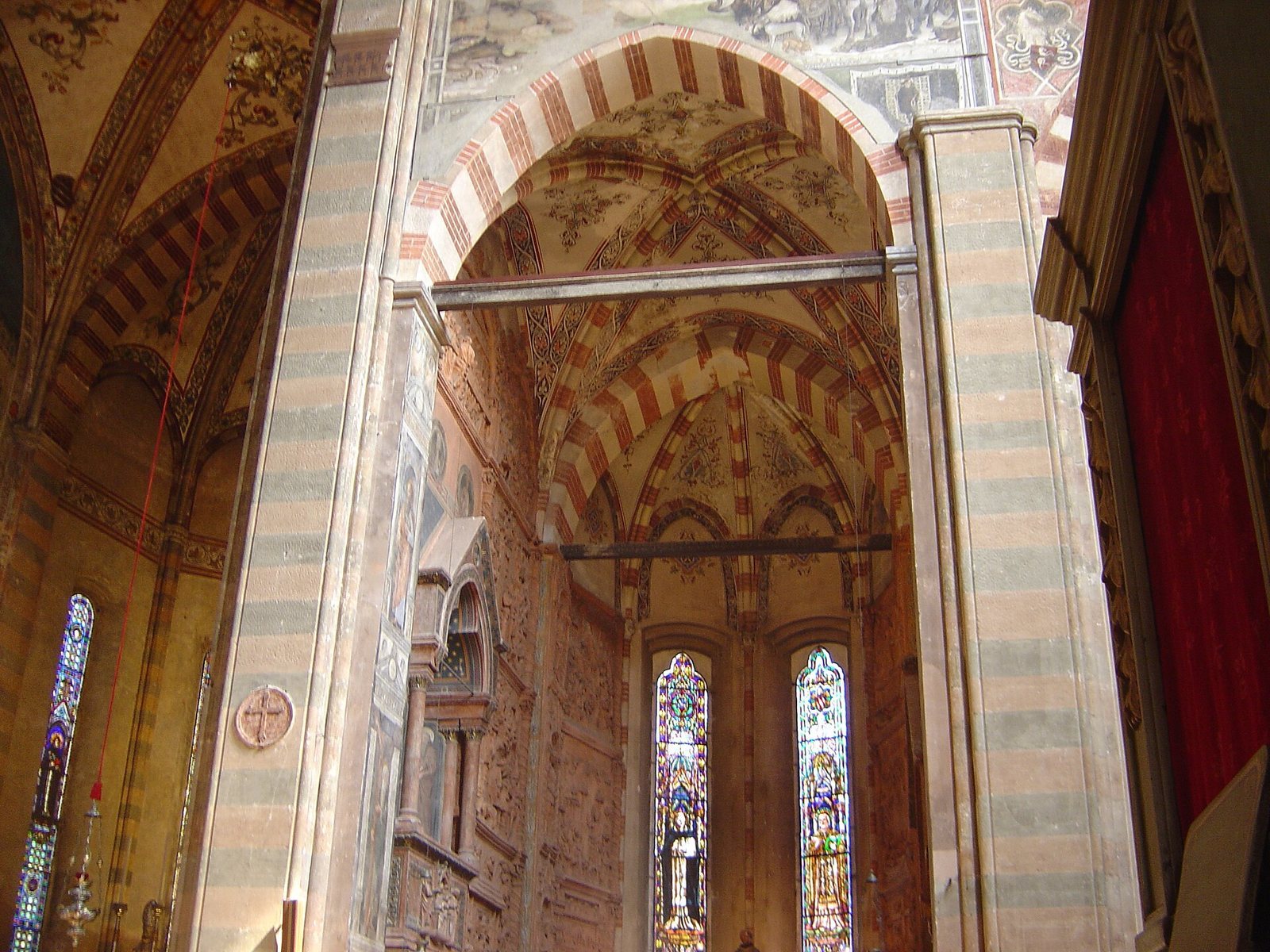
The chapel lies along the right transept, immediately to the right of the basilica’s main chapel. Its decoration includes a fresco above the entrance, terracotta scenes and figures around the arch separating the chapel from the apse, and tombs on the two side walls.
Painted and sculpted decoration
Saint George and the Princess
Pisanello’s Saint George and the Princess, considered his masterpiece, is painted on the exterior arch above the chapel entrance. The right section, showing Saint George taking leave of the princess, survives in fair condition; the left section, with a dragon among the remains of its victims beyond water crossed by a sailing ship, survives only in fragments. The fanciful landscape includes exotic figures and many naturally rendered animals. In the background, an idealized city has elegant towers and openwork architecture, meaning construction pierced with decorative openings. Beneath the right section are the inscription SANTVS GIORGIVS and the Pellegrini arms, a pilgrim figure on painted cloth edged with ermine, the winter-white fur used in heraldry. The emblem also plays on the name Giorgio. Saint George is a Christian martyr traditionally associated with a dragon legend.
Terracotta scenes and figures
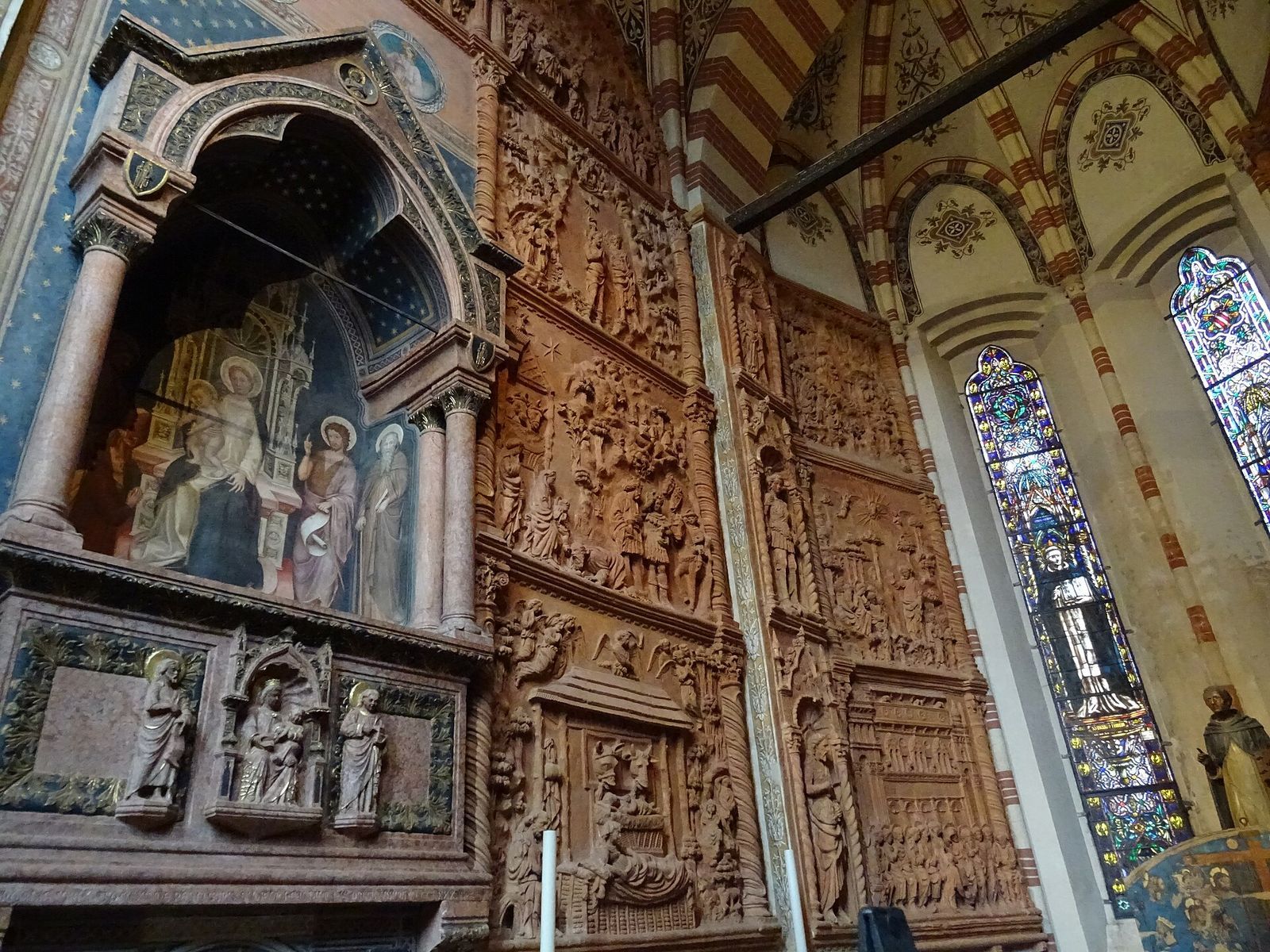
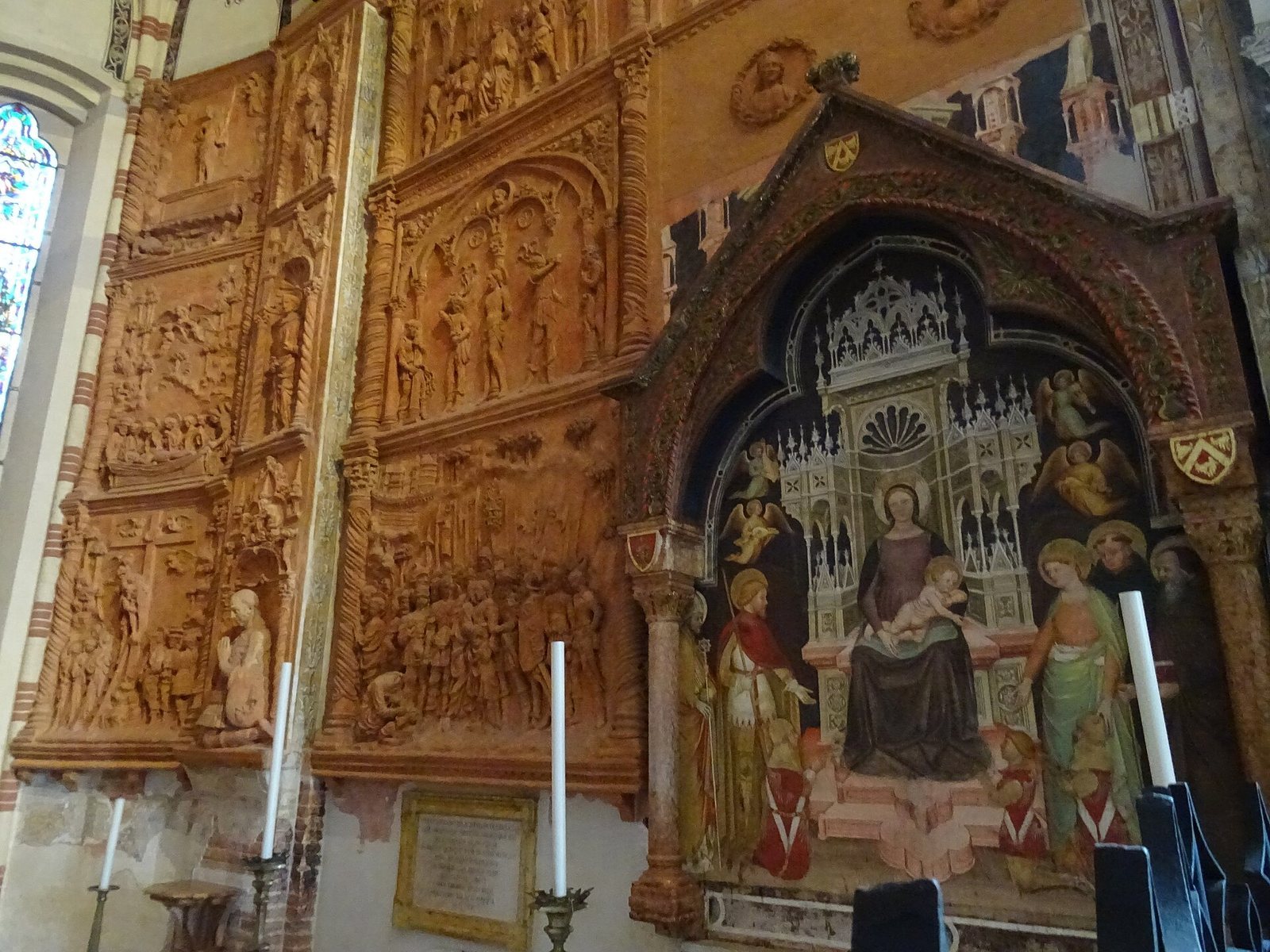
Seventeen originally polychrome terracotta scenes from the Life of Jesus are attributed to Michele da Firenze. The scenes are interrupted by three tiers of niches on each of the two pilasters, shallow supports attached to the wall, which frame the arch between chapel and apse. The figures include Andrea Pellegrini praying toward the Virgin’s altar; Saints Dominic, founder of the Dominican Order, and Peter Martyr, a Dominican preacher and martyr, on the right; and, on the left, John the Baptist, the biblical prophet who baptized Jesus, the Archangel Michael, and Saint Leonard. The sculptures show International Gothic attention to detail and treatment of space, as well as the influence of Donatello and Lorenzo Ghiberti, influential Italian sculptors of the period.
Other saint frescoes
Vasari described additional paintings of Saint Eustace, a Christian martyr, caressing a brown-and-white spotted dog, and Saint George wearing silver armor. The locations of these works are uncertain; they may have been on the left pillar and the pilaster to the right of the main fresco. The image of Saint Eustace was still visible in the seventeenth century.
Family tombs
Pellegrini-Bevilacqua tomb
On the right wall, a shrine-like frame encloses a fresco by Martino da Verona. The Madonna and Child appear with four musician angels, while three members of the Bevilacqua family are presented by Saints Catherine, Dominic, Anthony Abbot, George, and Zeno. A plaque below bears a Latin cross and the arms of the Pellegrini and Bevilacqua families.
Tommaso Pellegrini’s tomb
Antonio da Mestre made the tomb on the left wall. Its red-marble chest supports a large, pointed shrine-like frame bearing the family arms and a central circular panel, or roundel, of Christ being taken down from the cross. Reliefs on the chest show the Madonna and Child, Saint John the Baptist, and a female saint holding a book. Above, a fresco in colors associated with Martino da Verona depicts Tommaso in dark red robes, presented to the Virgin and Child by Saint Thomas, one of Jesus’s apostles; Saint John the Baptist stands on the other side.