St Dunstan-in-the-West: A Neo-Gothic Church on Fleet Street
Site at a Glance
- Rating
- 4.6
- Popularity
- Medium
- Country
- United Kingdom
- Primary era
- Modern
- Eras represented
- Early Modern, Modern
- Civilizations
- British, English
- Site type
- Religious
- Remains
- Church
On this page17 sections
History
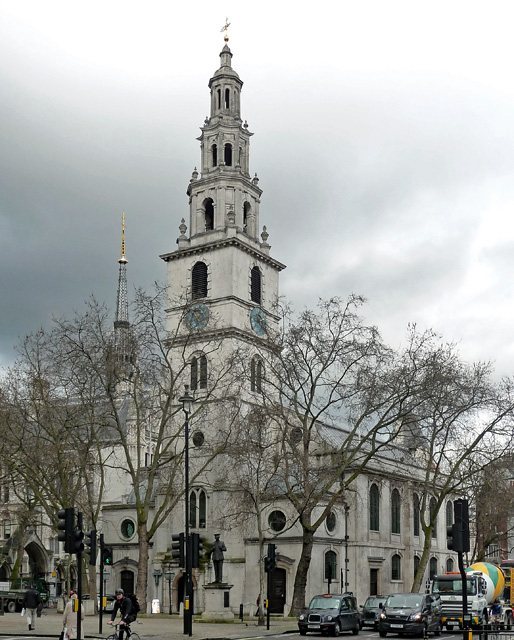
St Dunstan-in-the-West is a church on Fleet Street in London, United Kingdom. Its present Neo-Gothic building, a nineteenth-century revival of medieval Gothic design, was completed in the 1830s. The church developed from an older parish foundation and has long been associated with Fleet Street’s religious and working communities.
Medieval origins and patronage
The church may have been established between 988 and 1070. Its beginnings have been linked either to Dunstan, a tenth-century churchman who became Bishop of London and Archbishop of Canterbury and is venerated as a saint in the Church of England, or to priests who knew him. It may also have served Lundenwic, an early medieval trading settlement west of the Roman city of Londinium. By the late twelfth century, the church was already in existence.
In 1237, Henry III, king of England from 1216 to 1272, acquired the church, its endowments, and the right to appoint its priest from Westminster Abbey. He transferred these to the Domus Conversorum, or House of Converts, an institution for Jews who had converted to Christianity. This arrangement weakened attention to the church’s parish duties.
Worship and associations
The church’s Roman Catholic affiliation ended in 1534. Among those associated with it were William Tyndale, the Bible translator who lectured there, and John Donne, a poet and Anglican clergyman who served as vicar from 1624 to 1631 while also Dean of St Paul’s. Donne preached at the church, where Samuel Pepys also worshipped regularly and later referred to it in his diary.
The Worshipful Company of Cordwainers, a London livery company with historic links to shoemaking, has maintained an association with the church since the fifteenth century. Its annual service commemorates benefactors John Fisher and Richard Minge. A custom held that children were given a penny for every circuit they ran around the church after the service.
Several people connected with the church were buried there. The physician, poet, and composer Thomas Campion and the composer Philip Rosseter were among them, as were a Lord Baltimore and his son in 1632. Edward Latymer, who worshipped at the church, was buried in its south aisle in 1627. Izaak Walton served as a sidesman, a lay officer who assists with practical duties during services. Later burials included Jacobite preacher Matthew Bryan, a supporter of the Stuart claim to the throne after the 1688 Revolution, in 1699; churchwarden and clockmaker Charles Gretton in 1731; and watchmaker Thomas Mudge in 1794. Richard Lyst, the church’s rector, supported Anne Boleyn.
The medieval church changed over time. Shops were built against its walls, and its churchyard became a place for bookselling and publishing. Repairs introduced textured stonework and round-headed windows in place of some Gothic windows. In 1701, builders replaced the old vaulted roof with a flat ceiling decorated with recessed panels.
Fire, clock, and rebuilding
The church narrowly escaped the Great Fire of London in 1666. The Dean of Westminster rallied 40 Westminster School pupils, who formed a bucket line and put out the flames when they had advanced to within three doors of the church. A chiming clock was installed on the medieval building in 1671, perhaps in recognition of its escape.
Fleet Street’s widening led to the medieval church’s demolition and replacement. An Act authorising the work passed in July 1829, and materials from the old building were sold at auctions in December 1829 and September 1830. John Shaw Sr designed the new church, but died before it was finished; his son, John Shaw Jr, continued the work. The first stone was laid in July 1831. The final part of the medieval building, kept temporarily as a screen, was removed in August 1832. The replacement church was built slightly north of its predecessor, on the old burial ground, with its position adjusted for the street widening.
In 1828, before the demolition, Francis Seymour-Conway, 3rd Marquess of Hertford, had taken the medieval church’s clock to Winfield House in Regent’s Park. During the First World War, Winfield House served as a hostel for blinded soldiers. A charity established there adopted the name St Dunstan’s and is now called Blind Veterans UK. Harold Harmsworth, 1st Viscount Rothermere, returned the clock in 1935 to mark the Silver Jubilee of King George V.
War damage and later use
St Dunstan-in-the-West survived the London Blitz, the German bombing campaign against the city, largely intact, although its stained glass was lost and bombs damaged the tower lantern. It was struck again on 24–25 March 1944 during Operation Steinbock, a German air campaign against London late in the war. The church was largely restored in 1950, and the tower was rebuilt with a donation from newspaper founder William Berry, Viscount Camrose. That year, the building received Grade I listed status, England’s highest listed-building category, reserved for buildings of exceptional interest.
Since 1952, the church has served as a Guild Church, with a particular ministry to people working in Fleet Street. Anglican and Romanian Orthodox congregations share the building. A chapel is used by the Romanian Orthodox community; its wooden iconostasis, a screen bearing icons that separates the sanctuary from the main church, came from Antim Monastery in Bucharest and was dedicated in 1966.
Remains
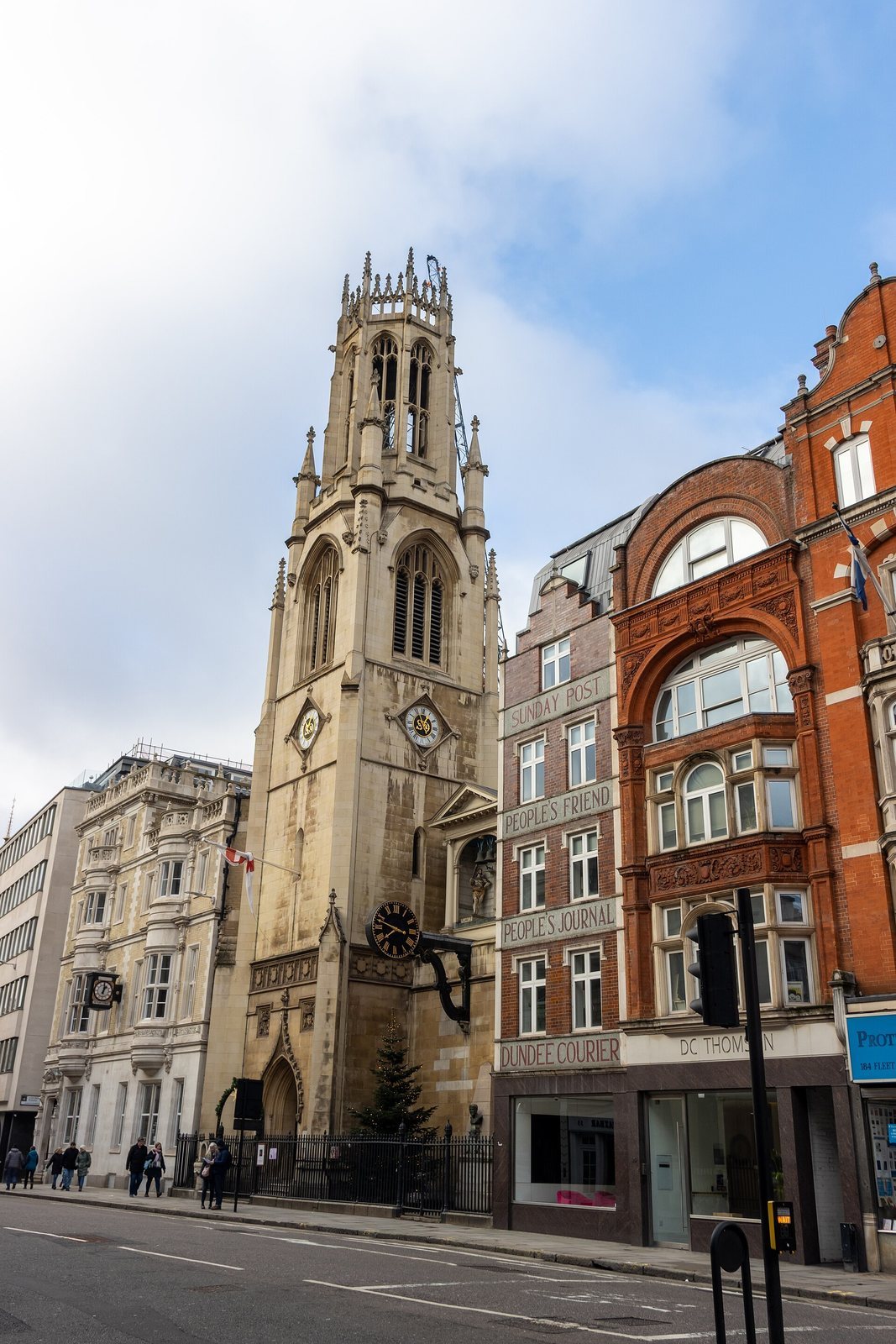
The present church is arranged around an octagonal central space, with a square tower forming its principal street-facing feature. Its Neo-Gothic design adapts medieval forms to a restricted site.
Interior plan and furnishings
Central space
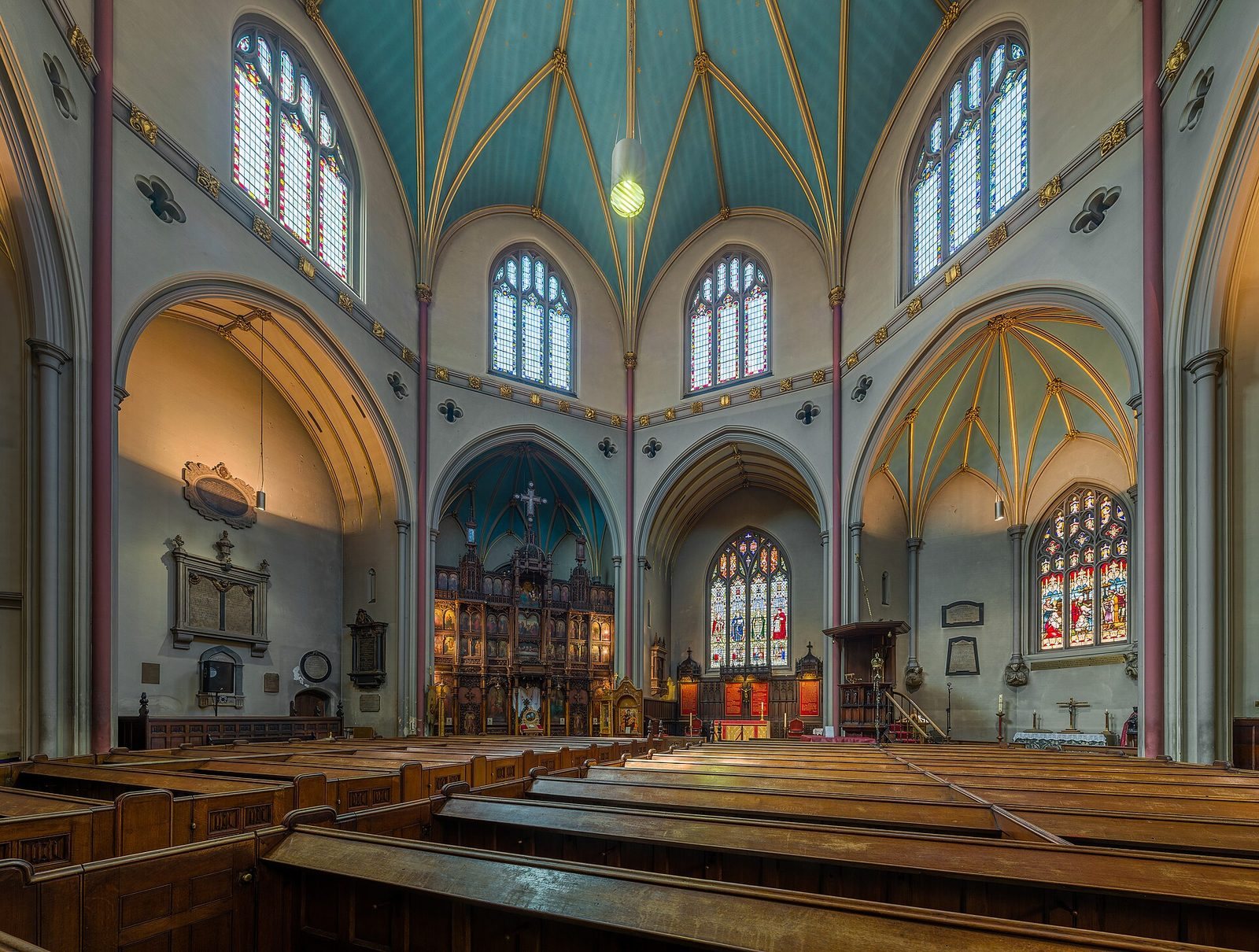
Seven sides of the central space open into arched recesses, while the eighth leads to a short passage beneath the organ and into the lowest level of the tower, which serves as the entrance porch. Four diagonally placed recesses have rib vaults, ceilings supported by masonry ribs. The west entrance and the eastern opening to the sacristy, a room used to store service objects and prepare clergy, have pointed barrel vaults shaped like tunnels. Above the central area, a clerestory, a high band of windows, has eight windows beneath a vaulted ceiling.
Sanctuary and chapels
The north sanctuary ends in a rectangular apse, a recessed area for the altar, beneath a pointed barrel vault. A large window rises above the wooden high altar, and a wooden pulpit stands opposite. The first chapel on the right contains a marble baptismal font with relief decoration and a wooden cover. In the chapel to the left of the main altar, a wooden iconostasis separates the space from the rest of the church.
Fittings and organ
The surviving communion rail was carved by Grinling Gibbons during John Donne’s time as vicar. Some memorials from the medieval church were installed in the replacement building. In the west gallery, an elaborate wooden case holds an organ first built by Halliday in 1905. David Wells rebuilt it in 2009, reusing material from the earlier instrument. It has 36 stops, or sets of pipes, three manuals, meaning hand-played keyboards, and a foot-operated pedalboard. Each manual has 58 notes, while the concave, fan-shaped pedalboard has 30.
Tower and clock
Tower and lantern
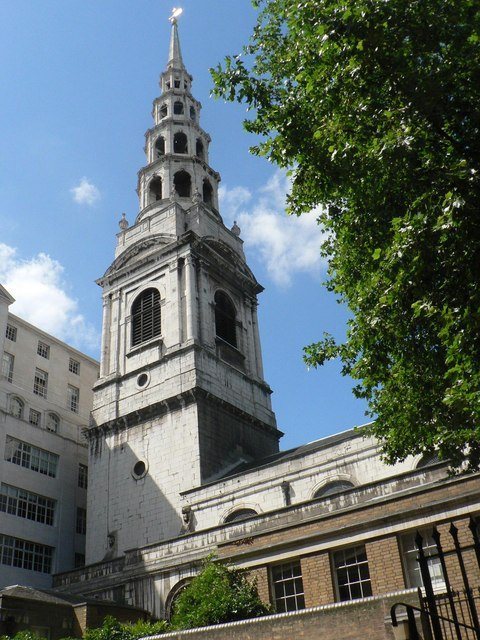
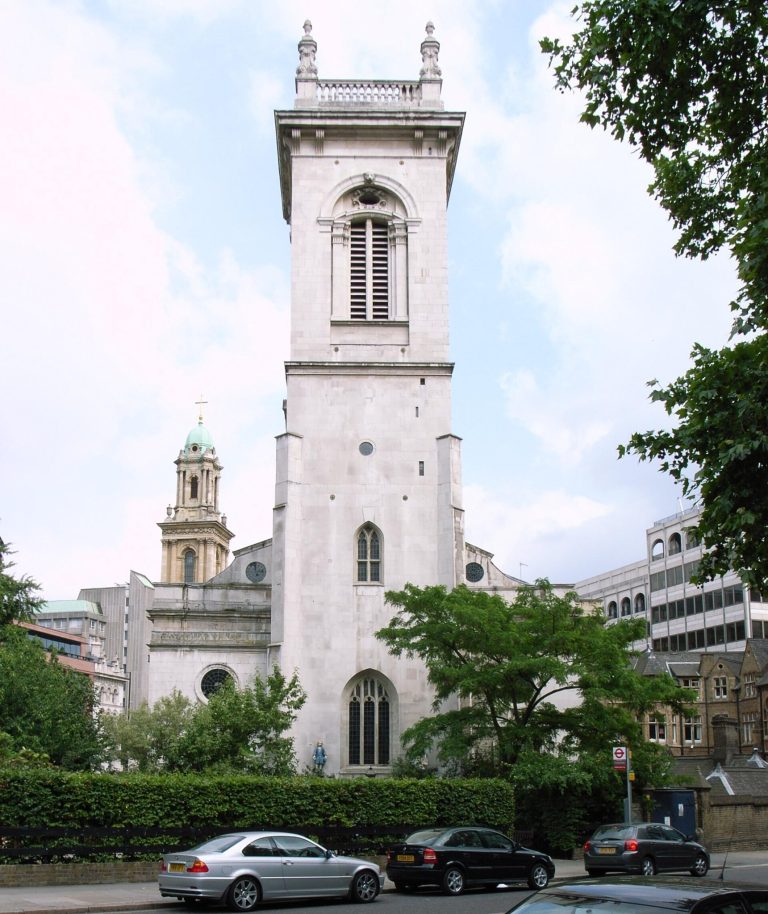
The square-plan tower, built of Ketton limestone, gives the church its main Fleet Street frontage. Its lowest stage contains the entrance and has a triple window on each side. Above it, an octagonal level has four pinnacles and paired windows on each side. An open-sided, octagonal lantern crowns the tower. Its form has been compared with lanterns at St Botolph’s Church in Boston and St Helen’s in York, and described as a copy of the lantern at All Saints, Pavement, in York. George Godwin proposed that St George’s Church in Ramsgate, built in 1825, may have provided its immediate model.
Chiming clock
The clock is set to the right of the tower in an aedicule, a small shrine-like architectural frame. Its figures, perhaps Gog and Magog, legendary giants in English tradition, strike the bells with clubs, mark the hours and quarter-hours, and turn their heads. The clock was the first public clock in London to display a minute hand. Ten new bells were dedicated and hung in 2012, replacing bells taken down in 1969.
Statues, memorials, and churchyard
Elizabeth I and the Ludgate figures
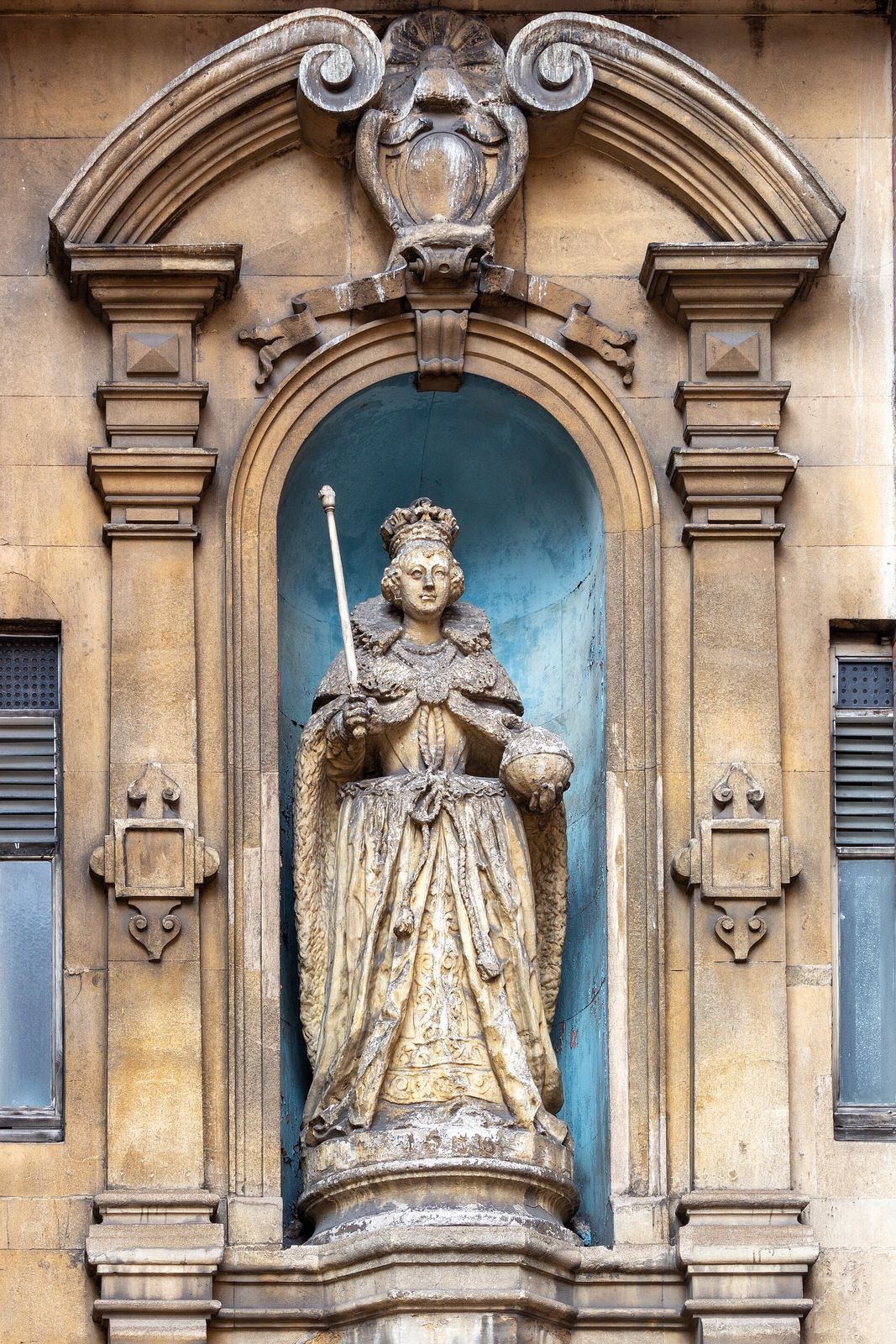
A statue of Elizabeth I stands in a niche beside the church, above the entrance to the former parochial school. William Kerwin made it in 1586, and it was transferred from Ludgate after the gate was demolished in 1760. It is thought to be London’s oldest outdoor statue. Three figures of ancient Britons from the same gate stand in the porch below; they represent the legendary King Lud and his two sons. Gwen John and her sister Winifred Jones worked with suffragists Millicent and Agnes Fawcett to secure repairs to the Elizabeth statue.
Memorials
Beside the Elizabeth statue is an obelisk to newspaper proprietor Lord Northcliffe, unveiled in 1930. Edwin Lutyens designed it, and Kathleen Scott made its bronze bust. A nearby tablet commemorates journalist James Louis Garvin. Near the font, a bronze plaque to Thomas Mudge was commissioned by the Worshipful Company of Clockmakers and installed in March 2019; Joanna Midgal made and engraved it. A marble tablet for clockmaker Henry Jones and his wife Hannah is mounted high on a wall behind the iconostasis, to the church’s left.
Churchyard fragment
A small part of the old churchyard survives between Clifford’s Inn and Bream’s Buildings.