St Clement Danes: The Central Church of the Royal Air Force
Site at a Glance
- Rating
- 4.7
- Popularity
- Low
- Country
- United Kingdom
- Primary era
- Early Modern
- External website
- Open
- Eras represented
- Medieval, Early Modern
- Civilizations
- British, English, Norman
- Site type
- Religious
- Remains
- Church
On this page11 sections
History
St Clement Danes is an Anglican church in London, United Kingdom, traditionally linked with a Danish settlement at Aldwych in the ninth century. The present building was constructed between 1680 and 1682 by Sir Christopher Wren after the Great Fire of London, and it now serves as the Central Church of the Royal Air Force.
Danish origins and medieval rebuilding
The church’s early foundation is associated with Danish settlers living near the boundary between English and Danish-controlled territory. Other traditions connect it with Alfred the Great’s settlement with Christianized Danes, a memorial for Danes killed in the eleventh century, an episode described in the Jómsvíkinga saga, or the Danish associations of King Harold I, known as Harold Harefoot. Its dedication to St Clement reflects the community’s maritime character. St Clement was an early Christian martyr traditionally regarded as a patron saint of mariners.
A church stood here during the Norman period and was rebuilt again in the Middle Ages. A new chancel was constructed over part of the churchyard in 1608. Repairs to the tower and other parts of the building followed in 1618. The late medieval church was built in the Perpendicular style, a form of English Gothic architecture, and parts of it were renewed in 1640.
Wren’s rebuilding
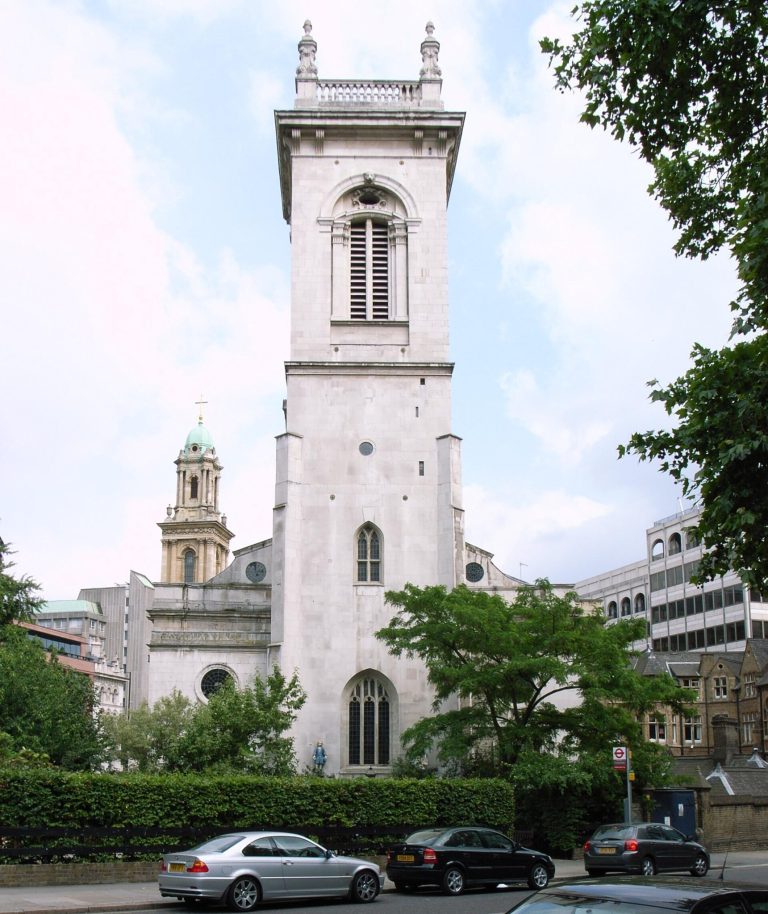
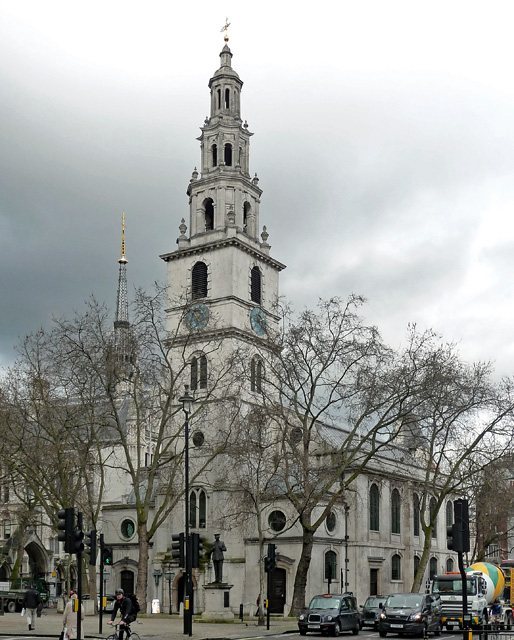
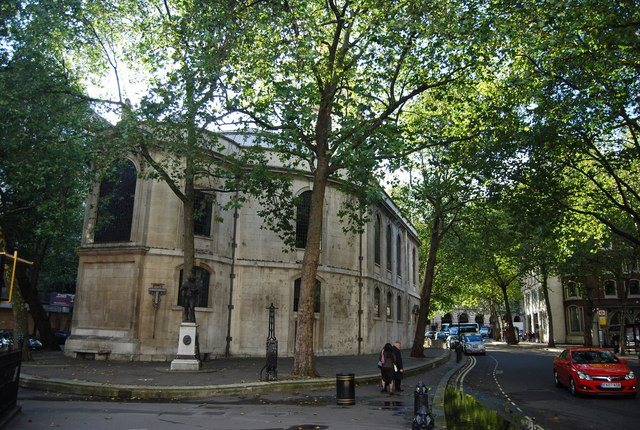
The Great Fire of London in 1666 left St Clement Danes in such poor condition that its tower was rebuilt from the foundations by 1669. The rest of the church was subsequently replaced. Wren designed the present church, which was erected between 1680 and 1682 in Portland stone while incorporating and recladding the existing tower. James Gibbs added the steeple and upper tower work in 1719, giving the building its characteristic crown.
The church later became one of the two so-called Island Churches on the Strand, the other being St Mary-le-Strand. A school connected with St Clement Danes was established after the churchwardens purchased land in 1552. The school building opened on Houghton Road in Holborn in 1862, after construction in 1844, remained there until 1928, moved to Shepherd’s Bush, and was re-established as a comprehensive school in Chorleywood, Hertfordshire, in 1975.
Wartime destruction and RAF restoration
German bombing during the Blitz, the aerial campaign against Britain during the Second World War, almost destroyed the church on 10 May 1941. Fire gutted the interior, and the ten bells fell, but the outer walls, tower, and Gibbs’s steeple survived. The bells were stored and recast after the war.
After a Royal Air Force fundraising appeal, the church was restored under the supervision of Sam Lloyd. The interior was reconstructed between 1955 and 1958 with the help of historical images. On 19 October 1958, Queen Elizabeth II and Prince Philip attended its reconsecration as the Central Church of the Royal Air Force. Since then, St Clement Danes has provided a setting for RAF worship, remembrance, and commemorative services connected with the service and associated organizations. It also belongs to the Community of the Cross of Nails, a post-conflict reconciliation community associated with Coventry Cathedral.
Associations and memorials
St Clement Danes is traditionally associated with the nursery rhyme “Oranges and Lemons,” although St Clement’s Eastcheap also claims the connection. The church bells play the rhyme’s melody, a practice interrupted by the wartime bombing. A related distribution of oranges and lemons to children continues through a revival of the Saint Clement’s service, begun by Rector William Pennington-Bickford in 1919 after the bells and carillon had been restored.
King Harold I is recorded as having been buried at the church, although no memorial marks the burial. William Webb Ellis, traditionally credited with inventing Rugby football in 1823, served as rector from 1843 to 1855 and is commemorated by a memorial tablet. RAF-associated burials or interments include Sir Archibald McIndoe, Marshal of the Royal Air Force Lord Tedder, and Marshal of the Royal Air Force Lord Douglas of Kirtleside. The church is a Grade I listed building.
Remains
Church structure
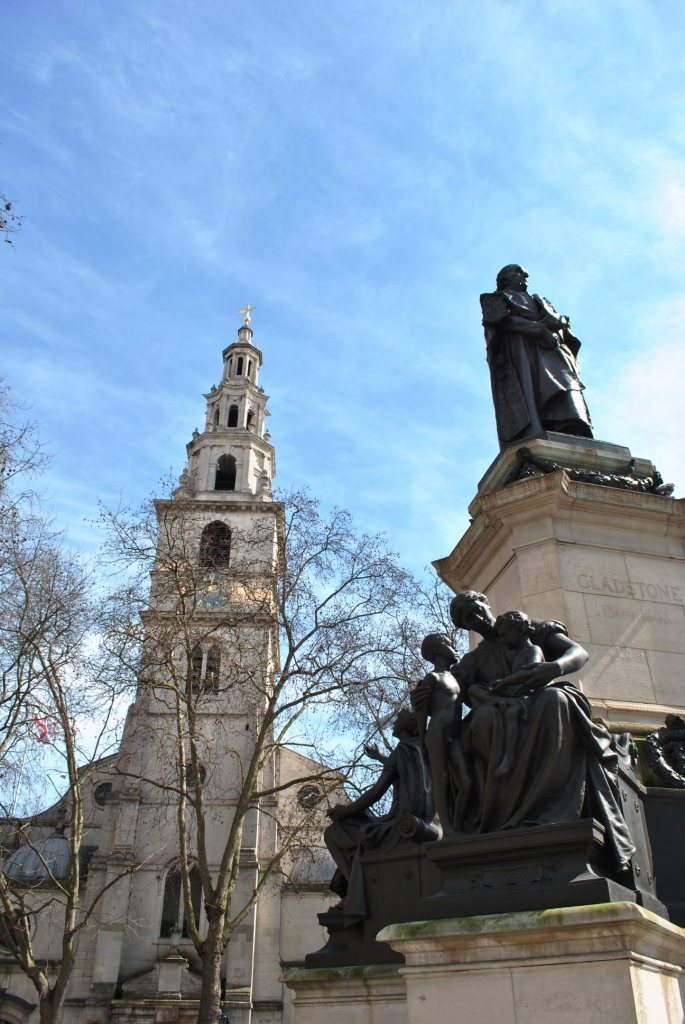
St Clement Danes retains the external form of Wren’s Portland stone church, with the surviving west tower and Gibbs’s steeple rising above the Strand. The core of the west tower dates from the fifteenth century, and one of its windows probably represents a post-Gothic tracery design. The steeple consists of three stages of superimposed octagons, creating the upper tower profile added by Gibbs in 1719.
The church has an apse, a rounded termination, at the east end. Its interior is arranged as a gallery church, with elevated galleries on three sides supported by square pillars that continue above gallery level as Corinthian columns. Corinthian columns are classical columns with ornate capitals traditionally decorated with acanthus leaves. Large round-headed windows at the upper level illuminate the bays above the galleries.
Interior construction
The nave has a barrel-vaulted ceiling, while the side aisles have cross-groin vaults. The interior was constructed as a plastered timber structure, a method chosen for structural and financial reasons. The side aisles and galleries continue around the choir, which ends in the apse. The floor is Welsh slate and carries the badges of more than 800 Royal Air Force commands, groups, stations, squadrons, and other formations. Near the entrance, badges of Commonwealth air forces form a ring around the RAF badge.
The north aisle floor contains a memorial to Polish airmen and squadrons who helped defend the United Kingdom and liberate Europe during the Second World War. Books of Remembrance commemorate RAF personnel who died in service and American airmen based in the United Kingdom who died there during the war. Near the altar, plaques commemorate Royal Air Force, Royal Flying Corps, Royal Naval Air Service, and Commonwealth personnel awarded the Victoria Cross or George Cross.
Archaeological remains and historic fittings
Excavations beneath the church in 1942 uncovered a crypt belonging to the Norman-period building. This surviving underground feature provides physical evidence of the earlier church beneath the later structure. A Latin inscription beneath the restored Royal coat of arms states that Wren built the church, aerial warfare destroyed it in 1941, and the Royal Air Force restored it in 1958. The inscription gives 1672 as Wren’s completion date, although the church itself was completed in 1682.
The church’s first organ was installed by Bernard Smith in 1690 and was rebuilt several times before its destruction during the Second World War. Harrison and Harrison installed the present organ in 1958 as a gift from the United States Air Force. Its case reproduces that of the destroyed Father Smith organ. The instrument has 38 stops on three manuals and pedals and uses electro-pneumatic action.
RAF standards and commemorative objects
The gallery contains retired Colours and Standards of active RAF squadrons, standards of disbanded squadrons, and the Royal Banner of the Royal Observer Corps. Above the west entrance is the armorial achievement of Lord Trenchard. The Order of the Garter Banner of Marshal of the Royal Air Force Lord Portal of Hungerford was transferred from St George’s Chapel, Windsor, after his death.
Several fittings were given by RAF and Commonwealth partners. The Royal Australian Air Force donated the lectern, the Air Training Corps provided the cross, the Dutch embassy gave the altar, the Royal Norwegian Air Force presented the font, and the Royal Belgian Air Force supplied the Paschal Candle. Pulpits, pews, and chairs were presented by various RAF-associated donors, including past Chiefs of the Air Staff, Sir Douglas Bader, and the Guinea Pig Club.
External and personal memorials
Statues of the wartime RAF leaders Arthur Harris and Hugh Dowding stand outside the church. Harris directed Bomber Command, while Dowding led Fighter Command during the Battle of Britain. Harris’s statue was erected in 1992 by the Bomber Harris Trust and unveiled by Queen Elizabeth the Queen Mother. Its installation was controversial because of Harris’s responsibility for bombing campaigns against German cities, including Dresden. The statue later faced protests and graffiti and required police protection.
Inside the church, a memorial tablet commemorates William Webb Ellis. Other memorials and ashes recall RAF-associated figures including Sir Archibald McIndoe, Lord Tedder, and Lord Douglas of Kirtleside. Together with the badges, standards, memorial books, and donated furnishings, these features give the restored interior its continuing role as a place of RAF remembrance.