Friedrich-List-Gymnasium Reutlingen: A Secondary School with Medieval Origins
Site at a Glance
- Popularity
- Medium
- Country
- Germany
- Primary era
- Early Modern
- Eras represented
- Early Modern, Modern
- Civilizations
- German, Holy Roman Empire
- Site type
- Civic
- Remains
- School
On this page14 sections
History
Friedrich-List-Gymnasium Reutlingen is a German Gymnasium, a secondary school preparing pupils for higher education, with a foundation dated to 1276. It is the oldest Gymnasium in Reutlingen and one of the oldest surviving schools in the German-speaking world. Its roots lie in a school attached to a Franciscan monastery, belonging to a Catholic religious order. The earliest mention of the school refers to a teacher of Latin.
From monastery school to municipal Latin school
In 1535, during the Reformation, a sixteenth-century religious movement that led to the establishment of Protestant churches, the monastery was dissolved. Its school continued as a municipal Latin school, where Latin was central to instruction. The monastery’s other buildings became a hospital and an arsenal, while Reutlingen’s council later held its meetings in the school building. Until the sixteenth century, the Latin school had been the imperial city’s only school. An imperial city was a self-governing city within the Holy Roman Empire.
War, school rules, and fire
The school remained open despite the severe damage Reutlingen endured during the Thirty Years’ War, a major European conflict fought from 1618 to 1648. Mayor Matthäus Beger (1588–1661) supported its continuation by employing additional teachers, even as the city’s population and the number of pupils declined. His plan for a more practically focused German Gymnasium was rejected as too advanced for its time, with no similar schools nearby to serve as models.
In 1668, Johann Philipp Laubenberger (1614–1683), later mayor, introduced a thirteen-part code governing the school’s organization, lessons, and examinations. The Latin school was then the only route for academically gifted pupils seeking preparation for university. The strict rules proved difficult to sustain: teachers faced heavy fines for violations despite low pay and often needed other sources of income. The school escaped damage when a fire swept through Reutlingen in 1726.
New courses and the Gymnasium, 1811–1887
A practical course, which later provided the basis for a secondary-school type focused on non-classical subjects, began in 1811. The Latin school became a Lyceum, another school designation, in 1842. The German Revolution of 1848–49, a series of political upheavals in the German states, led to its return to Latin-school status, which lasted until 1869.
As industrialization and population growth brought more pupils, rector Friderich proposed expanding the school into a Gymnasium. He sought to provide a humanistic education and raise Reutlingen’s standing. The town council approved the plan almost unanimously on 23 September 1885, and the change took effect the following April. The first pupils entered on 15 October; the first group completed its final examinations in summer 1887.
Reform, National Socialism, and war
In 1918, the school introduced 45-minute lessons, shifted the start of the school year to spring, and formed a student advisory council and a parents’ committee. Its main building underwent extensive renovation during the 1920s. A proposal to close the school in 1931, prompted by the economic crisis, was defeated by public opposition in Reutlingen.
The school took the name Friedrich-List-Schule in 1934, in honor of former pupil Friedrich List (1789–1846), an economic theorist. During the standardization of German school types in 1936–37, it became the Friedrich-List-Oberschule for boys. Under National Socialism, the Nazi Party’s ideology and regime, the Hitler Youth, its youth organization, took an increasingly prominent place in school life. Eventually, almost 98 percent of pupils belonged to it. Physical education rose to five hours weekly, and military exercises and combat sports became part of general education from 1938. From 1939, pupils needed an SA weapons badge to receive a leaving certificate unless they had left school for voluntary service. The SA was a paramilitary organization of the Nazi Party. Near the end of the Second World War, 150 pupils were being taught by 17 teachers.
Postwar growth and recent development
Teaching resumed in 1946 under a curriculum set by the French occupying authorities. Latin returned as the first foreign language in 1953, followed by English and Russian after a curriculum reform. Since 1957, the school has offered modern-language and mathematics-and-science tracks. Enrolment grew from 300 pupils in 1946 to 600, particularly with the introduction of the science track. Teaching space expanded to the Spitalhof in 1961, and enrolment later reached 1,000 in 1981.
A new science building was completed in autumn 2003, and both school buildings underwent extensive renovation from 2004 to 2007.
Remains
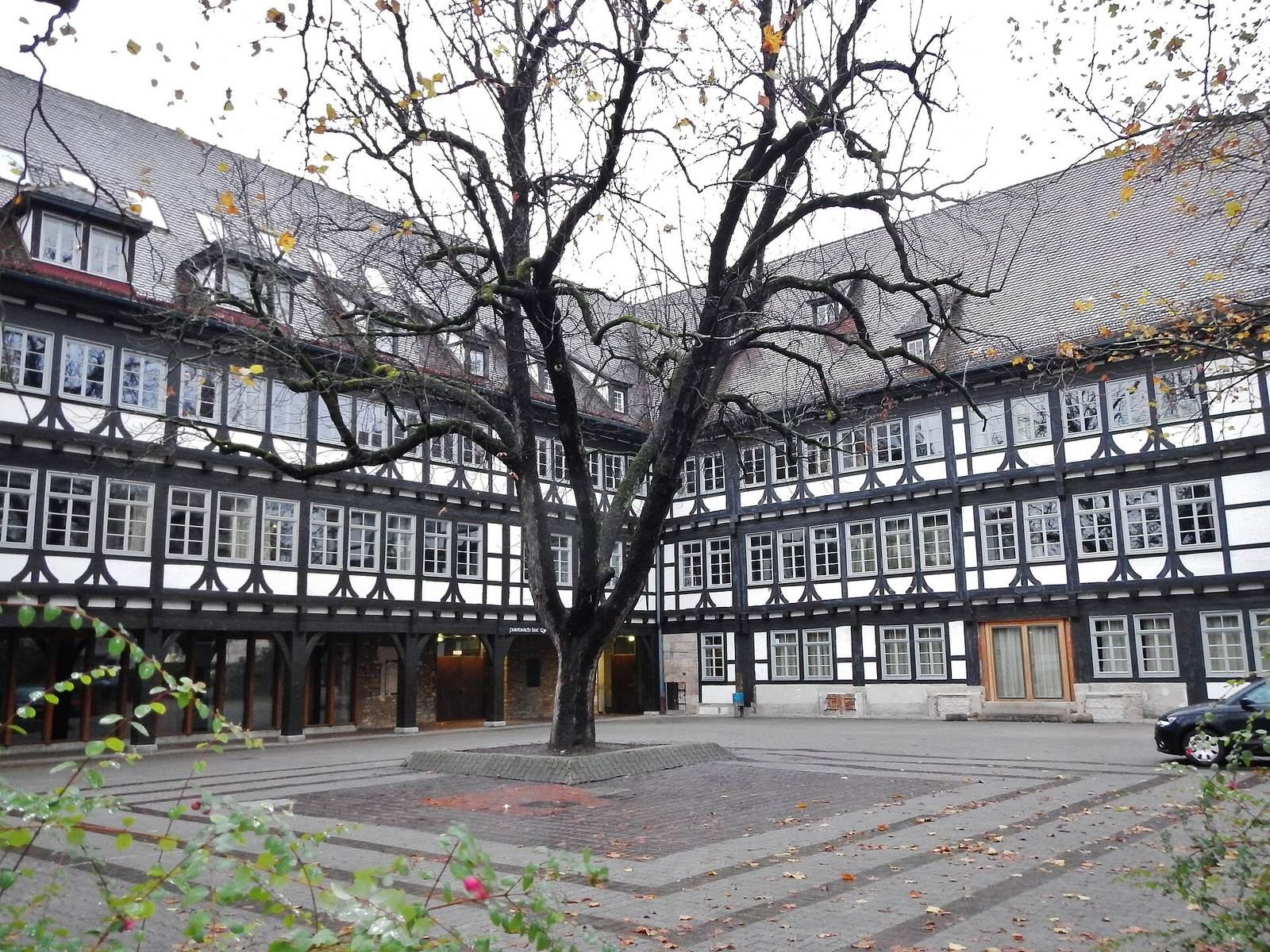
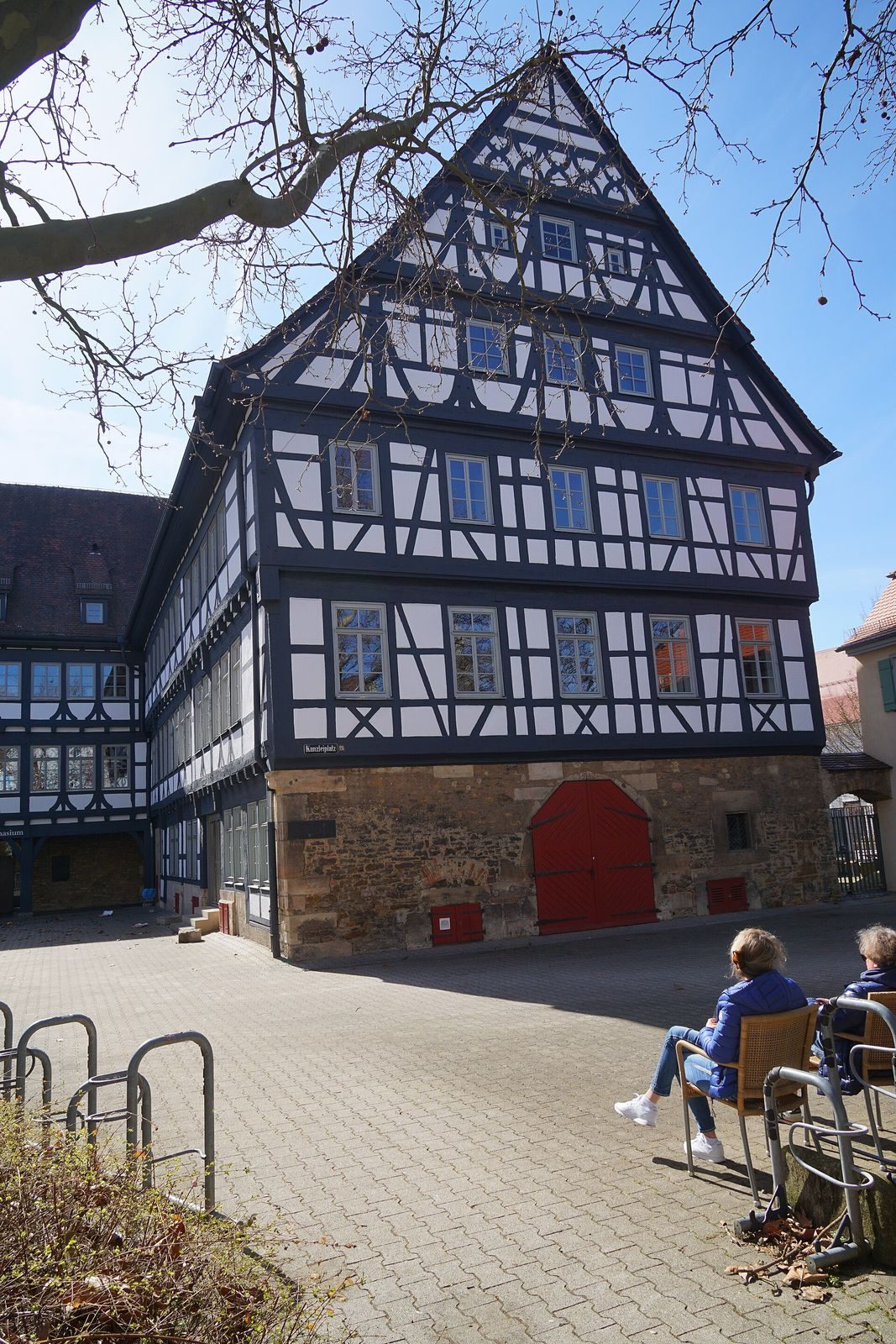
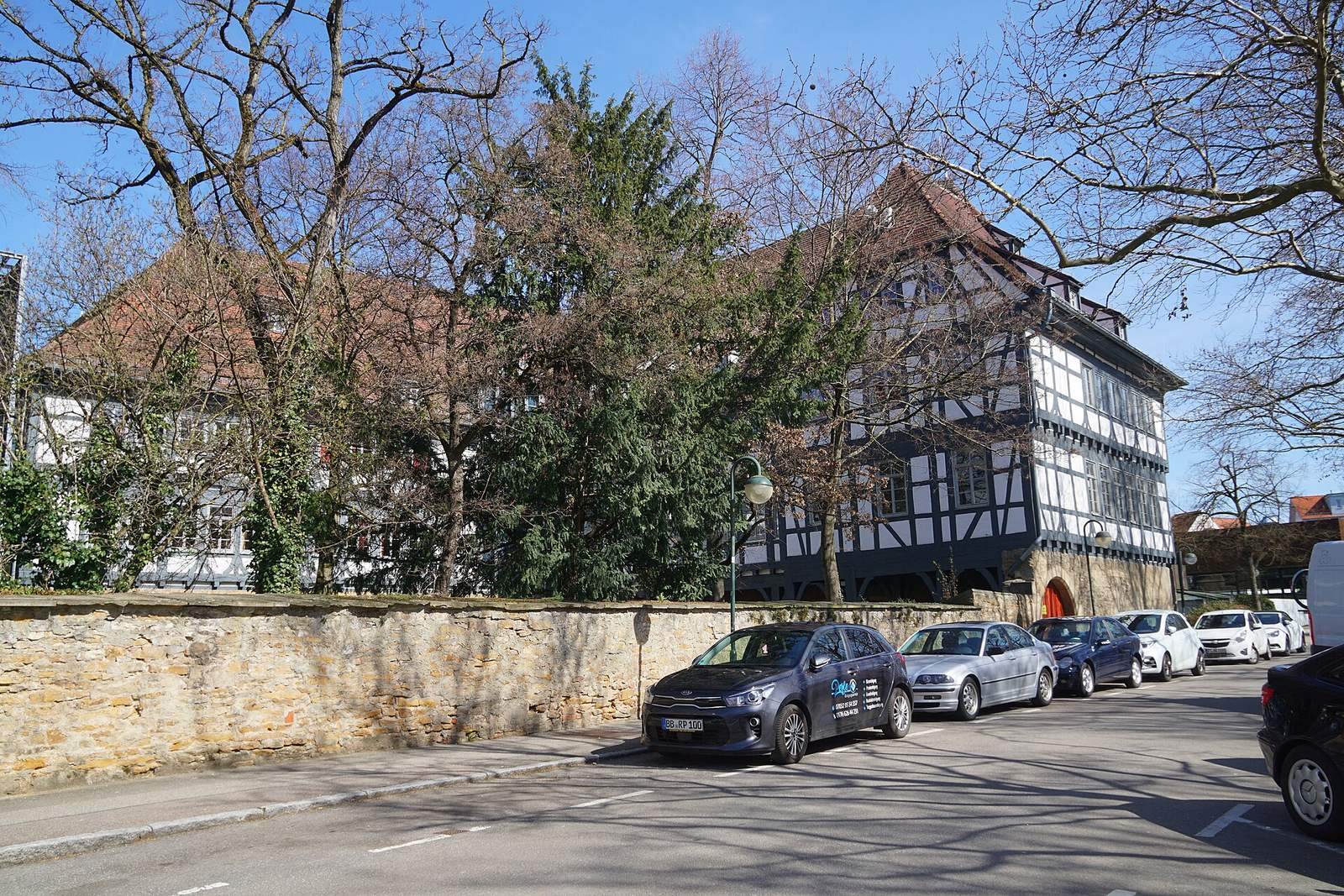
The school’s facilities are spread across buildings at Kanzleiplatz and Marktplatz, alongside dedicated science and sports spaces. The main school building is a sixteenth-century half-timbered structure; a second school building stands in the Spitalhof, about a five-minute walk away.
School buildings and learning spaces
Main school building
The half-timbered building at Kanzleiplatz houses the middle and upper grades. It is the school’s principal historic structure.
Spitalhof building
The building at Spitalhof, by Marktplatz, serves pupils in grades five to seven. Its facilities include specialist science rooms, a staff room, and a pupil lounge.
Science and shared facilities
The science building contains two rooms each for biology, chemistry, and physics, as well as two computer rooms. It also provides rooms for upper-grade pupils and independent work, a pupil library, and a rooftop terrace used for astronomy. Former subject-department rooms have been converted into classrooms and a multifunctional room. The renovated former caretaker’s house now contains a cafeteria with a meal-ordering system.
Sports facilities
Oskar-Kalbfell-Halle
The Oskar-Kalbfell-Halle, next to the main school building, is a well-equipped sports facility.
Rennwiese
The school also uses the Rennwiese for sports. The grounds border Volkspark and Pomologie.