Carissa: A Turdetani City and Roman Archaeological Site in Spain
Site at a Glance
- Rating
- 3.5
- Popularity
- Low
- Country
- Spain
- Primary era
- Classical
- Eras represented
- Stone Age, Classical, Medieval
- Civilizations
- Roman
- Site type
- Settlement
- Remains
- City
On this page14 sections
History
Carissa is an ancient Turdetani city and archaeological site between Bornos and Espera in Cádiz, Spain. Occupation began in the final phase of the Neolithic or the Copper Age and continued into the Middle Ages; the city later prospered under Roman rule in Hispania Baetica, Rome’s province in southern Iberia.
Roman city
Carissa belonged to the Roman regional district of Gades, an administrative and judicial area. It was known as Carissa Aurelia, while Carisa appears as another classical form. Ptolemy placed the city between Hispalis and Nabrissa. Pliny classified it among cities with Latin rights, a legal status distinct from full Roman citizenship. By the late first century BC, Carissa was one of 27 cities with this status, and many residents belonged to the Galeria, a Roman civic tribe.
The city held the standing of an incorporated Roman town and later was described as a community of Roman citizens. Julius Caesar favored Carissa. Under Emperor Vespasian, who ruled from AD 69 to 79, it gained the right to issue its own coins; several pieces attributed to the city survive.
Abandonment and later occupation
A destruction dated to about AD 560 preceded the city’s abandonment in the Late Roman period. A later claim that the Vandals, a Germanic people active in the western Roman world, razed Carissa has an uncertain chronology. Activity at the site continued into the Middle Ages, when simple pit burials were made in its cemeteries.
Antiquarian study and archaeological investigation
In the seventeenth century, Rodrigo Caro described remains at Carissa and objects circulating from the site. He also cited an inscribed stone later included by Hübner in a collection of Latin inscriptions. Romero de Torres subsequently surveyed what was known about Carissa, with particular attention to objects from the site. Archaeological work, including investigations by María Luisa Lavado and Lorenzo Perdigones in 1985–1986, examined the remains and excavated the northern cemetery. Spain designated Carissa an Asset of Cultural Interest as an Archaeological Zone in 2004.
Remains
Carissa extends across a series of low hills, from about 200 to 274 metres above sea level, in the foothills of the Sierra de Gamaza and Sierra del Calvario. The site overlooks the Coto de Bornos to the east and the Salado River valley to the west. Its distinct areas remain discernible across the hills, including an urban area, a levelled space that may have held public buildings, and cemeteries.
Urban layout and prehistoric remains
City remains
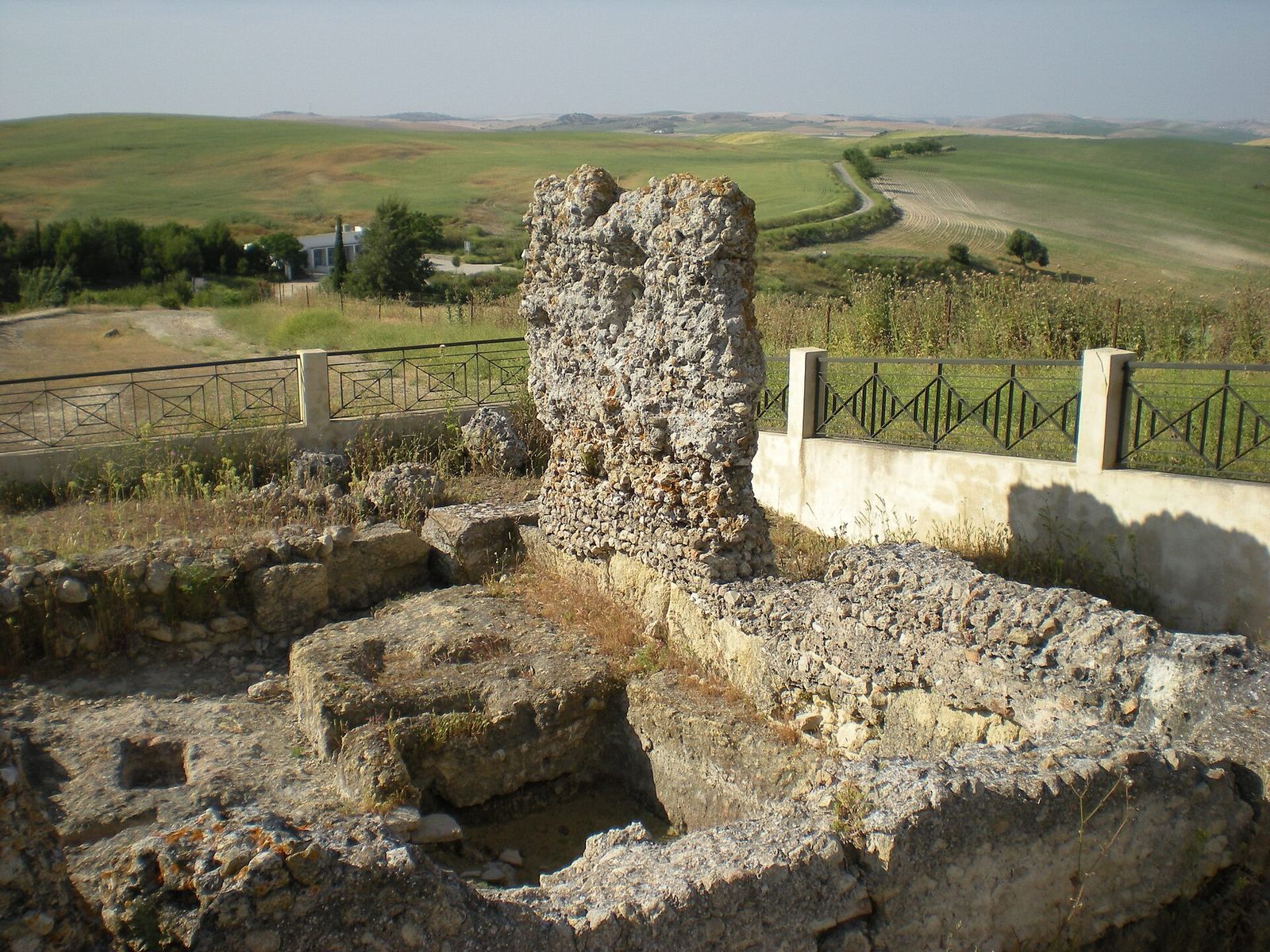
A Roman road survives within the city, with remains of gates along its sides. Sections of the city wall, building walls, other structures, and scattered construction material are also visible. The flattened area within the urban site may have served as the setting for public buildings.
Prehistoric silos
Excavations at the Late Roman cemetery of Trigal Northwest uncovered five prehistoric, silo-shaped structures. They may have belonged to an open-air settlement.
Necropolises
Northern cemetery path
A Roman-period path runs along the eastern slope of the northern cemetery. About one metre wide, it has a drainage channel on each side. The path probably continued around the cemetery’s eastern edge, providing a route through the burial area from the city.
Cremation burials
The northern cemetery includes simple and double burial pits for cremated remains. Covers over the double pits were made from large stone blocks, bricks, or roof tiles, arranged either as a pitched cover or in a flat layer. Other cremation burials used urns placed in pits beneath brick or tile covers, or urns set in ground-cut pits inside lead casings.
Inhumations
Burials of uncremated bodies occupy rectangular, square, irregular, and human-shaped pits. Some pits have covers of roof tiles arranged in a pitched form or laid flat, while others are covered with bricks. The cemetery also contains plain tombs built from large stone blocks and mixed constructions incorporating brick or roof tiles.
Columbaria and funerary slabs
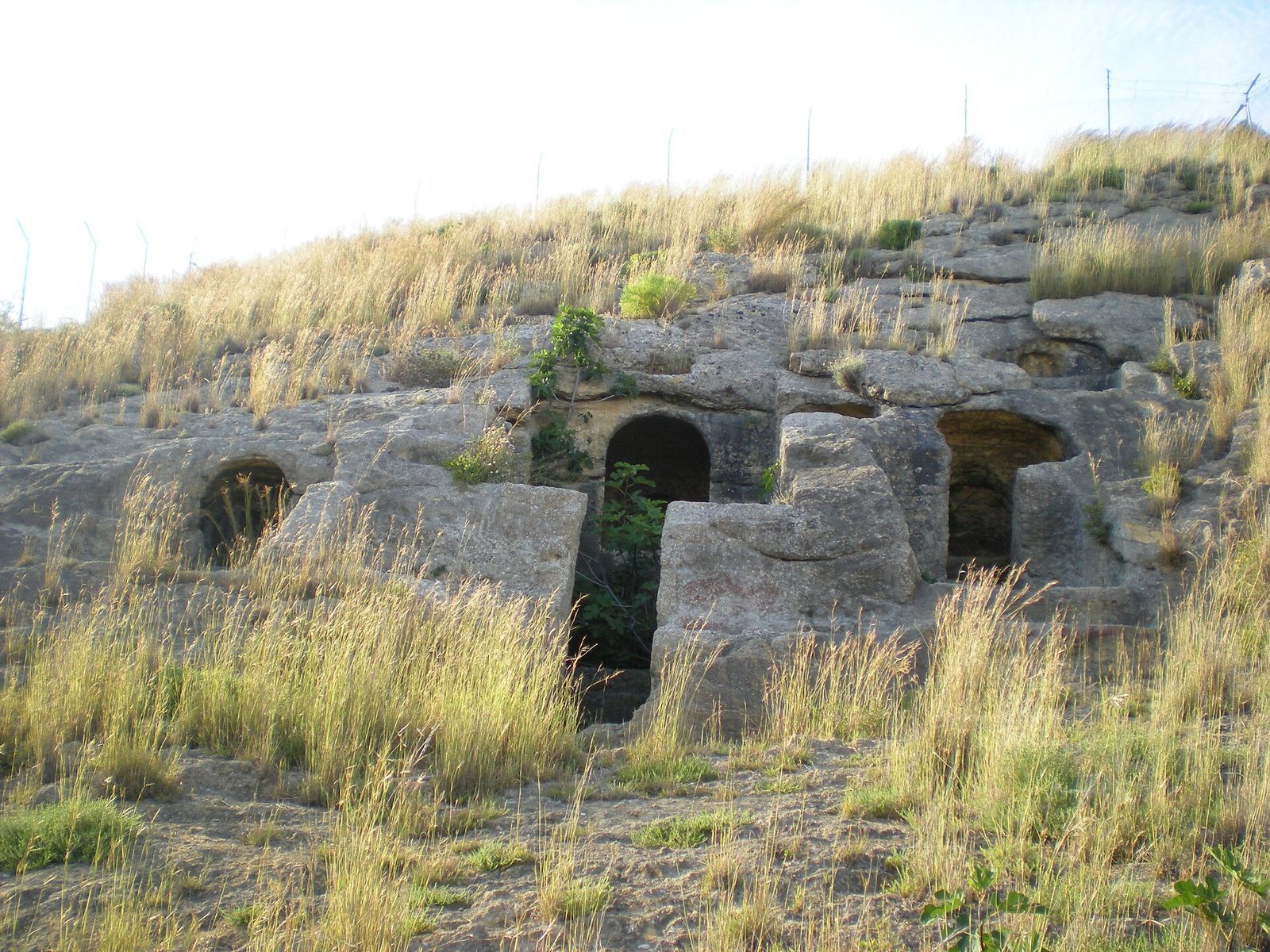
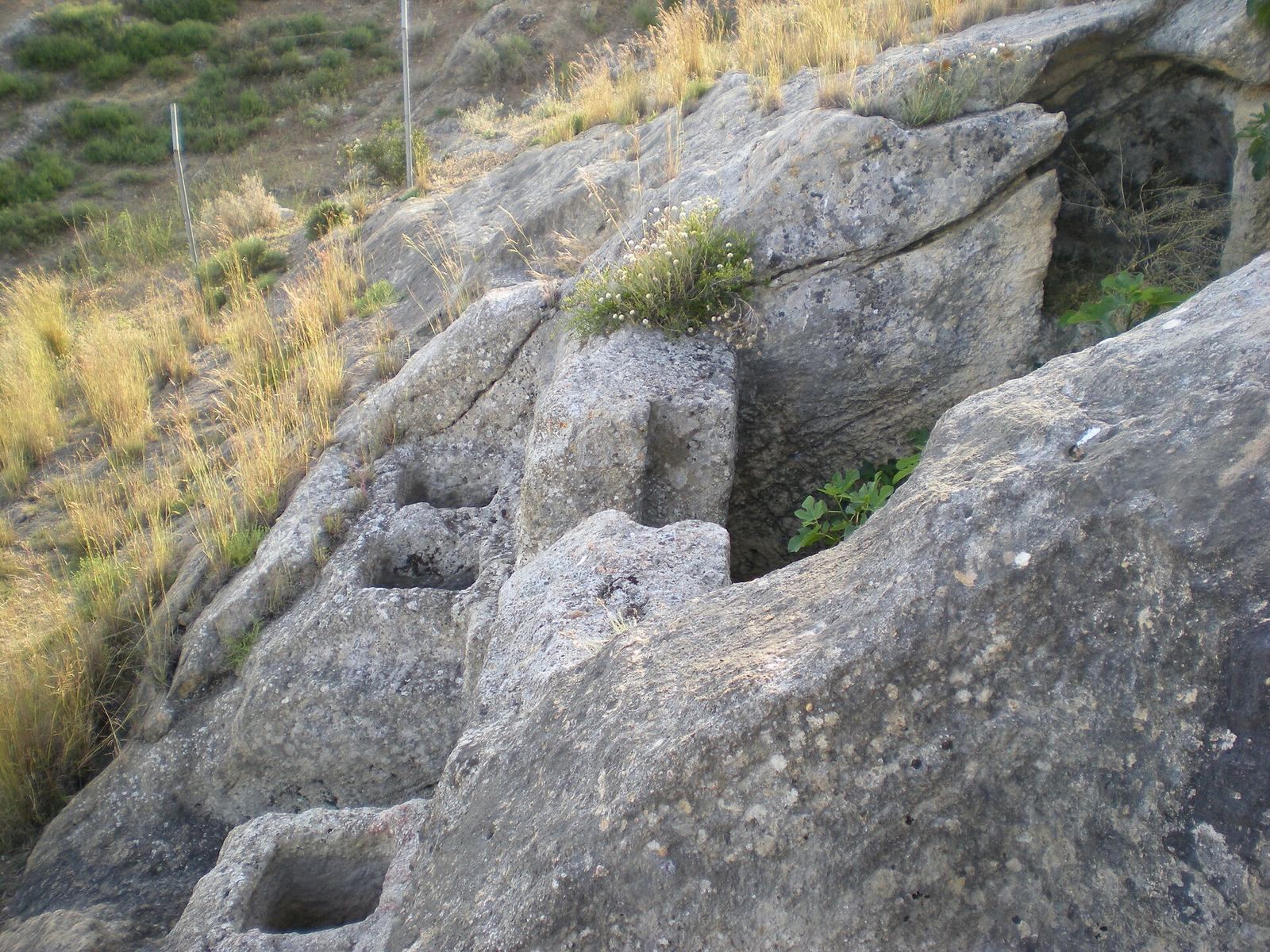
The northern cemetery has columbaria, funerary structures associated with cremation, cut into rock or built of stone. Their forms range from simple to composite, and some occur alongside other cremation burials. Inscribed funerary slabs have also been found at Carissa, including an early Christian example dated to the fourth or fifth century.
Southern cemetery
The southern cemetery occupies both sides of a road leading into the city. Its tombs include Greek-cross plans, truncated-cone forms, tombs with pitched covers, square masonry structures, cremation urns, and hypogea, or underground tomb chambers.