Church of the Visitation, Trakai: A Catholic Parish Church in Lithuania
Site at a Glance
- Rating
- 4.8
- Popularity
- High
- Country
- Lithuania
- Primary era
- Early Modern
- Eras represented
- Medieval, Early Modern, Modern
- Civilizations
- Grand Duchy of Lithuania, Polish–Lithuanian Commonwealth, Russian
- Site type
- Religious
- Remains
- Church
On this page12 sections
History
Foundation and royal endowment
The Church of the Visitation, Trakai, is a Catholic parish church in Lithuania, founded by Vytautas the Great on 24 May 1409. It is counted among the earliest Catholic churches in the Grand Duchy of Lithuania. Its founding charter dedicated it to the Visitation of the Blessed Virgin Mary, the Christian feast recalling Mary’s visit to Elizabeth, and to Saint John the Evangelist, traditionally identified as one of Jesus’s apostles. The charter assigned the Bezdež district to support three priests and provided a salary for a cleric or school supervisor.
In 1524, Sigismund I the Old, king of Poland and grand duke of Lithuania, established a provostship for the church. This ecclesiastical office carried governance rights comparable to those of a cathedral parish priest. The parish of Eišiškės was assigned to support it.
Damage and Baroque rebuilding
The church suffered substantial damage in 1655 during the war with Moscow and was repaired after 1670. In 1700, the Romer family, which owned estates around Trakai, added a chapel on the church’s south side. The building was badly damaged again during the Great Northern War in the early eighteenth century. Rebuilding and alterations gave it a Baroque character, with the central nave raised and towers added. The church was reconsecrated in 1718 after this work.
Fires and later repairs
A fire burned the church in 1794. Restoration followed in 1796, with further repairs in 1822, 1840, 1858 and 1867. Lightning caused another fire in 1900, and the churchyard was enclosed in 1902.
Pilgrimage and ecclesiastical status
The church is a Catholic pilgrimage site associated with the image of Our Lady of Trakai, a title for Mary linked to a devotional image. Tradition holds that Vytautas received the image from Byzantium. Jesuits from Vilnius organized solemn pilgrimages to Trakai, and the image bears the title Patroness of Lithuania. Pope Francis awarded it the Golden Rose, a ceremonial papal honor, in 2018.
On 15 August 2017, the Congregation for Divine Worship and the Discipline of the Sacraments, a Vatican department concerned with Catholic worship and sacraments, granted the church the title of minor basilica under Pope Francis’s authority. This is an honorific title given by the Catholic Church to certain churches. The church belongs to the Roman Catholic Church and the Vilnius Archdiocese, a major Catholic jurisdiction led by an archbishop, and is associated with the Trakai deanery, an administrative district within a diocese or archdiocese. Services are held in Lithuanian and Polish.
Remains
Main church
Plan and construction
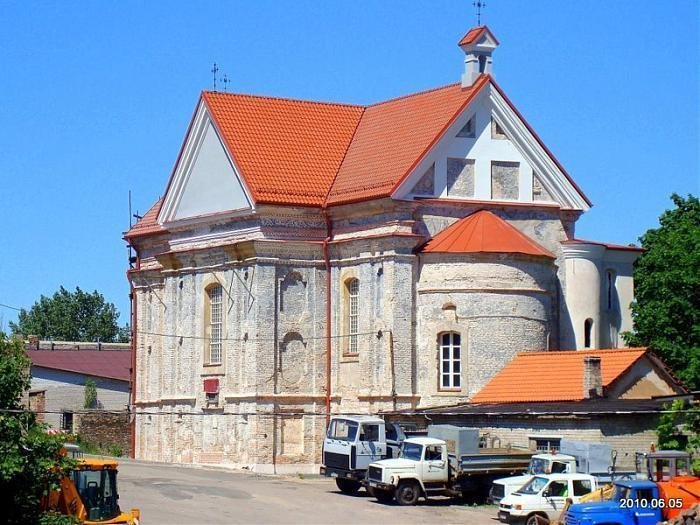
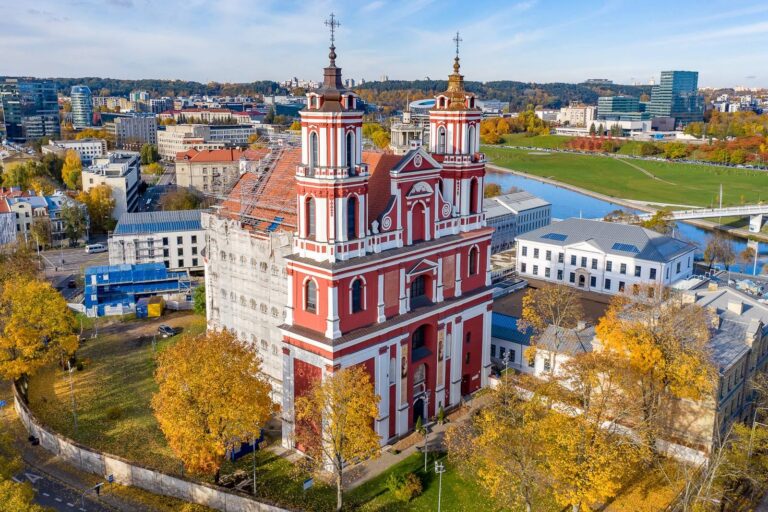
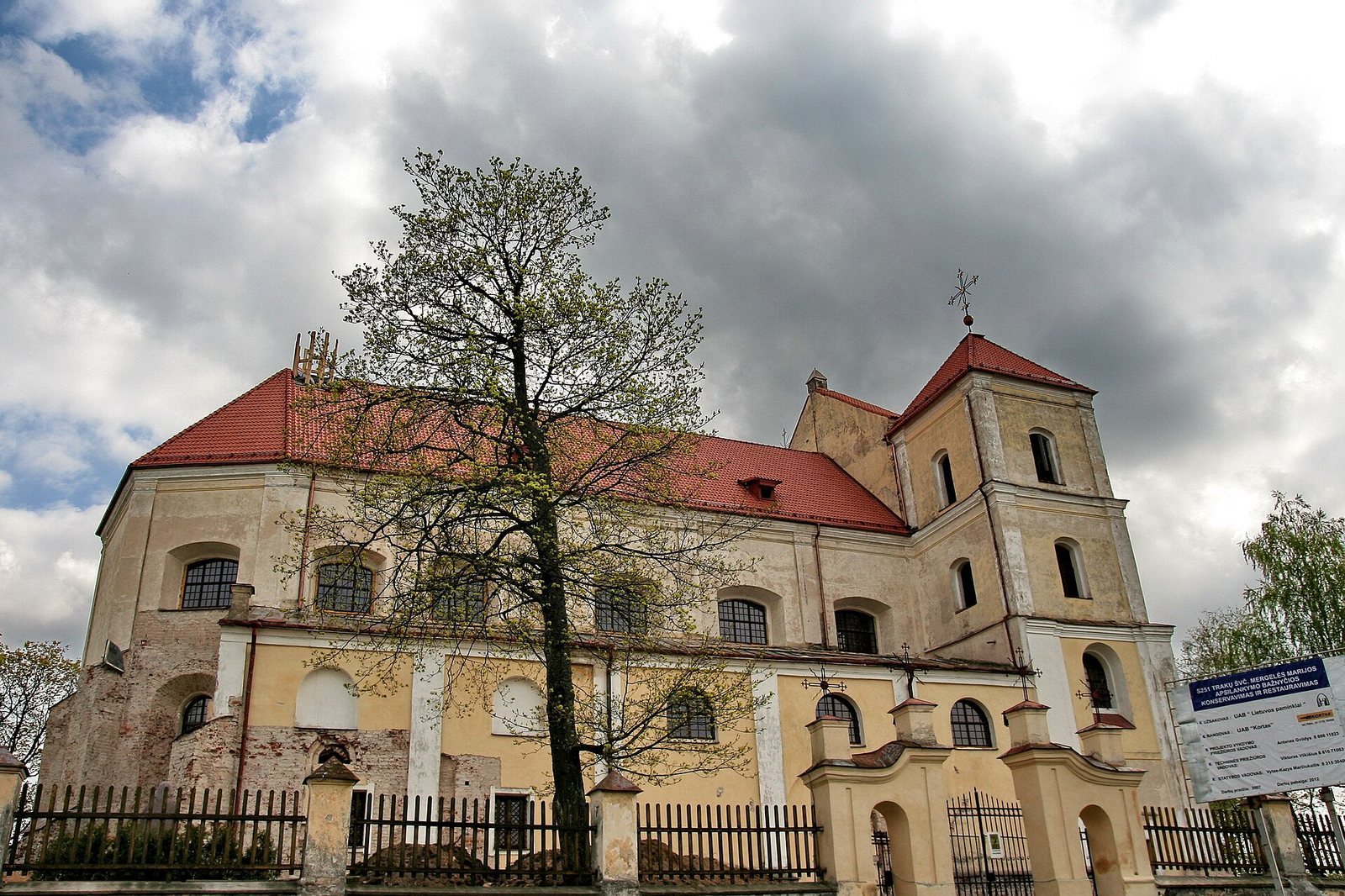
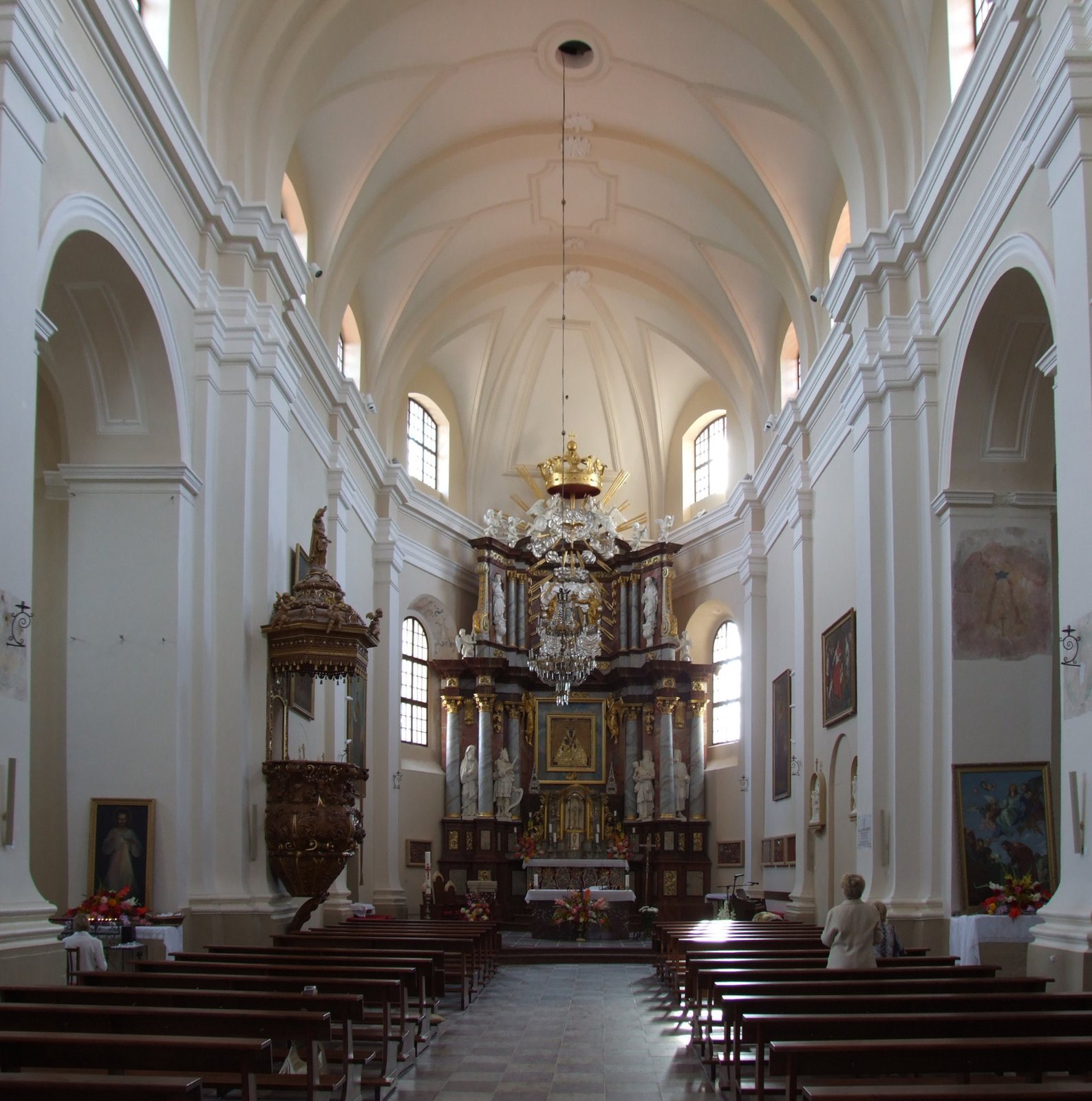
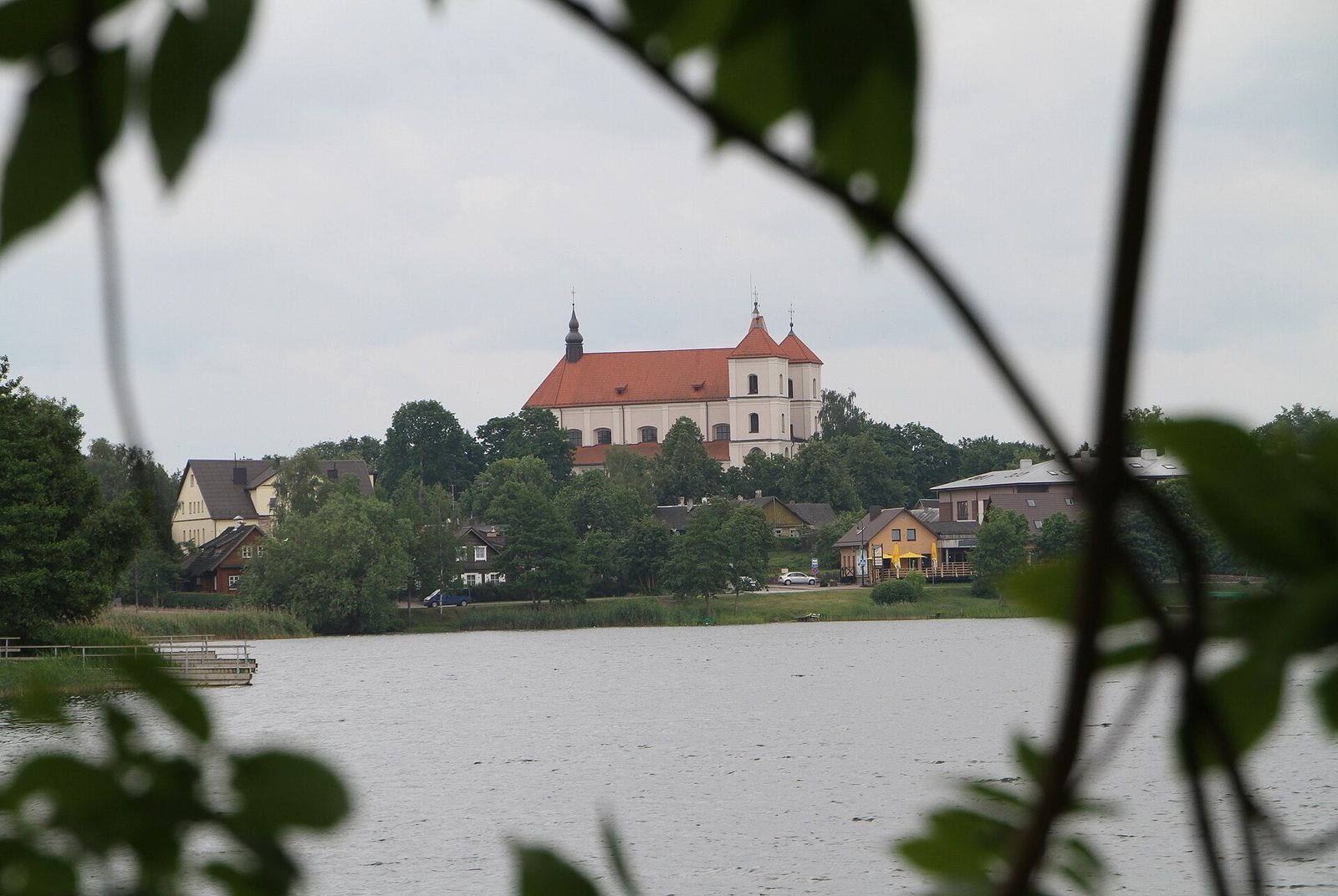
Near Lake Luka in Trakai’s old town, the church is built of plastered masonry and has an irregular rectangular plan, with its main body and projecting end markedly skewed. Its three-aisled hall layout has a central nave and side aisles of similar height. At the eastern end, a polygonal apse, the projecting end of the church, forms the presbytery; a small sacristy stands to its right. Two square towers rise from the main façade. Inside, the nave has a barrel vault, a continuous arched ceiling, while the side aisles have cross vaults formed by intersecting arches. A stone-masonry wall encloses the churchyard.
Main altarpiece
The main altarpiece holds the image of Our Lady of Trakai, showing Mary with the infant Jesus. The image is papally crowned.
Romer family chapel
Chapel and altar
The chapel occupies the south side of the church, at the end of a side aisle. Its Neoclassical walls have paired pilasters, shallow column-like projections, with grape-cluster ornaments on their capitals. The austere Crucifixion altar includes a striking crucifix dating to the mid-eighteenth century.
Tombs and family memorials
The chapel crypt contains Neoclassical tombs for Michal Romer (1778–1853), chief municipal official of Vilnius, and his wife Rachel de Raes (1783–1855). Designed by Kazimierz Jelski, a sculpture professor at Vilnius University, the tombs include sculpted likenesses of the couple and allegorical compositions. Jelski also renovated the chapel in the mid-nineteenth century. Plaques set into its walls commemorate other Romer family members buried there, including artists Edward Jan Romer (1806–1878) and his son Alfred Isidore (1832–1897).