Flåm Church: A 17th-Century Parish Church in Norway
Site at a Glance
- Rating
- 4.6
- Popularity
- High
- Country
- Norway
- Primary era
- Early Modern
- Eras represented
- Early Modern, Modern
- Civilizations
- Denmark–Norway, Norwegian
- Site type
- Religious
- Remains
- Church
On this page10 sections
History
The medieval predecessor and rebuilding
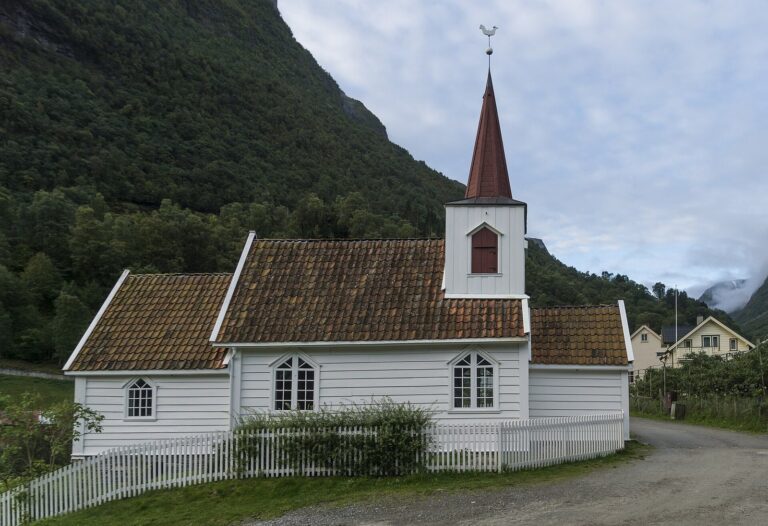
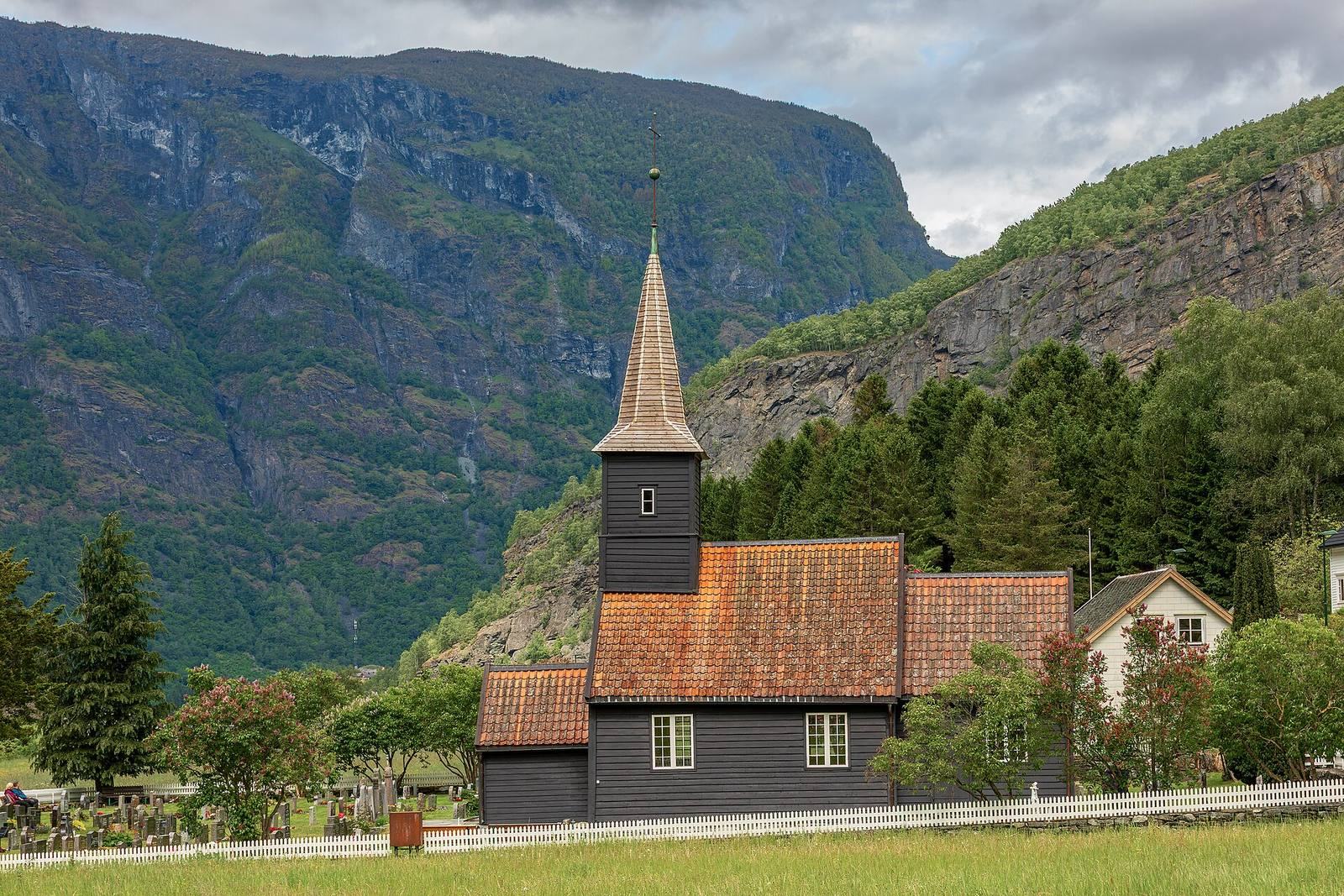
Flåm Church is a timber long church at the farm of Flåm in Flåmsdalen, Norway, completed in 1670. Built by master builder Magne Essen, it stands on the site of an earlier church. A long church has its main body and altar area arranged end to end.
A church probably stood at Flåm by the 13th century, before the Black Death, the devastating pandemic of the mid-14th century. Its earliest surviving written mention dates to around 1340, but does not establish when it was built. The predecessor was likely a stave church, a medieval timber building made with upright posts and planks, located approximately where the present church stands.
By 1661 the old church was in very poor condition. Essen was contracted to demolish it and build a replacement on the same site, reusing as much material as possible. Instead, he built a church at Fretheim, about two kilometres north, without first removing the old building. The Fretheim church was completed in 1668 and badly damaged by a windstorm the following year. In 1670 both churches were dismantled, and materials from each were used to build the present church on the old site. It was completed and consecrated that year.
Parish use and later changes
Flåm Church was formerly Catholic and is now an Evangelical Lutheran parish church of the Church of Norway. It belongs to the Diocese of Bjørgvin, a regional church administrative area. Until the system began to be phased out in 2004, the church was part of Aurland parish district, an administrative unit that could include several parishes.
Restoration work took place from 1928 to 1930, and an organ installed during the work was replaced in 1979. In 1967, conservators working under the Norwegian Directorate for Cultural Heritage uncovered a medieval textile among layers of altar cloths. In October 2014, floodwater entered the churchyard after the river rose along its wall; the water reached above the church floor. The church is automatically protected under Norwegian heritage law, without requiring a separate individual designation.
Remains
The church building
Layout and exterior
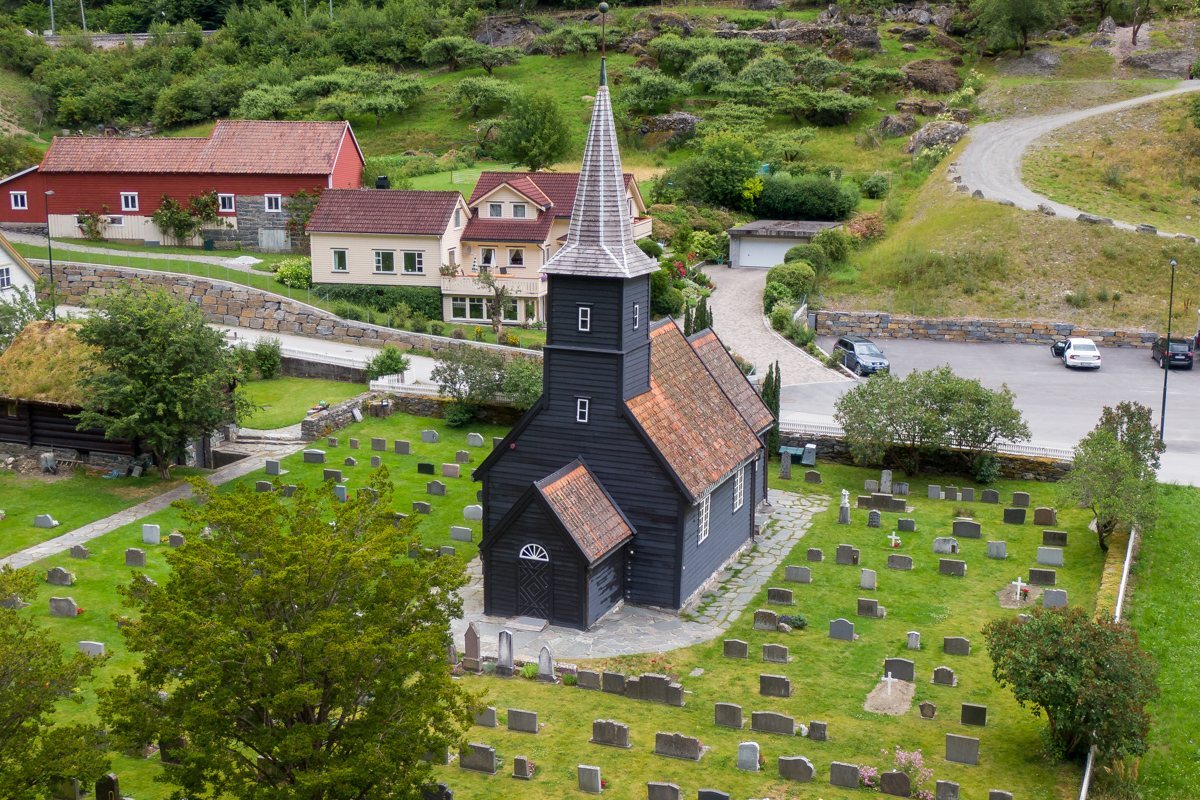
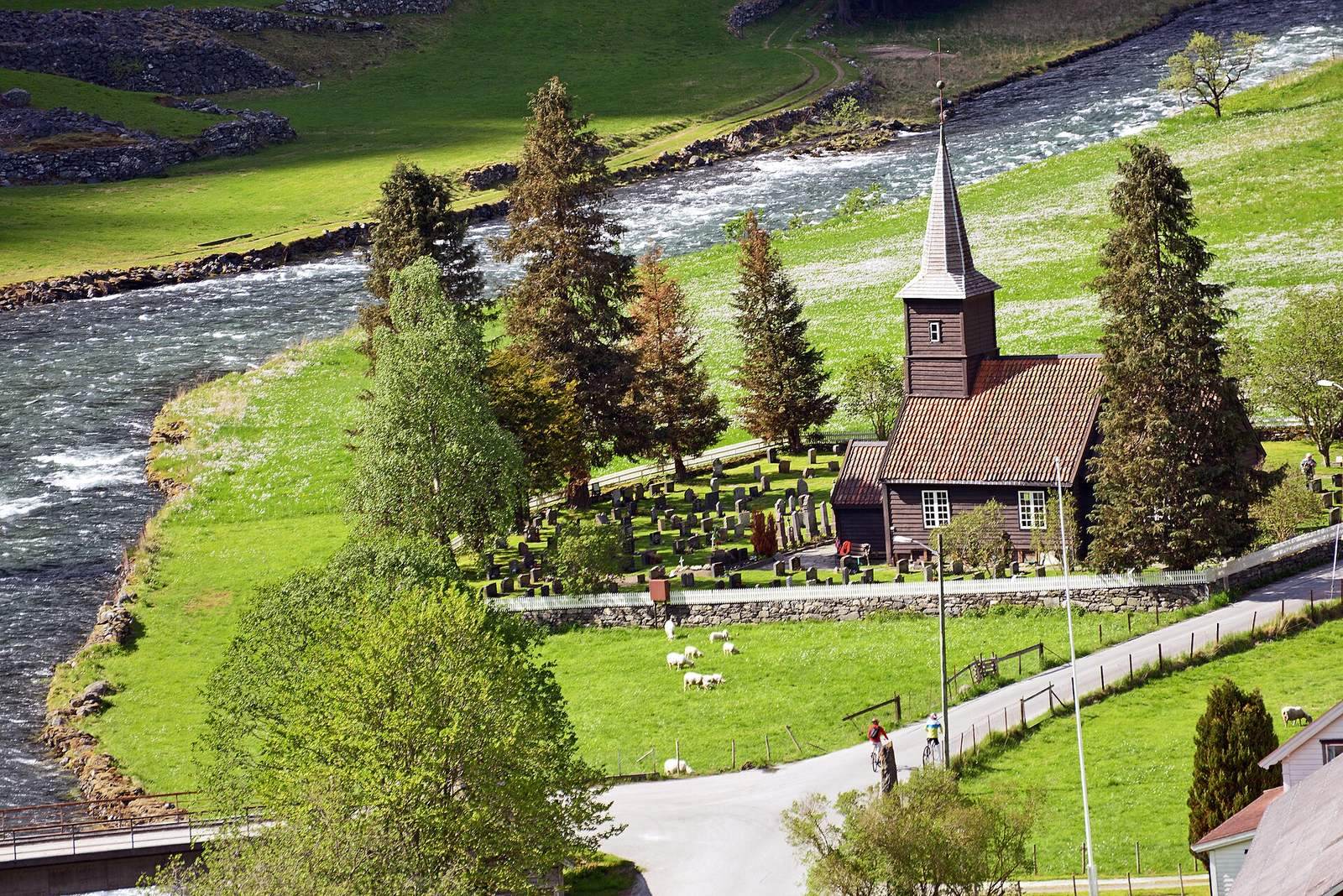
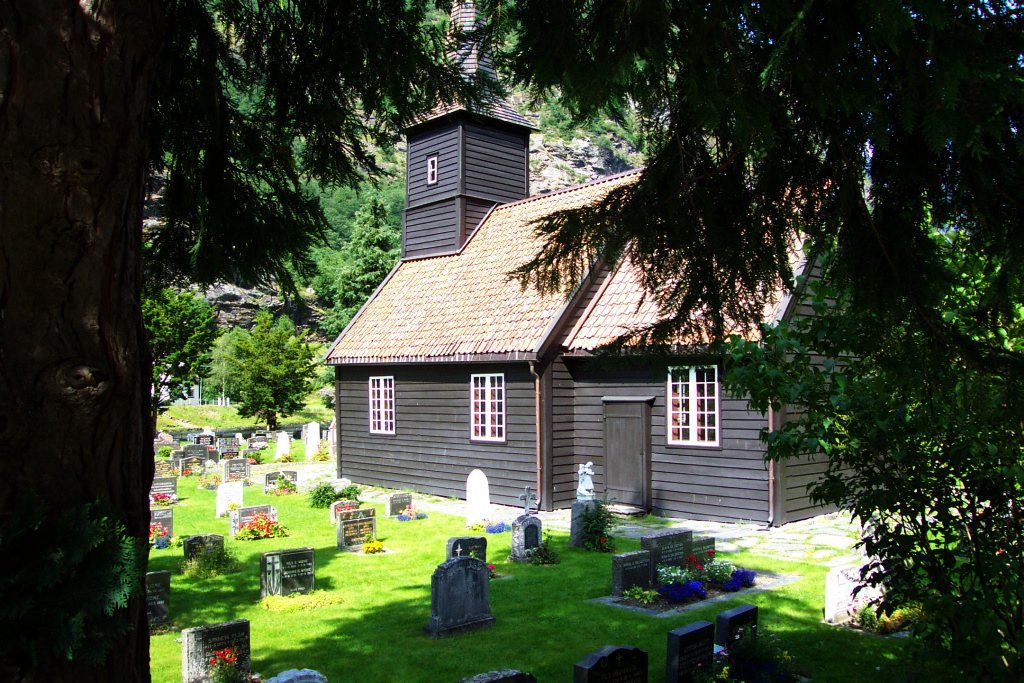
Beside the Flåm River, the church has an adjoining churchyard and stands about three kilometres from the head of the fjord. The timber building is designed to seat 160 people. Its rectangular nave, the main body of the church, measures about 8.7 by 7.2 metres; the chancel, the area around the altar, is square, measuring about 5.4 metres on each side. A tower rises above the nave’s west end, where a porch measures about three metres square.
Horizontal boards cover the exterior walls. They were originally tarred, painted white in the 19th century, and given a reddish-brown or dark-brown finish in 1926. Three windows are set into each side, two serving the nave and one the chancel. A porch was added in 1680 and renewed in the 1920s; the tower was also altered during that decade.
Painted decoration
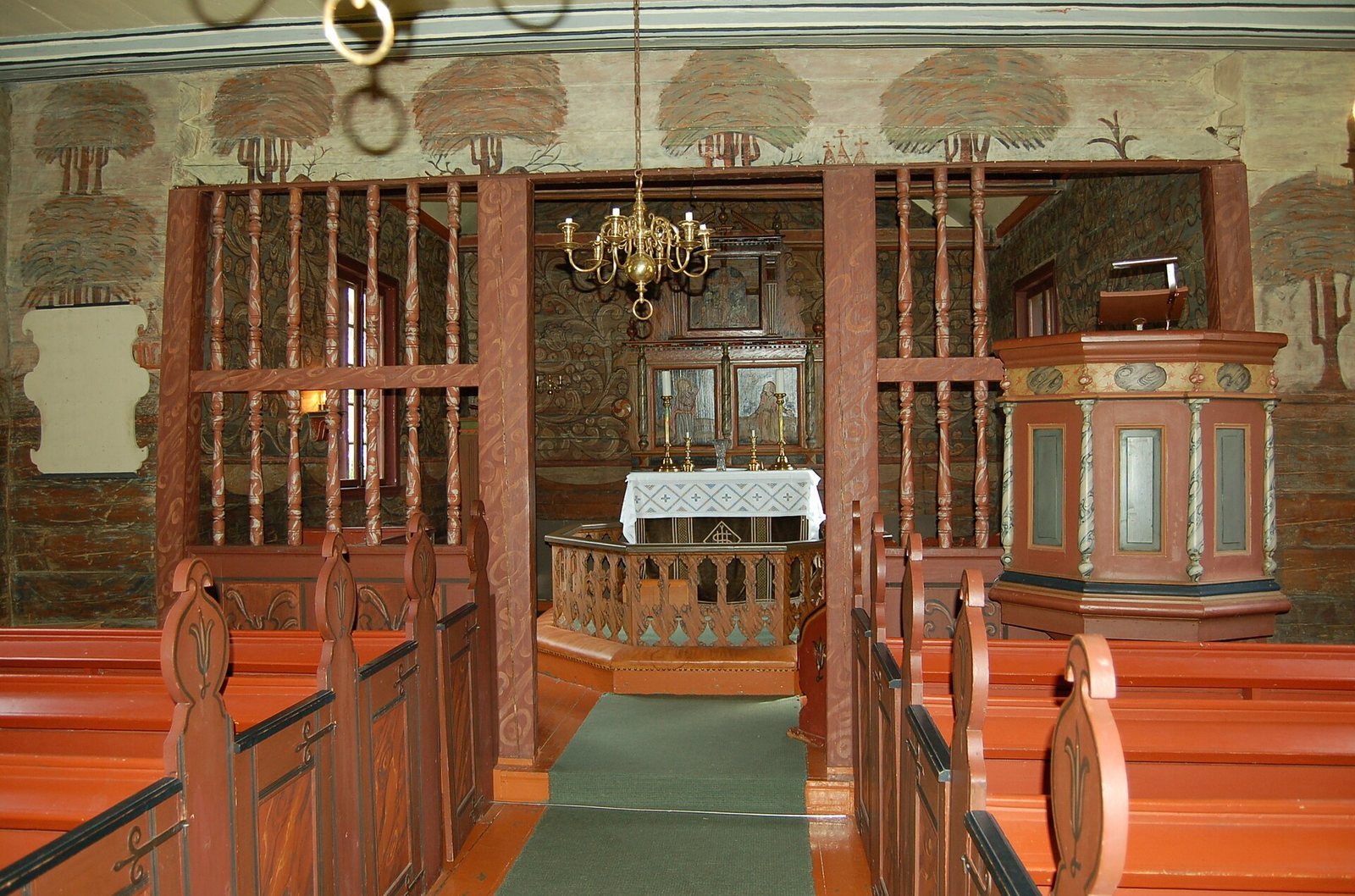
The nave walls carry painted foliage, animals, landscapes, and houses. The animals include deer, lions, hares, and red foxes. The relatively simple paintings are thought to be the work of a Bergen artist around the turn of the 17th and 18th centuries; related motifs also occur in some old private houses in Bergen. In the chancel, older decoration combines vines and stylized acanthus leaves in rosemaling, a floral and scrolling style of painting. It appears to be the work of a more accomplished painter than the nave decoration.
The paintings were covered over in 1870, apparently to prevent them from distracting worshippers. Some of the covering was removed in 1929, and the paintings were fully revealed in 1967. The rows of pews originally had doors.
Screen and furnishings
A Baroque-style chancel screen, a partition separating the chancel from the nave, dates to the church’s construction. The altarpiece was made in 1673 and painted in 1681. It shows Jesus on the cross with John and Mary; an inscription names the parish priest, a local royal official called a bailiff, and their wives. Although the inscription suggests they may have donated it, church accounts show that the church paid for the work. The oldest bell and the silver communion vessels date from the 16th century. The chalice bears a goldsmith’s mark from Lübeck, and the paten was probably made there as well.
Associated timber building
Kyrkjestova, a timber building dating to 1830, was moved from a neighbouring farm when the farm building was due to be demolished.
Medieval textile
The textile uncovered in 1967 is a half-silk cloth woven in Venice in the 14th century, measuring 109 by 134 centimetres. It may originally have been a cope, a ceremonial cloak worn by clergy, or a fine garment for a high-status man, before being adapted for church use. At Flåm it may have served as a chasuble, a vestment worn for the Eucharist, and later as an altar frontal, a cloth covering the front of an altar. It is now displayed in a glass case in the church hall beside the church. It is one of two medieval half-silk textiles found in Norway; the other came from Borgund Church.