Santa María la Mayor: A Gothic and Baroque Church in Alcañiz
Site at a Glance
- Rating
- 4.4
- Popularity
- Medium
- Country
- Spain
- Primary era
- Early Modern
- Eras represented
- Medieval, Early Modern, Modern
- Civilizations
- Crown of Aragon, Spanish
- Site type
- Religious
- Remains
- Church
On this page11 sections
History
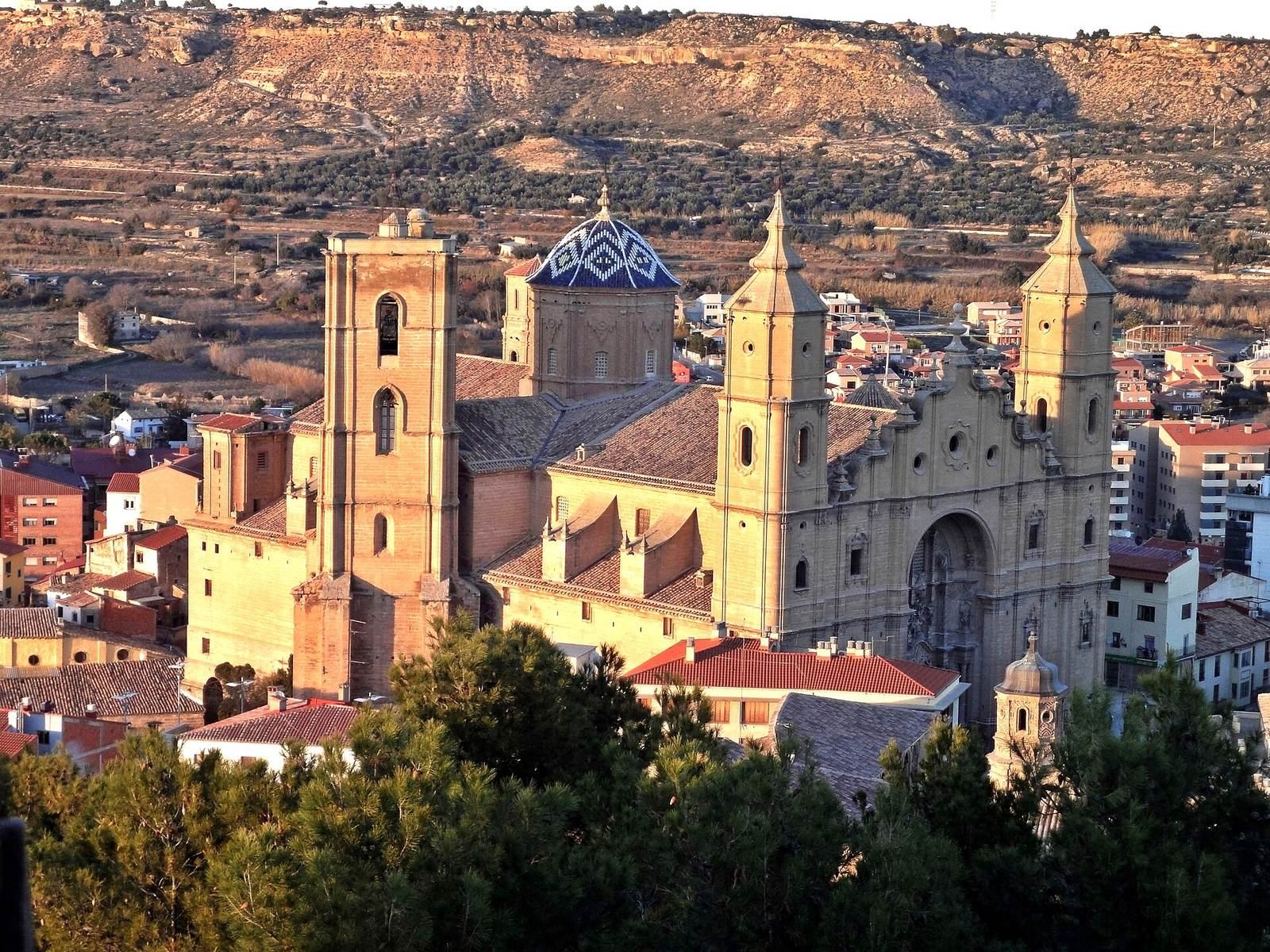
Santa María la Mayor is a Catholic church in Alcañiz, Teruel, Aragon, Spain. Its Gothic origins date chiefly to the thirteenth century, while its present Baroque form began in 1736.
Gothic church and collegiate chapter
In 1407, Pope Benedict XIII granted the church collegiate status in a papal bull, a formal decree issued by the pope. Benedict XIII was a claimant to the papacy during the Western Schism, when rival claimants competed for recognition as pope. Santa María la Mayor remained a collegiate church, served by a chapter of canons, until 1851.
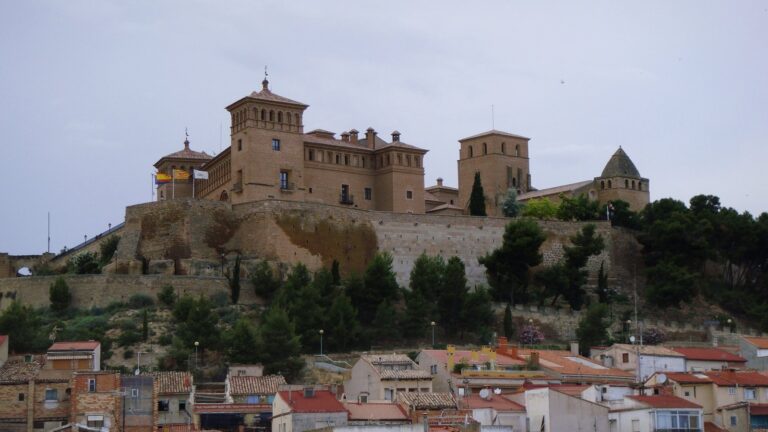
The scale of its medieval bell tower has been linked to Alcañiz’s effort to assert municipal authority in the face of the local lord, whose power was represented by the nearby castle of the Order of Calatrava, a medieval Catholic military order. The tower served religious and civic purposes as a bell tower and was also designed to offer a defensive refuge.
Eighteenth-century rebuilding and later changes
By the eighteenth century, the Gothic church had deteriorated severely, and a column supporting the choir had collapsed. In 1735, its demolition was agreed upon. The Chapel of Our Lady of Solitude, blessed in 1732, was spared. Tradition holds that a pilgrim had brought its images of the Virgin of Solitude and Christ to Alcañiz in the sixteenth century.
Work on a larger Baroque church began in 1736 and continued for several decades. The rebuilding answered the medieval church’s poor condition, a desire for greater capacity, and the aim of turning the building toward the town’s civic center. It also followed the fashion of the period, especially the example of Zaragoza’s Basilica of Our Lady of the Pillar. A stonemason and sculptor, Juan Bengoechea Ameztoy, had a leading role in executing the main portal, which was probably completed in 1779.
Late in the eighteenth century, the Chapel of Our Lady of Solitude was redecorated. Tomás Llovet, a sculptor from Alcañiz, made the main altarpiece between 1798 and 1801; its reliefs were reconstructed after the Spanish Civil War. The church’s musical establishment was led by chapel masters, who directed its music. José de Cáseda held the post from 1710 to 1716; Bernardo Pascual lived from 1689 to about 1754, though his service dates are not specified. Rafael Anglés served from 1754 to 1762 before becoming organist at Valencia Cathedral, and Manuel Gascón held the post from 1762. In 1988, the church received Spain’s Asset of Cultural Interest designation, a legal status for protected cultural heritage.
Remains
The site brings together fragmentary Gothic remains and a later Baroque church. The medieval tower and surviving fabric, considered alongside documentary evidence, allow an ideal reconstruction of the earlier building. The Baroque design gives the newer church a broad façade and a unified interior.
Gothic remains and chapel
Medieval church and tower
The Gothic church was organized around a central nave wider and higher than its two side aisles. At its eastern end, a polygonal apse was encircled by an ambulatory, a passage around the altar end, with chapels arranged around it. The church survives only in fragments, but its remains and the tower help establish the medieval plan.
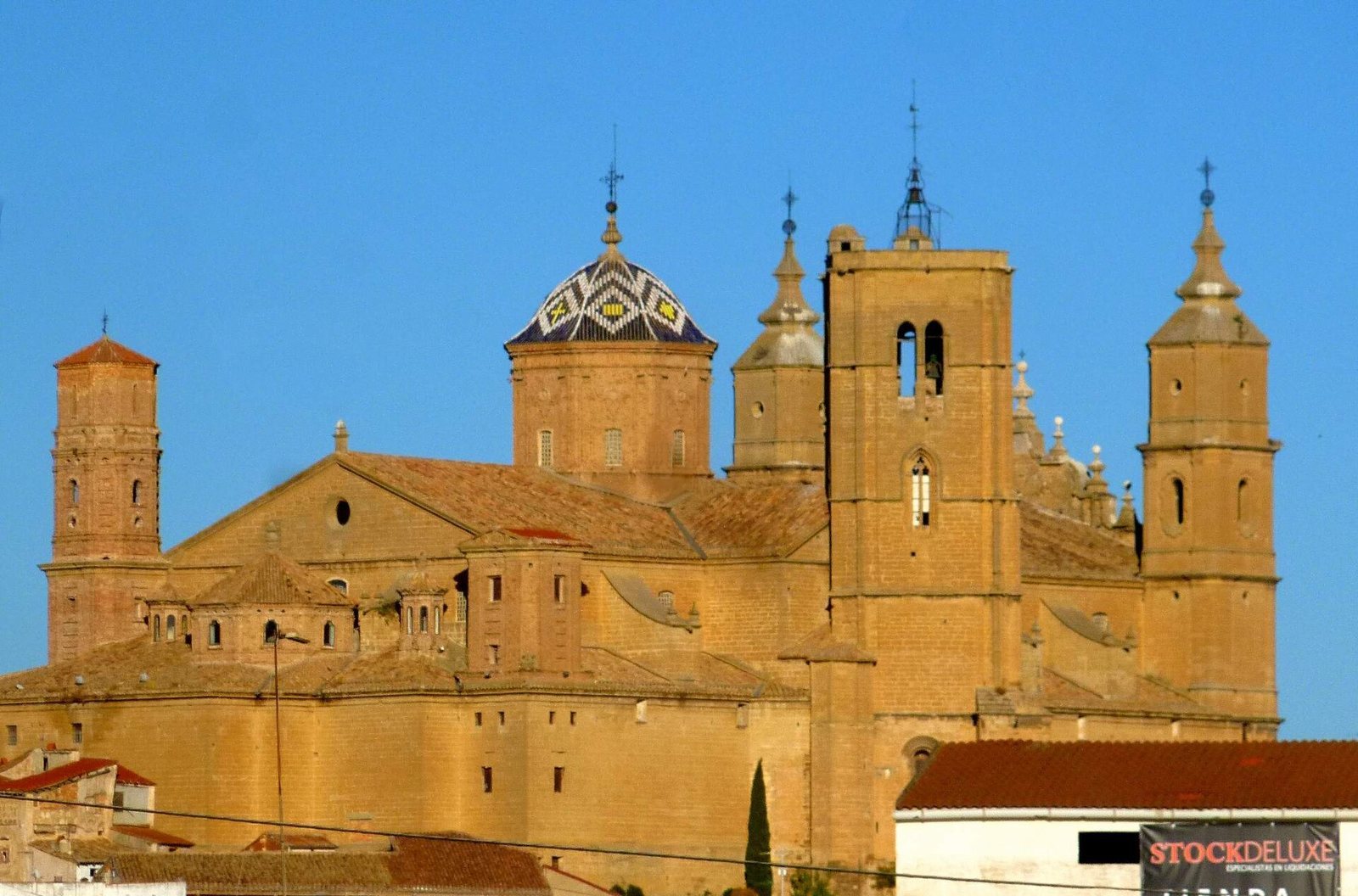
The Gothic tower has narrow windows, gargoyles, and a terrace at its summit. It is among the surviving parts of the medieval church.
Chapel of Our Lady of Solitude
Attached to the Gothic church’s apse, the chapel was conceived as an independent, unified structure. Its decoration focuses on the Passion, the suffering and death of Jesus, and on the themes of solitude and approaching death. Stucco ornament added during its later redecoration covers the chapel’s original paintings.
Baroque church and artworks
Façade and interior
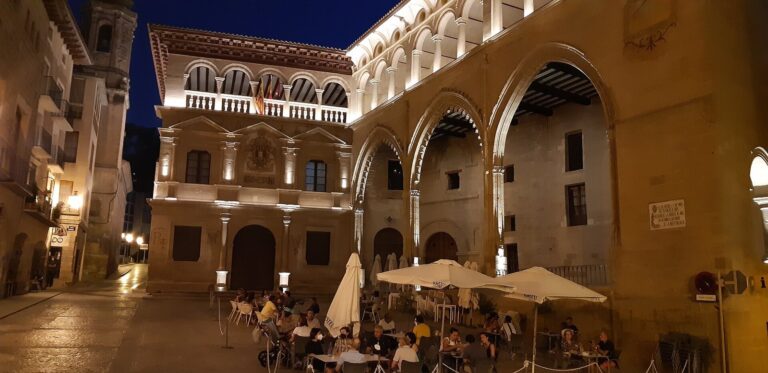
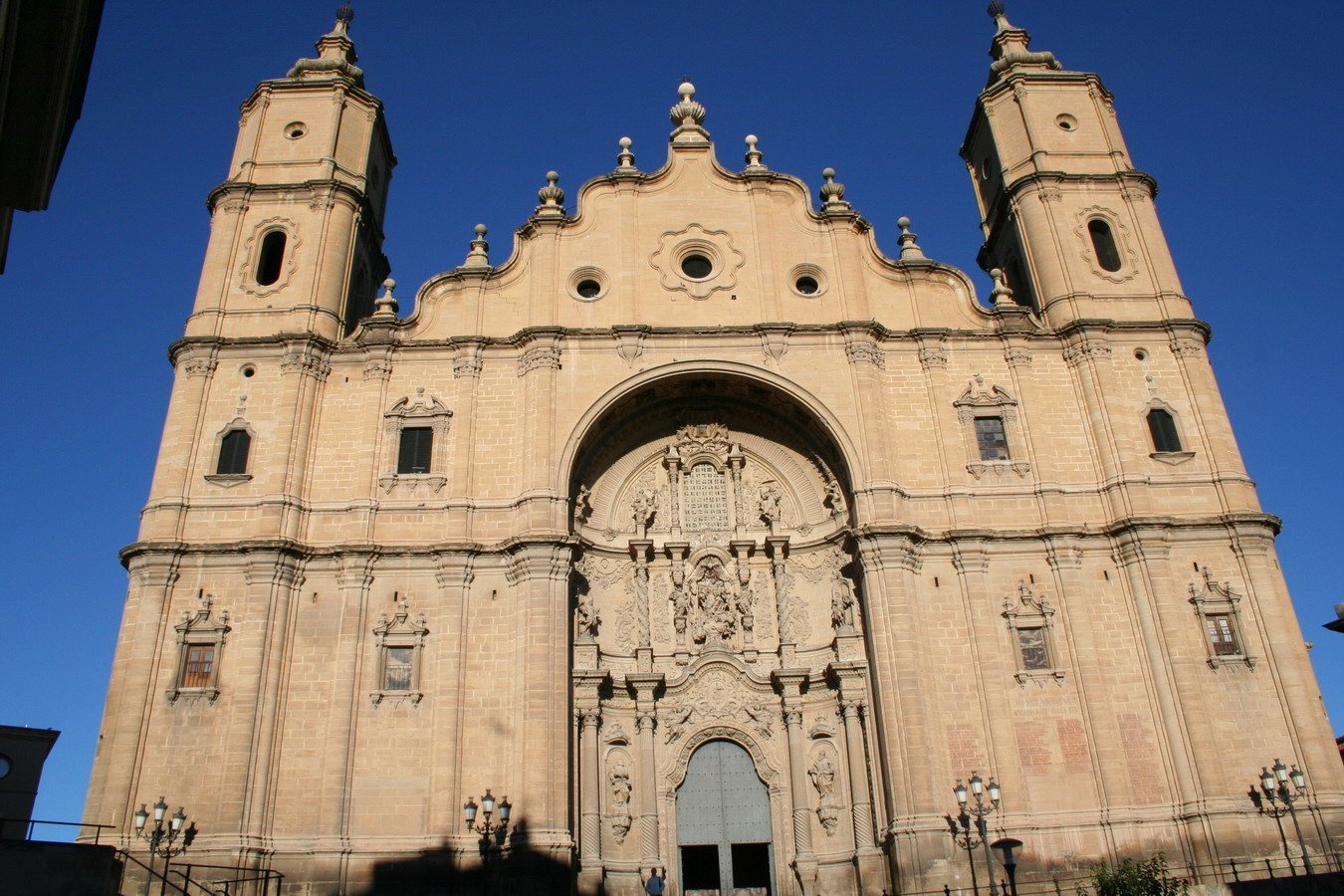
The Baroque church has a broad façade on a cathedral-like scale, flanked by two tall towers and centered on the main portal. Inside, the nave and side aisles are equal in height, creating a unified hall-church layout. Paired masonry supports carry the structure. Barrel vaults, continuous curved ceilings, cover the nave and the arms of the crossing; intersecting barrel vaults form the groin vaults over the side aisles. The lateral chapels have oval or circular domes. Above the central dome, an octagonal brick structure bears geometric decoration.
Main portal
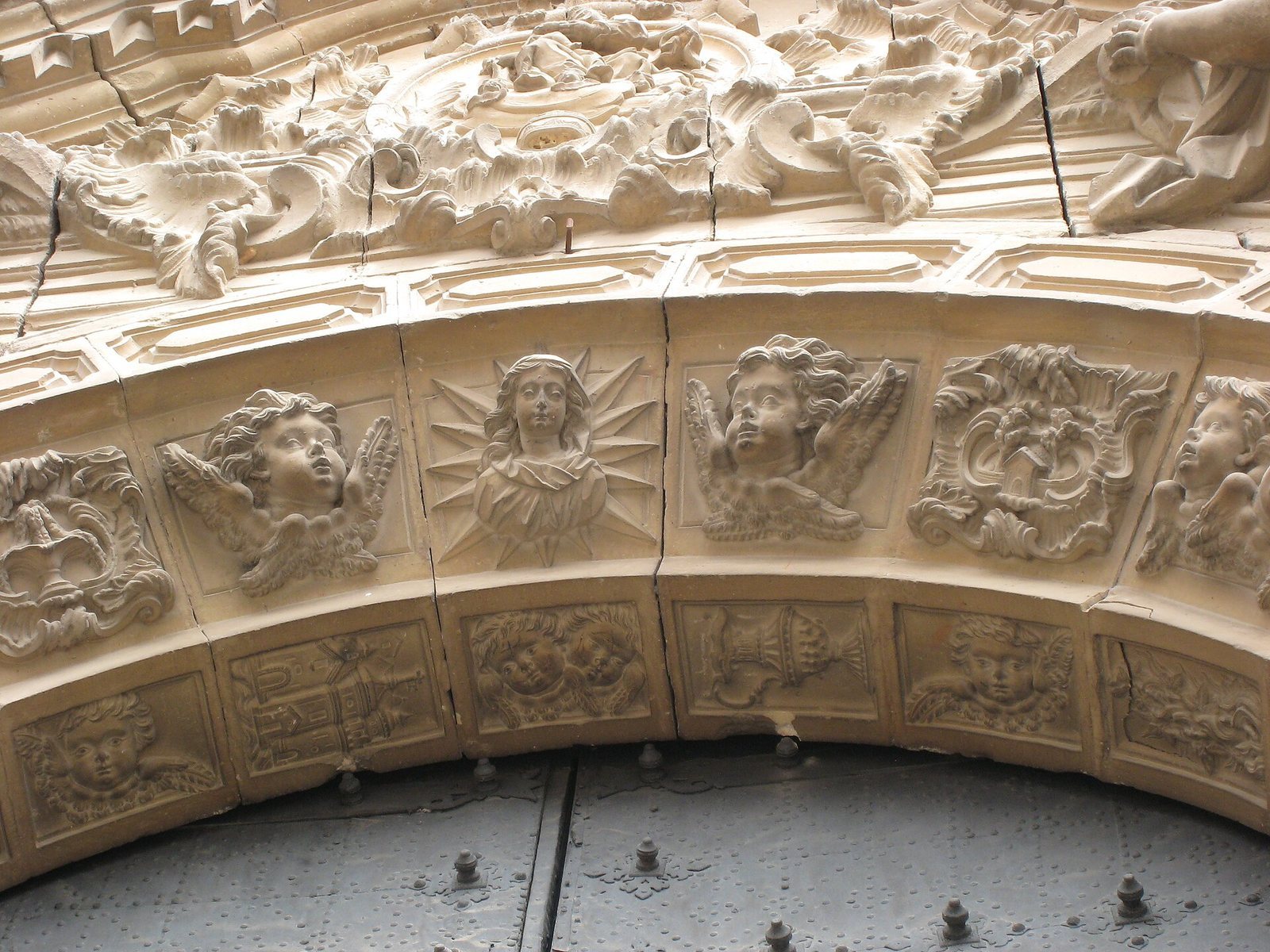
The main portal is set within a deep curved recess and framed by a large semicircular arch. Its sculptural arrangement rises in a pyramid-like sequence, with curved forms drawing attention to the center. Set out like an altarpiece in three tiers, it shows the apostles Peter and Paul below. In the middle, four archangels flank a large image of the Virgin Mary, the mother of Jesus. The upper tier depicts the Dominican religious figures Thomas Aquinas and Vincent Ferrer. Above the doorway, the collegiate chapter’s shield combines reeds referring to Alcañiz with the arms of Pope Benedict XIII.
Altarpiece and paintings
The main altarpiece’s central field contains a low-relief image of the Assumption, the Christian belief that Mary was taken body and soul into heaven. A broad horizontal architectural band separates it from the upper section, which has a triangular pediment and a circular image, or tondo, of the Trinity, one God in three persons.
A group of Gothic paintings attributed to the workshop of Domingo Ram includes a predella, the lower section of an altarpiece, with several scenes, as well as an image of Mary Magdalene. The church’s sacristy also holds six Renaissance panels from the first two decades of the sixteenth century, attributed to the Master of Alcañiz, identified with Blai Guiu of Lleida. Their subjects are Saints Cosmas and Damian, Christian physician-martyrs; Catherine of Siena, a mystic; Apollonia, an early Christian martyr; Jerome, a biblical scholar; Blaise, a bishop and martyr; and Saint Peter.