Sanctuary of Aphrodite in Chaidari: An Ancient Greek Open-Air Sanctuary
Site at a Glance
- Rating
- 4.6
- Popularity
- Medium
- Country
- Greece
- Primary era
- Classical
- Eras represented
- Classical
- Civilizations
- Ancient Greek
- Site type
- Religious
- Remains
- Sanctuary
On this page12 sections
History
Ancient worship
The Sanctuary of Aphrodite in Chaidari was an ancient Greek open-air sanctuary at Aphaia Skaramangas, on the Ancient Sacred Way between Athens and Eleusis in Greece. Dedicated to Aphrodite, a major Greek goddess associated especially with love and sexual attraction, it was used from the second half of the fifth century BC into Roman times. The road ran from Athens to Eleusis, where the Eleusinian Mysteries, religious rites associated with Demeter and Persephone, were celebrated.
The sanctuary lay about 12 km from Athens and 9 km before Eleusis. Its position beside the route, together with the rural character of Aphrodite’s worship, points to close connections with the Eleusinian rites. The site is identified with a sanctuary that Pausanias, a Greek writer of the second century AD, described on his way to Eleusis. Substantial quantities of Roman pottery also support the chronology of worship there.
Rediscovery and investigation
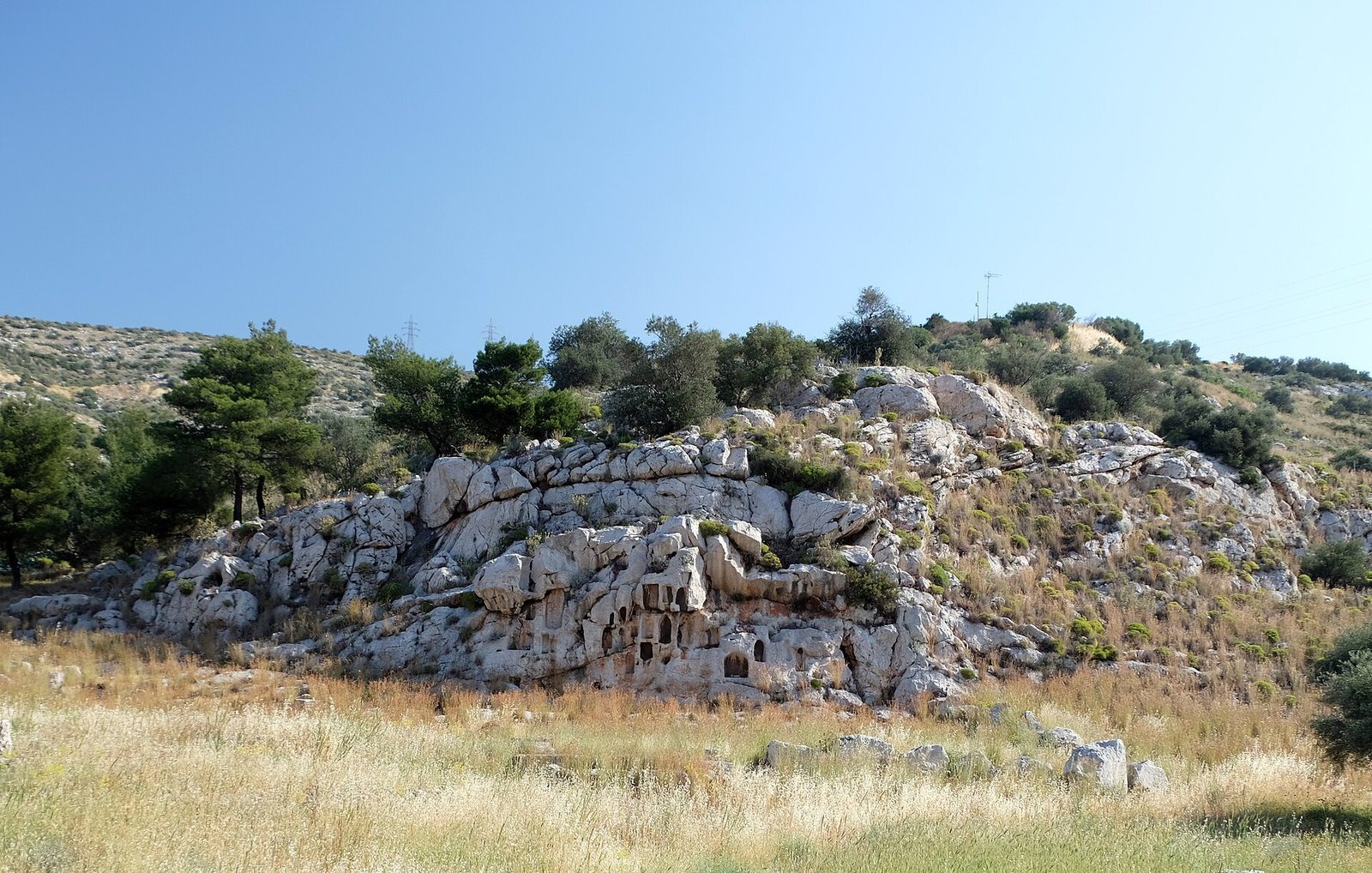
The rock-cut niches drew the attention of foreign travelers from the early nineteenth century. D. Kambouroglou led excavations in 1891–1892, followed by work conducted by K. Kourouniotis and I. Travlos from 1936 to 1939. The site was later restored and improved, and an enclosing fence was installed.
Remains
The sanctuary enclosure
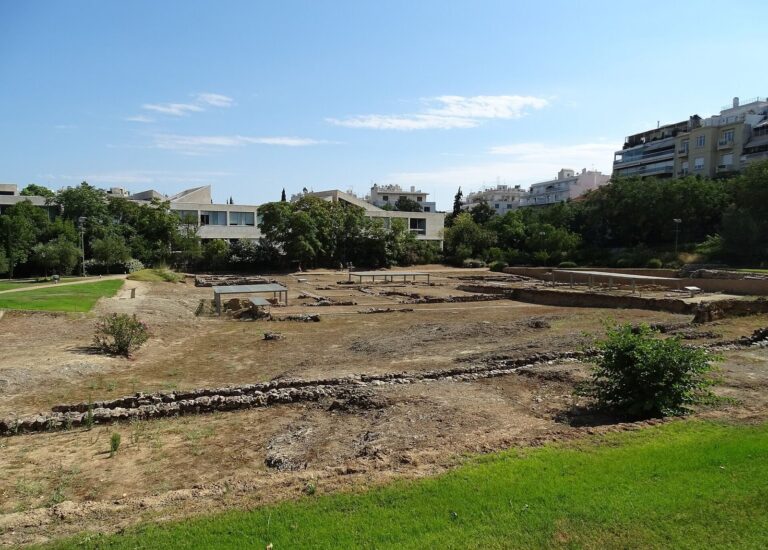
The main sanctuary occupies a roughly rectangular enclosure about 73 by 21 m in size, organized around a low rock face. Its remains combine cut rock, built structures, and open areas used for worship and offerings.
Rock face and sacred plaza
Niches cut into the rock formed part of the open-air worship area and were intended to hold offerings. A broad plaza in front of the rock preserves bases for dedicated objects, along with marks cut into the stone that indicate further offering places. The plaza was likely the sanctuary’s principal sacred area.
Entrance and altar
A monumental entrance, or propylaeum, had two columns on bases; one base retains a socket for fixing a column in place. Four steps, each 30 cm high, led to the entrance, and three survive. The temple’s north side meets the cut rock. Between the rock and the entrance is an altar or large base that may have supported Aphrodite’s principal worship image.
Offerings and sculpture
Finds include small figures of Aphrodite, groups showing her with Eros, a god associated with desire and love, and reliefs connected with Aphrodite, doves, and female genitalia. A fragment of the torso of the sanctuary’s worship image also survives. Another fragment, probably from a panel on the enclosure, shows a procession of Erotes, figures of Eros. These finds are held at the National Archaeological Museum.
Other buildings in the precinct
Cisterns and rectangular building
West of the main sanctuary, three carefully plastered cisterns were linked by channels and apparently collected rainwater. Two were later incorporated into a rectangular building whose use is undetermined. Most of this building, south of the temple, was probably open to the sky. At its western end, three surviving column bases mark a roofed colonnade, or stoa. Two small rooms with separate entrances occupied the building’s north side.
Multi-room building outside the enclosure
A small building with several rooms stood outside the enclosure. Its roughly worked stone walls reuse material from the older sanctuary, and its slightly different alignment indicates a later construction while the sanctuary was still in use.
Tower across the Ancient Sacred Way
Across the road stands a rectangular building measuring 25 by 15 m, built with polygonal masonry, in which polygon-shaped blocks are fitted together. It is identified with the rough-stone wall Pausanias described as worth seeing. The building resembled a fortification but did not belong to Attica’s regular defensive system. After it fell out of use, it served as a funerary monument.