Platonic Academy: Plato’s Philosophical School in Athens
Site at a Glance
- Popularity
- Very High
- Country
- Greece
- Primary era
- Classical
- Eras represented
- Classical
- Civilizations
- Ancient Greek
- Site type
- Civic
- Remains
- University
On this page10 sections
History
The Platonic Academy was a philosophical school founded by the ancient Greek philosopher Plato in Athens, Greece, around 387 BC. Plato led it until his death in 347 BC. Its earliest meetings were associated with an inherited olive-growing estate near the city, as well as a nearby gymnasium, a public institution for physical training that could also host intellectual activity.
Foundation and teaching
The precinct had sacred associations before the school began. Worship of Athena there was traced to the Bronze Age, and an early tradition connected the place and its name with Akademos, a legendary Athenian hero. The Academy’s legal and religious status is uncertain. Plato may have registered it as a religious association to secure land, though the early group may have operated more like a select club than a formal institution with a fixed curriculum.
Membership was limited rather than open to the public. Senior members could teach, while junior members studied. During Plato’s lifetime, instruction was free, but students had to provide for themselves and could offer voluntary contributions. Later heads of the school made fees compulsory.
Study ranged across mathematics, philosophy, astronomy, natural science and subjects linked to public life, including poetry, rhetoric and ethics. Mathematics included arithmetic, geometry, astronomy and the mathematical study of musical harmony. It was valued as preparation for dialectic, the testing of arguments through questions and replies. Teaching combined problems, dialogue and debate with lectures and public presentations. Pythagorean thought, a tradition that emphasized mathematics and cosmic order, influenced the Academy’s work in mathematics and astronomy.
How Plato taught remains debated. One interpretation holds that he also communicated doctrines orally that were not preserved in his dialogues; another treats the dialogues as his main teaching instrument. Aristoxenus recounted a lecture called On the Good, in which Plato spoke about mathematics, number and geometry. Plato also set mathematical and astronomical problems for members to solve.
Women who studied with Plato included Axiothea of Phlius and Lasthenia of Mantinea. The Academy also drew prominent thinkers such as Eudoxus of Cnidus, whose work addressed explanations of planetary motion. Aristotle studied there for about twenty years, from 367 to 347 BC, before founding his own school in Athens.
Successive heads and changing ideas
After Plato’s death, his nephew Speusippus led the Academy from 347 to 339 BC. He rejected Plato’s theory of Forms and placed greater emphasis on Pythagorean ideas. Xenocrates headed the school from 339 to 314 BC, sought to preserve Plato’s approach, tightened discipline and is credited with organizing its internal rules. Polemo led from 314 to 269 BC, followed by Crates from about 269 to 266 BC.
Under Arcesilaus, who took over around 266 BC, the Academy adopted skepticism, an approach that questioned whether certainty could be attained. Its arguments challenged claims made by the Stoics, a separate Greek philosophical school. Lacydes succeeded Arcesilaus; later, Evander and Telecles led jointly, followed by Hegesinus. From 155 BC, Carneades and then Clitomachus led the New Academy. It remained skeptical but gave practical weight to what seemed probable or persuasive. Philo of Larissa, head from about 110 to 84 BC, advanced a fallibilist position, which holds that claims to knowledge may be mistaken. Later classifications differ over whether the Academy should be divided into further fourth and fifth phases.
War and the destruction of the grove
During the First Mithridatic War, a conflict between Rome and the kingdom of Pontus under Mithridates VI, Philo left Athens for Rome in 88 BC. Two years later, the Roman general Sulla captured Athens. His forces devastated the Academy’s grove, cutting sacred olive trees for timber to build siege engines. The damage was severe enough that the school did not resume at its original site.
Teaching associated with Platonism continued elsewhere in Athens. Around 84 BC, Antiochus of Ascalon resumed teaching at the Ptolemy gymnasium, not at the Academy. His approach rejected skepticism and incorporated Stoic ideas; his place in the succession of Academies remains disputed.
Later schools and the Academy’s legacy
Later Athenian institutions belonged to a separate history from Plato’s Academy. In 176 AD, the emperor Marcus Aurelius established four publicly funded chairs of philosophy in Athens, including one for Platonism, taught by Atticus. Around 410 AD, a Neoplatonic school, part of a later tradition that interpreted Plato’s thought, was established in the city. Its members presented themselves as Plato’s successors, but the school had no geographic, institutional, economic or personal continuity with the original Academy. It operated as a private foundation in a large house.
The later school flourished under Proclus, who died in 485, and Damascius was its final head. The emperor Justinian’s closure of the school in 529 is traditionally reported, though whether that specific Athenian institution was closed then has been questioned. In 531-532, seven Athenian philosophers led by Damascius went to the court of the Sassanid Persian king Khosrau I at Ctesiphon, carrying philosophical and literary scrolls. A peace treaty between the Sassanid and Eastern Roman empires in 532 secured their personal safety. Damascius died around 540.
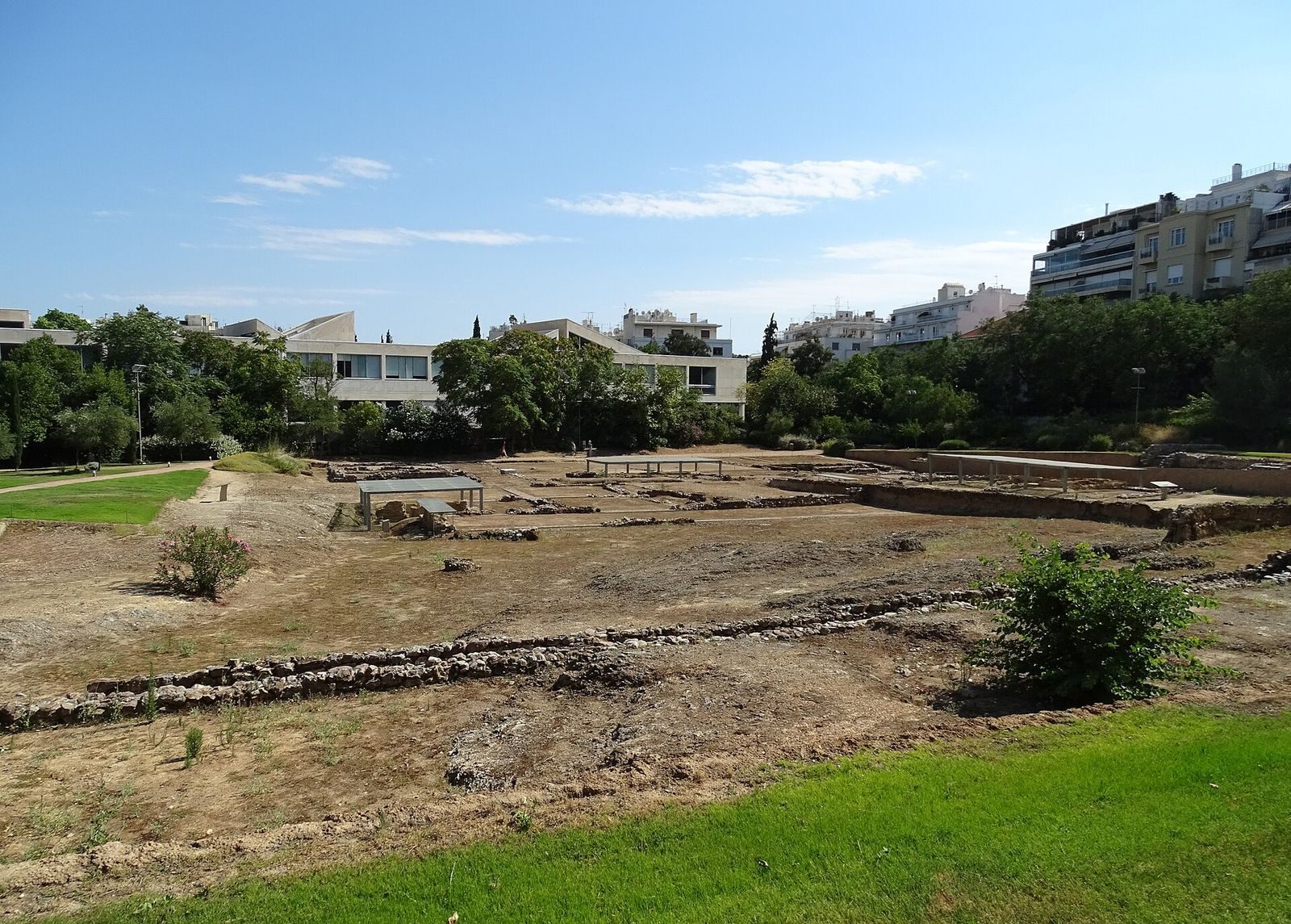
The Academy was excavated in the 20th century. In 2024, partial decipherment of a papyrus attributed to Philodemus, an Epicurean philosopher, suggested that Plato was buried in the Academy garden near a shrine to the Muses. The school’s name later became a common term for institutions of learning. A Platonic academy near Florence, associated with Marsilio Ficino in the mid-15th century, helped renew interest in Plato and Neoplatonism. Raphael’s fresco The School of Athens, painted between 1509 and 1511, depicts the Academy and several of its members.
Remains
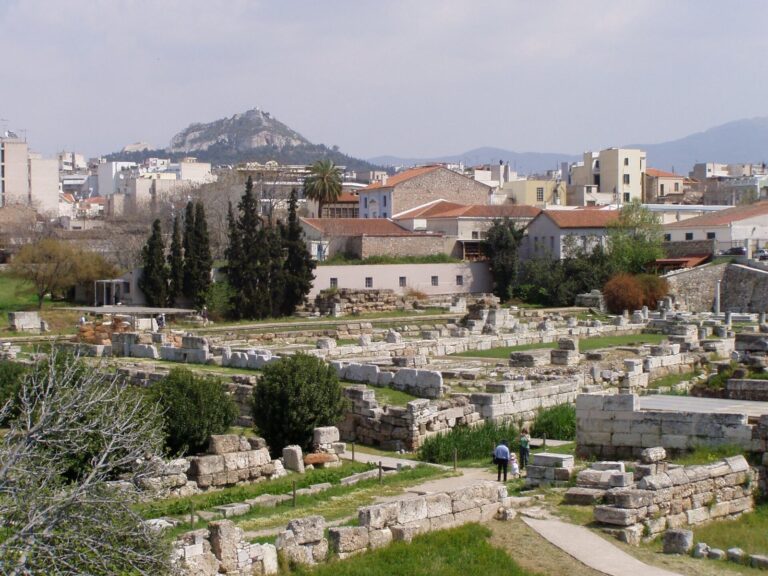
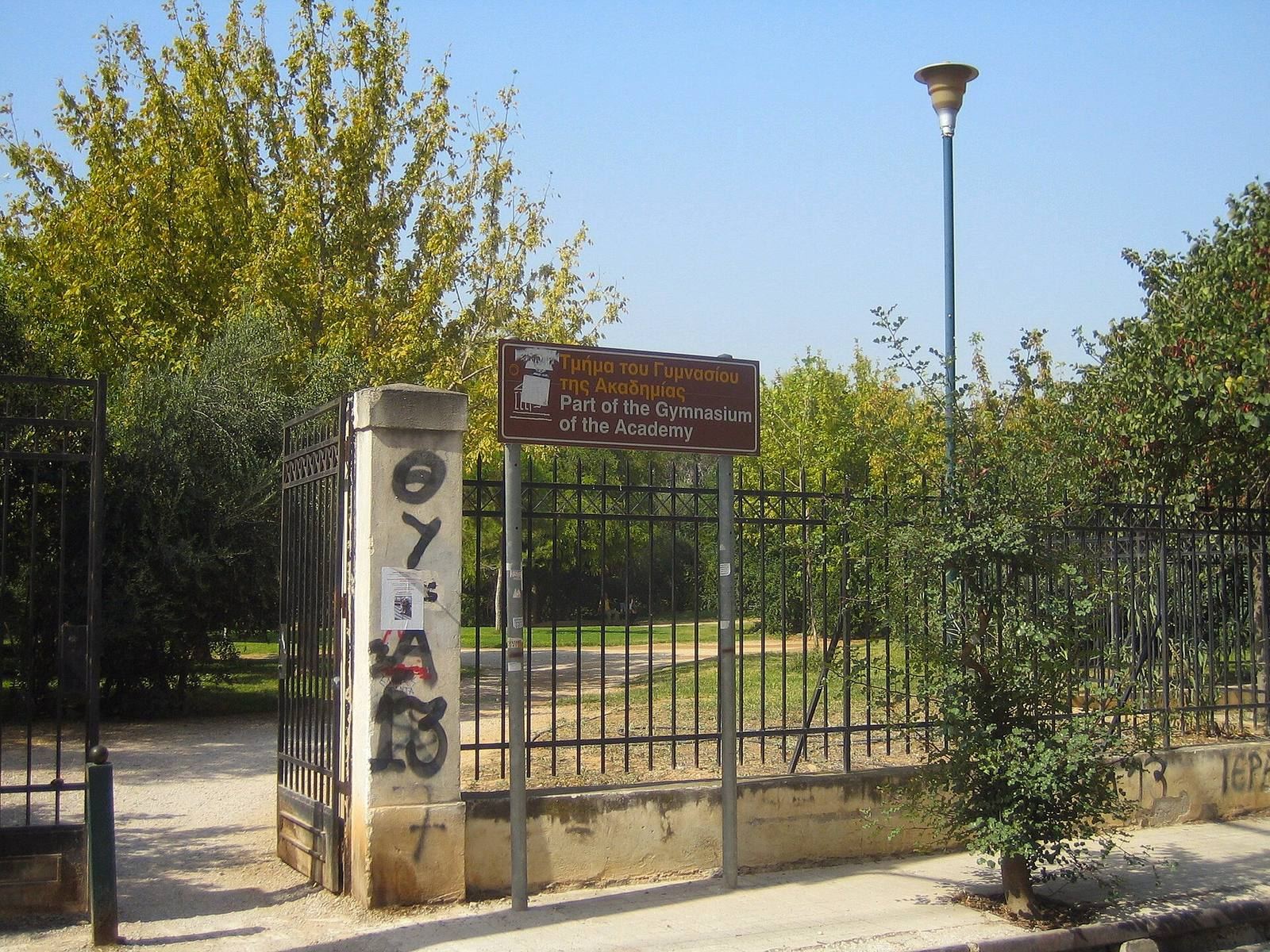
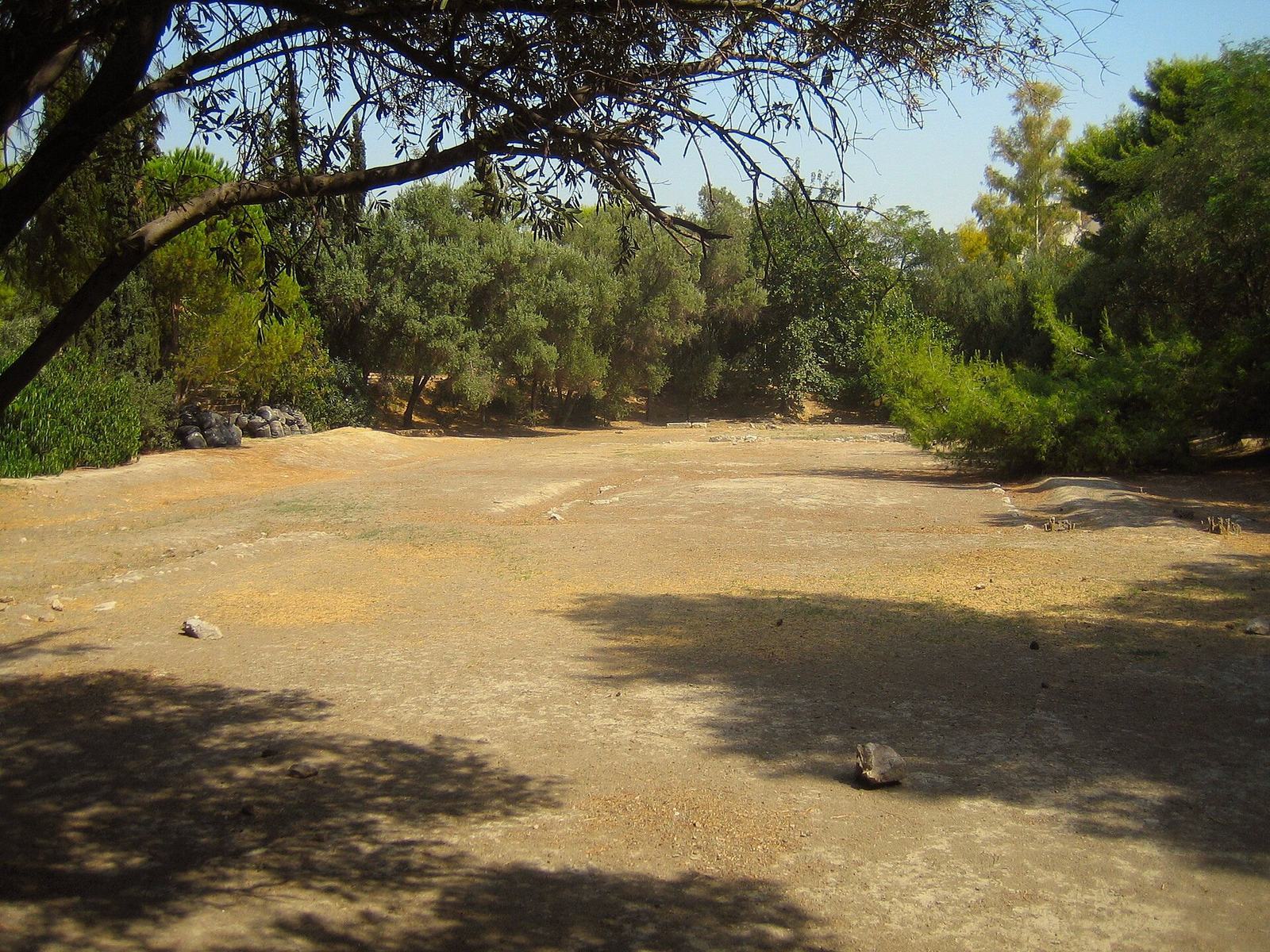
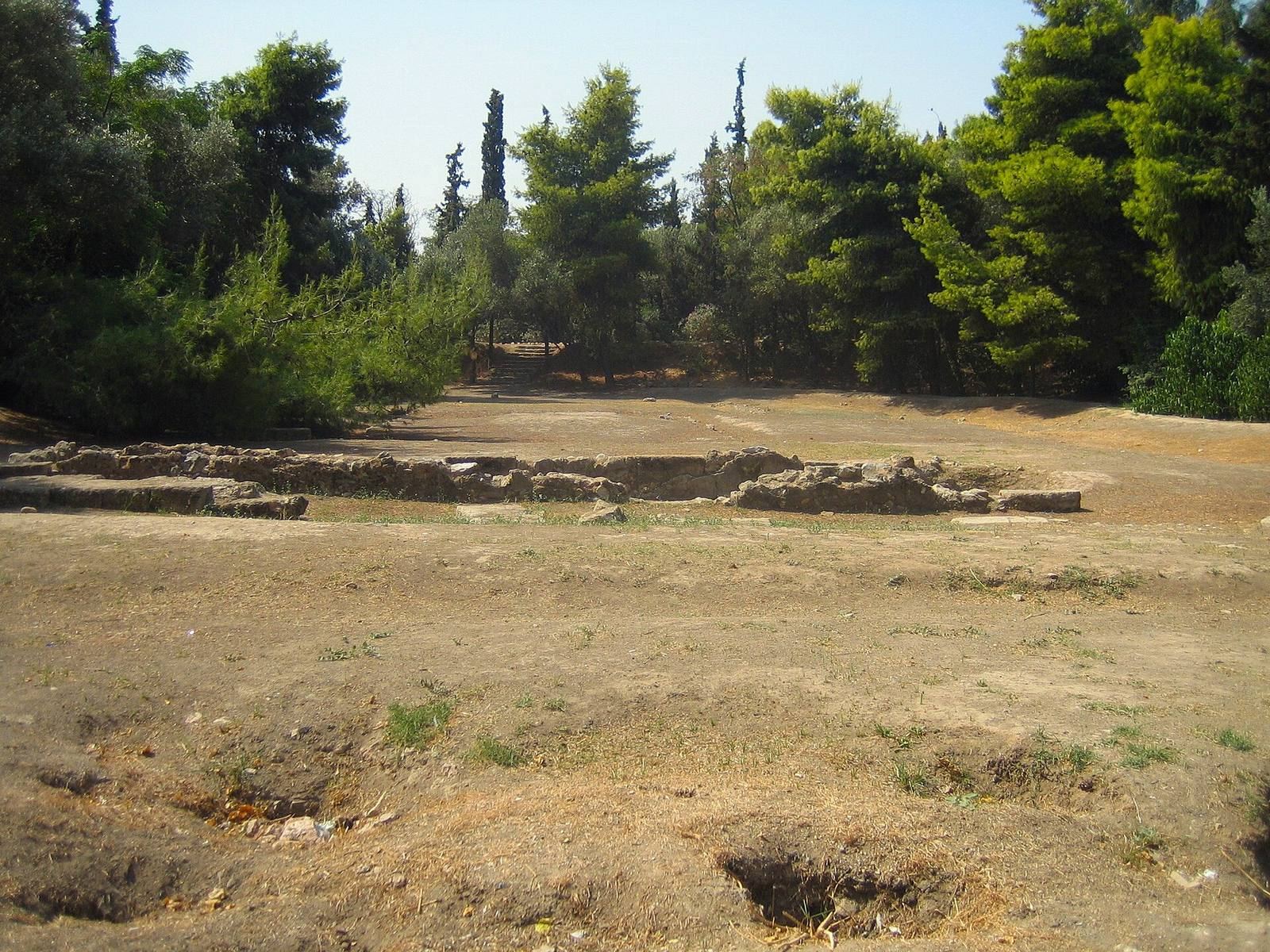
The archaeological site lies near Colonus, about 1.5 km north of Athens’ Dipylon Gate, in the modern Akadimia Platonos district. The ancient precinct stood beyond the city’s walls and included a bounded estate, a garden, learning and domestic spaces, and sacred areas. Cimon enclosed the precinct with a wall before the school formed; Plato’s estate also had its own boundary.
The estate and its structures
Teaching and gathering spaces
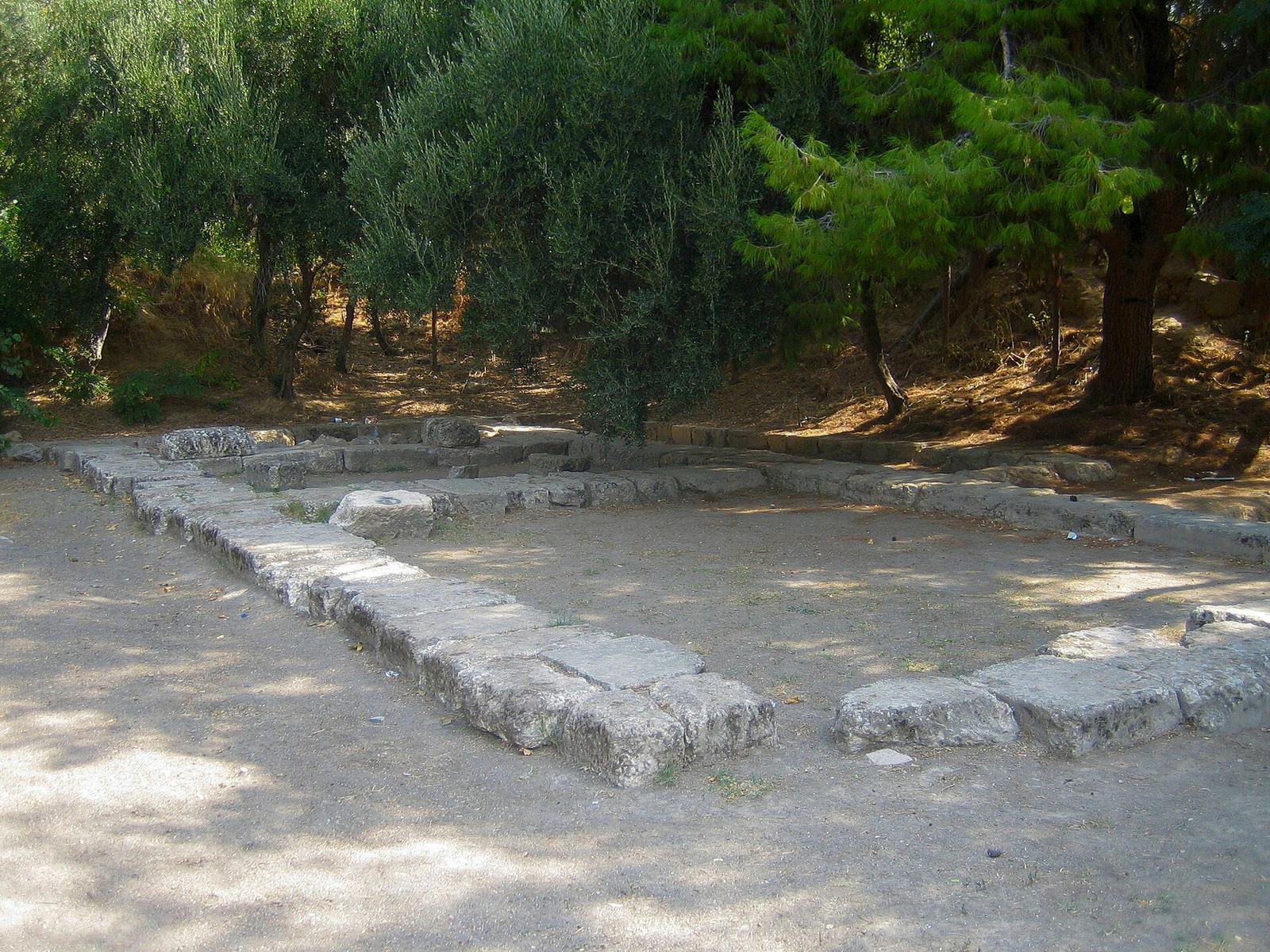
The estate included a garden, a sanctuary of Athena, several altars, a gymnasium, teaching rooms, dwellings and a substantial library. The gymnasium had enclosed spaces for discussion, and a covered gallery was associated with dining gatherings. Instruction may have taken place in the gymnasium for beginners and at Plato’s house in the garden for more advanced students. The estate and the nearby Academy gymnasium both served as meeting places.
Garden shrines and statues
The garden contained an altar to the Muses, goddesses associated with the arts and learning, and a small shrine built after the Academy was established. Plato was credited with setting up a statue of Apollo, while Speusippus was associated with statues of the Graces. The garden and its religious features formed part of the Academy’s physical precinct.
The approach from Athens
A route between Athens and the Academy passed graves of Athenian citizens. It was used for a torchlit race that began at altars in the city and ended at an altar of Prometheus, a figure in Greek mythology, at the Academy. A procession for Dionysus, the Greek god associated with wine and festivity, travelled to the precinct and then returned to Athens.