Eleusis: An Ancient Greek City and Sanctuary
Site at a Glance
- Popularity
- Medium
- Country
- Greece
- Primary era
- Classical
- Eras represented
- Classical, Medieval
- Civilizations
- Ancient Greek, Byzantine, Roman
- Site type
- City
On this page11 sections
History
Eleusis is an ancient Greek city and sanctuary at the location of the modern settlement in Greece. Its religious life centered on the Eleusinian Mysteries, initiation rites honoring Demeter, goddess of agriculture and grain, and her daughter Persephone, associated with the seasons and the underworld. The territory was inhabited in antiquity and may have been settled as early as the Mycenaean period.
Mythic origins and Athenian rule
Mythic traditions counted Eleusis among twelve Attic cities founded by Cecrops, a legendary early king of Athens. They also said that Theseus, a legendary king credited with uniting Attica, later brought the city into association with Athens. A separate tradition named Celeus, a legendary king of Eleusis, as its founder. In this account, he named the city after his father, the hero Eleusis, and archaeological finds have been linked to the tradition. The name was also connected with Demeter’s arrival. An earlier name, Saisaria, was associated with Celeus’s youngest daughter, and Celeus was said to have made his daughters priestesses of Demeter.
Another mythic account describes a conflict between Eleusis and Athens during the reign of Eumolpus, a legendary Eleusinian king, while Erechtheus, a legendary Athenian king, ruled Athens. After the Eleusinians lost, they accepted Athenian supremacy but retained control over the celebration of the Mysteries. The city became a deme, or local administrative community, of ancient Attica in 508 BCE, affiliated with the Hippothontis tribe and its coastal subdivision. Despite its dependence on Athens, Eleusis retained the title of polis, a Greek city-state, and the right to issue its own coins, privileges linked to its religious standing.
Eleusis sent 11 representatives to the Athenian Council from 508 to 307/306 BCE. Its representation rose to 12 in both the 307/306–224/223 BCE and 224/223–201/200 BCE periods. The original deme ended in the third century CE and was succeeded by a deme of Eleusis. The city’s political history remained closely connected to Athens.
Religious life and classical conflicts
Under Peisistratus, a sixth-century BCE Athenian ruler, the Mysteries gained a reach that drew pilgrims from throughout Greece and beyond. Each year, a procession travelled from Athens to Eleusis along the Sacred Way. The city was regarded as one of the most sacred places in Greek religion until the end of paganism.
Persians burned the ancient temple of Demeter in 484 BCE. Rebuilding did not begin until the time of Pericles, a leading Athenian statesman. Around 433/432 BCE, a dispute with Megara over Eleusinian territory led Athens to prohibit Megarian goods. The grounds cited included claims that Megarians sheltered Athenian fugitives and cultivated sacred land near the Attic–Megarian border.
After the Thirty Tyrants, an oligarchic regime that briefly ruled Athens following its defeat in the Peloponnesian War, were overthrown in 403 BCE, oligarchs withdrew to Eleusis, which they had fortified earlier. Athenians killed them after democracy was restored. Eleusis also served as a base for the second year of young men’s civic and military training. Those undergoing the training guarded the road toward Megara.
Roman rule and later settlement
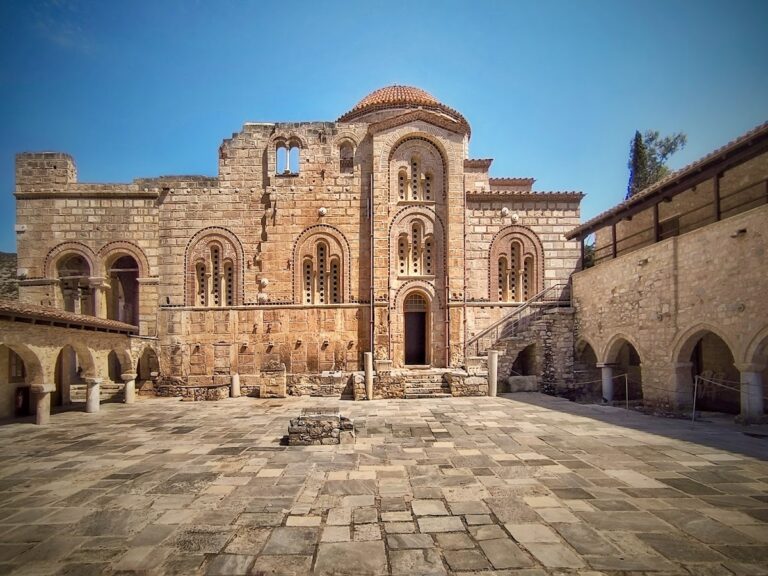
Eleusis prospered under Roman rule, when initiation into its Mysteries became fashionable among Roman aristocrats. In 396 CE, the Visigothic king Alaric and his forces destroyed the city. Eleusis then largely disappeared from historical records.
The settlement was re-established in the eighteenth century and grew gradually. After the defeat of Greek forces in Asia Minor in 1922 and the displacement of Greek communities, many families from Asia Minor settled in Eleusis. Their arrival doubled the population and contributed to the area’s cultural and economic life.
Remains
City, sanctuary, and harbor
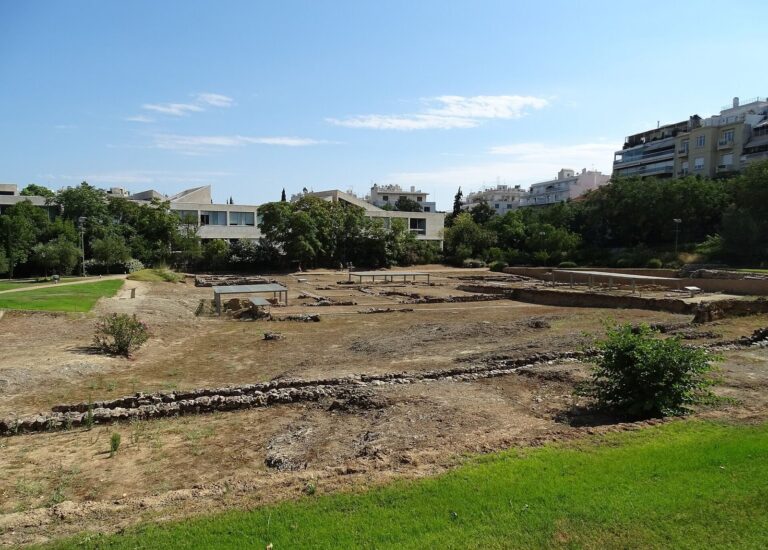
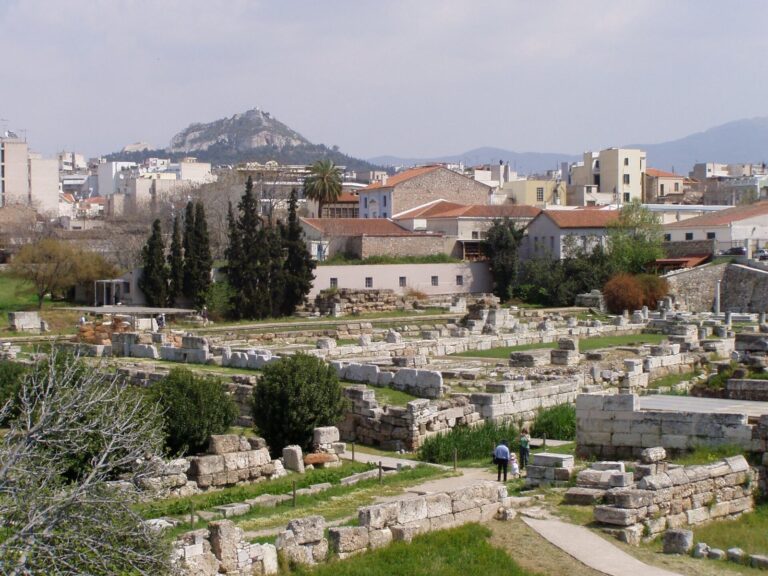
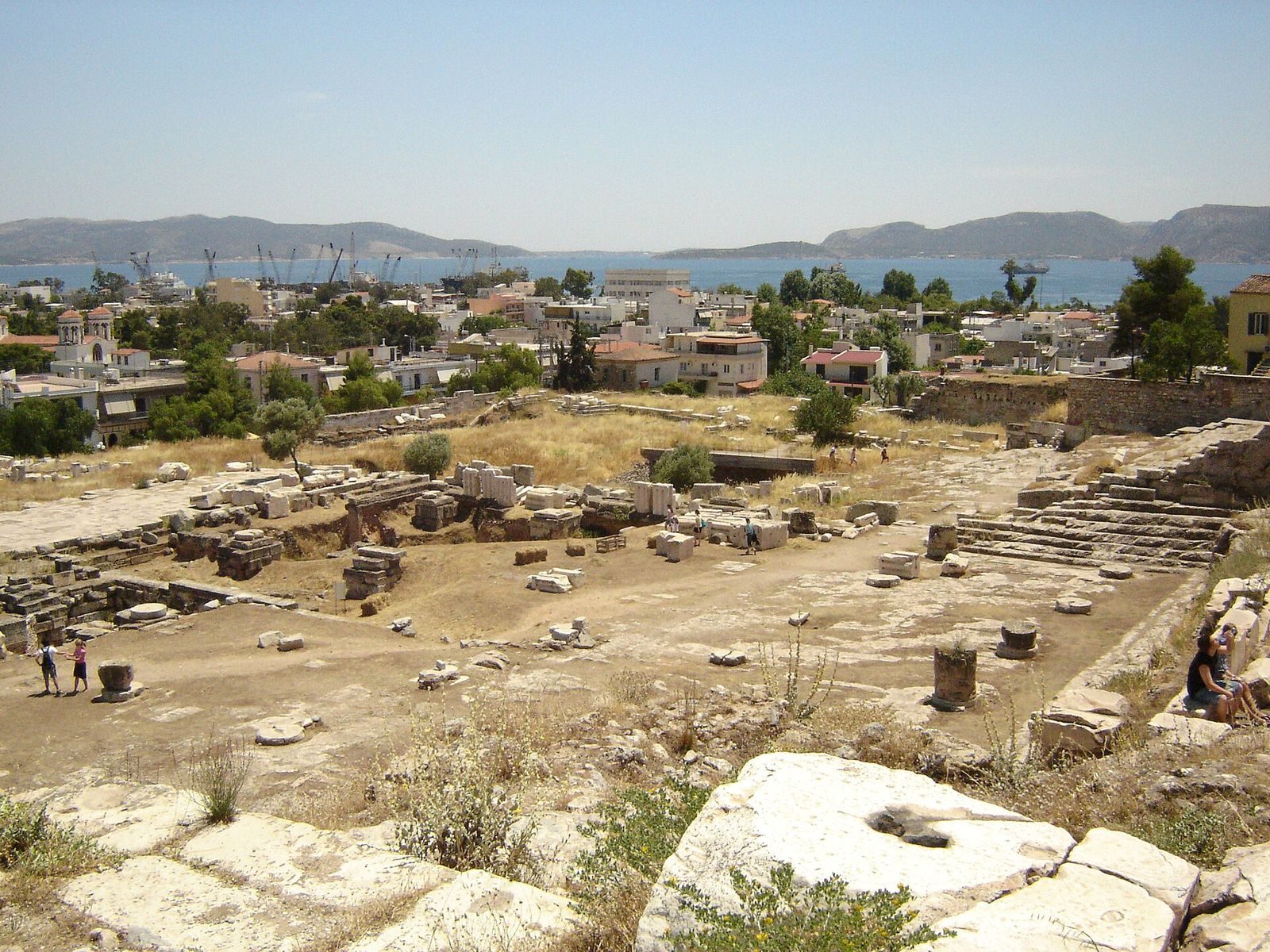
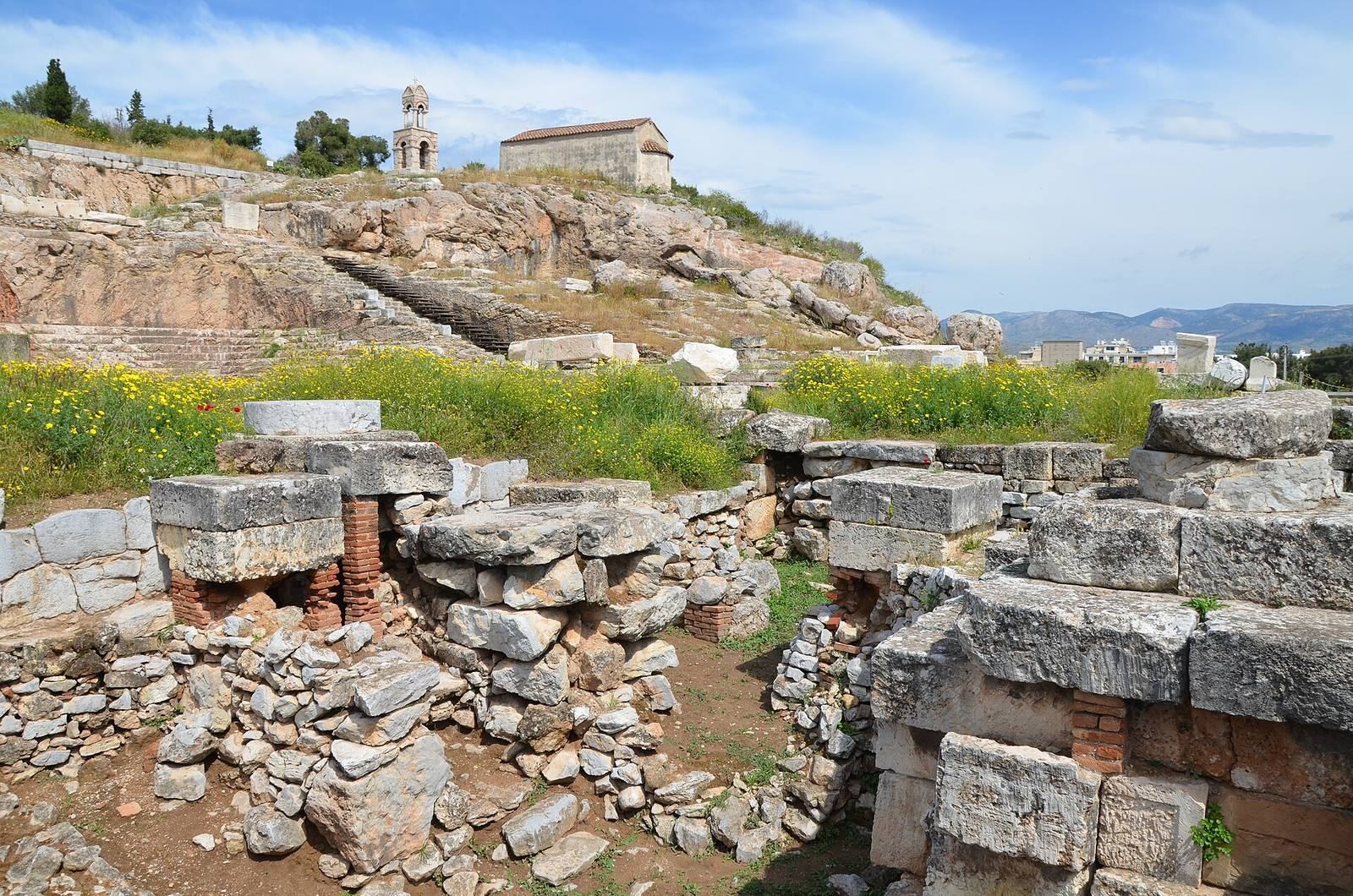
Ancient and modern Eleusis occupy the same location, on the eastern slope of a low ridge near the coast and opposite the island of Salamis. The city lay about 21 kilometres from Athens, on the route toward the Corinthian Isthmus, beside a fertile plain and a large gulf bordered to the south by Salamis. Its roughly triangular area measured about 500 metres on each side between the hill and the coast. The eastern end of the hill was levelled to provide ground for the sanctuary of Demeter and its adjoining sacred buildings. The acropolis, the fortified high part of the city, stood above it.
The city walls incorporated an embankment built with reclaimed marshland. In the Byzantine period, a fortification was added on the eastern side of the walls. During the classical period, the embankment was extended toward the sea to form a pier sheltering an artificial harbor. Three piers, each about 100 metres long, served the harbor, which ranked second to the Piraeus in maritime traffic in the Saronic Gulf.
The sanctuary of Demeter
Temple of Demeter
The principal building was the temple of Demeter, also known as the mystic sanctuary or place of initiation. It was described as Greece’s largest temple. Strabo, a Greek geographer, wrote that it could accommodate a crowd comparable to that of a theatre. Ictinus designed its plan, and construction was completed years later with the involvement of other architects. Around 318 BCE, during the time of the Athenian statesman Demetrius of Phalerum, the architect Philo added a portico of 12 columns. Afterward, the temple was regarded as one of the four finest examples of Greek marble architecture.
The temple faced southeast, but its site is now occupied by the modern town centre, making the building difficult to examine in detail. Its main enclosed chamber, or cella, was estimated at 166 square metres and had a marble roof supported by 28 Doric columns (a sturdy, relatively plain Greek design), each nearly a metre in diameter. The columns stood in two double rows, one toward the front and one toward the rear, with smaller columns above them. A portico in front of the chamber had 12 Doric columns, each 1.5 metres wide at the base.
A platform at the rear rose as much as 6 metres above the portico floor. Stairs at the temple’s northwest corner led to it, while a separate stairway reached a small gateway with two columns that connected the temple to the acropolis.
Propylaea and inner enclosure
A broad paved approach from Athens ended at the remains of the Eleusinian Propylaea, a monumental gateway whose scale and design were compared with those of the gateway on the Athenian Acropolis. Partway along the paving stood a small temple identified as that of Artemis Propylaia, measuring 12 by 6 metres. Its surrounding colonnade adjoined the Propylaea and formed the outer enclosure of Demeter’s temple.
About 50 metres from the Propylaea lay the northeast corner of the inner enclosure, an irregular pentagon. The rock there had been cut for a smaller gateway, an opening 9.7 metres wide between parallel walls about 50 metres long. A colossal piece of marble from Mount Pentelicus near Athens was found in this area. It was first thought to come from Demeter’s cult statue, but its find position and rough surface suggest that it was part of the temple’s architectural decoration. The upper section of a Caryatid, a sculpted female figure used as an architectural support, from the Lesser Propylaea is held at the Eleusis Archaeological Museum; it dates to about 50 BCE.
Other sacred places
Other recorded sanctuaries included temples of Triptolemus, a mythological figure associated with the spread of agriculture, and Poseidon under the cult title the Father. The Kallichoron was a well where Eleusinian women danced and sang in Demeter’s honor. It may correspond to a point at the foot of the hill’s northern slope, where roads toward Megara and Eleutherae met. A nearby plain was traditionally linked with the first cultivation of cereals used in sacrificial offerings and is mentioned in the Homeric Hymn to Aphrodite, though its location is uncertain. Herodotus, a Greek historian, also mentioned a monument to the Athenian Tellus near Eleusis.
Flood control and water supply
The Cephissus was nearly dry for much of the year but could rise dangerously in autumn, threatening the city and surrounding land with floods. After experiencing a flood while wintering in Athens, the Roman emperor Hadrian had embankments built. Two ancient earthworks about two kilometres south of Eleusis are probably remnants of these works. Hadrian also provided an aqueduct for drinking water, and its ruins remain visible in the northeastern part of the Eleusinian plain.