St John’s Kirk, Perth: A Church of Scotland Parish Church
Site at a Glance
- Rating
- 4.5
- Popularity
- Medium
- Country
- United Kingdom
- Primary era
- Medieval
- Eras represented
- Medieval, Early Modern, Modern
- Civilizations
- British, Kingdom of Scotland
- Site type
- Religious
- Remains
- Church
On this page13 sections
History
St John’s Kirk, Perth, is a Church of Scotland parish church in Perth, Scotland, United Kingdom. A church has stood on the site since the twelfth century, and its foundation is dated to 1126 in connection with King David I’s financial support for Dunfermline Abbey. In 1128, the church was given to the abbey’s Benedictine monks. Christian worship may have taken place here as early as the fifth century, and the site was associated with Perth Castle.
Early church and medieval worship
In 1242, David de Bernham, Bishop of St Andrews, consecrated a church on the site. Probably only its choir, the area traditionally used by clergy and singers, had been completed by then. Dedicated to John the Baptist, the church was once called the Church of the Holy Cross of St John the Baptist. Perth itself was formerly known as St Johns Toun, or Saint Johnstoun, after the saint. In 1286, the heart of King Alexander III was buried at the church. During his 1296 invasion of Scotland, King Edward I attended mass there. Kings Charles I and Charles II, and Prince Charles Edward Stuart, are also recorded as having worshipped at the kirk.
Rebuilding and worship before the Reformation
With the consent of Perth’s monks and citizens, rebuilding of the church began in 1440. Before the Reformation, the city’s craft incorporations, organized bodies of tradespeople comparable to guilds, maintained altars in the kirk. The wrights, or carpenters, and the barbers supported an altar dedicated to Our Lady of Pity, a devotional title for the Virgin Mary. Members who broke their trade rules paid fines in wax for the altar’s lights.
The Reformation and divided congregations
On 11 May 1559, the Protestant reformer John Knox preached against idolatry at the kirk. The sermon marked the beginning of the Scottish Reformation, the sixteenth-century shift from Roman Catholicism to Protestant churches in Scotland. Afterward, members of the congregation stoned the priest and stripped the church of its ornaments. They then stripped the Greyfriars, Blackfriars, and Charterhouse monasteries to their bare walls. The kirk was ill-suited to Reformed services and had fallen into disuse by the end of the sixteenth century.
Rebuilding began in 1598, and the church was divided among three congregations, known as East, Middle, and West, each with its own minister. The separate interior arrangements lasted until restoration work in the 1920s removed the partitions and brought the congregation together again.
Repairs and memorials
Repairs took place in the nineteenth century, including work on the choir in 1894. In the 1920s, Sir Robert Lorimer restored the church as a memorial to Perthshire men killed in the First World War. Knox Chapel was dedicated to those who later died in the Second World War. Further repairs and restoration followed in the 1980s and early twenty-first century. The kirk is a Category A listed building, Scotland’s highest category for buildings of special architectural or historic interest, and it also belongs to a Category A listed building group.
Remains
Plan and medieval fabric
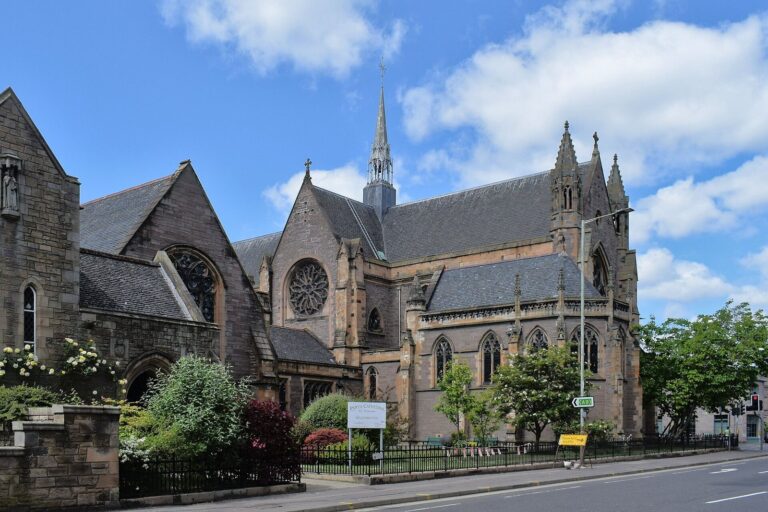
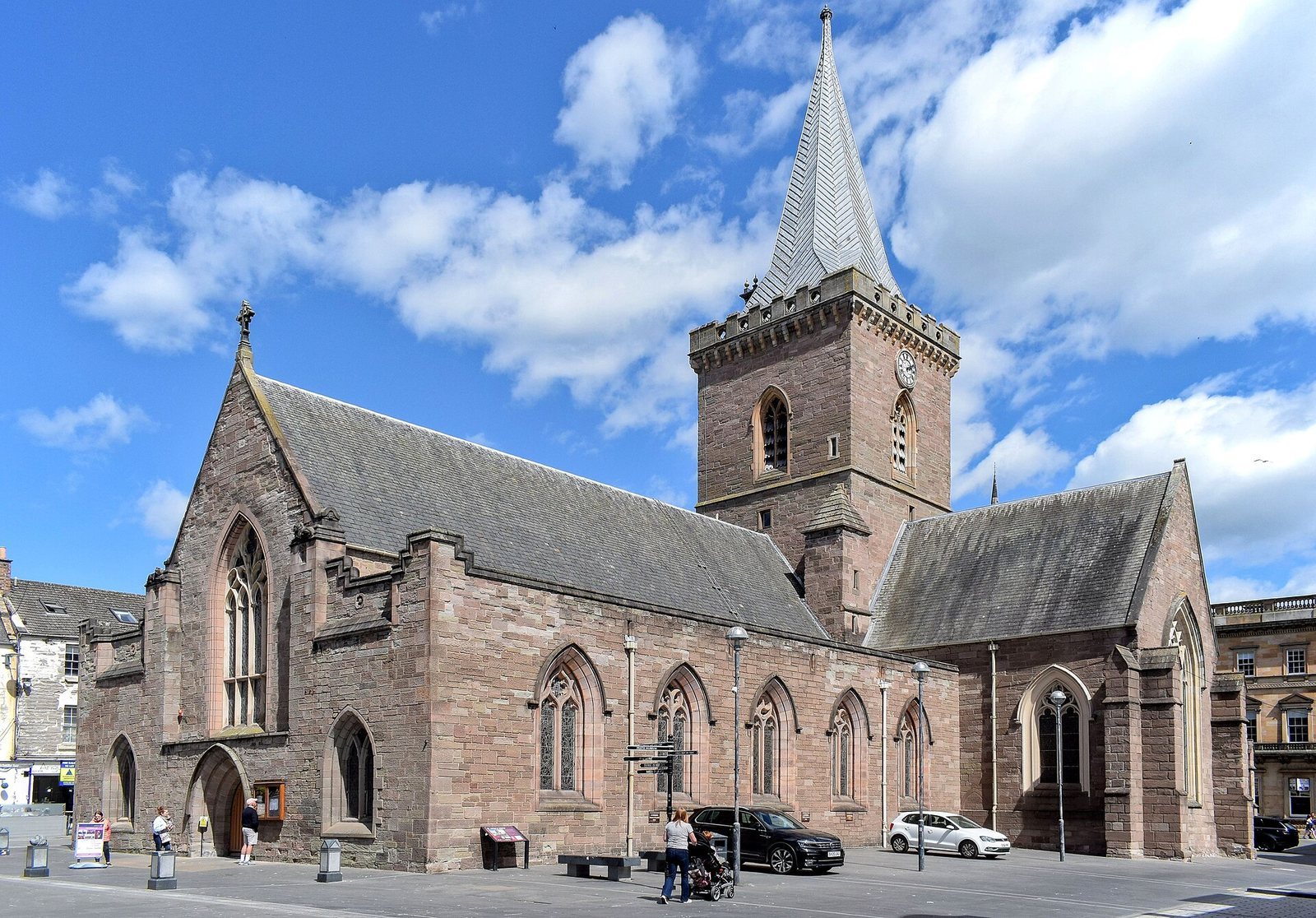
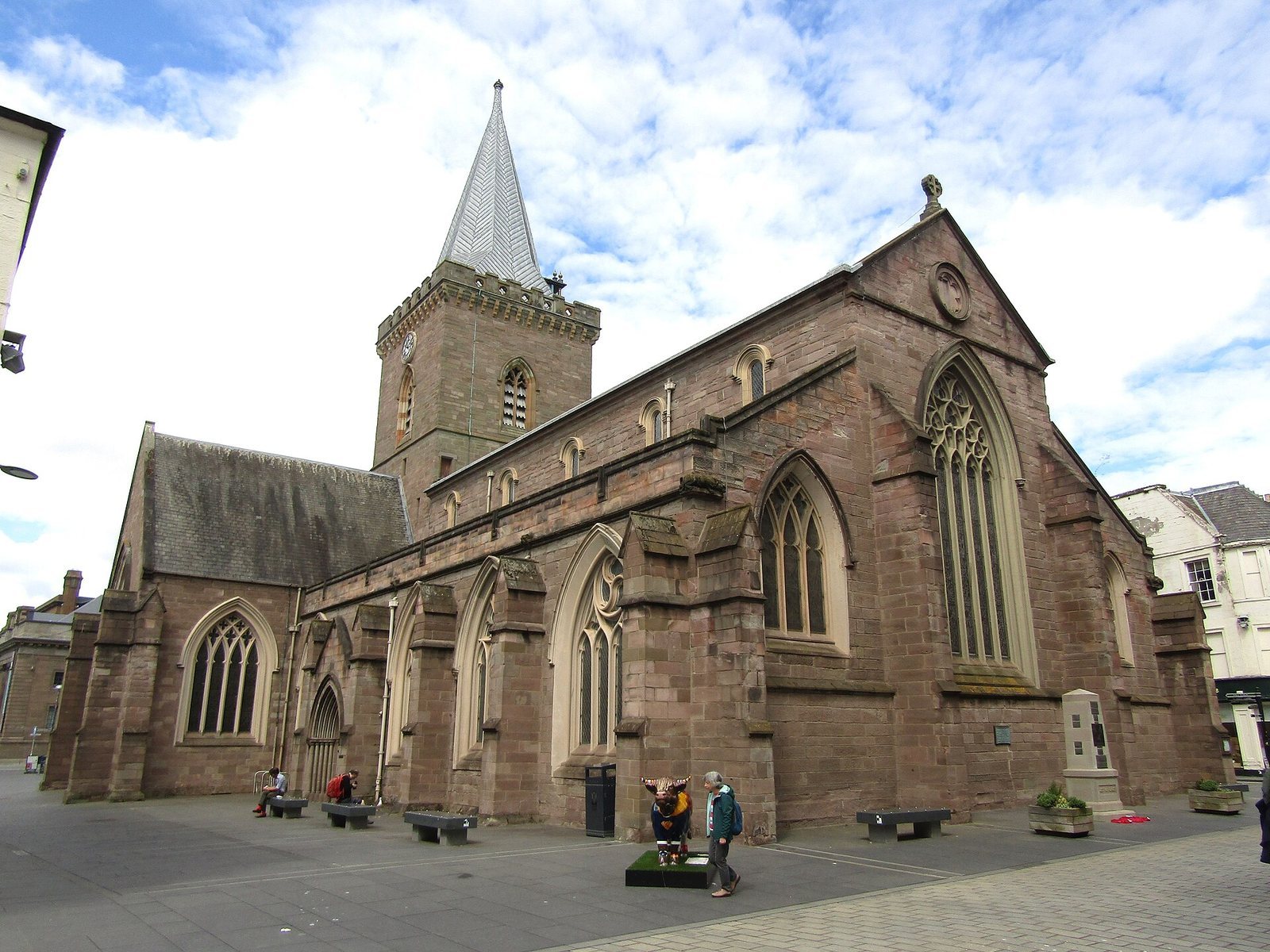
The present church has a cruciform, or cross-shaped, plan. It stands beside Perth Museum, formerly Perth City Hall, on a site bounded by St John’s Place to the north, South St John’s Place to the south, St John Street to the east, and Flesher’s Vennel to the west. Kirkgate leads to the north side and St Ann’s Lane to the south. The choir is the oldest surviving part of the building, dating to 1448; the nave was probably completed toward the end of the fifteenth century, and the bell tower was finished in 1511. The central tower is understood to have provided a model for the two towers of St Machar’s Cathedral in Aberdeen.
North porch and interior features
The north porch, called Halkerston’s Tower, may take its name from John Halkerston, an architect who worked at the church in the 1460s. Its upper room was once used as a prison for prostitutes. That upper level was removed in 1823, then reinstated by Lorimer during his restoration of the church. In the 1820s, architect James Gillespie Graham also shortened the north transept to improve traffic flow and carried out repairs. Surviving pre-Reformation features include holy-water stoups, which held water for devotional use, a piscina, a basin for water used in religious rites, a stone niche, and masons’ marks. The kirk also contains a medieval collection box and a modern tapestry.
Stained glass and furnishings
Early stained glass in the church includes work by Ballantine and Allan, Stephen Adam, and Douglas Strachan. American glazier Harvey Salvin made the Blue Window in the northwest corner. William Wilson created the Black Watch Window and the St Christopher window; Elizabeth the Queen Mother visited in 1955 to dedicate the Black Watch Window. The chandelier of the Virgin Mary, believed to have hung in the kirk in the fifteenth century, was sold to Perth Museum and Art Gallery in the nineteenth century and later returned to the church.
Bells
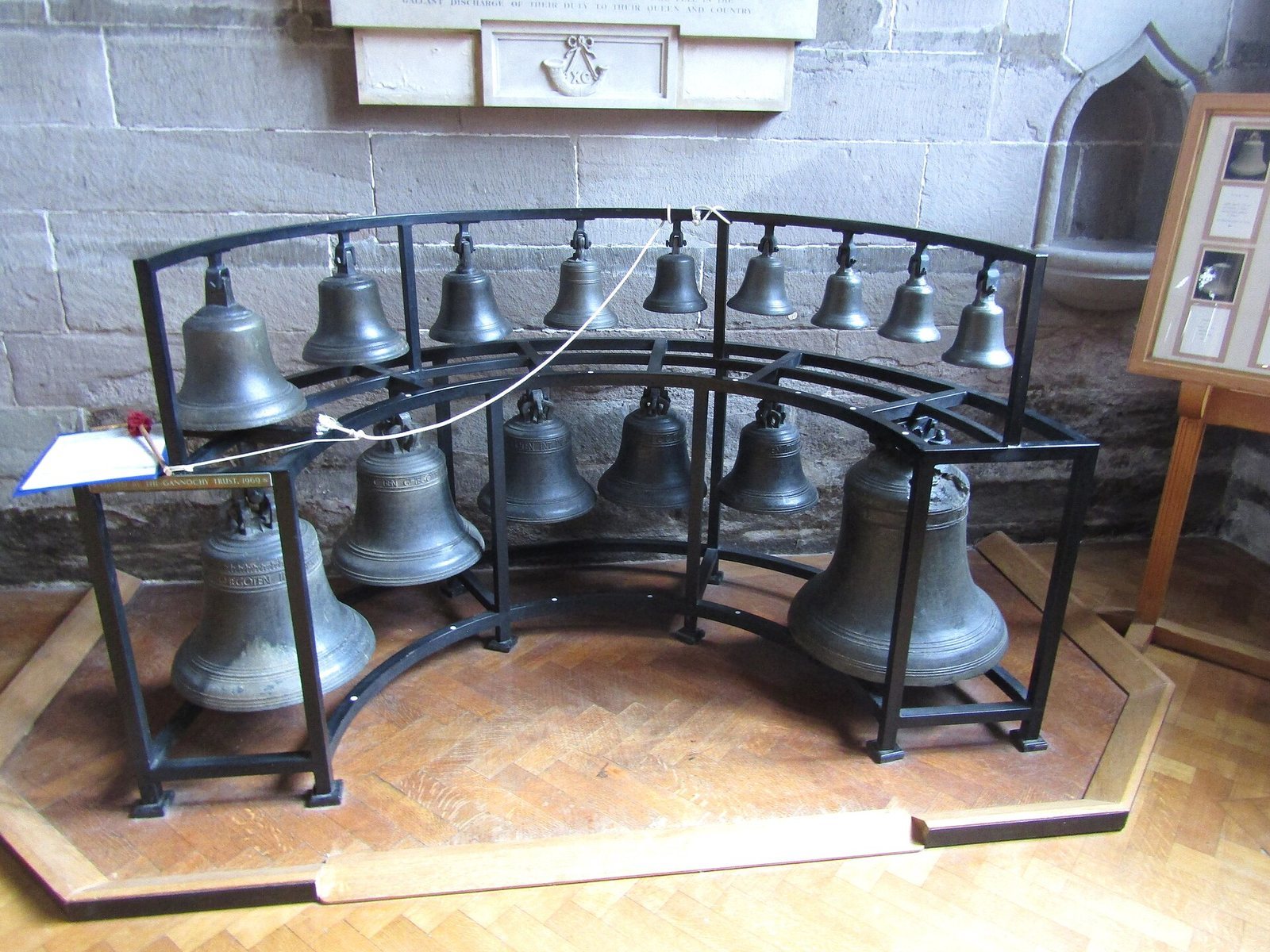
The church contains 63 bells, more than any other church in the British Isles. Thirty-five form the active carillon, a set of tuned bells played from a keyboard, in the main tower belfry. The other 28 are disused: 13 hang in a side belfry on the north side of the spire and can be seen from outside, while 15 are held in a metal frame at floor level inside the church.
The carillon
The carillon combines the 1506 bourdon, the set’s largest and lowest-pitched bell, with 34 bells cast by Gillett & Johnston in 1934. The bourdon weighs 1,429 kilograms and was cast by Peter Waghevens of Mechlin, also known as Malines. It hangs in a low-side cast-iron frame that permits full-circle ringing, in which the bell swings through a complete circle as it sounds. The other 34 bells are fixed in a metal framework beside it, arranged across five levels, and are not visible from street level. The carillon was assembled for playing at the Croydon bell foundry in January 1935 and inspected by Prime Minister Ramsay MacDonald. In 2022, its keyboard-to-bell mechanism was replaced and the bell frame was cleaned and repainted.
Earlier bells
Eight of the church’s bells predate the Reformation. The Ave Maria bell, in the side belfry, dates to about 1340. The disused Agnus Dei bell, among those kept at floor level, probably dates to the early sixteenth century. Five Flemish chime bells at floor level were cast in 1526 and may have been made by Willem van den Ghein of Mechlin.
Burials and war memorial
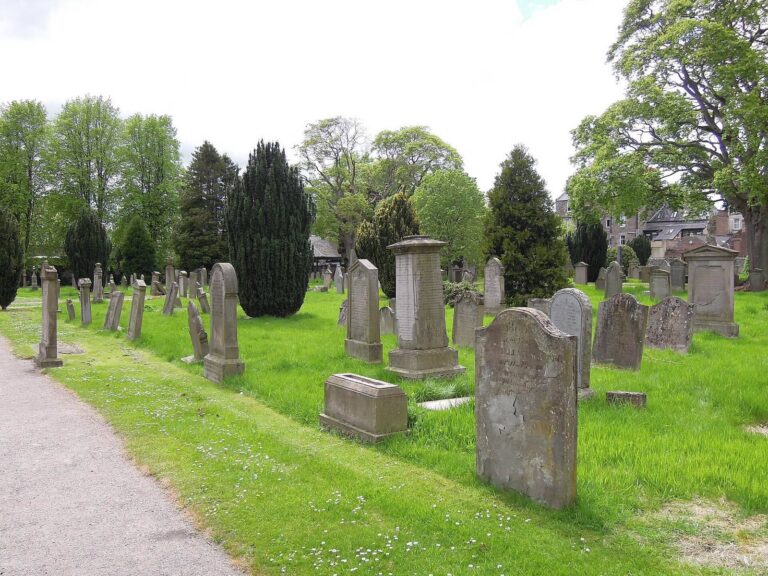
Until 1580, the church grounds served as Perth’s principal cemetery. Burials remain in the vicinity, and prominent citizens were also buried inside the church. Perth’s first dedicated war memorial was unveiled on St John Street behind the kirk in 2021. Earlier remembrance services had taken place at the mercat cross, a public marker associated with the town’s market and civic life, a location regarded as insulting to veterans.