Thracian Tomb of Aleksandrovo: A Painted Aristocratic Mausoleum
Site at a Glance
- Rating
- 4.7
- Popularity
- High
- Country
- Bulgaria
- Primary era
- Iron Age
- Eras represented
- Iron Age
- Civilizations
- Thracian
- Site type
- Burial
- Remains
- Tomb
On this page21 sections
History
Ancient function
The Thracian Tomb of Aleksandrovo is an early fourth-century-BCE burial monument near the village of Aleksandrovo in southeastern Bulgaria, built by the ancient Thracians for an unidentified aristocrat. It also served as a temple-mausoleum. Its possible connection with the Triballi, one of the Thracian peoples, remains uncertain.
Discovery and investigation
Earth-moving work exposed the tomb in December 2000. On 17 December, archaeologists led by Bulgarian archaeologist Georgi Kitov entered through an opening made by looters. The team conducted rescue investigations from 2000 to 2003. Looters had damaged parts of the wall paintings before the work began, and later restoration brought additional details to light.
Museum and heritage recognition
Construction of the Museum Center ‘Thracian Art in the Eastern Rhodopes’ started in February 2008, and the center opened on 15 May 2009. It brings together museum displays and research facilities, including spaces for restoration and conservation. The tomb is on UNESCO’s Tentative List, a national submission list for places that may be considered for World Heritage status. In 2021, the tomb and museum center received the European Heritage Label, an EU distinction for sites connected with European history and culture. They became the first Bulgarian site to receive the label.
Remains
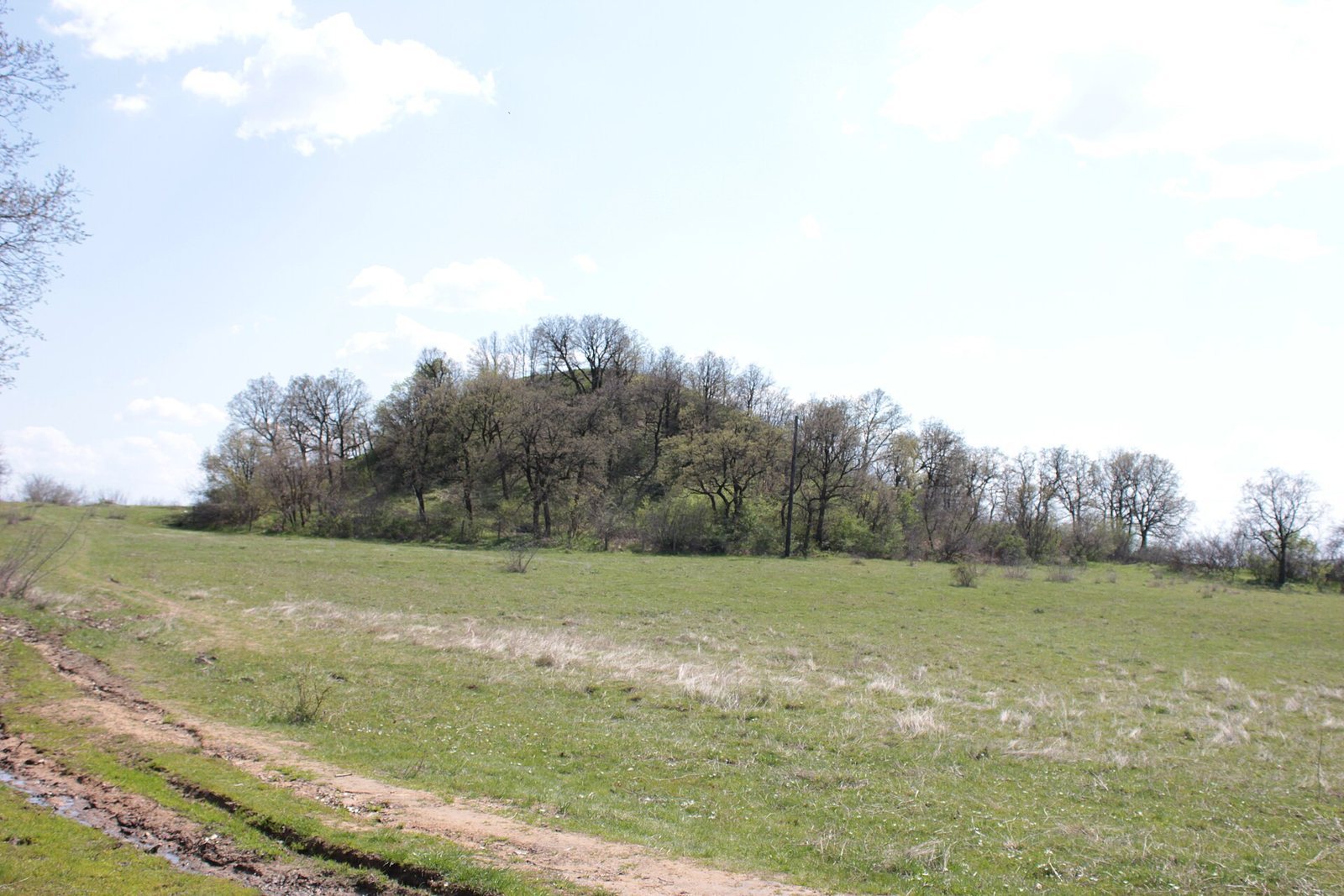
The tomb lies beneath a mound about 15 metres high and 70 metres across, near the eastern foot of the Assara massif. Its entrance is on the mound’s eastern side, roughly 10 metres inside its edge. From there, a passage leads west through a rectangular antechamber to the circular burial chamber.
Passage and burial chambers
Entrance passage
The entrance façade was destroyed in antiquity. An approximately 15-metre-long passage runs east to west, built from stone blocks of different sizes laid without mortar. Roughly worked slabs form its floor. The passage slopes down toward the west, with a height of about 2.25 metres at the entrance and 1.8 metres at the far end; its width ranges from 1.17 to 1.25 metres. Its uneven plaster and sloping western floor have been interpreted as signs of hurried construction.
Rectangular antechamber
The passage opens into a north-to-south rectangular room measuring about 1.9 by 1.5 metres, covered by a roof with a trapezoidal profile. The opening from the passage is approximately 1.2 metres high and 0.7 metres wide. Like the circular chamber beyond it, the antechamber is made of carefully shaped blocks set without mortar, with deliberately textured faces, then plastered and painted. This finish is more precise than the construction of the entrance passage.
Circular chamber
The innermost room is 3.3 metres in diameter at floor level and 3.4 metres high. Its bell-shaped ceiling narrows upward from the floor. Carefully worked, mortar-free stone blocks form its walls; plaster and paint cover the surfaces. A lower floor of stone blocks and a later surface of compacted earth indicate at least two periods of use. The sloping sides of the entrance frame direct the view south, toward the stone bed and the paintings above it.
Ritual bed and stone door
A bed made from stone blocks stood along the chamber’s southern edge. It had been broken apart before the tomb was found, leaving pieces scattered on the floor. Stone supports shaped like pillows stood at each end, and traces of plaster show that the bed was painted, though its decoration was destroyed by looters. A two-leaf stone door once closed the opening between the circular room and the antechamber. Looters broke it: one leaf was found on the entrance-passage floor, while fragments of the other lay in the passage and circular chamber. Red plaster remains on the leaves, along with a bronze ring from the door’s complex locking mechanism.
Paintings in the circular chamber
Funerary feast and inscription
Paint covers the chamber walls in six horizontal bands of different widths. Two contain human scenes, with 23 figures in all. The lowest, badly damaged, depicts three seated people opposite the entrance. A bearded man turns toward an attendant offering wine in a horn-shaped vessel; a sword hangs from his chair. A man and woman sit beside him with their hands together. The scene is interpreted as a ruler and his consort at a funerary feast. Another standing attendant presents a gold rhyton (a drinking or pouring vessel, often shaped like a horn). Gold and silver vessels sit on a table. Much of the scene’s right side is damaged, but a surviving fragment shows vessels thought to have belonged to the room’s banquet furnishings.
A red band above the feast contains the carved profile of a young man and the inscription KODZIMASES HRESTOS. The first word is understood as a Thracian personal name; the second is an epithet meaning gifted, skilled, or able. Kitov identified the profile as the painter’s self-portrait and the inscription as a signature. Other readings treat the figure as the tomb’s patron, or the words as a dedication added later.
Geometric decoration
Above the red band, linked black-and-white swastika motifs form a horizontal pattern. A decorative moulding borders it below, while a white area dotted with red marks separates it from the hunting scene above.
Hunting scene and interpretations
The best-preserved band shows a hunt in which four riders on grey, yellow, white, and red horses join foot soldiers attacking boars and deer. Around ten black, yellow, and white dogs take part. The first three riders face left; the rider on the red horse faces right and appears above the stone bed. The figures’ clothes, weapons, horses, and garment seams are rendered in detail. The scene forms a continuous circle, without a clear beginning or end.
One interpretation reads the hunt as a ruler’s life course, from youth and service as a foot soldier through mounted hunting to rebirth as Zalmoxis, a Thracian religious figure associated with life after death. In this reading, Zalmoxis holds a royal double axe and is treated as a demigod, a being with both mortal and divine status. Another interpretation sees the ruler hunting alongside other members of the Thracian aristocracy. The red-horse rider has also been understood as the ruler at the end of life, while the leopard-patterned saddle has been read as a mark of high rank. Some interpretations connect the boar hunt with victory over chaos and the establishment of cosmic order.
Other figures add to the scene’s range of possible meanings. A nude hunter attacks a boar, while a giant-like figure strikes a stag with a curved Thracian knife. The nude hunter, who also wields a double axe, has been identified variously as an ancestor, Heracles, the Greek hero famed for his strength and legendary labours, or Zalmoxis.
Dome and upper decoration
A heart-shaped pattern forms a raised decorative band between the hunting scene and the upper dome. It was originally yellow and has faded toward grey through natural ageing. At the ceiling’s crown, the central stone carries a painted, flat circular disk divided into four unequal parts. The larger southern and western sections are red and black, respectively, and have been interpreted as signs of life and day, and death and the underworld. The two narrower sections between them form a double-axe shape, a royal emblem.
Paintings in the passage and antechamber
Entrance passage
The passage’s damaged paintings include mounted combat on both walls. On the north side, a spear-bearing rider with a large round shield attacks a naked foot soldier who is fleeing. On the south side, a rider fights two foot soldiers: one stands with a sword raised, while the other kneels and offers his weapon.
Antechamber
Combat scenes also appear in the antechamber. Part of a panel facing west survives, showing a mounted fighter and a foot soldier. The paintings in both the passage and antechamber are damaged.
Artistic character
The paintings’ naturalistic detail offers evidence for Thracian clothing, weapons, and equipment used in hunting and combat. Their figures differ from the more idealized, Greek-influenced style of the Kazanlak Tomb, another Thracian burial monument. That comparison relates to the Hellenistic period, the era of Greek cultural influence that followed Alexander the Great’s conquests, beginning in the late fourth century BCE. Greek-style footwear in the Aleksandrovo paintings has also been interpreted as evidence of Greek influence.
Paintings in the rectangular chamber
The chamber’s lower walls were painted black. Horizontal floral bands, bordered by rows of decorative moulding, separate these dark areas from the red ceiling. The murals are badly damaged.
Museum and full-scale replica
The nearby museum center covers 834 square metres and contains a full-scale replica of the tomb, reproduced at a one-to-one scale with its paintings. Its displays include 98 gold objects, as well as ornaments and jewellery. The center also houses research facilities and spaces for restoration and conservation.