Pallantion: An Ancient Arcadian City-State in Greece
Site at a Glance
- Popularity
- Medium
- Country
- Greece
- Primary era
- Iron Age
- Eras represented
- Iron Age, Classical, Medieval
- Civilizations
- Ancient Greek, Byzantine, Roman
- Site type
- Settlement
- Remains
- City
On this page10 sections
History
Greek city and traditions
Pallantion was an ancient Arcadian city-state in Greece, on a small plain west of Tegea and southwest of Mantineia. Stories about its foundation differed: some attributed it to Pallas, described as a son of Lycaon or a grandson of Pelasgus, while another connected the city’s name with the goddess Athena. The early Greek poet Hesiod provides its earliest known literary mention.
Pallantion probably belonged to the Peloponnesian League, an alliance of Greek communities, through Maenalia, an Arcadian district organized as a tribal state. It later joined the Arcadian League, another political and military association. From about 421 to 371 BCE, the city issued silver coins using the Aeginetan weight system, a standard for coin weights. In 371 BCE, Pallantion helped establish Megalopolis as the Arcadian League’s new center, while remaining an independent city. Its people were listed among forces associated with the Theban general Epaminondas before the Battle of Mantineia in 362 BCE, although it is uncertain whether they took part in the fighting. Macedonian commander Polyperchon captured Pallantion in 318 BCE. In 228 BCE, forces led by Spartan king Cleomenes and Greek military leader Aratus fought near the city.
Roman traditions and imperial renewal
Roman tradition linked Pallantion with the legendary Arcadian Evander, who was said to have led colonists to the Tiber and settled with them on the Palatine Hill. The story connected the hill’s name to the Arcadian city and gave Pallantion a place in Roman tradition that exceeded its standing in Greek political history.
After declining to a village, Pallantion was restored and enlarged in the second century CE by Emperor Antoninus Pius, who ruled from 138 to 161 CE. He granted it free-city status, meaning exemption from taxation and other privileges, in recognition of its reputed connection with Rome. The Greek travel writer and geographer Pausanias visited the city during the same century.
Christian use and modern study
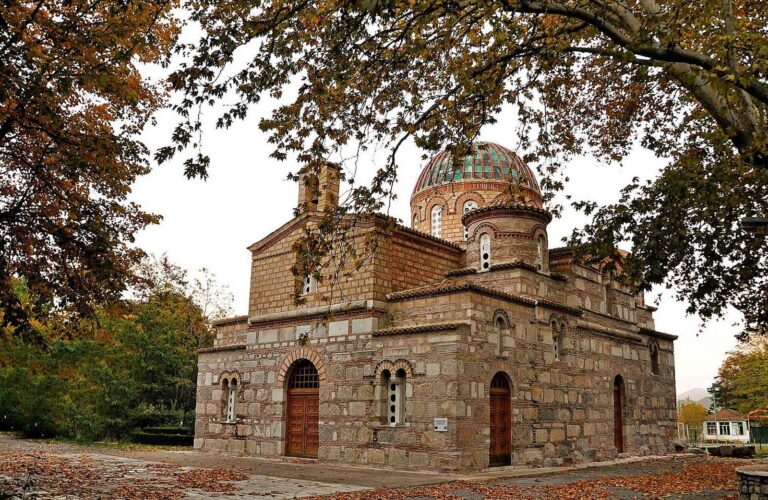
Christian worship brought new buildings to the plain below the hill. In modern times, French researchers identified Pallantion during the Morea expedition, a French expedition to the Peloponnese, from 1828 to 1833. The Italian Archaeological School of Athens excavated the site in 1939 and 1940, in work associated with Guido Libertini and Alfonso De Franciscis. Further excavations took place from 1984 to 1986 in collaboration with the Norwegian Institute at Athens, with Erik Østby and Mario Iozzo associated with the work. In 1927, the modern village took the name Pallantion to reflect its connection with the ancient city.
Remains
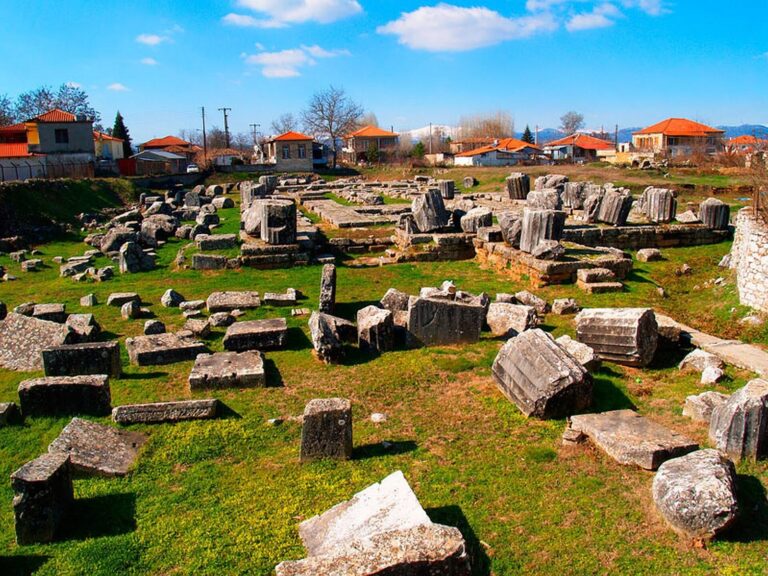
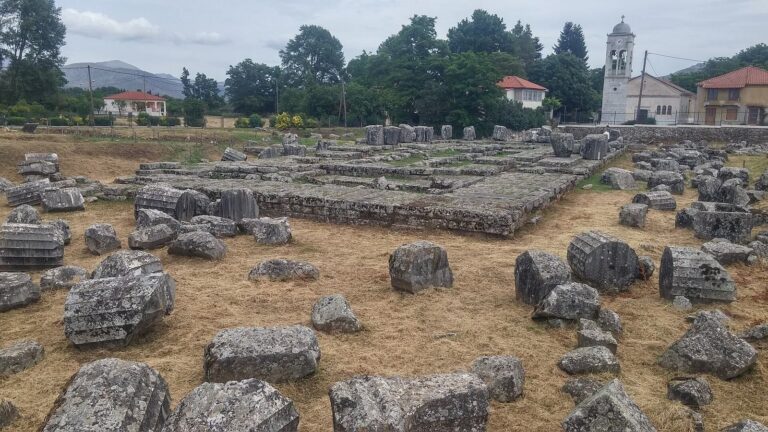
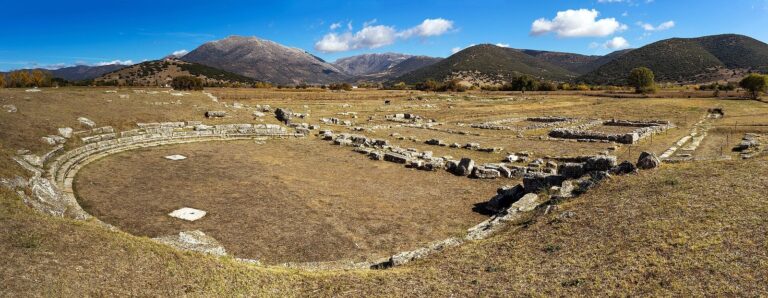
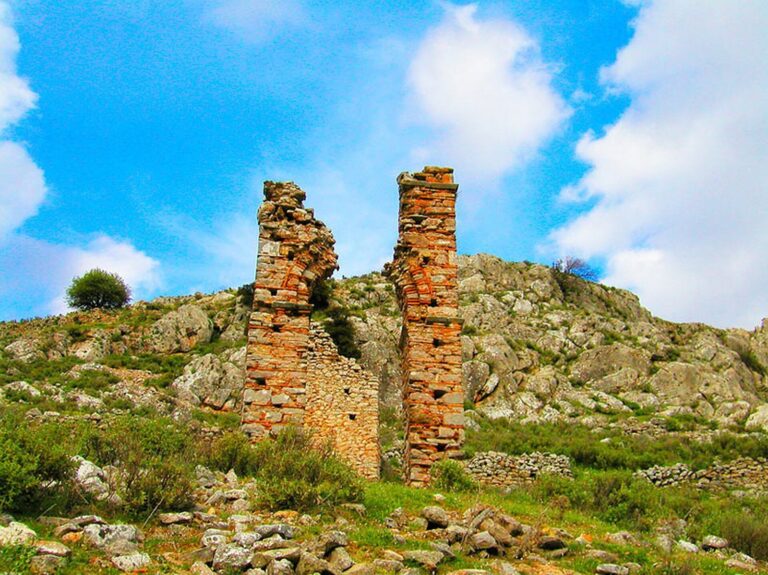
The city’s remains are arranged around a hilltop acropolis, the elevated center of an ancient city, and a lower town on the plain to its north and east. Surviving features include sections of the acropolis walls, temple foundations, buildings and tombs in the lower town, and churches on the plain. The archaeological site lies about three kilometres west of the modern village of Pallantion and seven kilometres southwest of Tripoli. A low ridge separates the plain from that of Tegea, while Mount Boreion lies to the south. The A7 highway now crosses the northwest part of the acropolis and upper town through a cutting in the rock.
Acropolis and lower town
Acropolis walls and temples
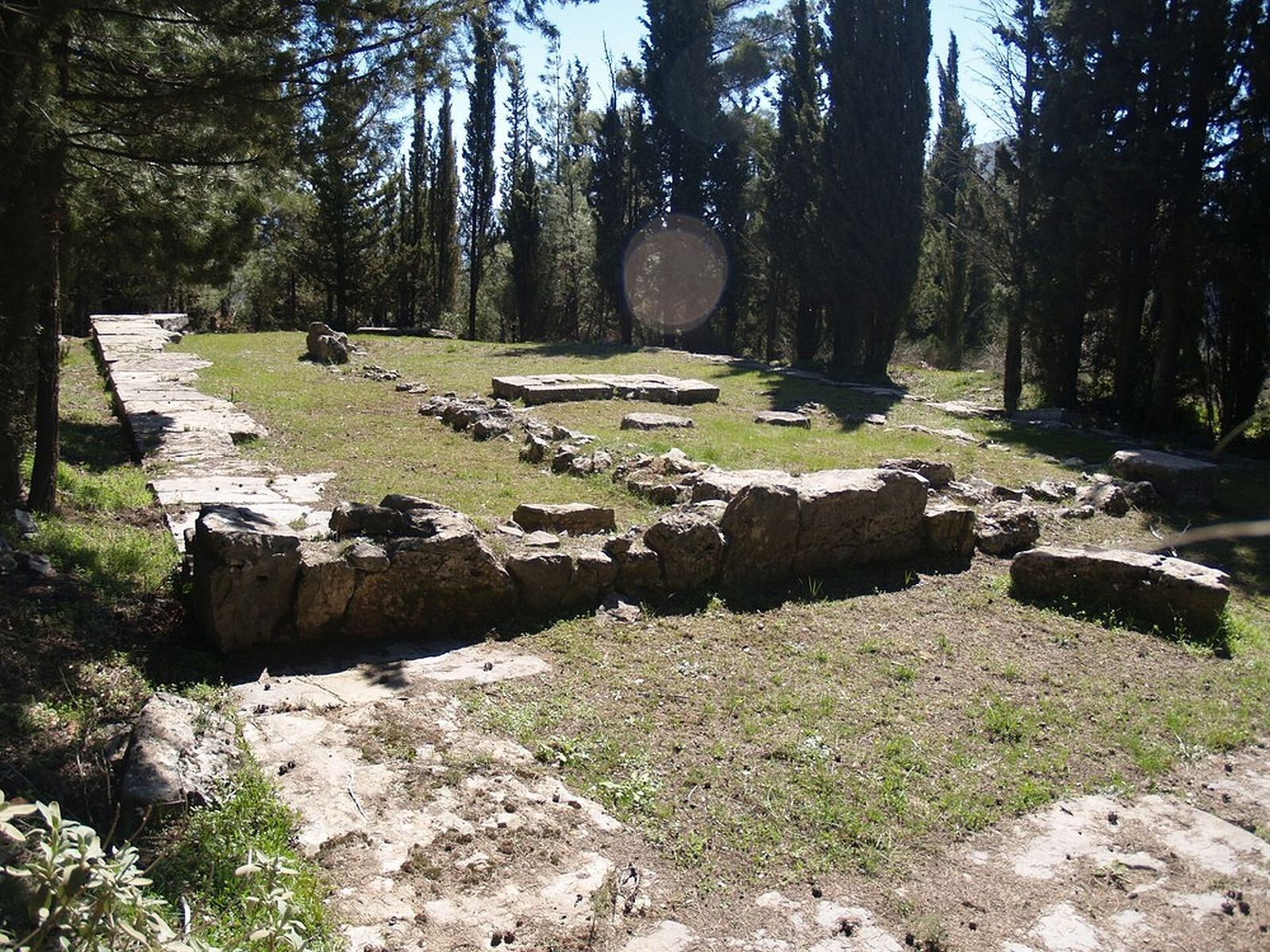
Sections of the walls survive around the hilltop area, within which four small temple ruins have been identified on the hill and its southern slope. Most are assigned to about 600 to 550 BCE; a temple on a terrace on the southern slope dates to the fourth century BCE. One temple has foundations about 16.2 by 8.9 metres and may be the temple of the Pure Gods described by Pausanias. These were deities understood not to receive blood sacrifices. The temple may occupy the site of the present church of Saint John on the hill. To its north are the foundations of a megaron-like temple, resembling a large rectangular hall, about 10.5 by 4.5 metres. The southern-slope temple measures about 21.4 by 11.7 metres at its foundations.
Lower town and sanctuary
Classical-period buildings and tombs have been found in the lower town. Statues of Pallas and Evander were also recovered there. Pausanias described a sanctuary in the city with statues of Pallas, Evander, and the historian Polybius, as well as a temple of Kore, another name for Persephone. Finds from Pallantion are held at the Archaeological Museum of Tegea.
Early Christian basilicas
Two early Christian basilicas stand in ruins on the plain below the hill. A basilica is a large hall-type building adapted for Christian worship. Their construction incorporates architectural elements from earlier buildings. One basilica dates to the sixth century and was dedicated to Saint Christopher.
Temple at Vigla
A separate temple stood at Vigla, about 1.6 kilometres southwest of the archaeological site and west of ancient Pallantion, beside the road from Asea to Tegea. The rocky, remote place is identified with Gravari. Pausanias attributed the temple’s foundation to Odysseus on his return from Troy; a sanctuary had already occupied the site in the sixth century BCE. Built in the late sixth century BCE, the temple followed the Doric order, an ancient Greek style with sturdy columns and plain capitals. It had six columns at each end and thirteen along each side, and its foundations measure about 11.6 by 24.7 metres. The building was made of Doliana marble. Remains of triangular-gable sculptures and offerings to the deity, including tridents and small statuettes, have been found. The foundations remain, while much of the temple’s building material was reused over time. In 1837, a large amount went into a church at Valtetsi. A small church dedicated to the Transfiguration of the Savior stands at the temple’s northern edge, partly over its ruins.