Orbe-Boscéaz: A Gallo-Roman Villa and Mosaic Site in Switzerland
Site at a Glance
- Rating
- 4.4
- Popularity
- Medium
- Country
- Switzerland
- Primary era
- Classical
- Eras represented
- Classical
- Civilizations
- Roman
- Site type
- Domestic
- Remains
- Villa
On this page16 sections
History
Orbe-Boscéaz is an archaeological site in Orbe, Switzerland, centered on a Gallo-Roman villa, a Roman-period estate built chiefly between AD 160 and 180. Occupation at the site reaches back to the Neolithic, followed by evidence of activity in the Bronze Age and the second Iron Age.
Mosaic discoveries
The first floor mosaics came to light in 1841. Finds in 1845 included the Triton and Labyrinth pavements. The Labyrinth was covered over later that year and uncovered again in 1930; in 1846, part of the Triton pavement was destroyed.
The Deities of the Week pavement was found in 1862, followed by Laurel Leaves in 1863. Laurel Leaves was covered and exposed again on several occasions, with rediscoveries continuing through 1925.
Excavation and protection
Scientific excavation began in 1896, and the site was classified as a historic monument in 1900. The whole complex also holds Switzerland’s cultural-property designation for sites of national importance.
Aerial photographs taken in 1976 revealed the villa’s full extent and plan. From 1986 to 2004, University of Lausanne students investigated the residential area through a field school; their work brought the ninth mosaic to light in 1993.
Remains
The villa’s residential zone extended for more than 200 metres within an estate covering 16 hectares. The complex included private bathing rooms and a temple dedicated to Mithras, a deity worshipped in the Roman world. Five pavilions house the Roman floor mosaics, a collection regarded as the richest Roman mosaic assemblage in Switzerland. Nine pavements are known, most preserved where they were laid.
Pavilion I: Geometric Floors
Eastern Triclinium, Mosaic 1
This geometric pavement decorated a triclinium, a formal Roman dining room. Its western border, found in 1925, is displayed in Pavilion I. Most of the floor was excavated in 1987 and is protected beneath a temporary shelter while restoration is pending.
Laurel Leaves, Mosaic 2
The black-and-white geometric pavement is among the villa’s best-preserved mosaics. It decorated a room, probably a vestibule, between the rooms containing mosaics 1 and 3.
Western Triclinium, Mosaic 3
This geometric floor belonged to another formal dining room. The surviving portion is its excavated southwest corner, found in 1925 and displayed in Pavilion I.
Pavilion II: Figurative Mosaics
Triton Mosaic, Mosaic 4
Triton, a sea deity, is the name associated with this figurative pavement, now represented by several fragments in Pavilion II. They include Theseus leaving Ariadne on Naxos, an episode from Greek myth, alongside a lion, panther, dolphin, hare and birds. Other fragments show Medusa, a Gorgon, floral designs and two sections of a plant-pattern border.
Labyrinth, Mosaic 5
A square image of the Cretan labyrinth forms the central feature of this figurative pavement, accompanied by a band of geometric decoration.
Pavilion III: Rural and Geometric Scenes
Rustic Procession, Mosaic 6
The surviving part of this figurative pavement shows a scene of rural life. Interpretations differ, and one possibility is that the scene represents a calendar.
Squares and Diamonds, Mosaic 7
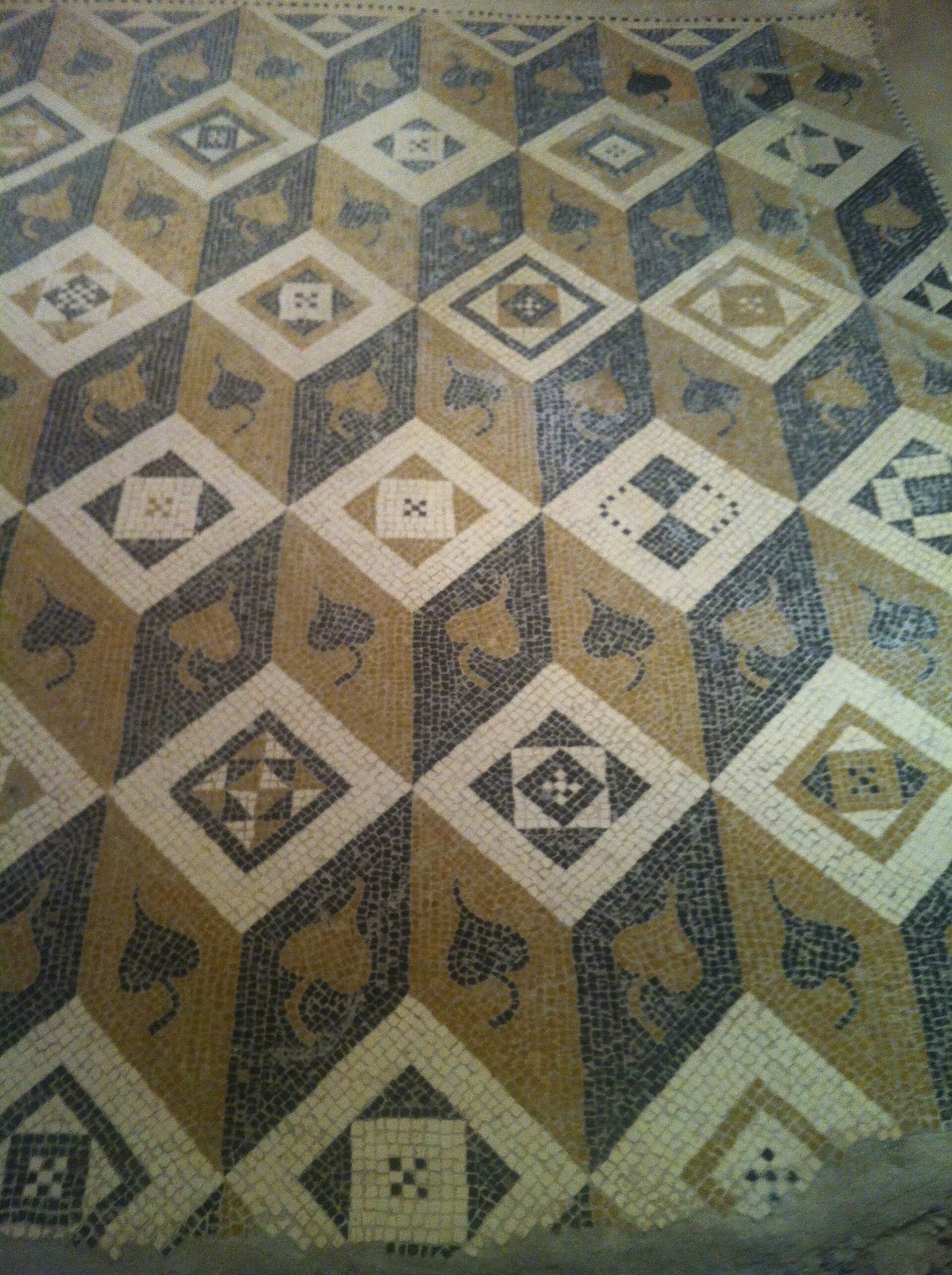
This geometric pavement creates an illusion of depth through diamond shapes decorated with ivy leaves and squares filled with varied patterns.
Pavilion IV: Deities of the Week
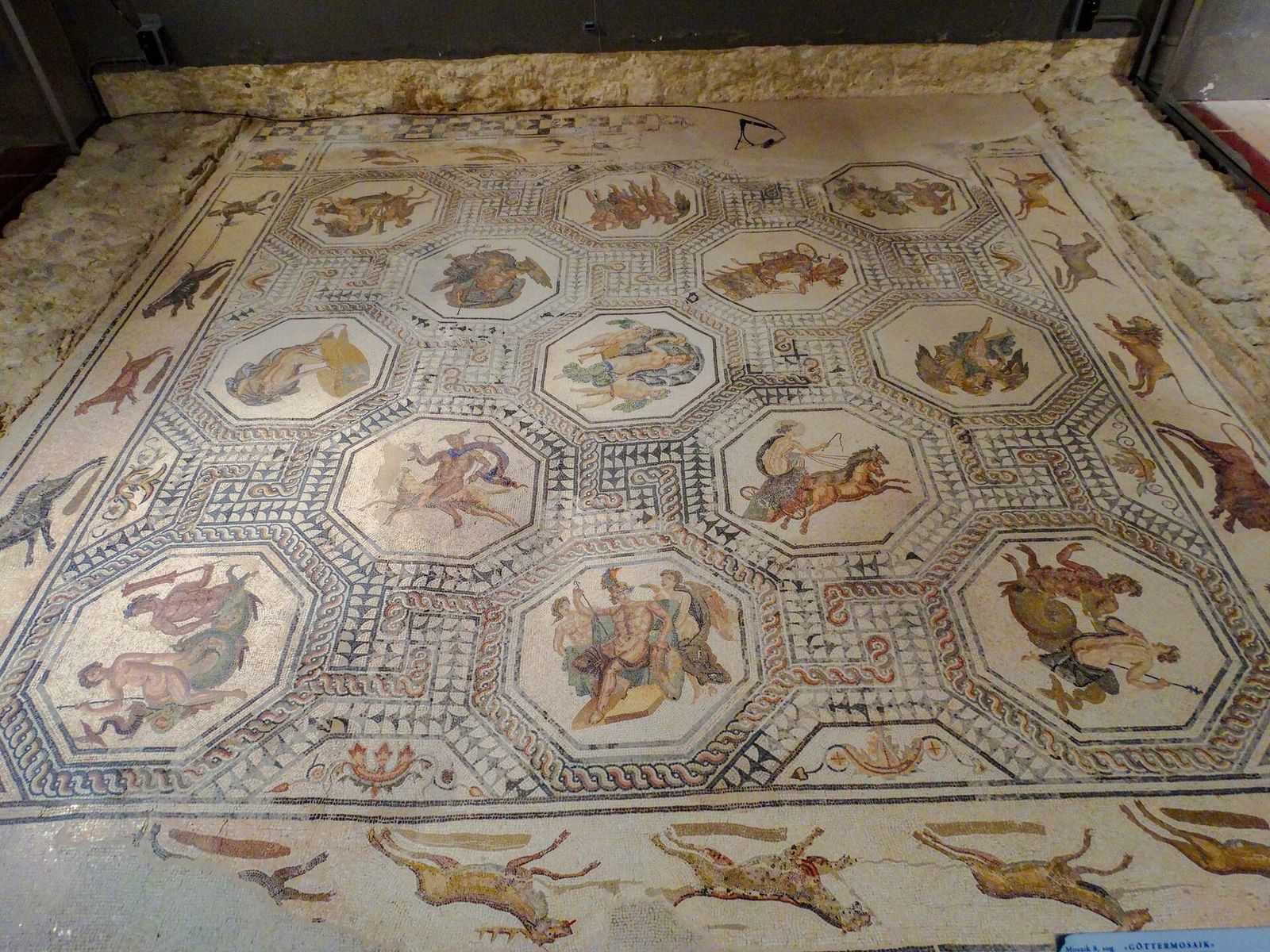
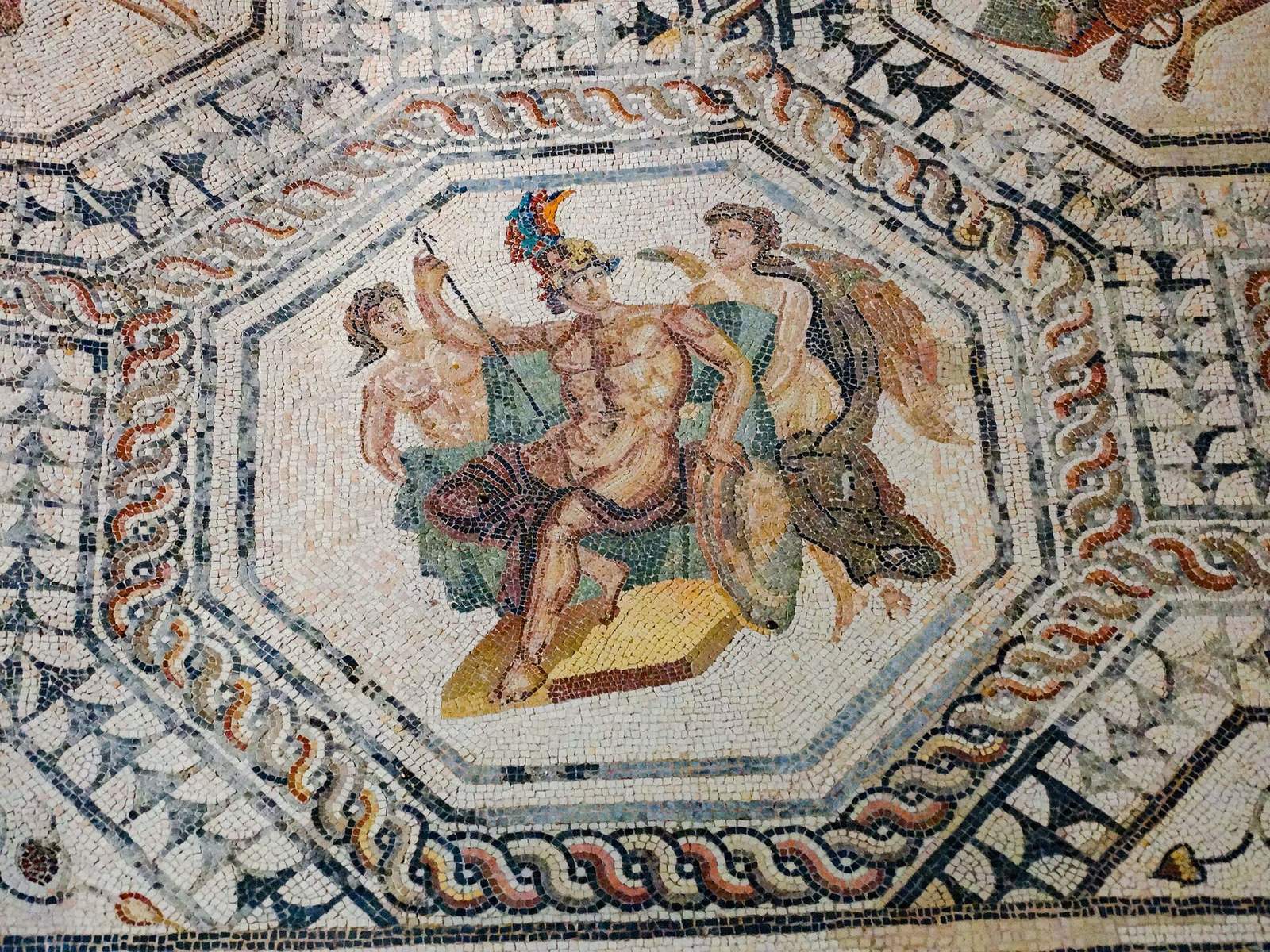
Among the villa’s best-preserved pavements, this figurative mosaic has thirteen medallions. Seven show Saturn, Sol, Luna, Mars, Mercury, Jupiter and Venus, deities associated in Roman tradition with the days of the week. Other medallions depict Narcissus, a mythic youth associated with his reflection; Ganymede, a Trojan youth carried off to serve the gods; and four pairs of Triton and Nereids, sea nymphs. Hunting and animal-combat scenes decorate the borders. Busts representing the seasons occupy the corners, with spring, autumn and part of winter surviving.
Pavilion V: Achilles at Skyros
This figurative pavement is arranged as two panels surrounded by thirty squares with different motifs. It depicts Greeks searching for Achilles on Skyros, an episode from the legendary Trojan War, a conflict central to Greek epic tradition. In the upper panel, Ulysses, the Latin name for Odysseus, appears on the palace ramparts while Agyrtes, his enslaved companion, plays a trumpet. Below, Achilles takes up his weapons as women in the palace’s women’s quarters panic. The mosaic is undergoing restoration.