Santa Maria della Ferraria: A Cistercian Abbey in Vairano Patenora
Site at a Glance
- Rating
- 3.8
- Popularity
- Low
- Country
- Italy
- Primary era
- Medieval
- Eras represented
- Medieval
- Civilizations
- Kingdom of Sicily
- Site type
- Religious
- Remains
- Monastery
On this page7 sections
History
Santa Maria della Ferraria was a Cistercian abbey in Vairano Patenora, Italy, founded in 1179 from Fossanova and affiliated through the order’s institutional lineage with Clairvaux, one of its principal abbeys. The Cistercians were a monastic order that followed the Rule of Saint Benedict.
Foundation and early growth
In 1171, Count Richard of Sangro granted land near Pietravairano, within the Diocese of Teano, for a monastery. Johannes de Ferrariis, a monk from Fossanova, was charged with establishing the new community. The abbey church was consecrated on 24 October 1179. The founding monks arrived later, in November 1184, under Abbot William.
Ferraria became the mother house, or founding monastery, of four Cistercian communities: Santa Maria dell’Arco in Sicily in 1212, Santo Spirito della Valle in Apulia in 1215, Santa Maria Incoronata in Apulia in 1232, and Santi Vito e Salvo in Abruzzo in 1257. Grants from popes Lucius III, Clement III, and Celestine III, the Sicilian kings William II and Tancred of Lecce, Henry VI, Empress Constance, and Frederick II helped it prosper. Frederick II, a Holy Roman Emperor, camped at the abbey for three days in September 1229.
Around 1228, a chronicle composed at Ferraria recounted events involving popes, emperors, and Apulia. A chronicle is a historical narrative arranged in chronological order, and this work is an important source for the abbey’s early history.
Institutional change and suppression
In 1449, the abbey was placed under commendam, an arrangement that entrusted an ecclesiastical office or benefice to an administrator who might not reside with the religious community. Its decline began after this change. Ferraria joined the Roman Cistercian Congregation in 1632. Cistercian congregations were groups of monasteries organized for shared governance; the Roman group united with the Tuscan Congregation in 1660. Ferraria left this grouping in 1765 and joined the Calabrian-Lucanian Congregation.
Which particular suppression ended the abbey’s life remains uncertain. It had been suppressed by 1807 at the latest, when Joseph Bonaparte, ruler of the Kingdom of Naples, suppressed religious orders.
Remains
Layout and surviving buildings
The abbey stood about two kilometres north of Pietravairano and one kilometre south of the Volturno River. Its complex included a large church with many altars, a bell tower, a cloister, and a large cistern.
Church and monastic buildings
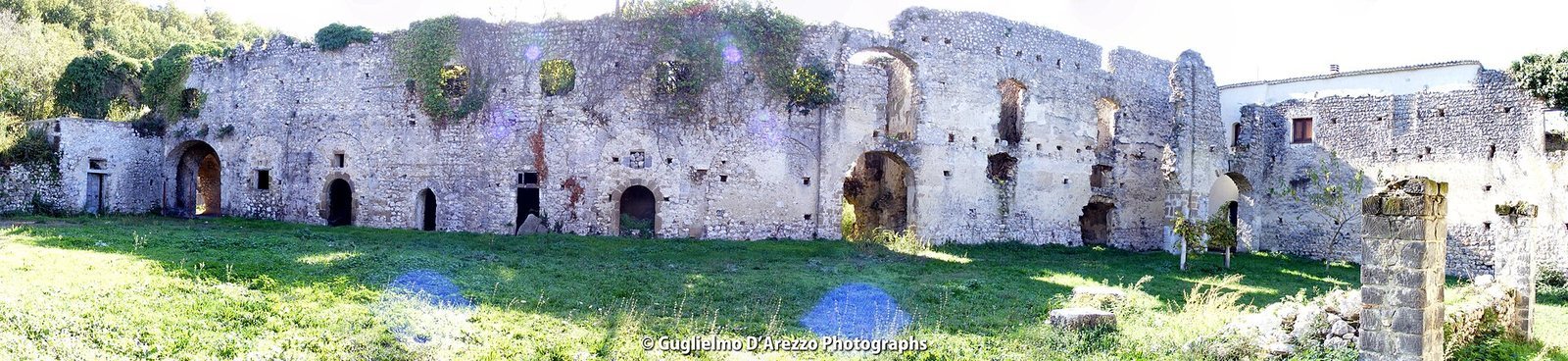
Ruins survive from the abbey complex, particularly the apse of the church. The church formed part of a group of buildings that also included the bell tower, cloister, and cistern.
Chapel of the Holy Staircase
The Chapel of the Holy Staircase remains intact. Its fresco depicts the funeral ceremonies of Malgerio Sorello, lord of Torcino and falconer to Frederick II. A falconer was responsible for keeping and training birds used in hunting.