Nikolauskloster: A Monastery in Jüchen, Germany
Site at a Glance
- Rating
- 4.6
- Popularity
- High
- Country
- Germany
- Primary era
- Early Modern
- Eras represented
- Medieval, Early Modern, Modern
- Civilizations
- Holy Roman Empire
- Site type
- Religious
- Remains
- Monastery
On this page9 sections
History
Nikolauskloster is a monastery in Jüchen, Germany, near Schloss Dyck. Its exact beginnings are unknown, though tradition places a chapel dedicated to St Nicholas here in the 12th century. The chapel is first mentioned in a record dated 25 February 1398, under the name Sinter Claes. The monastery later became the family house of the Salm-Reifferscheidt family and a spiritual centre of the Imperial Lordship of Dyck, a territory held directly under the authority of the Holy Roman Emperor.
In 1401 the hermit Heinrich von der Blume settled at the chapel and took possession of it and a nearby dwelling. Five or six other people joined him. In 1403 they professed the Rule of the Regular Tertiaries of St Francis, a Franciscan community that followed the saint’s rule while living together, establishing the monastery.
Monastery of the Salm-Reifferscheidt family
A new church was built in 1451. Until the monastery was taken from religious control in 1802, it served as the family monastery of the Salm-Reifferscheidt family and as a religious centre for the Lordship of Dyck.
Secularization and renewed worship
In 1802 the monastery was transferred to the French state, which initially leased it. In 1804 it was assigned to France’s Legion of Honour, a national order of merit established that year. The following year it passed to a French army supplier in settlement of war debts. When the Diocese of Aachen was established in 1802, the area was assigned to Glehn parish and the monastery church closed. Its furnishings, including a high altar in the Baroque style, a European artistic and architectural style, were sold or transferred to other churches and were subsequently lost.
On 6 May 1806 Joseph zu Salm-Reifferscheidt-Dyck bought the monastery and 103.5 hectares of land. The Salm-Dyck family leased the buildings, and the church became a storeroom. An agricultural school used rooms in the monastery from 1842 to 1854.
After the school closed, Prince Joseph arranged for the church to be restored and refurnished, including with a new altar in the Neo-Gothic style, a 19th-century revival of Gothic forms. Cardinal Johannes von Geissel, Archbishop of Cologne, transferred the church from Glehn parish to Bedburdyck parish. Worship resumed on 10 August 1860, chiefly as part of the church’s renewed role as the family’s burial church.
The Oblates and later uses
From 1893 Prince Alfred zu Salm-Reifferscheidt sought a religious order to occupy the monastery. The Missionary Oblates of Mary Immaculate, a Catholic missionary congregation, began discussions in 1901. Negotiations with the congregation, represented by Father Max Kassiepe, followed from October 1904, and an agreement was concluded in January 1905. The community at Hünfeld near Fulda established the monastery as its seventh house, which opened on 6 October 1905. Kassiepe was its first leader, serving from 1905 to 1910.
During the first half of the 20th century, the monastery became a centre for Catholic popular missions, preaching campaigns intended to renew religious life in parish communities. Its priests held missions, usually lasting one or two weeks, in communities across the Ruhr and Rhineland. From October 1944 the monastery also served as a military hospital, and a military cemetery was established on its grounds in 1945.
In 1953 the Oblates opened a residence for men pursuing a religious vocation later in life. The students attended the Viersen district’s evening secondary school. The residence closed in the late 2000s because of insufficient interest. The Oblates now operate a centre for children’s and family pastoral work at the monastery, which lies within the Diocese of Aachen.
Remains
Church and grounds
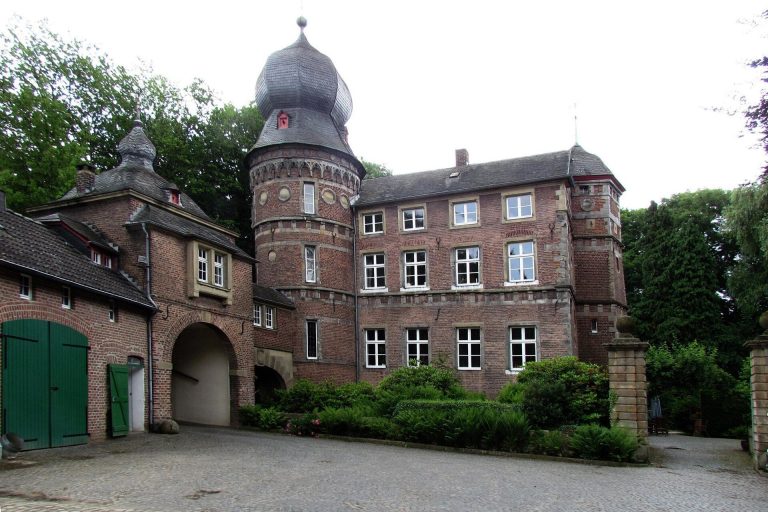
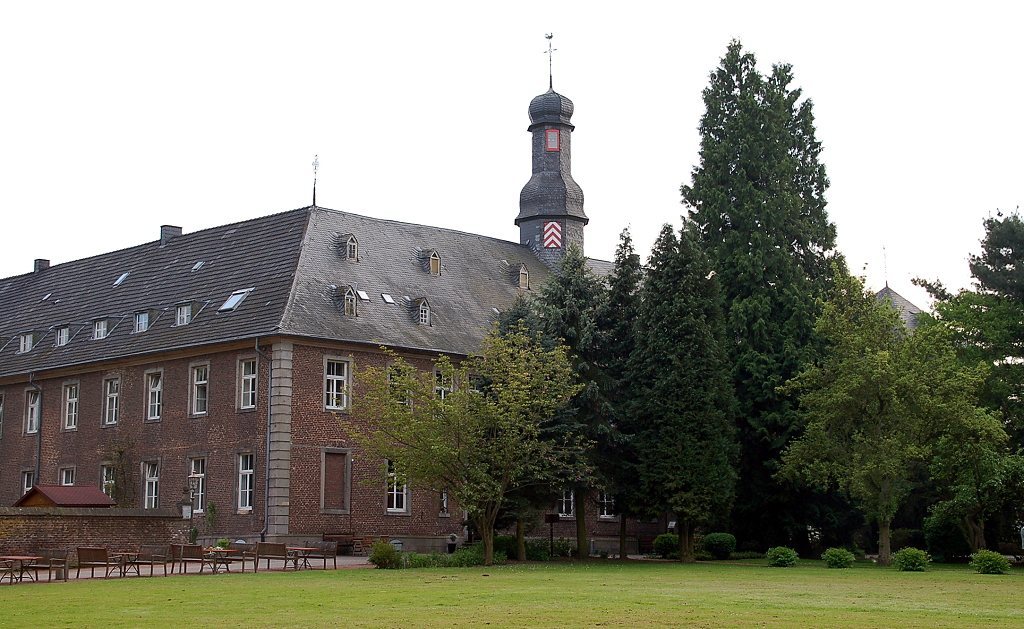
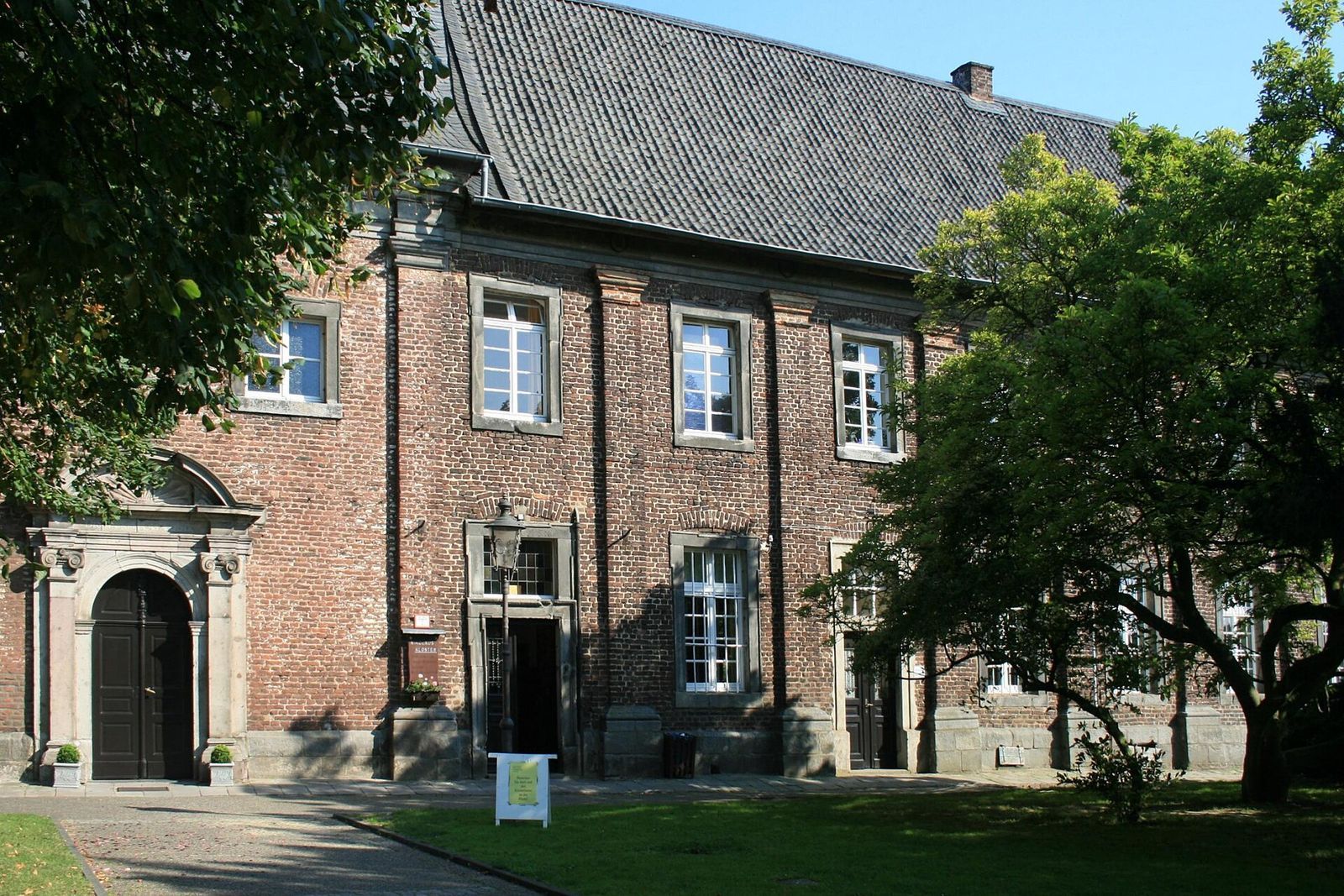
The monastery took its present overall form between 1715 and 1746. The complex includes the church, burial chambers below it, and a former gymnasium on the monastery grounds.
Family burial chambers
The family crypt, an underground burial chamber beneath the church, has been used for burials since at least 1495. The older chamber was permanently sealed during the church restoration of 1859, when a new crypt was made beneath most of the nave, the church’s main central space. Prince Joseph was the first person buried in the new chamber, in 1861. The most recent burial there was that of Princess and countess Cecilie zu Salm-Reifferscheidt-Dyck in 1991.
Marble memorial
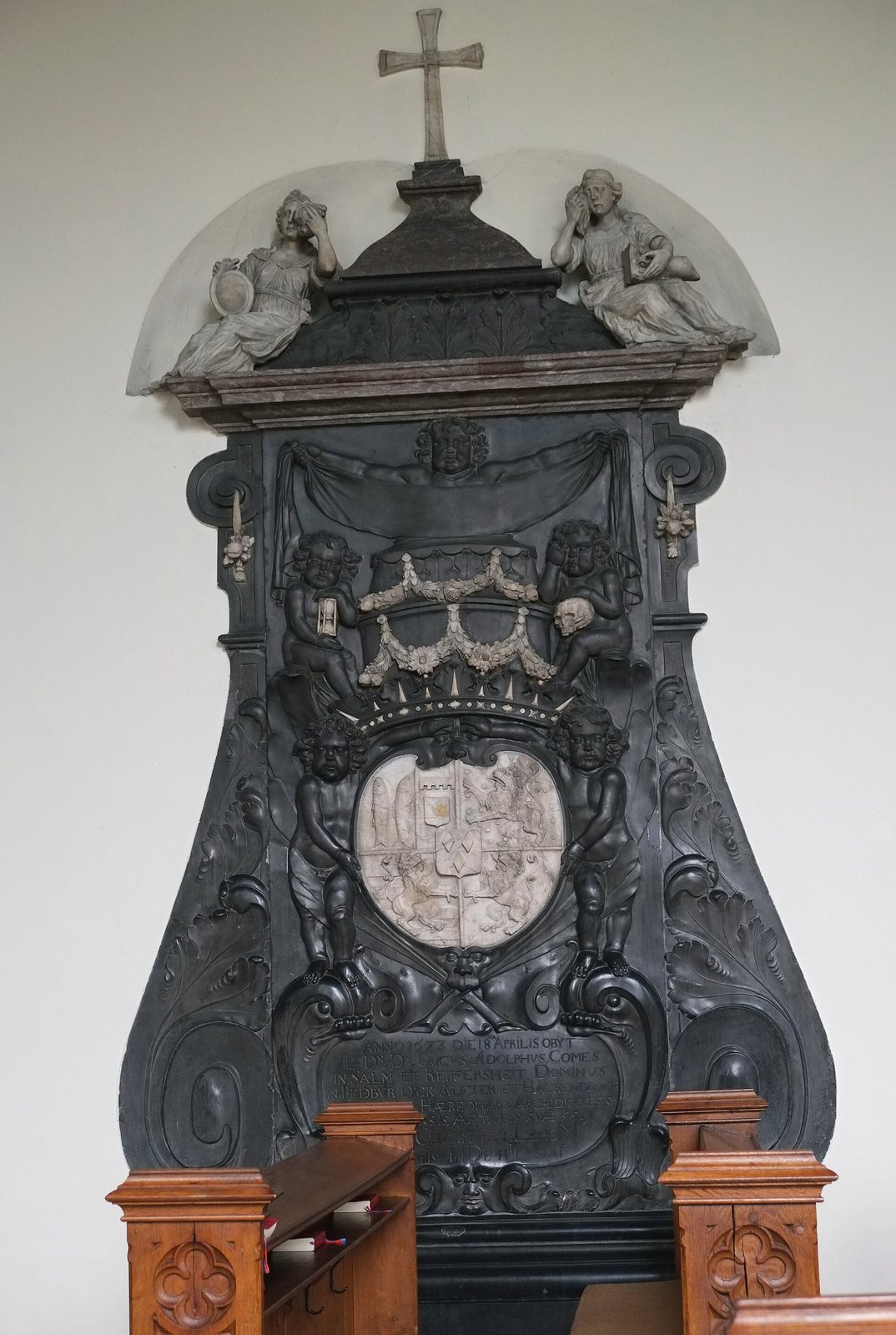
A large funerary memorial of black and white marble is fixed to the church’s south wall. It commemorates Count Erich-Adolph von Salm-Reifferscheidt, who died in 1673, and displays the family arms between two scroll-shaped ornaments supported by childlike figures. The memorial came from Bethlehem Monastery. After that monastery was suppressed and sold in 1805, it was moved to the old St Lambertus Church in Bedburg. Following that church’s demolition in 1895, the memorial was installed at Nikolauskloster.
Former gymnasium
In 2016 a children’s and family church was created from a former gymnasium on the monastery grounds.